
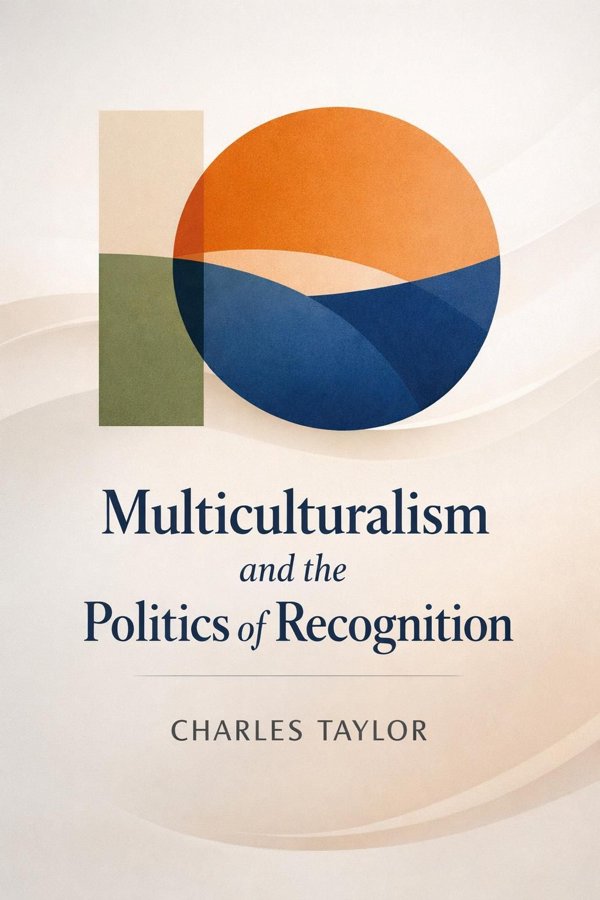
Multiculturalism and the Politics of Recognition: Summary & Key Insights
 10 min7 chaptersAudio available
What Is Multiculturalism and the Politics of Recognition About?
Multiculturalism and the Politics of Recognition by Charles Taylor is a politics book spanning 7 pages. This influential work by Canadian philosopher Charles Taylor explores the concept of multiculturalism and the moral and political challenges of recognizing cultural diversity within liberal democratic societies. The book originated from Taylor’s essay and includes critical commentaries by other scholars, addressing issues of identity, equality, and the politics of recognition.
This FizzRead summary covers all 7 key chapters of Multiculturalism and the Politics of Recognition in approximately 10 minutes, distilling the most important ideas, arguments, and takeaways from Charles Taylor's work. Also available as an audio summary and Key Quotes Podcast.
Multiculturalism and the Politics of Recognition
This influential work by Canadian philosopher Charles Taylor explores the concept of multiculturalism and the moral and political challenges of recognizing cultural diversity within liberal democratic societies. The book originated from Taylor’s essay and includes critical commentaries by other scholars, addressing issues of identity, equality, and the politics of recognition.
Who Should Read Multiculturalism and the Politics of Recognition?
This book is perfect for anyone interested in politics and looking to gain actionable insights in a short read. Whether you're a student, professional, or lifelong learner, the key ideas from Multiculturalism and the Politics of Recognition by Charles Taylor will help you think differently.
- ✓Readers who enjoy politics and want practical takeaways
- ✓Professionals looking to apply new ideas to their work and life
- ✓Anyone who wants the core insights of Multiculturalism and the Politics of Recognition in just 10 minutes
Want the full summary?
Get instant access to this book summary and 100K+ more with Fizz Moment.
Get Free SummaryAvailable on App Store • Free to download
Key Chapters
In exploring the politics of recognition, I began with two distinct but interrelated approaches that have shaped modern democratic thought: the politics of universal dignity and the politics of difference. The first emerged from the Enlightenment and focuses on treating all individuals as bearers of equal rights and intrinsic worth. It insists that every human being deserves respect simply by virtue of being human. This vision gave birth to liberalism’s profound commitment to equality before the law. Yet, as I argue, universal dignity can also obscure a deeper human need—the need for recognition of one’s particular identity.
The politics of difference, in contrast, takes seriously the fact that individuals and groups possess unique cultural backgrounds, histories, and modes of expression. To deny this distinctiveness in the name of uniformity is to erase the very thing that gives meaning to people’s lives. Recognition here means acknowledging—not erasing—difference. We move, therefore, from the idea that everyone is the same to the idea that everyone is equally entitled to be different.
But equality and difference are not easy companions. Liberalism has often assumed that neutrality—treating everyone the same—is the fairest approach. Yet neutrality may inadvertently favor the dominant cultural norms that structure society. For example, the supposedly neutral public institutions of Western democracies often carry assumptions born from majority traditions that make minority cultures invisible. Thus, recognition must go beyond abstract equality to a form of respect that genuinely engages with the particular identity of each group and individual.
I regard this shift toward the politics of equal recognition as one of the most significant moral developments of our time. It represents a transition from demanding equal rights to demanding recognition of distinct identities under those same rights. This complex balancing act—between equal dignity and cultural diversity—is at the heart of the contemporary struggle for multicultural justice.
To understand why recognition plays such a central role in modern life, it helps to look back at how human identity has historically evolved. Premodern societies were structured hierarchically: status, class, and rank were assumed to reflect an objective social order, and recognition was distributed accordingly. Kings and nobles were recognized because they occupied privileged positions within a fixed hierarchy. Common people were rarely recognized beyond their social function.
This began to change with thinkers like Rousseau and, later, Hegel. Rousseau exposed the tensions in how individuals sought esteem from others, revealing that recognition was not merely external—it shaped internal self-consciousness. Hegel then developed this into a powerful theory: human selfhood arises through a dialectical process of mutual recognition. We come to know ourselves only as others acknowledge us, and as we, in turn, recognize them. This mutuality gave philosophical form to the moral intuitions of equality emerging in post-Enlightenment Europe.
Modernity, then, brought a decisive moral transformation. The decline of hierarchical society made recognition a universal aspiration rather than a privilege of the few. People were now seen as free and equal agents whose dignity demanded acknowledgment independent of birth or rank. At the same time, the rise of nationalism and cultural particularism created new identities that demanded recognition not at the level of the individual but at that of peoples and cultures. It is this dual movement—the affirmation of universal equality and the insistence on cultural particularity—that forms the historical backdrop to today’s politics of multiculturalism.
In tracing this evolution, my purpose was not merely to recount a philosophical genealogy but to show that the moral need for recognition is deeply woven into the fabric of modern identity. We live in a world where the struggle for recognition defines not just political debates but the very sense of what it means to be human.
+ 5 more chapters — available in the FizzRead app
All Chapters in Multiculturalism and the Politics of Recognition
About the Author
Charles Taylor is a Canadian philosopher known for his contributions to political philosophy, social theory, and the philosophy of language. His work often focuses on modernity, identity, and the role of recognition in human life. He has taught at McGill University and Oxford University and is regarded as one of the most important contemporary thinkers in political theory.
Get This Summary in Your Preferred Format
Read or listen to the Multiculturalism and the Politics of Recognition summary by Charles Taylor anytime, anywhere. FizzRead offers multiple formats so you can learn on your terms — all free.
Available formats: App · Audio · PDF · EPUB — All included free with FizzRead
Download Multiculturalism and the Politics of Recognition PDF and EPUB Summary
Key Quotes from Multiculturalism and the Politics of Recognition
“The first emerged from the Enlightenment and focuses on treating all individuals as bearers of equal rights and intrinsic worth.”
“To understand why recognition plays such a central role in modern life, it helps to look back at how human identity has historically evolved.”
Frequently Asked Questions about Multiculturalism and the Politics of Recognition
Multiculturalism and the Politics of Recognition by Charles Taylor is a politics book that explores key ideas across 7 chapters. This influential work by Canadian philosopher Charles Taylor explores the concept of multiculturalism and the moral and political challenges of recognizing cultural diversity within liberal democratic societies. The book originated from Taylor’s essay and includes critical commentaries by other scholars, addressing issues of identity, equality, and the politics of recognition.
More by Charles Taylor


You Might Also Like

Antifa: The Anti-Fascist Handbook
Mark Bray
10 min
Attack from Within: How Disinformation Is Sabotaging America
Barbara McQuade
10 min
Coercion, Capital, and European States, AD 990–1992
Charles Tilly
10 min
Digital Democracy: Concepts, Methodologies, Tools, and Applications
Various Authors
10 min
Fascism
Stanley G. Payne
10 min
Fire And Fury: Inside The Trump White House
Michael Wolff
10 minBrowse by Category
Ready to read Multiculturalism and the Politics of Recognition?
Get the full summary and 100K+ more books with Fizz Moment.