
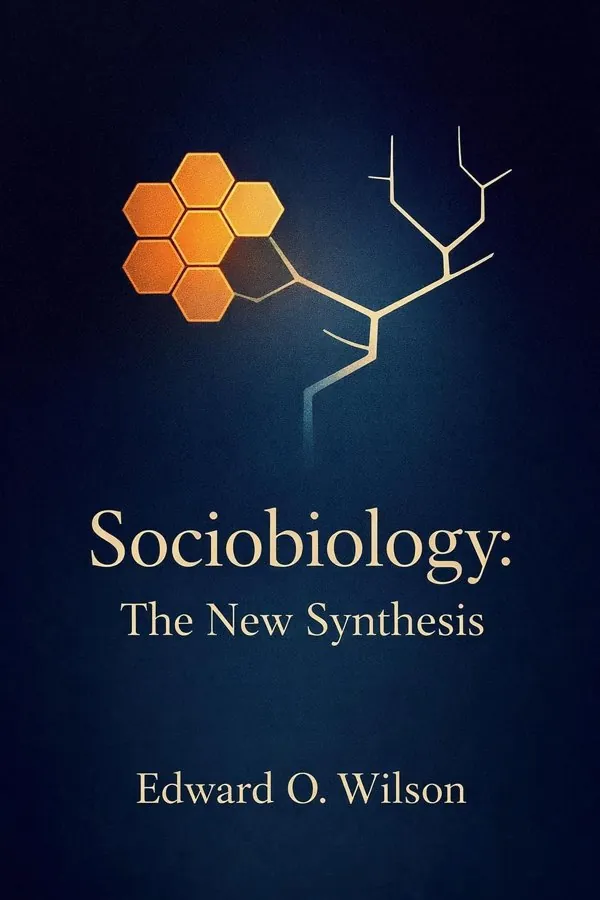
Sociobiology: The New Synthesis: Summary & Key Insights
 10 min9 chaptersAudio available
Key Takeaways from Sociobiology: The New Synthesis
The deepest puzzle of social life is this: why would evolution, a process often described as ruthless competition, produce cooperation, loyalty, and even sacrifice?
One of the most persistent mistakes in debates about behavior is to assume that a trait must be either genetic or environmental.
No complex society can function without information.
At first glance, altruism seems to contradict Darwinian evolution.
Social harmony is never the whole story.
What Is Sociobiology: The New Synthesis About?
Sociobiology: The New Synthesis by Edward O. Wilson is a life_science book spanning 8 pages. Edward O. Wilson’s Sociobiology: The New Synthesis is one of the most ambitious scientific works of the twentieth century: a sweeping attempt to explain social behavior through evolution. Drawing on evidence from insects, birds, mammals, primates, and humans, Wilson argues that cooperation, aggression, dominance, mating systems, parental care, and even moral tendencies can be studied as products of natural selection rather than as isolated cultural accidents. The book matters because it helped create a unified framework for thinking about how genes, ecology, and behavior interact to shape social life across species. Wilson was uniquely qualified to make this case. A Harvard biologist and world-renowned expert on ants, he combined encyclopedic knowledge of animal behavior with deep evolutionary insight. His studies of eusocial insects gave him a model for understanding how complex societies emerge from simple biological rules. At the same time, his extension of these ideas to humans triggered fierce debate, especially around the relationship between biology, culture, and free will. Whether one agrees with all of Wilson’s conclusions or not, this book remains foundational for anyone seeking to understand the evolutionary roots of social life.
This FizzRead summary covers all 9 key chapters of Sociobiology: The New Synthesis in approximately 10 minutes, distilling the most important ideas, arguments, and takeaways from Edward O. Wilson's work. Also available as an audio summary and Key Quotes Podcast.
Sociobiology: The New Synthesis
Edward O. Wilson’s Sociobiology: The New Synthesis is one of the most ambitious scientific works of the twentieth century: a sweeping attempt to explain social behavior through evolution. Drawing on evidence from insects, birds, mammals, primates, and humans, Wilson argues that cooperation, aggression, dominance, mating systems, parental care, and even moral tendencies can be studied as products of natural selection rather than as isolated cultural accidents. The book matters because it helped create a unified framework for thinking about how genes, ecology, and behavior interact to shape social life across species.
Wilson was uniquely qualified to make this case. A Harvard biologist and world-renowned expert on ants, he combined encyclopedic knowledge of animal behavior with deep evolutionary insight. His studies of eusocial insects gave him a model for understanding how complex societies emerge from simple biological rules. At the same time, his extension of these ideas to humans triggered fierce debate, especially around the relationship between biology, culture, and free will. Whether one agrees with all of Wilson’s conclusions or not, this book remains foundational for anyone seeking to understand the evolutionary roots of social life.
Who Should Read Sociobiology: The New Synthesis?
This book is perfect for anyone interested in life_science and looking to gain actionable insights in a short read. Whether you're a student, professional, or lifelong learner, the key ideas from Sociobiology: The New Synthesis by Edward O. Wilson will help you think differently.
- ✓Readers who enjoy life_science and want practical takeaways
- ✓Professionals looking to apply new ideas to their work and life
- ✓Anyone who wants the core insights of Sociobiology: The New Synthesis in just 10 minutes
Want the full summary?
Get instant access to this book summary and 100K+ more with Fizz Moment.
Get Free SummaryAvailable on App Store • Free to download
Key Chapters
One of the most persistent mistakes in debates about behavior is to assume that a trait must be either genetic or environmental. Wilson rejects this false choice. Social organization, he argues, emerges from the interaction between inherited predispositions and surrounding conditions. Genes do not rigidly script behavior in every detail, but they do help establish probabilities, sensitivities, and developmental pathways through which organisms respond to their world.
Wilson’s work on social insects makes this especially vivid. In ant colonies, caste roles, task allocation, defensive responses, and communication patterns all show strong biological underpinnings. Yet the exact expression of these tendencies can shift depending on colony size, food availability, climate, or threat level. The same principle extends beyond insects. Birds may have innate song-learning capacities, but local environments shape the songs they actually produce. Primates may carry evolved tendencies toward bonding, dominance, or coalition formation, but those tendencies unfold differently under different social and ecological pressures.
This framework has important consequences for human understanding. It suggests that culture is not opposed to biology; culture develops through minds that were themselves shaped by evolution. Human beings are highly flexible, but flexibility is itself an evolved trait. That means social systems can vary widely while still reflecting recurring biological predispositions such as kin attachment, mate choice, reciprocity, and status sensitivity.
In practical terms, this idea can improve how we think about education, institutions, and conflict. If behavior is channelled by both nature and context, then environments matter enormously. Good systems work with human tendencies rather than pretending those tendencies do not exist.
Actionable takeaway: Avoid “nature versus nurture” thinking and instead ask how inherited tendencies and environmental conditions interact to produce a given social outcome.
No complex society can function without information. Wilson shows that communication is the hidden architecture of social organization because cooperation depends on signals that coordinate action, reduce uncertainty, and align behavior among individuals. From pheromone trails in ants to alarm calls in birds and facial cues in primates, communication systems evolve because they help organisms survive and reproduce together more effectively than they could alone.
Wilson pays special attention to the variety of channels through which species communicate: chemical, auditory, tactile, visual, and ritualized behavioral displays. In ants, tiny chemical differences can regulate labor, defense, and colony recognition. In mammals, scent marks define territory, while vocalizations warn of predators or help maintain group cohesion. These signals are not random; they are shaped by ecological need. A nocturnal species may rely more on smell, while a visually oriented primate may depend on posture, expression, and gaze.
Communication also imposes limits on social complexity. The more effectively a species can transmit reliable information, the more sophisticated its cooperative structures can become. Human societies represent the extreme case, where language enables planning, shared memory, law, myth, and institutions across generations. But the underlying principle is already visible in simpler species: organized behavior rests on evolved signaling systems.
A useful application of Wilson’s insight is that many conflicts arise not only from competing interests but from failed signaling. Misread intentions, ambiguous boundaries, and unreliable cues can destabilize cooperation in both animal groups and human organizations. Strong social systems therefore depend on credible communication norms.
Actionable takeaway: To strengthen cooperation in any group, improve the clarity, reliability, and shared meaning of the signals members use to coordinate behavior.
At first glance, altruism seems to contradict Darwinian evolution. Why would an organism help another at a cost to itself? Wilson explains that the paradox dissolves once we shift from individual survival alone to inclusive fitness: the total propagation of shared genes through both personal reproduction and assistance to relatives. Kin selection offers a powerful answer to why sacrifice can evolve. If aiding relatives increases the survival of genetically related individuals, then genes promoting such aid may spread.
This principle helps explain many puzzling behaviors. Worker bees forgo reproduction to support a queen. Ground squirrels give alarm calls that attract danger to themselves but protect nearby kin. Parents invest enormous energy in offspring. Even sibling rivalry and parental favoritism can be understood through gradients of relatedness and reproductive value. Wilson does not claim kin selection explains all cooperation, but he shows that it accounts for a substantial part of it.
He also discusses reciprocity and other mechanisms that extend cooperation beyond relatives. Among social animals that interact repeatedly, helping can become advantageous if favors are likely to be returned later. This opens the door to more complex social contracts, from mutual grooming in primates to alliance formation in humans. The key point is that altruism need not be mystical or anti-evolutionary; it can emerge from systematic selection pressures.
In everyday life, this perspective sharpens our understanding of why generosity is often strongest in families, local groups, and long-term relationships. It also reminds us that enduring cooperation requires structures that reward trust and punish exploitation.
Actionable takeaway: Build cooperative systems around repeated interaction, trust, and mutual benefit, while recognizing the special force of kinship and close social bonds.
Social harmony is never the whole story. Wilson emphasizes that competition is equally central to social evolution, and much of social structure exists to regulate conflict rather than eliminate it. Dominance hierarchies, territorial behavior, and reproductive strategies all arise because organisms compete for limited resources: food, mates, shelter, status, and safety. These systems reduce chaotic violence by establishing predictable rules about who gets access to what.
Dominance can appear in many forms. In some species, physical power determines rank. In others, age, coalition support, ritual display, or prior ownership matters more. Once rank is established, lower-level individuals may avoid costly fights by yielding strategically, while higher-ranking individuals conserve energy by relying on reputation and display rather than constant combat. Territory works similarly. Instead of endless roaming conflict, animals often defend bounded spaces that secure resources and reproductive opportunity.
Reproductive strategies grow out of these constraints. Males and females of many species face different trade-offs due to differences in parental investment, fertility, and risk. As a result, selection can favor mate guarding, competition, display, choosiness, promiscuity, pair bonding, or cooperative breeding depending on the ecological context. Wilson’s contribution is to place all of this under a coherent evolutionary framework rather than treating each behavior as an isolated curiosity.
For humans, this lens can illuminate office politics, status competition, neighborhood boundaries, and mating behavior without reducing them to inevitabilities. It suggests that institutions matter most when they channel conflict into stable, less destructive forms.
Actionable takeaway: Instead of assuming competition can be erased, design environments that regulate status and resource conflict through clear norms, roles, and boundaries.
To understand human social life, Wilson turns to our primate relatives. The comparison is not meant to erase the uniqueness of culture, language, and symbolic thought, but to reveal the older evolutionary scaffolding on which these capacities were built. Primates offer evidence for how alliance formation, maternal care, dominance, sexual selection, reconciliation, play, and group identity may have developed before the emergence of fully human civilization.
Wilson highlights recurring patterns across primate societies: individuals pursue status yet depend on allies, mothers invest heavily in offspring, coalitions reshape rank, and social intelligence becomes a major adaptive advantage. In such settings, survival often depends not merely on strength but on reading intentions, remembering relationships, and navigating shifting networks of trust and rivalry. This helps explain why the primate lineage, and eventually humans, evolved large brains attuned to social complexity.
The relevance to human life is considerable. Many persistent features of human society—ingroup loyalty, prestige seeking, jealousy, territoriality, childcare cooperation, and moralized reciprocity—can be better understood when viewed as elaborations of older primate tendencies rather than as purely modern inventions. At the same time, Wilson insists that culture dramatically amplifies, redirects, and constrains these inherited tendencies.
Practically, this perspective encourages humility. Human beings are neither blank slates nor prisoners of instinct. We are culturally inventive primates carrying ancient dispositions into highly artificial environments. Recognizing this can improve policy, education, leadership, and self-understanding.
Actionable takeaway: Interpret human behavior through both our cultural institutions and our primate inheritance, especially when dealing with status, belonging, cooperation, and conflict.
One reason Sociobiology became controversial is that many readers feared Wilson was reducing human beings to genes. Yet his larger argument is subtler: culture is real, powerful, and transformative, but it arises in organisms whose minds were shaped by natural selection. Human symbolic systems, moral codes, institutions, and traditions are not detached from biology. They are made possible by biological capacities for learning, imitation, language, attachment, categorization, and norm enforcement.
Wilson’s position challenges two extremes. Against strict biological determinism, he does not claim that genes specify detailed social rules in advance. Against radical cultural autonomy, he argues that not every human custom is infinitely malleable. Certain recurring patterns appear across societies because they resonate with species-typical predispositions. Family bonds, mate competition, incest taboos, reciprocal exchange, group boundary-making, and moral judgments around fairness and loyalty are examples of domains where biology may shape the range of likely cultural forms.
This has practical implications for social reform. If institutions consistently fail, it may be because they ask human beings to behave in ways radically misaligned with evolved tendencies. Durable systems are more likely to succeed when they harness motives such as belonging, reputation, kin concern, and reciprocal trust. Education, law, and organizational design all benefit from this realism.
Wilson’s larger point is not that biology justifies existing norms, but that understanding human nature improves our ability to shape humane ones. Culture gives us extraordinary freedom, but that freedom operates through inherited cognitive and emotional architectures.
Actionable takeaway: When evaluating social ideals, ask not only whether they are morally attractive, but whether they are psychologically and biologically sustainable for real human beings.
Perhaps the most misunderstood aspect of sociobiology is the leap some critics feared from “this behavior evolved” to “this behavior is morally right.” Wilson repeatedly forces readers to separate explanation from justification. A scientific account of aggression, dominance, nepotism, or sex differences does not endorse those behaviors any more than understanding a disease endorses illness. Sociobiology describes how certain social tendencies may have arisen; ethics concerns what we ought to do with that knowledge.
This distinction matters because evolutionary explanations can be politically explosive. If people hear that some behavior has biological roots, they may assume it is inevitable, desirable, or impossible to change. Wilson’s work resists that conclusion. Biology sets tendencies and constraints, not final moral commands. Human beings possess symbolic thought, foresight, institutions, and moral reflection precisely because evolution made those capacities adaptive too. We are capable of revising impulses through law, custom, education, and ethical reasoning.
A practical lesson here is that uncomfortable facts should not be censored simply because they can be misused. Better science, paired with clearer ethics, is safer than ignorance. For example, understanding evolved tribal tendencies may help societies design stronger norms of pluralism. Knowing that status competition is persistent may encourage fairer institutions rather than romantic denials. Recognizing kin bias can improve anti-corruption safeguards.
Wilson’s contribution is to invite a mature relationship between science and values. We should neither worship biology nor ignore it. We should learn from it while preserving ethical responsibility.
Actionable takeaway: Use biological explanations as tools for wiser moral and institutional design, never as excuses for injustice or fatalism.
All Chapters in Sociobiology: The New Synthesis
About the Author
Edward Osborne Wilson (1929–2021) was an American biologist, naturalist, and author whose work reshaped modern thinking about evolution, behavior, and biodiversity. A longtime professor at Harvard University, he was one of the world’s leading experts on ants and a pioneer in myrmecology. Wilson helped develop the theory of island biogeography, advanced the study of biodiversity and conservation, and introduced sociobiology as a major scientific framework for understanding social behavior across species. Known for combining rigorous science with elegant prose, he wrote influential books for both specialists and general readers. Wilson received many honors during his career, including two Pulitzer Prizes, and remains one of the most significant biological thinkers of the twentieth century.
Get This Summary in Your Preferred Format
Read or listen to the Sociobiology: The New Synthesis summary by Edward O. Wilson anytime, anywhere. FizzRead offers multiple formats so you can learn on your terms — all free.
Available formats: App · Audio · PDF · EPUB — All included free with FizzRead
Download Sociobiology: The New Synthesis PDF and EPUB Summary
Key Quotes from Sociobiology: The New Synthesis
“The deepest puzzle of social life is this: why would evolution, a process often described as ruthless competition, produce cooperation, loyalty, and even sacrifice?”
“One of the most persistent mistakes in debates about behavior is to assume that a trait must be either genetic or environmental.”
“No complex society can function without information.”
“At first glance, altruism seems to contradict Darwinian evolution.”
“Social harmony is never the whole story.”
Frequently Asked Questions about Sociobiology: The New Synthesis
Sociobiology: The New Synthesis by Edward O. Wilson is a life_science book that explores key ideas across 9 chapters. Edward O. Wilson’s Sociobiology: The New Synthesis is one of the most ambitious scientific works of the twentieth century: a sweeping attempt to explain social behavior through evolution. Drawing on evidence from insects, birds, mammals, primates, and humans, Wilson argues that cooperation, aggression, dominance, mating systems, parental care, and even moral tendencies can be studied as products of natural selection rather than as isolated cultural accidents. The book matters because it helped create a unified framework for thinking about how genes, ecology, and behavior interact to shape social life across species. Wilson was uniquely qualified to make this case. A Harvard biologist and world-renowned expert on ants, he combined encyclopedic knowledge of animal behavior with deep evolutionary insight. His studies of eusocial insects gave him a model for understanding how complex societies emerge from simple biological rules. At the same time, his extension of these ideas to humans triggered fierce debate, especially around the relationship between biology, culture, and free will. Whether one agrees with all of Wilson’s conclusions or not, this book remains foundational for anyone seeking to understand the evolutionary roots of social life.
More by Edward O. Wilson
You Might Also Like
The Selfish Gene
Richard Dawkins
10 min
Awakenings
Oliver Sacks
10 min
Parasite Rex: Inside the Bizarre World of Nature's Most Dangerous Creatures
Carl Zimmer
10 min
The Atlas of Life on Earth
Various
10 min
The Book of Humans: The Story of How We Became Us
Adam Rutherford
10 min
The Horse
Wendy Williams
10 minBrowse by Category
Ready to read Sociobiology: The New Synthesis?
Get the full summary and 100K+ more books with Fizz Moment.