
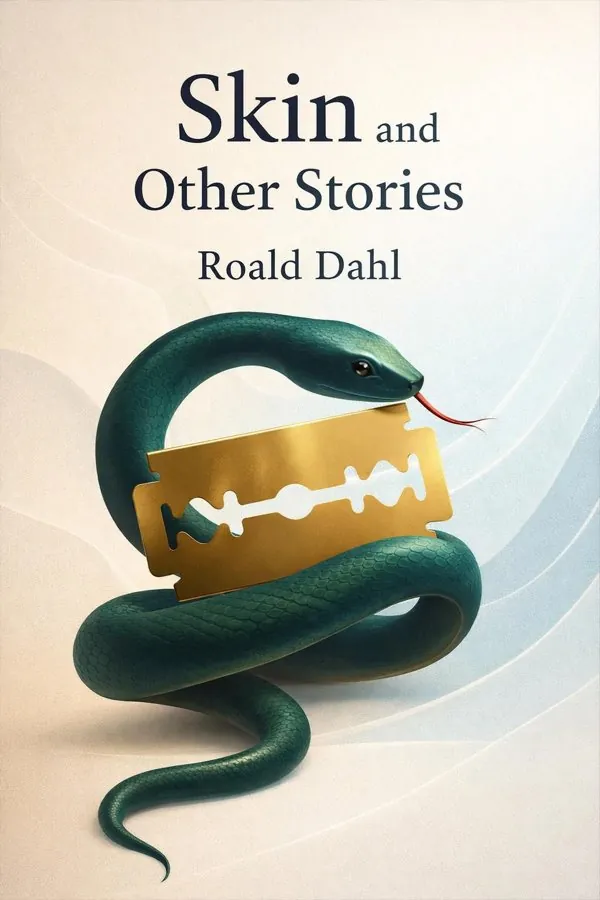
Skin and Other Stories: Summary & Key Insights
by Roald Dahl
 10 min9 chaptersAudio available
Key Takeaways from Skin and Other Stories
The most disturbing kind of greed is the kind that can look reasonable.
Violence becomes most unsettling when it erupts from the familiar.
Some suffering becomes unbearable not because it is greatest, but because no one else can hear it.
The mind can generate terrors more vivid than any external threat.
Cleverness is morally neutral; what matters is the appetite directing it.
What Is Skin and Other Stories About?
Skin and Other Stories by Roald Dahl is a bestsellers book spanning 13 pages. What makes Roald Dahl’s adult fiction so unforgettable is not simply that it is dark, but that it reveals how darkness hides inside ordinary life. Skin and Other Stories gathers some of Dahl’s sharpest, strangest, and most deliciously unsettling tales, each built around a seemingly simple premise that spirals into irony, cruelty, greed, fear, or absurdity. A tattoo becomes a priceless artwork. A perfect housewife becomes a murderer. A machine tries to hear what humans cannot. Across these stories, Dahl exposes how easily civility gives way to appetite, vanity, self-preservation, and deception. This collection matters because it showcases Dahl at full command of the short story form. He writes with deceptive simplicity, strips scenes down to their essentials, and then lands endings that feel both shocking and inevitable. Though many readers know him for children’s classics, his adult stories display another side of his genius: his ability to turn everyday settings into moral traps. Skin and Other Stories is not merely a set of entertaining twists. It is a study of human weakness, social performance, and the comic brutality of fate—written by a master who knew exactly how to make readers smile, then wince.
This FizzRead summary covers all 9 key chapters of Skin and Other Stories in approximately 10 minutes, distilling the most important ideas, arguments, and takeaways from Roald Dahl's work. Also available as an audio summary and Key Quotes Podcast.
Skin and Other Stories
What makes Roald Dahl’s adult fiction so unforgettable is not simply that it is dark, but that it reveals how darkness hides inside ordinary life. Skin and Other Stories gathers some of Dahl’s sharpest, strangest, and most deliciously unsettling tales, each built around a seemingly simple premise that spirals into irony, cruelty, greed, fear, or absurdity. A tattoo becomes a priceless artwork. A perfect housewife becomes a murderer. A machine tries to hear what humans cannot. Across these stories, Dahl exposes how easily civility gives way to appetite, vanity, self-preservation, and deception.
This collection matters because it showcases Dahl at full command of the short story form. He writes with deceptive simplicity, strips scenes down to their essentials, and then lands endings that feel both shocking and inevitable. Though many readers know him for children’s classics, his adult stories display another side of his genius: his ability to turn everyday settings into moral traps. Skin and Other Stories is not merely a set of entertaining twists. It is a study of human weakness, social performance, and the comic brutality of fate—written by a master who knew exactly how to make readers smile, then wince.
Who Should Read Skin and Other Stories?
This book is perfect for anyone interested in bestsellers and looking to gain actionable insights in a short read. Whether you're a student, professional, or lifelong learner, the key ideas from Skin and Other Stories by Roald Dahl will help you think differently.
- ✓Readers who enjoy bestsellers and want practical takeaways
- ✓Professionals looking to apply new ideas to their work and life
- ✓Anyone who wants the core insights of Skin and Other Stories in just 10 minutes
Want the full summary?
Get instant access to this book summary and 100K+ more with Fizz Moment.
Get Free SummaryAvailable on App Store • Free to download
Key Chapters
The most disturbing kind of greed is the kind that can look reasonable. In the title story, “Skin,” Dahl gives us Drioli, an aging, impoverished man whose back bears a tattoo created years earlier by a then-unknown artist who later became famous. What should be a touching relic of friendship becomes, in the eyes of dealers and collectors, an object of enormous monetary value. The horror lies in the transformation: Drioli is no longer treated as a human being with memory, dignity, and need, but as a container for an asset.
Dahl’s genius here is to make the premise grotesque and believable at the same time. The art world’s obsession with ownership, rarity, and prestige overtakes basic morality. Everyone sees the painting; almost no one sees the man. The story becomes a broader commentary on how markets can distort values. When something becomes “valuable,” compassion often becomes negotiable. We see similar patterns in modern life whenever people are reduced to their usefulness, brand value, social capital, or productivity.
That is what gives “Skin” its lasting force: it is not merely a macabre art story. It is about what happens when human beings become secondary to what they possess, represent, or can be extracted for. In workplaces, social networks, and institutions, this logic appears whenever status matters more than character.
A practical way to apply this story is to ask, in any high-stakes situation: am I responding to a person, or to what they can do for me? That question exposes hidden exploitation quickly. The actionable takeaway is simple: when value and dignity come into conflict, choose dignity first.
Violence becomes most unsettling when it erupts from the familiar. “Lamb to the Slaughter” begins in an ordinary domestic setting, with Mary Maloney presented as a devoted wife whose life is structured around habit, tenderness, and expectation. When her husband calmly delivers devastating news, Dahl pivots the story from quiet realism into dark comedy and crime. Mary’s reaction is swift, shocking, and yet psychologically persuasive: emotional collapse turns into action before morality can catch up.
What makes the story memorable is not just the murder, but the irony that follows. Mary regains control not through brilliance in the conventional detective-story sense, but through her ability to perform normalcy. The household, the meal, her role as a wife—all the symbols of domestic innocence become tools of concealment. The investigators, trapped by their assumptions about femininity, marriage, and respectability, fail to see what is directly before them.
Dahl is doing more than delivering a clever twist. He is exposing how social stereotypes distort judgment. People often trust appearances that fit familiar scripts: the grieving spouse, the respectable home, the soft-spoken woman. In real life, this tendency appears whenever we confuse presentation with truth, politeness with goodness, or convention with innocence.
The practical lesson is powerful. In any conflict, negotiation, or investigation, ask which assumptions are shaping your interpretation. Are you trusting someone because they seem harmless, or because the evidence supports it? The story also reminds us that emotional shocks can transform behavior faster than we expect.
The actionable takeaway: do not let labels like “respectable,” “ordinary,” or “nice” substitute for clear observation. Pay attention to behavior, not just roles.
Some suffering becomes unbearable not because it is greatest, but because no one else can hear it. In “The Sound Machine,” Dahl follows an eccentric inventor who becomes obsessed with the possibility that plants produce screams when cut. The premise sounds absurd, even comic, but that absurdity is exactly the point. Dahl explores what happens when a person perceives a reality that others dismiss, and how fragile truth becomes when it exceeds accepted categories.
The story operates on two levels. On the surface, it is about scientific curiosity pushed toward mania. Beneath that, it is about isolation. The inventor is not simply trying to prove a theory; he is trying to bridge a gap between experience and belief. Once he thinks he has heard hidden suffering, ordinary acts become morally charged. Trimming flowers, cutting grass, or chopping roots no longer feel innocent.
Whether or not the machine works matters less than what the story suggests: human beings are often deaf to pain that falls outside familiar signals. In everyday life, people may be enduring stress, grief, burnout, humiliation, or loneliness without expressing it in socially recognizable ways. Institutions especially reward visible performance while ignoring silent distress.
Dahl’s broader message is that skepticism can become cruelty if it hardens into reflexive dismissal. We need evidence, yes, but we also need imagination—the ability to entertain the possibility that another form of experience exists beyond our current understanding.
A practical application is to listen for what is missing, not just what is said. When someone becomes erratic, withdrawn, or obsessive, ask what unseen pressure may be driving them. The actionable takeaway: cultivate curiosity before judgment, because unheard pain often appears first as strange behavior.
The mind can generate terrors more vivid than any external threat. Dahl explores this brilliantly in stories such as “Galloping Foxley” and “The Wish,” where fear emerges from memory, imagination, and the lingering instability of childhood. In “Galloping Foxley,” a man believes he recognizes the sadistic school bully who once dominated his youth. The tension lies not only in whether the identification is correct, but in how powerfully the past still governs the present. In “The Wish,” a child turns a small domestic challenge into an epic test of survival, revealing how imagination can transform ordinary spaces into landscapes of danger.
These stories show that fear is not always irrational in the trivial sense. Rather, it is deeply meaningful because it reveals the structure of a person’s inner world. Childhood humiliations, threats, and fantasies do not simply vanish with age. They become stored templates through which later experience is interpreted. A face on a train, a patterned carpet, a minor uncertainty—any of these can reactivate old vulnerability.
Dahl’s brilliance lies in refusing to condescend to these emotional realities. He does not treat childhood fear as cute. He presents it as existential. That makes these stories useful beyond literature. Adults often underestimate the intensity of children’s emotional experiences, and they also underestimate how long those experiences echo.
In practical terms, this means taking small fears seriously—our own and others’. If a reaction feels disproportionate, there may be an old emotional logic underneath it. Reflection, therapy, journaling, or simply naming the memory can reduce its hidden power.
The actionable takeaway: do not mock fears that seem minor. Investigate them. What feels small on the outside may be carrying a much older wound.
Cleverness is morally neutral; what matters is the appetite directing it. Dahl returns to this idea in stories like “The Surgeon,” “The Bookseller,” and “The Umbrella Man,” where intelligence, charm, and improvisation become tools for extraction. These are not grand villains in the epic sense. They are opportunists, con artists, and schemers who understand one basic principle: people want to believe flattering, convenient, or urgent stories.
In “The Umbrella Man,” a seemingly harmless old man manipulates perception through performance, turning politeness and pity into profit. In “The Bookseller,” fraud hides behind the respectable image of literary business. In “The Surgeon,” professional skill and self-interest collide in a setting where ethical boundaries should be absolute. Across these stories, Dahl dismantles the comforting belief that corruption always announces itself dramatically. More often, it arrives smiling, plausible, and well-spoken.
What unites these tales is the economics of trust. Each trick works because the target assumes certain social signals still mean what they once did: old age implies harmlessness, a business implies legitimacy, expertise implies ethics. Dahl reminds us that systems of trust are necessary—but also exploitable. The more automatic our trust, the easier we are to manipulate.
This has obvious modern relevance. Online scams, polished sales tactics, fake authority, and prestige laundering all depend on the same mechanics. The lesson is not to become cynical about everyone; it is to become more precise about what earns confidence.
A practical habit is to separate charm from credibility. Ask: what evidence supports this person’s claim? What incentive do they have? What would they gain if I say yes? The actionable takeaway: admire ingenuity, but never assume intelligence and integrity come as a package.
One of Dahl’s most entertaining warnings is that efficiency can become a form of theft. “The Great Automatic Grammatizator” imagines a machine capable of producing literature at industrial speed, allowing one entrepreneur to flood the market and pressure writers into surrendering their names and livelihoods. The satire is playful, but the underlying question is serious: what happens when creativity is treated as output rather than expression?
Dahl is not simply mocking machines. He is examining systems that reward volume, market control, and formula over originality. Once writing becomes a scalable product, art risks becoming detached from the human experiences that gave it life. The story also captures an uncomfortable truth about creative industries: many readers, publishers, and consumers claim to value uniqueness, but often reward familiarity, branding, and convenience.
This idea extends beyond literature. In any field, automation can free people from drudgery, but it can also flatten judgment, style, and individuality if adopted uncritically. A sales email can be generated, a painting imitated, a report assembled, a melody replicated. The challenge is not whether tools exist, but whether humans remain responsible for meaning.
Dahl’s insight feels especially contemporary because he understood something timeless: systems optimize for what can be measured, while real value often lies in what cannot. Voice, risk, surprise, and moral texture are difficult to standardize.
A useful application is to ask, whenever using technology: is this tool supporting my thinking, or replacing it? In creative work, preserve spaces where human choice, revision, and idiosyncrasy still matter.
The actionable takeaway: use machines for efficiency, but defend the human voice wherever originality, judgment, and conscience are at stake.
People often imagine revenge as a burst of rage, but Dahl shows it can be systematized, packaged, and sold. In “Vengeance is Mine Inc.,” personal grievance becomes business. The story’s brilliance lies in how calmly it treats a fundamentally explosive impulse. By turning revenge into a service, Dahl reveals both the persistence of resentment and the human desire to avoid direct responsibility for morally dubious actions.
This is one of the collection’s recurring themes: people like outcomes they do not want to own. Rather than confronting an enemy, forgiving them, or accepting injury, they seek mechanisms that allow retaliation at a distance. The company structure in the story makes revenge seem procedural, almost respectable. That is precisely the satire. Bureaucracy can sanitize cruelty. Once an action is mediated by contracts, fees, and professional methods, people may feel less ethically implicated.
The same pattern appears far beyond the story. Gossip outsourced through “concern,” workplace retaliation disguised as policy, online harassment hidden behind anonymity, and passive-aggressive social maneuvering all allow people to injure others while preserving self-image. Dahl strips away that self-deception. If you commission harm, you are still participating in harm.
At the same time, the story acknowledges something real: injured people want justice. The danger lies in confusing justice with revenge. Justice aims at proportion, truth, and order. Revenge aims at emotional satisfaction, often without limit.
A practical application is to pause whenever you feel the urge to “teach someone a lesson.” Ask what outcome you truly want: repair, accountability, distance, or humiliation. Naming that difference can prevent long-term damage.
The actionable takeaway: do not outsource your anger. Face it honestly, and choose responses aligned with justice rather than the intoxication of retaliation.
The fastest judgments are often the least reliable. “The Hitchhiker” is a comic and energetic story, but beneath its light surface lies a sharp lesson about appearances, class assumptions, and hidden skill. The narrator picks up a hitchhiker who at first seems unremarkable, perhaps even suspicious in the vague way strangers often do. As the journey unfolds, Dahl overturns expectations by revealing the man’s extraordinary dexterity and criminal craft.
What makes the story work is the pleasure of delayed recognition. The hitchhiker is not who he first appears to be, and neither is the social situation itself. Dahl enjoys exposing how quickly we assign intelligence, danger, competence, or innocence based on dress, speech, and manner. Those judgments may feel intuitive, but they are frequently just rehearsed social prejudice.
This same concern appears in “Poison,” though in a much darker register. There, fear and racial tension distort perception, and what begins as a crisis becomes an exposure of prejudice lurking beneath civilized behavior. Together, these stories show how pressure reveals character. Under stress, people often default to hidden hierarchies and inherited assumptions.
In practical life, this matters enormously. Hiring decisions, first meetings, customer interactions, classroom dynamics, and even casual travel all involve snap readings of strangers. Sometimes quick assessment is necessary, but Dahl reminds us that confidence in those assessments should remain low until evidence accumulates.
A useful habit is to replace instant certainty with provisional curiosity. Instead of deciding who someone is, ask what you have actually observed. That shift reduces error and broadens understanding.
The actionable takeaway: treat first impressions as hypotheses, not verdicts. The stranger in front of you may be far more complicated than your categories allow.
A twist ending is not merely a trick; at its best, it is a moral x-ray. Across Skin and Other Stories, Dahl uses surprise not to show off cleverness but to expose the hidden logic of desire, fear, vanity, and self-interest. The endings land because they force readers to reinterpret everything that came before. What seemed innocent contains menace. What seemed respectable contains rot. What seemed absurd turns out to be plausible after all.
This is why Dahl’s stories endure. He understood that plot twists are memorable when they reveal truth rather than simply conceal information. The shock comes from recognition. We realize that greed was always there, that deception was always possible, that social roles were always disguises. In this sense, the collection is less about bizarre events than about the strange predictability of human weakness.
Dahl also balances darkness with wit. He does not moralize heavily; instead, he lets irony do the work. Readers laugh, then feel uneasy for laughing. That tonal mixture is part of his brilliance. It creates stories that are highly readable while still carrying ethical sting.
There is a practical lesson here for reading and for life: outcomes rarely emerge from nowhere. They are usually prepared by small details, incentives, blind spots, and unexamined assumptions. If you train yourself to notice those earlier signs, you become a better reader of situations as well as stories.
The actionable takeaway: when something shocks you, look backward and ask what made it possible. The habit of tracing outcomes to hidden causes sharpens judgment in literature, work, and relationships.
All Chapters in Skin and Other Stories
About the Author
Roald Dahl (1916–1990) was a British novelist, short story writer, poet, and screenwriter whose work ranged from beloved children’s fantasy to sharply crafted adult fiction. Born in Wales to Norwegian parents, Dahl worked for Shell and later served as a Royal Air Force pilot during World War II. His experiences in war and travel helped shape the vivid tension, danger, and irony found throughout his writing. While he became world-famous for children’s books such as Charlie and the Chocolate Factory, Matilda, and The BFG, he also earned lasting acclaim for adult short stories known for their dark humor, clean prose, and ingenious twist endings. Dahl’s ability to blend the playful with the macabre made him one of the most distinctive and widely read storytellers of the twentieth century.
Get This Summary in Your Preferred Format
Read or listen to the Skin and Other Stories summary by Roald Dahl anytime, anywhere. FizzRead offers multiple formats so you can learn on your terms — all free.
Available formats: App · Audio · PDF · EPUB — All included free with FizzRead
Download Skin and Other Stories PDF and EPUB Summary
Key Quotes from Skin and Other Stories
“The most disturbing kind of greed is the kind that can look reasonable.”
“Violence becomes most unsettling when it erupts from the familiar.”
“Some suffering becomes unbearable not because it is greatest, but because no one else can hear it.”
“The mind can generate terrors more vivid than any external threat.”
“Cleverness is morally neutral; what matters is the appetite directing it.”
Frequently Asked Questions about Skin and Other Stories
Skin and Other Stories by Roald Dahl is a bestsellers book that explores key ideas across 9 chapters. What makes Roald Dahl’s adult fiction so unforgettable is not simply that it is dark, but that it reveals how darkness hides inside ordinary life. Skin and Other Stories gathers some of Dahl’s sharpest, strangest, and most deliciously unsettling tales, each built around a seemingly simple premise that spirals into irony, cruelty, greed, fear, or absurdity. A tattoo becomes a priceless artwork. A perfect housewife becomes a murderer. A machine tries to hear what humans cannot. Across these stories, Dahl exposes how easily civility gives way to appetite, vanity, self-preservation, and deception. This collection matters because it showcases Dahl at full command of the short story form. He writes with deceptive simplicity, strips scenes down to their essentials, and then lands endings that feel both shocking and inevitable. Though many readers know him for children’s classics, his adult stories display another side of his genius: his ability to turn everyday settings into moral traps. Skin and Other Stories is not merely a set of entertaining twists. It is a study of human weakness, social performance, and the comic brutality of fate—written by a master who knew exactly how to make readers smile, then wince.
More by Roald Dahl


You Might Also Like
The Godfather
Mario Puzo
10 min
The Handmaid's Tale
Margaret Atwood
10 min
The Hunger Games
Suzanne Collins
10 min
The Nightingale
Kristin Hannah
10 min
The Seven Husbands of Evelyn Hugo
Taylor Jenkins Reid
10 min
Backwater Justice
Fern Michaels
10 minBrowse by Category
Ready to read Skin and Other Stories?
Get the full summary and 100K+ more books with Fizz Moment.