
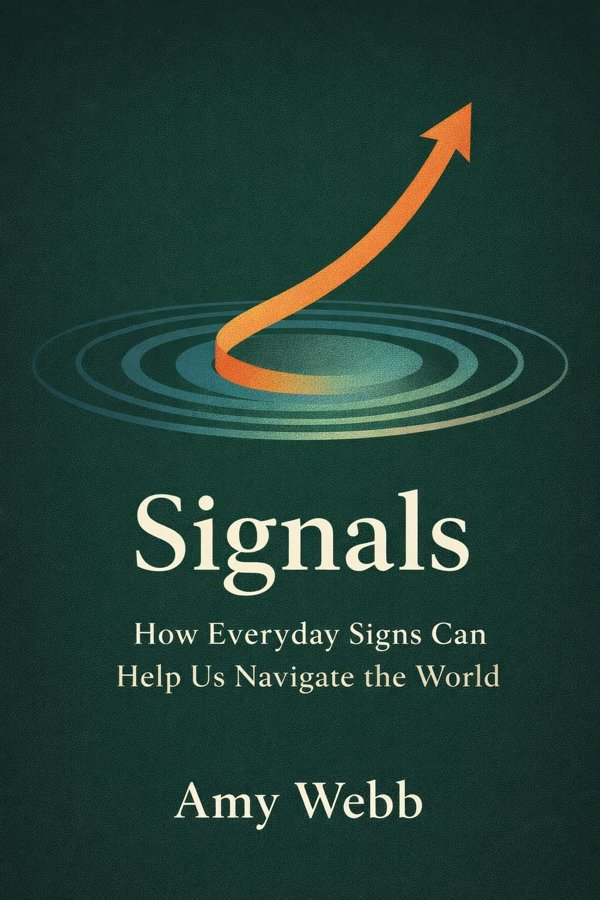
Signals: How Everyday Signs Can Help Us Navigate the World: Summary & Key Insights
by Amy Webb
 10 min8 chaptersAudio available
What Is Signals: How Everyday Signs Can Help Us Navigate the World About?
Signals: How Everyday Signs Can Help Us Navigate the World by Amy Webb is a future_trends book spanning 8 pages. In this book, futurist Amy Webb explores how subtle signals in our daily lives can reveal emerging trends and help us anticipate the future. Drawing from data analysis, behavioral science, and strategic foresight, Webb teaches readers how to identify weak signals that indicate larger shifts in technology, society, and business, empowering individuals and organizations to make better long-term decisions.
This FizzRead summary covers all 8 key chapters of Signals: How Everyday Signs Can Help Us Navigate the World in approximately 10 minutes, distilling the most important ideas, arguments, and takeaways from Amy Webb's work. Also available as an audio summary and Key Quotes Podcast.
Signals: How Everyday Signs Can Help Us Navigate the World
In this book, futurist Amy Webb explores how subtle signals in our daily lives can reveal emerging trends and help us anticipate the future. Drawing from data analysis, behavioral science, and strategic foresight, Webb teaches readers how to identify weak signals that indicate larger shifts in technology, society, and business, empowering individuals and organizations to make better long-term decisions.
Who Should Read Signals: How Everyday Signs Can Help Us Navigate the World?
This book is perfect for anyone interested in future_trends and looking to gain actionable insights in a short read. Whether you're a student, professional, or lifelong learner, the key ideas from Signals: How Everyday Signs Can Help Us Navigate the World by Amy Webb will help you think differently.
- ✓Readers who enjoy future_trends and want practical takeaways
- ✓Professionals looking to apply new ideas to their work and life
- ✓Anyone who wants the core insights of Signals: How Everyday Signs Can Help Us Navigate the World in just 10 minutes
Want the full summary?
Get instant access to this book summary and 100K+ more with Fizz Moment.
Get Free SummaryAvailable on App Store • Free to download
Key Chapters
Across the globe, the landscape of artificial intelligence—both in technology and capital—is almost completely shaped by nine dominant corporations. The six American firms—Google, Amazon, Apple, Microsoft, Facebook, and IBM—have built an ecosystem governed by data and algorithms, leveraging immense computing power, information networks, and global commercial reach. Through cloud infrastructure, advertising systems, operating platforms, and social networks, they integrate billions of users into their algorithmic decision grids.
In contrast, China’s Baidu, Alibaba, and Tencent have risen under robust government support. They are deeply intertwined with national policy, sharing vast pools of social and commercial data while rapidly deploying AI in urban management, finance, and public safety. The Nine Giants thus represent two contrasting AI cultures: a market-driven model rooted in profit-seeking logic and a state-directed model focused on national strategy and governance. Their competition embodies the defining tension of global AI over the coming decades.
Regardless of origin, all nine share a similar temptation—the desire to control the future through algorithms. Because AI requires enormous datasets and processing resources, the ecosystem naturally gravitates toward centralization. When companies control personal data and algorithmic logic, they effectively shape the flow of information—and, by extension, the moral frameworks of society. That is why I call them giants—not merely corporations, but the invisible architects of our reality.
The American AI ecosystem was born from a peculiar fusion of free-market innovation and venture capital. In the mid-twentieth century, the U.S. government laid the foundation for artificial intelligence research, funding universities and laboratories to advance open science. But over subsequent decades, as the Cold War waned and market forces took precedence, leadership in AI gradually shifted to the private sector. Top scientists left academia for companies like Google, Amazon, and Facebook, transforming AI into a capital-heavy industry.
This approach produced astonishing speed and creativity. Google’s TensorFlow, Microsoft’s cloud AI platforms, and Amazon’s algorithm-driven logistics turned AI from a scientific curiosity into a weapon of business competition. Yet this model also embedded structural bias. Efficiency and profit became core design goals, meaning that algorithms often served corporate interests more than human welfare. Recommendation systems reinforced extremism, advertising algorithms deepened information bubbles—AI became an extension of economic incentives rather than a vehicle for social good.
The greatest danger of the U.S. AI ecosystem, as I argue, is its shortsighted extremism. Quarterly earnings, shareholder returns, and competitive pressure drive corporations to prioritize short-term gains over ethical foresight. Even as tech leaders claim to “make the world better,” their algorithms increasingly produce a more confined and controllable society.
+ 6 more chapters — available in the FizzRead app
All Chapters in Signals: How Everyday Signs Can Help Us Navigate the World
About the Author
Amy Webb is an American quantitative futurist, author, and founder of the Future Today Institute. She advises leaders and organizations on emerging technologies and strategic foresight. Webb is also a professor at New York University’s Stern School of Business and a frequent speaker on the future of technology and society.
Get This Summary in Your Preferred Format
Read or listen to the Signals: How Everyday Signs Can Help Us Navigate the World summary by Amy Webb anytime, anywhere. FizzRead offers multiple formats so you can learn on your terms — all free.
Available formats: App · Audio · PDF · EPUB — All included free with FizzRead
Download Signals: How Everyday Signs Can Help Us Navigate the World PDF and EPUB Summary
Key Quotes from Signals: How Everyday Signs Can Help Us Navigate the World
“Across the globe, the landscape of artificial intelligence—both in technology and capital—is almost completely shaped by nine dominant corporations.”
“The American AI ecosystem was born from a peculiar fusion of free-market innovation and venture capital.”
Frequently Asked Questions about Signals: How Everyday Signs Can Help Us Navigate the World
Signals: How Everyday Signs Can Help Us Navigate the World by Amy Webb is a future_trends book that explores key ideas across 8 chapters. In this book, futurist Amy Webb explores how subtle signals in our daily lives can reveal emerging trends and help us anticipate the future. Drawing from data analysis, behavioral science, and strategic foresight, Webb teaches readers how to identify weak signals that indicate larger shifts in technology, society, and business, empowering individuals and organizations to make better long-term decisions.
More by Amy Webb

You Might Also Like
Futureproof: 9 Rules for Humans in the Age of Automation
Kevin Roose
10 min
The Third Wave
Alvin Toffler
10 min
2030: How Today's Biggest Trends Will Collide and Reshape the Future of Everything
Mauro F. Guillén
10 min
A Very Human Future: Enriching Humanity in a Digitized World
Rohit Talwar, Steve Wells, Alexandra Whittington
10 min
AI 2041: Ten Visions for Our Future
Kai-Fu Lee, Chen Qiufan
10 min
Abundance: The Future Is Better Than You Think
Peter H. Diamandis, Steven Kotler
10 minBrowse by Category
Ready to read Signals: How Everyday Signs Can Help Us Navigate the World?
Get the full summary and 100K+ more books with Fizz Moment.