
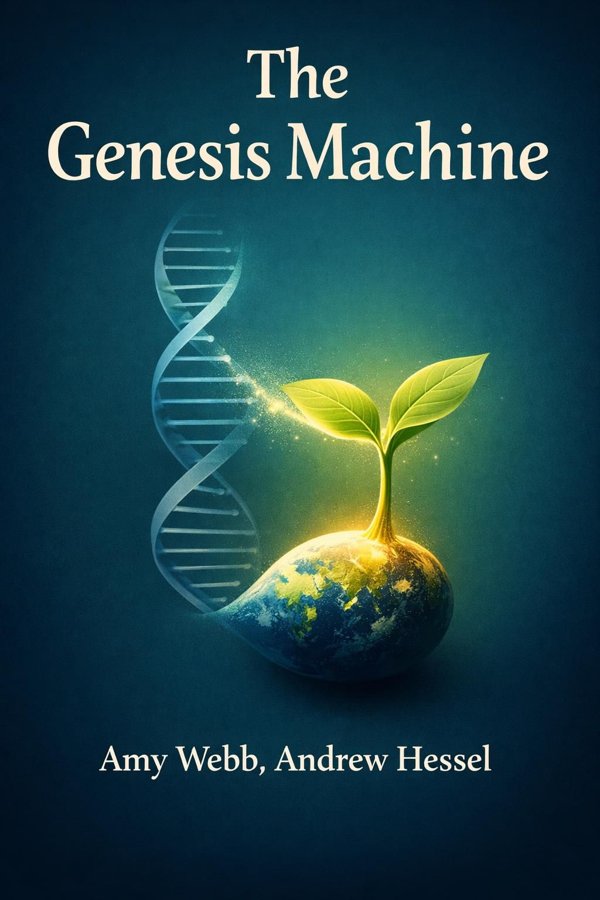
The Genesis Machine: Our Quest to Rewrite Life in the Age of Synthetic Biology: Summary & Key Insights
 10 min8 chaptersAudio available
What Is The Genesis Machine: Our Quest to Rewrite Life in the Age of Synthetic Biology About?
The Genesis Machine: Our Quest to Rewrite Life in the Age of Synthetic Biology by Amy Webb, Andrew Hessel is a emerging_tech book spanning 8 pages. The Genesis Machine explores the emerging field of synthetic biology and its potential to reshape life itself. Amy Webb and Andrew Hessel examine how scientists are learning to design and program living organisms, offering both extraordinary opportunities and profound ethical challenges. The book discusses the implications for medicine, agriculture, climate change, and even human evolution, urging readers to consider how society should govern this powerful technology.
This FizzRead summary covers all 8 key chapters of The Genesis Machine: Our Quest to Rewrite Life in the Age of Synthetic Biology in approximately 10 minutes, distilling the most important ideas, arguments, and takeaways from Amy Webb, Andrew Hessel's work. Also available as an audio summary and Key Quotes Podcast.
The Genesis Machine: Our Quest to Rewrite Life in the Age of Synthetic Biology
The Genesis Machine explores the emerging field of synthetic biology and its potential to reshape life itself. Amy Webb and Andrew Hessel examine how scientists are learning to design and program living organisms, offering both extraordinary opportunities and profound ethical challenges. The book discusses the implications for medicine, agriculture, climate change, and even human evolution, urging readers to consider how society should govern this powerful technology.
Who Should Read The Genesis Machine: Our Quest to Rewrite Life in the Age of Synthetic Biology?
This book is perfect for anyone interested in emerging_tech and looking to gain actionable insights in a short read. Whether you're a student, professional, or lifelong learner, the key ideas from The Genesis Machine: Our Quest to Rewrite Life in the Age of Synthetic Biology by Amy Webb, Andrew Hessel will help you think differently.
- ✓Readers who enjoy emerging_tech and want practical takeaways
- ✓Professionals looking to apply new ideas to their work and life
- ✓Anyone who wants the core insights of The Genesis Machine: Our Quest to Rewrite Life in the Age of Synthetic Biology in just 10 minutes
Want the full summary?
Get instant access to this book summary and 100K+ more with Fizz Moment.
Get Free SummaryAvailable on App Store • Free to download
Key Chapters
When we first imagined writing The Genesis Machine, we wanted to tell the story of how humanity learned to edit its own blueprint. The first pages trace the lineage of synthetic biology back to the breakthroughs of molecular genetics — to the moment Watson and Crick described DNA as a double helix carrying coded information, and to the advent of recombinant DNA technology in the 1970s. These events turned biology into a kind of engineering discipline. Genetic engineering let scientists cut and paste fragments of DNA, creating transgenic organisms and pioneering early biotech industries. But synthetic biology goes further. It treats living cells as platforms for design, much like computers running biological software. Instead of tweaking existing lifeforms, it asks: what if we could design entirely new ones? This vision crystallized in the early 21st century with advances in gene synthesis and high-throughput sequencing—the ability to read and write genetic code faster, cheaper, and more precisely than ever before. I recall the moments when researchers began printing DNA on demand, effectively manufacturing genes as easily as ordering parts from a hardware catalog. That was the turning point. Biology’s transformation from discovery to design allowed us to imagine not just curing diseases but programming cells to act, think, and respond predictably. As authors, we emphasize that this change marks a paradigm shift: life is no longer merely observed; it is engineered.
At the heart of synthetic biology lies a profound perspective — that DNA is code. Each strand carries instructions written in a four-letter alphabet: A, T, C, and G. These letters form genes, genes form proteins, and proteins shape everything that lives. In our book, we draw analogies to computer programming not for novelty, but because biology itself operates by processing information. Once scientists learned how to sequence genomes, they could start to 'debug' nature's code — finding errors that cause disease, optimizing sequences for new functions, and even designing genetic circuits that make cells behave like programmable machines. Andrew Hessel’s work in genomic design inspired us to view DNA as an editable script, where humanity’s creativity meets the deep logic of evolution. Learning to write biology means understanding not just the syntax of genes but the consequences of editing them. In medicine, we see this through CRISPR, the revolutionary tool that gives scientists the power to cut and rewrite genetic code with extraordinary precision. We highlight the story of Jennifer Doudna and Emmanuelle Charpentier’s discovery as emblematic of this new age — showing how human ingenuity can align with nature’s processes to shape life’s future. But understanding DNA as information also reminds us that biological data is sensitive, powerful, and ethical boundaries must be drawn. When life becomes readable and writable, privacy isn't just about data — it's about our bodies, identities, and generations to come.
+ 6 more chapters — available in the FizzRead app
All Chapters in The Genesis Machine: Our Quest to Rewrite Life in the Age of Synthetic Biology
About the Authors
Amy Webb is a quantitative futurist and founder of the Future Today Institute, known for her work on emerging technologies and strategic foresight. Andrew Hessel is a biologist and entrepreneur specializing in synthetic biology, co-founder of Humane Genomics, and a leading advocate for open science and responsible biotechnology.
Get This Summary in Your Preferred Format
Read or listen to the The Genesis Machine: Our Quest to Rewrite Life in the Age of Synthetic Biology summary by Amy Webb, Andrew Hessel anytime, anywhere. FizzRead offers multiple formats so you can learn on your terms — all free.
Available formats: App · Audio · PDF · EPUB — All included free with FizzRead
Download The Genesis Machine: Our Quest to Rewrite Life in the Age of Synthetic Biology PDF and EPUB Summary
Key Quotes from The Genesis Machine: Our Quest to Rewrite Life in the Age of Synthetic Biology
“When we first imagined writing The Genesis Machine, we wanted to tell the story of how humanity learned to edit its own blueprint.”
“At the heart of synthetic biology lies a profound perspective — that DNA is code.”
Frequently Asked Questions about The Genesis Machine: Our Quest to Rewrite Life in the Age of Synthetic Biology
The Genesis Machine: Our Quest to Rewrite Life in the Age of Synthetic Biology by Amy Webb, Andrew Hessel is a emerging_tech book that explores key ideas across 8 chapters. The Genesis Machine explores the emerging field of synthetic biology and its potential to reshape life itself. Amy Webb and Andrew Hessel examine how scientists are learning to design and program living organisms, offering both extraordinary opportunities and profound ethical challenges. The book discusses the implications for medicine, agriculture, climate change, and even human evolution, urging readers to consider how society should govern this powerful technology.
You Might Also Like
Blockchain Technology Guide (Chinese Edition)
Li Qilei
10 min
21st Century Technologies Revisited: What is Happening and What is Next
Organisation for Economic Co-operation and Development (OECD)
10 min
Autonomous Vehicles: Opportunities, Strategies, and Challenges
Various Authors
10 min
Autonomy
Lawrence Burns
10 min
Blockchain Basics: A Non-Technical Introduction in 25 Steps
Daniel Drescher
10 min
Blockchain Revolution: How the Technology Behind Bitcoin and Other Cryptocurrencies Is Changing the World
Don Tapscott & Alex Tapscott
10 minBrowse by Category
Ready to read The Genesis Machine: Our Quest to Rewrite Life in the Age of Synthetic Biology?
Get the full summary and 100K+ more books with Fizz Moment.