
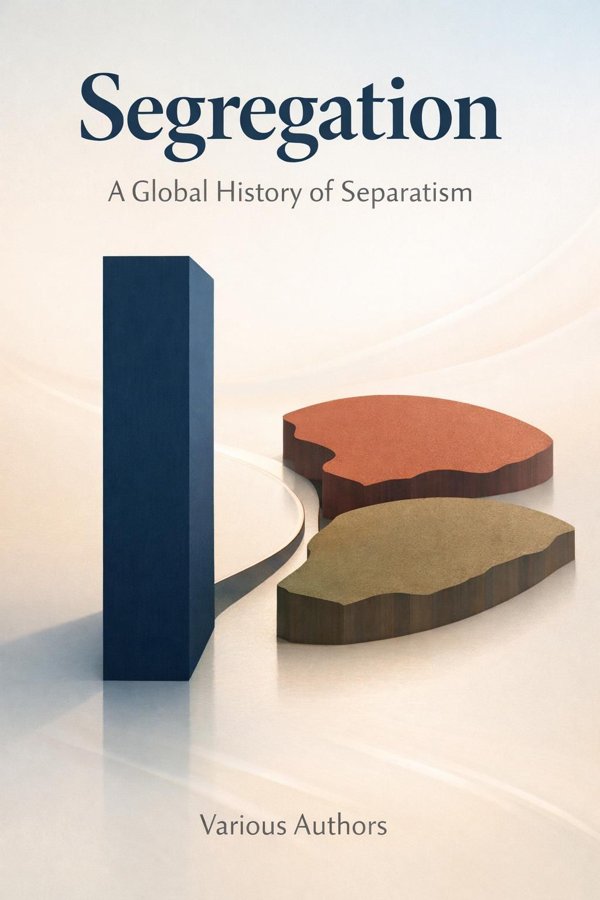
Segregation: A Global History of Separatism: Summary & Key Insights
 10 min8 chaptersAudio available
Key Takeaways from Segregation: A Global History of Separatism
One of the book’s most striking insights is that segregation rarely begins as spontaneous social distance; it is usually engineered by power.
Cities are often celebrated as places where difference meets, but the book insists on a harder truth: cities also perfect division.
The United States often presents segregation through a familiar image: the Jim Crow South.
Apartheid in South Africa is often treated as the ultimate symbol of segregation, and the book agrees that it was one of the most systematic cases in modern history.
Many societies describe religious or ethnic separation as ancient hatred, but this book warns against that lazy explanation.
What Is Segregation: A Global History of Separatism About?
Segregation: A Global History of Separatism by Various Authors is a world_history book spanning 6 pages. Segregation is often discussed as if it belongs to a few notorious cases, but this book argues that separation by race, religion, ethnicity, class, and culture is a deeply global phenomenon. Segregation: A Global History of Separatism brings together scholars from history, sociology, political science, and postcolonial studies to show how divided spaces are made, justified, resisted, and remembered across different regions and eras. Rather than treating segregation as a local anomaly, the collection reveals recurring patterns: states classify people, institutions turn difference into policy, cities harden social boundaries, and communities learn to live within or fight against imposed separation. What makes the volume especially valuable is its comparative reach. It moves from empire to nation-state, from colonial administrations to modern urban planning, and from legal systems to everyday practices. The result is a richer understanding of why segregation persists even when its formal structures are abolished. The contributors write with academic depth, but their collective insight speaks directly to contemporary debates about borders, migration, housing, schooling, policing, and identity. This is a serious, illuminating study of how power organizes human difference—and why those divisions still shape the modern world.
This FizzRead summary covers all 8 key chapters of Segregation: A Global History of Separatism in approximately 10 minutes, distilling the most important ideas, arguments, and takeaways from Various Authors's work. Also available as an audio summary and Key Quotes Podcast.
Segregation: A Global History of Separatism
Segregation is often discussed as if it belongs to a few notorious cases, but this book argues that separation by race, religion, ethnicity, class, and culture is a deeply global phenomenon. Segregation: A Global History of Separatism brings together scholars from history, sociology, political science, and postcolonial studies to show how divided spaces are made, justified, resisted, and remembered across different regions and eras. Rather than treating segregation as a local anomaly, the collection reveals recurring patterns: states classify people, institutions turn difference into policy, cities harden social boundaries, and communities learn to live within or fight against imposed separation.
What makes the volume especially valuable is its comparative reach. It moves from empire to nation-state, from colonial administrations to modern urban planning, and from legal systems to everyday practices. The result is a richer understanding of why segregation persists even when its formal structures are abolished. The contributors write with academic depth, but their collective insight speaks directly to contemporary debates about borders, migration, housing, schooling, policing, and identity. This is a serious, illuminating study of how power organizes human difference—and why those divisions still shape the modern world.
Who Should Read Segregation: A Global History of Separatism?
This book is perfect for anyone interested in world_history and looking to gain actionable insights in a short read. Whether you're a student, professional, or lifelong learner, the key ideas from Segregation: A Global History of Separatism by Various Authors will help you think differently.
- ✓Readers who enjoy world_history and want practical takeaways
- ✓Professionals looking to apply new ideas to their work and life
- ✓Anyone who wants the core insights of Segregation: A Global History of Separatism in just 10 minutes
Want the full summary?
Get instant access to this book summary and 100K+ more with Fizz Moment.
Get Free SummaryAvailable on App Store • Free to download
Key Chapters
One of the book’s most striking insights is that segregation rarely begins as spontaneous social distance; it is usually engineered by power. In the colonial era, European empires did not simply conquer territory—they reorganized space itself. They drew boundaries between rulers and ruled, Europeans and natives, settlers and laborers, Christians and non-Christians. These divisions appeared in law, housing, schools, transportation, taxation, and labor systems. What looked like administrative order was often a machinery for ranking human beings.
The collection shows that colonial governments used maps, censuses, pass systems, and urban zoning to transform fluid identities into fixed categories. In cities such as Algiers, Calcutta, Nairobi, and Johannesburg, colonial administrators designated districts for different populations, often justifying separation through language of hygiene, security, civilization, or public order. But beneath these rationales lay a political purpose: easier control, reduced solidarity, and the normalization of inequality.
This matters because many postcolonial societies inherited more than infrastructure—they inherited the social geometry of empire. Rail lines, neighborhoods, land laws, and bureaucratic categories often outlived the colonial state. Even where formal empires disappeared, their dividing logic remained embedded in planning systems and public institutions.
A practical way to apply this idea is to look at present-day inequality through historical design, not just current prejudice. When certain communities still lack access to land, schools, sanitation, or mobility, the causes may be structural and centuries old. The actionable takeaway is simple: when examining modern divisions, ask not only who is separated today, but who first designed the separation and for what purpose.
Cities are often celebrated as places where difference meets, but the book insists on a harder truth: cities also perfect division. Urban segregation is not accidental crowding or mere economic sorting. Again and again, city authorities, landlords, developers, and police have turned neighborhoods into instruments of hierarchy. Streets, transit routes, municipal services, and housing regulations all help determine who belongs where—and who does not.
The contributors compare colonial capitals and modern metropolises to show how urban space becomes political space. Colonial cities often had a “European quarter” and an “indigenous quarter,” each with sharply unequal access to sanitation, policing, lighting, and public investment. Postcolonial cities did not always abolish this logic. Instead, segregation often shifted form: informal settlements expanded on the margins, elite enclaves became fortified, and infrastructure was distributed unevenly. In many places, class inequality blended with race, caste, ethnicity, or religion, producing urban landscapes where social distance became physically visible.
The book also highlights that segregation is maintained through everyday routines. Commutes become longer for some groups. Schools are tied to neighborhoods. Public space feels welcoming to some and threatening to others. A city can appear open while still channeling people into invisible boundaries.
This insight helps readers understand contemporary debates over gentrification, exclusionary zoning, policing, and transportation policy. Urban injustice is not only about poverty; it is about how the built environment reproduces unequal life chances. The actionable takeaway is to read cities critically: pay attention to who gets parks, transit, security, and investment, because the map often reveals the social order more clearly than political speeches do.
The United States often presents segregation through a familiar image: the Jim Crow South. This volume complicates that narrative by placing American racial segregation in a broader and more global framework. Segregation in the United States was not confined to one region, nor was it solely a matter of personal prejudice. It was sustained by law, finance, schooling, transportation, labor markets, and real estate practices across the country.
The book emphasizes that American racial separation operated through both explicit and hidden mechanisms. In the South, legal segregation governed schools, voting, public accommodations, and marriage. In the North and West, segregation often appeared through restrictive covenants, redlining, discriminatory lending, school district boundaries, and employment exclusion. In both cases, the result was similar: racial hierarchy turned into everyday geography.
By placing the United States alongside colonial and apartheid systems, the collection invites readers to see how American institutions participated in a wider global history of categorized citizenship. The U.S. case was distinctive, but not isolated. Ideas about race circulated internationally, and segregation in America both influenced and was compared to systems elsewhere.
This perspective remains relevant because formal equality has not erased inherited spatial inequality. Wealth gaps, school segregation, policing patterns, and environmental burdens still reflect historical design. Readers can apply this insight by looking beyond the language of equal rights to the realities of unequal systems. The actionable takeaway is to evaluate fairness not by whether discrimination is officially banned, but by whether institutions still reproduce the outcomes segregation was built to create.
Apartheid in South Africa is often treated as the ultimate symbol of segregation, and the book agrees that it was one of the most systematic cases in modern history. Yet one of the collection’s most provocative arguments is that apartheid was also part of a wider family of segregative regimes. Its pass laws, racial classifications, territorial partitions, labor controls, and separate public institutions were unusually comprehensive, but the logic behind them appeared elsewhere too.
The volume traces parallels between apartheid and colonial governance, American racial policy, settler regimes, and other systems of ethnicized territorial control. This does not flatten important differences; instead, it helps explain why apartheid was legible to the world. It drew on familiar techniques: state registration of identity, restricted mobility, labor extraction, and the use of planning to naturalize unequal citizenship. Bantustans, for example, were presented as self-governing homelands, but in practice they were tools for denying full political membership while preserving economic dependence.
The broader lesson is that extreme segregation does not emerge from nowhere. It grows from ordinary bureaucratic habits: categorizing, zoning, separating, monitoring. Once these practices become normalized, a state can scale them dramatically.
For modern readers, this matters when governments justify separation in the language of order, security, tradition, or demographic management. History suggests that technical language can conceal moral violence. The actionable takeaway is to treat any policy that links rights, movement, or residence to rigid identity categories as a warning sign, even when it is presented as administrative common sense.
Many societies describe religious or ethnic separation as ancient hatred, but this book warns against that lazy explanation. Difference may be old, yet segregation is usually produced through modern political choices. Communities that once interacted through trade, shared neighborhoods, or layered identities can be redefined as mutually exclusive blocs when states, parties, or colonial rulers find division useful.
The essays show how censuses, legal codes, school systems, and electoral arrangements harden identities that were once more flexible. Under these conditions, religion and ethnicity become not only cultural markers but administrative categories tied to land rights, political representation, military service, and access to resources. Once institutions reward people for identifying in narrow terms, everyday coexistence can become more fragile.
Examples from partitioned territories, mixed cities, and border regions illustrate how fear is organized. Rumor, propaganda, historical grievance, and selective memory help convert neighbors into outsiders. Segregation then appears as protection rather than exclusion. Separate schools, segregated neighborhoods, autonomous regions, or defensive militias are justified as necessary for survival, even as they deepen the mistrust that made separation seem necessary in the first place.
This framework is useful far beyond historical case studies. It helps explain why multicultural societies can deteriorate quickly when political actors weaponize identity. It also shows why peacebuilding cannot rely on tolerance rhetoric alone; institutions matter.
The actionable takeaway is to be skeptical when leaders present communal division as natural and inevitable. Ask how laws, incentives, media narratives, and administrative systems may be turning identity into a boundary that serves political power more than public safety.
A central lesson of the book is that ending legal segregation does not end segregated life. Formal barriers may fall through decolonization, civil rights reform, democratization, or constitutional change, yet the underlying structures often endure. Roads still connect some places better than others. Schools remain funded through unequal systems. Property markets preserve older exclusions. Policing patterns continue to mark certain communities as suspect. In this sense, segregation has an afterlife.
The contributors show that dismantling a regime of separation is easier on paper than in practice. Laws can prohibit discrimination, but they cannot instantly undo generations of unequal wealth accumulation, dispossession, and institutional bias. Formerly excluded communities may gain citizenship while still lacking access to jobs, healthcare, security, or political influence. Meanwhile, privileged groups often adapt. They shift from open exclusion to coded forms of separation through market language, suburbanization, privatized services, and selective admissions.
This is one reason segregation can survive beneath the rhetoric of inclusion. A society may celebrate integration while everyday patterns remain deeply divided. The persistence of school segregation, gated communities, migrant labor compounds, or unequal urban infrastructure shows how old hierarchies mutate instead of disappearing.
For readers concerned with reform, this chapter offers a practical warning: symbolic victories are not enough. Structural inequality requires long-term institutional redesign, not just legal declarations. The actionable takeaway is to judge social progress by material outcomes—where people live, learn, travel, work, and receive protection—rather than by whether a state has formally renounced discriminatory principles.
Segregation does more than distribute people across space; it reshapes how they understand themselves and others. One of the collection’s deeper insights is that separation creates identities even as it claims merely to manage them. When communities are sorted into separate schools, neighborhoods, worship spaces, or legal categories, those boundaries begin to feel natural. People inherit memories of exclusion, danger, pride, humiliation, and resistance, and those memories can endure long after the original system has changed.
The book explores how segregated life influences language, political consciousness, and collective memory. Marginalized groups often develop powerful forms of solidarity, cultural creativity, and political resistance precisely because exclusion forces them into shared institutions and common struggle. At the same time, dominant groups may internalize entitlement, nostalgia, or denial, remembering order where others remember violence. This asymmetry of memory can make reconciliation difficult.
Monuments, textbooks, museums, and family stories all matter here. The past is not only archived in official records; it lives in habits, fears, and local geographies. A neighborhood line may become a psychological border. A school system may transmit old status assumptions to new generations. Understanding segregation, then, requires attention not just to policy but to emotional and symbolic inheritance.
This insight is useful in contemporary debates over historical justice. Repair is not only about redistributing resources but also about confronting narratives that normalize inequality. The actionable takeaway is to examine how public memory describes divided histories: if a society remembers segregation as unfortunate but necessary, it has not yet fully broken with the values that sustained it.
The book refuses the comforting idea that segregation belongs to the past. In many parts of the world, separatism now appears in subtler forms: migrant dormitories, refugee encampments, gated communities, heavily policed peripheries, privatized schools, digital surveillance, and border regimes that sort mobility by nationality, race, or class. Contemporary segregation is often less explicit than colonial statutes or apartheid law, but it can be just as consequential in shaping unequal lives.
A major contribution of the volume is its insistence on comparative thinking. Today’s divisions may be framed through economics, security, culture, or legality rather than overt biology or empire. Yet the core pattern remains familiar: one group enjoys protection, circulation, and full belonging, while another is monitored, restricted, or contained. Informal settlements may be tolerated without being serviced. Migrant workers may be economically essential while socially segregated. Religious minorities may be legally recognized yet spatially concentrated and politically excluded.
This perspective helps readers identify segregation where it is usually denied. If groups do not share equal access to infrastructure, visibility, safety, and political voice, separation is still operating even without explicit segregationist language. The book therefore broadens the concept beyond infamous historical cases to include the quieter architectures of exclusion embedded in globalization.
The actionable takeaway is to look for segregation in systems of mobility, housing, labor, and security—not just in formal law. If a society insists everyone is equal while organizing daily life through starkly unequal spaces, that contradiction deserves scrutiny.
All Chapters in Segregation: A Global History of Separatism
About the Author
Various Authors refers to the collection of international scholars who contributed to this edited volume on segregation and separatism. The contributors come from fields such as global history, political sociology, race and ethnicity studies, colonial and postcolonial studies, and urban history. Their combined expertise allows the book to move across regions, time periods, and disciplinary approaches while maintaining a strong comparative focus. Rather than presenting one narrow national story, the volume draws on specialists familiar with distinct case studies, from empire and apartheid to urban division and ethnic conflict. This collaborative structure is central to the book’s authority: it reflects a broad academic conversation about how segregation is created, enforced, resisted, and remembered. Together, these authors offer a multidimensional account of one of the most enduring features of modern social and political life.
Get This Summary in Your Preferred Format
Read or listen to the Segregation: A Global History of Separatism summary by Various Authors anytime, anywhere. FizzRead offers multiple formats so you can learn on your terms — all free.
Available formats: App · Audio · PDF · EPUB — All included free with FizzRead
Download Segregation: A Global History of Separatism PDF and EPUB Summary
Key Quotes from Segregation: A Global History of Separatism
“One of the book’s most striking insights is that segregation rarely begins as spontaneous social distance; it is usually engineered by power.”
“Cities are often celebrated as places where difference meets, but the book insists on a harder truth: cities also perfect division.”
“The United States often presents segregation through a familiar image: the Jim Crow South.”
“Apartheid in South Africa is often treated as the ultimate symbol of segregation, and the book agrees that it was one of the most systematic cases in modern history.”
“Many societies describe religious or ethnic separation as ancient hatred, but this book warns against that lazy explanation.”
Frequently Asked Questions about Segregation: A Global History of Separatism
Segregation: A Global History of Separatism by Various Authors is a world_history book that explores key ideas across 8 chapters. Segregation is often discussed as if it belongs to a few notorious cases, but this book argues that separation by race, religion, ethnicity, class, and culture is a deeply global phenomenon. Segregation: A Global History of Separatism brings together scholars from history, sociology, political science, and postcolonial studies to show how divided spaces are made, justified, resisted, and remembered across different regions and eras. Rather than treating segregation as a local anomaly, the collection reveals recurring patterns: states classify people, institutions turn difference into policy, cities harden social boundaries, and communities learn to live within or fight against imposed separation. What makes the volume especially valuable is its comparative reach. It moves from empire to nation-state, from colonial administrations to modern urban planning, and from legal systems to everyday practices. The result is a richer understanding of why segregation persists even when its formal structures are abolished. The contributors write with academic depth, but their collective insight speaks directly to contemporary debates about borders, migration, housing, schooling, policing, and identity. This is a serious, illuminating study of how power organizes human difference—and why those divisions still shape the modern world.
More by Various Authors



You Might Also Like
The Age of Capital
Eric Hobsbawm
10 min
The Gulag Archipelago
Aleksandr Solzhenitsyn
10 min
Jerusalem: The Biography
Simon Sebag Montefiore
10 min
The Anglo-Saxons
James Campbell
10 min
The Boer War
Thomas Pakenham
10 min
The Industrial Revolutionaries: The Making of the Modern World 1776–1914
Gavin Weightman
10 minBrowse by Category
Ready to read Segregation: A Global History of Separatism?
Get the full summary and 100K+ more books with Fizz Moment.