
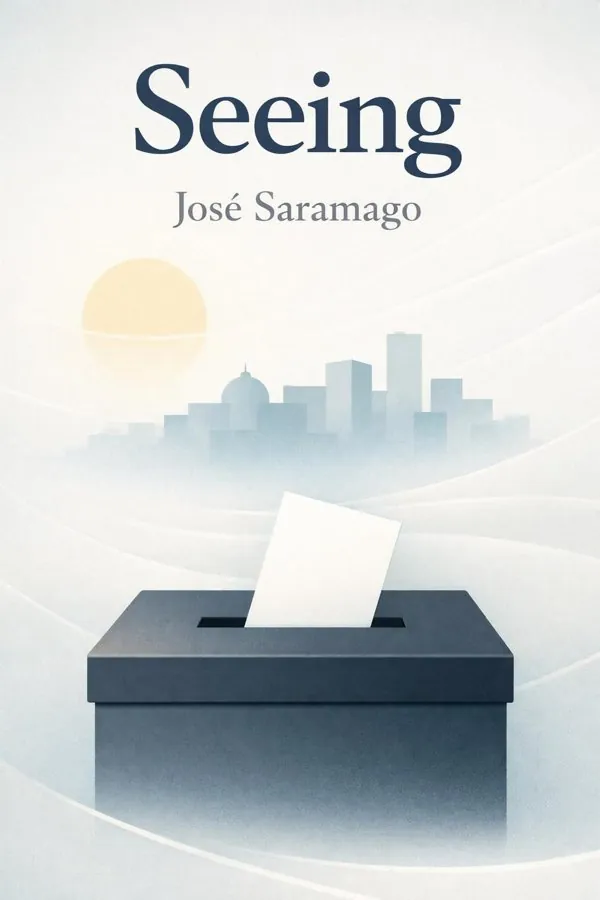
Seeing: Summary & Key Insights
 10 min9 chaptersAudio available
Key Takeaways from Seeing
Sometimes the most disruptive political act is not shouting louder, but refusing to speak in the language power expects.
Authority is rarely most frightened by violence; it is most frightened by ambiguity.
When power loses moral confidence, it often stages experiments to prove the public cannot govern itself.
A society is not held together only by laws; it is held together by countless unnoticed acts of consideration.
Repression rarely begins with tanks in the street; it begins with a story told in official language.
What Is Seeing About?
Seeing by José Saramago is a bestsellers book spanning 4 pages. What happens when ordinary citizens obey every rule of democracy and still terrify the state? In Seeing, José Saramago begins with a simple but explosive premise: during a national election, an overwhelming majority of voters submit blank ballots. No riot, no coup, no slogan-filled uprising—just silence at the ballot box. That silence becomes unbearable to those in power. As the government struggles to interpret this collective refusal, its response exposes the insecurity, vanity, and violence hidden beneath democratic ceremony. A companion novel to Blindness, Seeing returns to the same unnamed city and asks a sharper political question: what if civic awareness, rather than ignorance, became the true threat to authority? Saramago does not write conventional political fiction. In his long, flowing sentences and morally charged irony, he transforms elections, bureaucracy, police reports, and public speeches into a profound investigation of legitimacy, freedom, and conscience. This novel matters because it challenges readers to rethink what democracy means beyond procedure. Written by the 1998 Nobel Prize-winning Portuguese author José Saramago, Seeing is both a dark satire and a serious meditation on power, public obedience, and the unsettling possibility that citizens may see more clearly than their leaders.
This FizzRead summary covers all 9 key chapters of Seeing in approximately 10 minutes, distilling the most important ideas, arguments, and takeaways from José Saramago's work. Also available as an audio summary and Key Quotes Podcast.
Seeing
What happens when ordinary citizens obey every rule of democracy and still terrify the state? In Seeing, José Saramago begins with a simple but explosive premise: during a national election, an overwhelming majority of voters submit blank ballots. No riot, no coup, no slogan-filled uprising—just silence at the ballot box. That silence becomes unbearable to those in power. As the government struggles to interpret this collective refusal, its response exposes the insecurity, vanity, and violence hidden beneath democratic ceremony.
A companion novel to Blindness, Seeing returns to the same unnamed city and asks a sharper political question: what if civic awareness, rather than ignorance, became the true threat to authority? Saramago does not write conventional political fiction. In his long, flowing sentences and morally charged irony, he transforms elections, bureaucracy, police reports, and public speeches into a profound investigation of legitimacy, freedom, and conscience.
This novel matters because it challenges readers to rethink what democracy means beyond procedure. Written by the 1998 Nobel Prize-winning Portuguese author José Saramago, Seeing is both a dark satire and a serious meditation on power, public obedience, and the unsettling possibility that citizens may see more clearly than their leaders.
Who Should Read Seeing?
This book is perfect for anyone interested in bestsellers and looking to gain actionable insights in a short read. Whether you're a student, professional, or lifelong learner, the key ideas from Seeing by José Saramago will help you think differently.
- ✓Readers who enjoy bestsellers and want practical takeaways
- ✓Professionals looking to apply new ideas to their work and life
- ✓Anyone who wants the core insights of Seeing in just 10 minutes
Want the full summary?
Get instant access to this book summary and 100K+ more with Fizz Moment.
Get Free SummaryAvailable on App Store • Free to download
Key Chapters
Sometimes the most disruptive political act is not shouting louder, but refusing to speak in the language power expects. In Seeing, the central event is astonishingly quiet: on election day, the majority of citizens cast blank ballots. They do not boycott the process, attack polling stations, or organize a visible rebellion. They participate fully and then withhold endorsement. This is what makes their action so destabilizing. A blank vote is not apathy in the novel; it is a refusal to legitimize a system that offers form without substance.
Saramago turns a routine civic ritual into a philosophical crisis. Democracies often assume that participation itself confirms legitimacy. But what if citizens participate precisely to reveal their dissatisfaction? The government cannot interpret the blank ballots as lawful dissent. Instead, it treats them as a threat to the entire political order. The act is alarming because it reveals that obedience to procedure does not guarantee consent.
This idea has broad relevance beyond the novel. In workplaces, schools, and public institutions, people may follow official channels while still signaling deep distrust. A team may attend every meeting and still stop contributing ideas. Consumers may buy less without protesting publicly. Communities may comply outwardly while withdrawing belief inwardly. Systems often fail not when people break the rules, but when they expose the emptiness of the rules.
Saramago asks us to see that citizenship is more than choosing among options provided by elites. Sometimes democratic maturity appears as hesitation, skepticism, or principled nonendorsement. The blank ballot becomes a moral mirror held up to the state.
Actionable takeaway: Pay attention to silent forms of dissent in your own institutions; they may reveal deeper truths than noisy conflict.
Authority is rarely most frightened by violence; it is most frightened by ambiguity. After the election results emerge, the government in Seeing becomes obsessed with discovering who orchestrated the blank vote. The ruling class cannot imagine that thousands of citizens might independently arrive at the same judgment. To those in power, coordinated meaning must come from conspiracy, manipulation, or hidden enemies. The possibility of collective moral intelligence is almost unthinkable.
This is one of Saramago’s sharpest insights. Institutions built on control need events to be legible. They can repress mobs, negotiate with parties, and condemn radicals. But they do not know how to respond when the public communicates through disciplined, collective uncertainty. Because the blank vote has no spokesperson and no manifesto, the state fills the silence with paranoia. It seeks plots where there may be only conscience.
We see this pattern repeatedly in real life. A sudden decline in employee engagement is blamed on a few “negative influences” instead of structural problems. Public distrust in institutions is attributed to misinformation alone, not to repeated failures of accountability. Leaders often prefer a simple enemy to a complex truth, because enemies can be targeted while truths demand reform.
Saramago shows how interpretive failure becomes moral failure. When rulers cannot understand the people, they stop trying to listen and begin trying to control. Misreading dissent as sabotage allows the state to avoid self-examination. The novel suggests that the crisis is not the citizens’ silence but the government’s inability to imagine that silence as meaningful.
Actionable takeaway: When a group’s behavior unsettles you, resist the urge to search first for culprits; start by asking what unmet reality their behavior may be expressing.
When power loses moral confidence, it often stages experiments to prove the public cannot govern itself. In Seeing, the government responds to the election shock by declaring a state of emergency, withdrawing officials from the capital, and isolating the city. The expectation is clear: without authority, citizens will descend into disorder. The state hopes chaos will justify its suspicions and restore its legitimacy.
But Saramago brilliantly reverses the script. The city does not collapse. Daily life continues with surprising calm and cooperation. The absence of official oversight reveals an uncomfortable possibility: much of social order may come not from state command but from ordinary habits of mutual dependence, responsibility, and practical intelligence. The government’s retreat becomes a failed test of its own assumptions.
This section of the novel exposes a recurring political myth—that citizens are fundamentally unruly and require constant supervision. We hear versions of this in debates about public trust, remote work, community self-organization, and local governance. Leaders sometimes assume that if they step back, dysfunction will naturally follow. Yet communities frequently display resilience when people share norms, communicate informally, and solve immediate problems together.
Saramago is not arguing that institutions are useless. Rather, he questions the vanity of institutions that believe they alone create order. The state in Seeing wants proof of public irresponsibility and is frustrated to find competence instead. That frustration is revealing. It suggests that some authorities prefer failure in the population because failure strengthens the case for control.
Actionable takeaway: Before assuming that order depends entirely on top-down management, look for the informal networks of trust and cooperation that already sustain everyday life.
A society is not held together only by laws; it is held together by countless unnoticed acts of consideration. One of the most powerful dimensions of Seeing is its portrayal of citizens who, despite suspicion and political pressure, continue to behave with decency toward one another. Their restraint is not dramatic heroism. It is ordinary civic life: maintaining routines, avoiding panic, helping neighbors, and refusing to become the caricature the government expects.
Saramago suggests that real citizenship is not exhausted by voting, flag-waving, or loyalty to institutions. It appears in how people share space, tolerate uncertainty, and preserve human dignity under pressure. The government wants visible disorder because visible disorder would confirm its narrative that the public is immature. Instead, the people’s quiet cooperation becomes a deeper political statement than any campaign speech.
This idea translates easily into contemporary life. In times of institutional mistrust, social fabric is often preserved not by official messaging but by local acts: checking on vulnerable neighbors, sharing accurate information, keeping conflicts from escalating, and sustaining humane routines. Communities recover from crises through practical solidarity long before they receive polished explanations from above.
Saramago’s achievement is to make this everyday morality politically significant. The novel reminds us that civic strength does not always look grand. It often looks like patience, restraint, and shared responsibility. By centering these behaviors, Seeing challenges the assumption that politics happens only in parliaments, press rooms, and party headquarters. Politics also happens in the ethics of daily coexistence.
Actionable takeaway: Strengthen democracy where you are by practicing small, reliable forms of mutual care; social trust grows through repeated ordinary actions.
Repression rarely begins with tanks in the street; it begins with a story told in official language. In Seeing, the government gradually transforms blank voting from a lawful electoral outcome into a moral and security emergency. Through speeches, reports, and insinuations, the state reclassifies citizens from participants into suspects. Saramago pays close attention to how language sanitizes coercion and converts fear into policy.
This is one of the novel’s most enduring lessons. Political language often does not describe reality neutrally; it manufactures the emotional conditions for extraordinary measures. Terms such as “destabilization,” “emergency,” “subversion,” or “national protection” can conceal the fact that rulers are punishing citizens for embarrassing them. Bureaucratic wording makes insecurity sound like reason.
The same mechanism appears in many institutional settings. A company may call surveillance “performance visibility.” A government may label criticism “disinformation” without distinguishing falsehood from dissent. A school may describe harsh uniformity as “maintaining standards.” Euphemism allows power to act aggressively while presenting itself as responsible.
Saramago’s satire works because it reveals how absurd and dangerous this transformation can be. Once citizens are linguistically recast as threats, almost any response becomes defensible. The novel asks readers to notice not just what institutions do, but how they narrate what they do. Control depends on interpretation as much as force.
To read Seeing well is to become suspicious of polished official narratives that flatten complexity and criminalize discomfort. If public authorities cannot tolerate ambiguous dissent, they may redefine dissent until punishment appears necessary.
Actionable takeaway: Whenever institutions justify exceptional measures, examine the language closely; the first warning sign of abuse is often rhetorical, not physical.
The clearest sight in Saramago’s world belongs not to the powerful, but to those who have learned to witness suffering without surrendering their conscience. In Seeing, the reappearance of the doctor’s wife from Blindness is deeply significant. She is linked to memory, ethical endurance, and a kind of inner vision that stands apart from official narratives. Her presence reconnects the political crisis of this novel with the moral catastrophe of the earlier one.
The authorities, desperate for explanations, are drawn toward her because she represents something they lack: credibility rooted in lived reality rather than institutional status. Yet that same moral authority makes her dangerous. She embodies the possibility that genuine clarity comes from compassion, responsibility, and memory—not from office, ideology, or force.
Saramago uses her character to show that seeing is not merely visual perception or intellectual analysis. It is a moral act. To see truly is to recognize vulnerability, resist dehumanization, and remain answerable to what one knows. The doctor’s wife has already endured a world stripped of social masks. Because of that history, she cannot be easily manipulated by official explanations.
In practical terms, every community has figures like this: people whose moral authority comes from service, sacrifice, or consistent integrity rather than title. During crises, these people often see more clearly than formal leaders because they are less invested in preserving appearances. They ask the human question before the procedural one.
Saramago invites us to consider whose vision we trust when institutions become self-protective. Technical expertise matters, but conscience matters too. Without moral sight, intelligence becomes another instrument of evasion.
Actionable takeaway: In moments of confusion, seek out the people whose credibility comes from integrity and lived responsibility, not merely rank.
When trust collapses, insecure power often reaches for information instead of introspection. In Seeing, the government responds to uncertainty with investigation, monitoring, and suspicion. It wants names, networks, motives, and chains of influence. The assumption is that if enough data can be gathered, authority can regain control. But Saramago exposes a crucial truth: surveillance may uncover patterns, yet it cannot manufacture legitimacy.
This insight feels especially contemporary. Institutions facing public distrust often increase oversight, analytics, and enforcement. Governments track more. Employers monitor productivity more closely. Platforms moderate more aggressively. These measures may produce compliance, but compliance is not the same as confidence. If people feel unseen, disrespected, or manipulated, more observation only deepens alienation.
In the novel, surveillance reflects a refusal to confront the central question: why did so many citizens choose not to endorse the political options before them? Monitoring substitutes for listening. It treats moral dissent as an intelligence problem rather than a democratic signal. The government seeks explanation without accepting accountability.
On a personal level, this pattern appears in relationships too. Someone who senses distance may check messages, seek reassurance compulsively, or analyze behavior instead of addressing the underlying loss of trust. More scrutiny often worsens what honesty might heal.
Saramago’s warning is clear: a system that depends increasingly on watchfulness may already have lost the loyalty it claims to protect. Visibility is not the same as understanding, and information is not the same as consent. Legitimacy arises from justice, responsiveness, and credibility.
Actionable takeaway: When trust is weakening, prioritize honest dialogue and structural change over tighter monitoring; control can expose problems, but only reform can address them.
A ballot is a tool, not a guarantee of freedom. One of the deepest themes in Seeing is that democracy cannot be reduced to elections, parties, and constitutional rituals. The state assumes that because voting has taken place, legitimacy should follow automatically. But the blank ballots reveal a painful gap between democratic procedure and democratic substance. Citizens have been invited to choose, yet many clearly feel unrepresented by what is on offer.
Saramago does not reject democracy. He demands that we take it more seriously. A healthy democracy depends on meaningful alternatives, public trust, accountability, and institutions willing to hear unwelcome truths. When those elements weaken, formal participation may continue while genuine consent erodes. The result is a political order that is legal but brittle.
This distinction matters in many areas of life. A company may have feedback channels without a culture of listening. A school may hold student elections while ignoring student concerns. A family may ask for opinions while punishing honesty. Procedure creates the appearance of inclusion, but substance determines whether inclusion is real.
The novel therefore serves as a challenge to complacent democracies. It asks whether systems are designed to hear the people or merely to process them. Blank ballots become evidence that the population still believes in civic action enough to use the system, but no longer believes the system reflects them.
Saramago’s point is unsettling because it denies easy reassurance. Democracy is not secured once and for all by institutions; it must be renewed by responsiveness, humility, and the willingness to face disaffection without criminalizing it.
Actionable takeaway: Evaluate every institution you belong to by asking not only whether people are allowed to participate, but whether their participation can meaningfully change outcomes.
Political systems often appear immense until a moral test reveals how fragile they are. By the later movements of Seeing, Saramago shows that power can command police, issue decrees, shape narratives, and isolate populations, yet still fail to master conscience. The machinery of the state remains formidable, but its authority looks increasingly hollow when measured against citizens who refuse the meanings imposed on them.
This does not mean conscience always wins cleanly or safely. Saramago is too dark and realistic for that. Institutions can punish, distort, and destroy. Individuals may suffer. Yet the novel insists that there is a limit to what coercion can achieve. A government can force silence, but it cannot force sincere belief. It can punish disobedience, but it cannot fully extinguish moral judgment.
This idea is relevant wherever people feel overwhelmed by large systems—bureaucracies, political parties, corporations, or cultural pressures. It is easy to assume that because institutions are durable, they are also right. Saramago reminds us that moral endurance often survives beneath visible defeat. The persistence of conscience may be quiet, but it is historically powerful.
There is also a personal dimension here. In difficult environments, people sometimes compromise because resistance seems futile. Seeing offers a sterner but hopeful perspective: even when external victory is uncertain, maintaining clarity about what is true and what is false matters. Conscience is not valuable only when it prevails publicly; it is valuable because it preserves human dignity.
The novel ends not with neat restoration, but with the stubborn residue of ethical awareness. That residue is Saramago’s real source of hope.
Actionable takeaway: In any system under strain, protect your moral clarity first; even when outcomes are uncertain, integrity keeps you from becoming part of the lie.
All Chapters in Seeing
About the Author
José Saramago (1922–2010) was a Portuguese novelist, essayist, and playwright widely regarded as one of the most important literary figures of the modern era. Raised in a poor rural family and largely self-educated, he worked in various jobs before gaining international recognition as a writer. His fiction is known for its distinctive long sentences, ironic tone, and philosophical depth, often using allegory to examine power, morality, religion, and human community. In 1998, he received the Nobel Prize in Literature for work that combined imagination, compassion, and critical intelligence. Among his most celebrated books are Blindness, Seeing, The Gospel According to Jesus Christ, Baltasar and Blimunda, and All the Names. His writing remains essential for readers interested in literature that confronts political and ethical questions with originality and force.
Get This Summary in Your Preferred Format
Read or listen to the Seeing summary by José Saramago anytime, anywhere. FizzRead offers multiple formats so you can learn on your terms — all free.
Available formats: App · Audio · PDF · EPUB — All included free with FizzRead
Download Seeing PDF and EPUB Summary
Key Quotes from Seeing
“Sometimes the most disruptive political act is not shouting louder, but refusing to speak in the language power expects.”
“Authority is rarely most frightened by violence; it is most frightened by ambiguity.”
“When power loses moral confidence, it often stages experiments to prove the public cannot govern itself.”
“A society is not held together only by laws; it is held together by countless unnoticed acts of consideration.”
“Repression rarely begins with tanks in the street; it begins with a story told in official language.”
Frequently Asked Questions about Seeing
Seeing by José Saramago is a bestsellers book that explores key ideas across 9 chapters. What happens when ordinary citizens obey every rule of democracy and still terrify the state? In Seeing, José Saramago begins with a simple but explosive premise: during a national election, an overwhelming majority of voters submit blank ballots. No riot, no coup, no slogan-filled uprising—just silence at the ballot box. That silence becomes unbearable to those in power. As the government struggles to interpret this collective refusal, its response exposes the insecurity, vanity, and violence hidden beneath democratic ceremony. A companion novel to Blindness, Seeing returns to the same unnamed city and asks a sharper political question: what if civic awareness, rather than ignorance, became the true threat to authority? Saramago does not write conventional political fiction. In his long, flowing sentences and morally charged irony, he transforms elections, bureaucracy, police reports, and public speeches into a profound investigation of legitimacy, freedom, and conscience. This novel matters because it challenges readers to rethink what democracy means beyond procedure. Written by the 1998 Nobel Prize-winning Portuguese author José Saramago, Seeing is both a dark satire and a serious meditation on power, public obedience, and the unsettling possibility that citizens may see more clearly than their leaders.
More by José Saramago


You Might Also Like

The Godfather
Mario Puzo
10 min
The Handmaid's Tale
Margaret Atwood
10 min
The Hunger Games
Suzanne Collins
10 min
The Nightingale
Kristin Hannah
10 min
The Seven Husbands of Evelyn Hugo
Taylor Jenkins Reid
10 min
Backwater Justice
Fern Michaels
10 minBrowse by Category
Ready to read Seeing?
Get the full summary and 100K+ more books with Fizz Moment.