
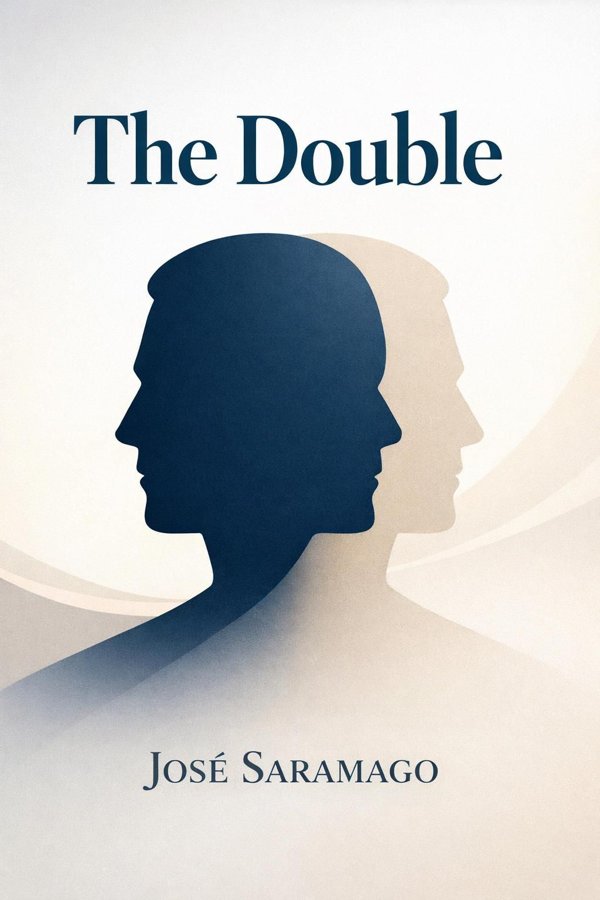
The Double: Summary & Key Insights
 10 min9 chaptersAudio available
Key Takeaways from The Double
One of the most frightening forms of crisis does not arrive dramatically; it settles in quietly, disguised as routine.
Some discoveries enlarge us; others consume us.
Meeting your double should create solidarity, but in Saramago’s world it produces suspicion, competition, and fear.
A face may look identical, but a self is more than a surface.
Private crises rarely stay private for long; they spill into every relationship around us.
What Is The Double About?
The Double by José Saramago is a classics book spanning 5 pages. What happens when the most unsettling mystery in your life is not a stranger, but yourself? In The Double, José Saramago turns an uncanny premise into a profound philosophical thriller. Tertuliano Máximo Afonso, a weary and emotionally detached history teacher, rents a film one evening and notices something impossible: a minor actor on the screen is physically identical to him. What begins as curiosity soon hardens into obsession, then spirals into dread, rivalry, and tragedy. From this deceptively simple setup, Saramago asks enormous questions: What makes a person unique? How fragile is identity? And what happens when the story we tell ourselves about who we are no longer feels secure? This novel matters because it transforms a familiar fear—the loss of individuality—into a meditation on modern life, loneliness, and the hidden violence of self-comparison. Written in Saramago’s distinctive style of flowing sentences, shifting voices, and ironic philosophical commentary, The Double is both psychologically intimate and intellectually expansive. As a Nobel Prize–winning author, Saramago brings rare authority to this exploration, creating a novel that is at once eerie, unsettling, and deeply humane.
This FizzRead summary covers all 9 key chapters of The Double in approximately 10 minutes, distilling the most important ideas, arguments, and takeaways from José Saramago's work. Also available as an audio summary and Key Quotes Podcast.
The Double
What happens when the most unsettling mystery in your life is not a stranger, but yourself? In The Double, José Saramago turns an uncanny premise into a profound philosophical thriller. Tertuliano Máximo Afonso, a weary and emotionally detached history teacher, rents a film one evening and notices something impossible: a minor actor on the screen is physically identical to him. What begins as curiosity soon hardens into obsession, then spirals into dread, rivalry, and tragedy. From this deceptively simple setup, Saramago asks enormous questions: What makes a person unique? How fragile is identity? And what happens when the story we tell ourselves about who we are no longer feels secure?
This novel matters because it transforms a familiar fear—the loss of individuality—into a meditation on modern life, loneliness, and the hidden violence of self-comparison. Written in Saramago’s distinctive style of flowing sentences, shifting voices, and ironic philosophical commentary, The Double is both psychologically intimate and intellectually expansive. As a Nobel Prize–winning author, Saramago brings rare authority to this exploration, creating a novel that is at once eerie, unsettling, and deeply humane.
Who Should Read The Double?
This book is perfect for anyone interested in classics and looking to gain actionable insights in a short read. Whether you're a student, professional, or lifelong learner, the key ideas from The Double by José Saramago will help you think differently.
- ✓Readers who enjoy classics and want practical takeaways
- ✓Professionals looking to apply new ideas to their work and life
- ✓Anyone who wants the core insights of The Double in just 10 minutes
Want the full summary?
Get instant access to this book summary and 100K+ more with Fizz Moment.
Get Free SummaryAvailable on App Store • Free to download
Key Chapters
One of the most frightening forms of crisis does not arrive dramatically; it settles in quietly, disguised as routine. At the beginning of The Double, Tertuliano Máximo Afonso is not a man in visible ruin, but he is profoundly unalive in spirit. He teaches history, follows habits, maintains limited relationships, and drifts through his days with a kind of exhausted neutrality. His life is stable enough to appear functional, yet emotionally it is drained of vitality. Saramago uses this dullness deliberately: before the double appears, Tertuliano is already estranged from himself.
This matters because the novel suggests that obsession rarely begins in a vacuum. It often grows in the space created by boredom, alienation, and unasked questions. Tertuliano does not merely discover another man; he discovers that his own life has become so thin, so unexamined, that the appearance of a duplicate feels more real than his daily existence. The double acts like a shock to a stagnant system, exposing how little solidity Tertuliano actually feels within himself.
In practical terms, the novel invites readers to notice how routine can become a form of self-erasure. A person can fulfill roles—teacher, partner, employee—yet lose contact with desire, agency, and meaning. Modern life often rewards predictability while quietly punishing reflection. That is why disruptions, whether a coincidence, a failure, or a strange encounter, can feel both threatening and strangely liberating.
Saramago’s insight is that monotony is not merely boring; it can be existentially dangerous because it leaves us vulnerable to forces we do not understand. When identity is not actively inhabited, it can be easily destabilized.
Actionable takeaway: Examine one area of your life that feels automatic, and ask whether you are living it consciously or simply repeating it.
Some discoveries enlarge us; others consume us. When Tertuliano sees an actor in a rented film who looks exactly like him, he experiences not simple surprise but a destabilizing rupture. This is not a passing resemblance or a playful coincidence. The actor appears to be his exact physical duplicate. In that moment, the ordinary rules by which Tertuliano understands reality collapse. If another version of him exists, then what becomes of his uniqueness, his biography, his certainty that he is singular?
Saramago carefully traces the transformation of curiosity into obsession. At first, Tertuliano tries to verify what he saw. He replays the film, studies the face, and seeks the actor’s identity. But each attempt at clarification deepens his fixation. The search becomes less about facts and more about recovering psychological control. He cannot tolerate the unanswered question because the question has begun to redefine him.
This dynamic has wide relevance beyond the novel. In everyday life, people often become trapped not by major events themselves but by the need to master uncertainty. A strange medical result, an unanswered message, a social comparison, or an online trace of a former self can trigger disproportionate mental energy because ambiguity is hard to bear. We tell ourselves we are looking for closure when we may actually be feeding a compulsion.
The brilliance of The Double lies in showing that obsession often masquerades as rational inquiry. Tertuliano appears to be investigating, but he is also surrendering his life to a question that will not leave him alone. The more he knows, the less stable he becomes.
Actionable takeaway: When a question begins consuming your emotional life, pause and ask whether you are seeking truth—or trying to escape uncertainty.
Meeting your double should create solidarity, but in Saramago’s world it produces suspicion, competition, and fear. Once Tertuliano and the actor—Antonio Claro, who also uses the stage name Daniel Santa-Clara—make contact, their relationship does not evolve into brotherhood. Instead, each man experiences the other as an intolerable challenge. The existence of one seems to diminish the legitimacy of the other. If both are identical, who is original? Who has the rightful claim to identity, intimacy, and social place?
This encounter reveals one of the novel’s sharpest insights: similarity does not always produce comfort. It can also provoke hostility. We often imagine conflict as something generated by difference, but many of our most intense rivalries emerge from resemblance. Colleagues in the same field, siblings with overlapping roles, peers with comparable talents, or friends who want the same recognition may feel uniquely threatening because they expose our replaceability.
In the novel, the two men’s conversations and maneuvers become increasingly tense because neither can peacefully absorb the implications of the other’s existence. The double is not simply a mirror; he is a living accusation. He raises questions about authenticity, freedom, and control. Tertuliano wants answers, but he also wants hierarchy. Antonio Claro, equally unsettled, responds with his own mix of caution and aggression.
Saramago thus turns the doppelgänger motif into a study of ego. What unsettles us is not only that someone else resembles us, but that they may occupy our symbolic space just as convincingly as we do. The novel asks whether identity is truly internal or whether we rely on being socially unrepeatable.
Actionable takeaway: The next time someone similar to you triggers insecurity, treat that reaction as a clue to what part of your identity depends too heavily on comparison.
A face may look identical, but a self is more than a surface. One of the central philosophical tensions in The Double is the gap between physical sameness and personal identity. Tertuliano and Antonio Claro share a body in outward terms, yet they are not the same person in temperament, choices, profession, and history. Saramago uses their uncanny resemblance to challenge a simplistic understanding of individuality. If the body can be duplicated, then perhaps identity rests less in visible uniqueness than in the way a life is lived, remembered, and narrated.
This idea has surprising practical significance. In a culture increasingly shaped by image, branding, and curated self-presentation, people often confuse recognizability with selfhood. We think our style, our profile, our voice, or our public role defines us. But The Double reminds us that identity is not secured by appearance alone. It is built through memory, responsibility, and relationships. To be someone is not merely to look distinct; it is to inhabit a particular moral and experiential path.
At the same time, Saramago does not let us rest in comforting conclusions. The novel shows how fragile this deeper identity can feel when external markers fail. Tertuliano does not calmly reassure himself that inner life matters more than the body. Instead, the bodily duplication wounds him because physical singularity had quietly underwritten his sense of self. He discovers that what he thought was metaphysical certainty may have depended on something embarrassingly superficial.
That is part of the novel’s enduring power: it exposes how much of our confidence rests on assumptions we never examine until they are shaken.
Actionable takeaway: Define your identity in terms of values, commitments, and actions rather than traits or appearances that could be imitated.
A random event can expose truths that years of routine keep hidden. The entire plot of The Double is set in motion by accident: a bored man watches a rented film and notices a face. Yet Saramago does not present chance as meaningless. Instead, chance becomes a mechanism that strips away illusion. It does not create Tertuliano’s insecurity, emptiness, or susceptibility to obsession; it reveals them.
This is one of the novel’s most valuable insights. We often think of character as something expressed in major, chosen moments, but much of who we are is exposed by interruptions we never planned for. A delay, a betrayal, an unexpected opportunity, or a disturbing coincidence can force us into contact with parts of ourselves that ordinary life keeps dormant. The event may be external, but the response belongs to us.
Tertuliano’s reaction to discovering the actor becomes a moral test. How will he handle uncertainty? Will he seek truth with restraint, or possession with desperation? Will he consider the lives of others, or narrow his vision to his own distress? As the novel advances, it becomes clear that chance may initiate the drama, but character determines its shape.
For readers, this has practical resonance. The disruptions that most unsettle us are often the very moments when our values become visible. Anyone can feel composed when life confirms their expectations. The harder achievement is to remain ethical when reality becomes strange, unjust, or incomprehensible.
Saramago’s genius is to make an absurd premise feel morally exact. The double is improbable, but the reactions it triggers—fear, jealousy, control, denial—are entirely believable. Through chance, the novel reveals responsibility.
Actionable takeaway: When life surprises you, focus first on the quality of your response, because unexpected events often reveal your character more clearly than planned ones.
In The Double, what is told matters almost as much as what happens. Saramago’s distinctive style—long, flowing sentences, sparse punctuation, ironic commentary, and a narrator who seems to think alongside the characters—does more than decorate the story. It creates the very atmosphere in which identity becomes unstable. Readers are not given a neat, objective report. Instead, they are drawn into a verbal current where thought, perception, doubt, and interpretation overlap.
This stylistic choice is central to the novel’s meaning. The story concerns uncertainty, and Saramago writes uncertainty into the experience of reading. Dialogue slides into narration. Commentary interrupts action. Reasoning and feeling mingle. The result is a sense that reality is never encountered raw; it is always mediated by language, thought, and narrative framing. Tertuliano’s crisis is therefore not only about another body existing in the world. It is also about the stories available to explain that existence.
This has a practical application beyond literature. People live through narratives. We explain ourselves through memory, role, expectation, and interpretation. When something destabilizing happens, the first struggle is often linguistic: What do I call this? How do I describe what I feel? Which version of events do I believe? Clarity is not only emotional or factual; it is verbal.
Saramago reminds us that confusion often persists because we lack a form of language equal to our experience. At the same time, he warns that narrative can become a trap. The stories we choose can justify obsession as purpose, fear as caution, or manipulation as necessity.
Actionable takeaway: In moments of confusion, write down the story you are telling yourself and ask whether a different, more honest narrative might change your choices.
The desire to be unique can be inspiring, but it can also become a source of panic. Beneath the suspense of The Double lies a modern anxiety that many readers will recognize: the fear of being replaceable. Tertuliano’s distress is not only metaphysical. It is also social and emotional. If someone else can exist with his exact face, then perhaps his own presence carries less meaning than he imagined. The novel exposes how much modern identity depends on the belief that each person occupies an unrepeatable place.
This pressure is especially relevant in competitive, image-driven societies. People are encouraged to cultivate personal distinction while simultaneously being measured against countless peers. We are told to be authentic, but also marketable; original, but legible; individual, but comparable. In such a world, the double is not merely a fantastic device. He is the literal embodiment of comparison culture.
Saramago does not mock the longing for uniqueness, but he reveals its instability. If your worth depends entirely on being unlike everyone else, then resemblance becomes catastrophe. A healthier form of identity would not rest on irreplaceability alone, but on character, love, responsibility, and the capacity to live truthfully. Tertuliano struggles because he has not built that deeper foundation.
The novel’s dark power comes from showing where the hunger to be singular can lead when joined to fear. Instead of accepting complexity, the characters try to dominate it. Instead of expanding their understanding of selfhood, they reduce identity to a contest.
Actionable takeaway: Base your sense of worth less on being incomparable and more on being accountable, compassionate, and fully present in your own life.
The most unsettling possibility in The Double is not that one duplicate exists, but that duplication may never truly end. In the aftermath of the novel’s tragic events, Saramago refuses to offer simple closure. Instead, he leaves readers with the haunting sense that identity is not a stable possession finally recovered, but a repeating problem. The appearance of another possible double suggests that the crisis was never only about one man meeting his match. It was about the endless vulnerability of the self to fragmentation, replacement, and uncertainty.
This final movement gives the novel its lasting philosophical weight. Many stories resolve identity crises by restoring the original order: the true self is found, the threat is removed, the world becomes coherent again. Saramago does the opposite. He implies that the desire for complete certainty about who we are may itself be misguided. Human identity is contingent, relational, and always somewhat unfinished.
Far from making the novel nihilistic, this ambiguity can be read as a challenge to humility. If the self is not a sealed monument but an unstable process, then we must live with greater attentiveness and less arrogance. We cannot assume that our roles, names, and outward continuity are enough. We must repeatedly become ourselves through choices, honesty, and relation to others.
In practical life, this insight encourages flexibility. Careers change, relationships alter us, losses reshape memory, and major events fracture old self-images. Trying to preserve a rigid idea of who we are can make adaptation painful. The novel suggests that identity is real, but not fixed.
Actionable takeaway: Treat identity as an ongoing practice rather than a completed fact, and revisit who you are through your choices instead of clinging to old certainty.
All Chapters in The Double
About the Author
José Saramago (1922–2010) was a Portuguese novelist, essayist, and playwright whose work transformed ordinary situations into profound moral and philosophical inquiries. Raised in a poor rural family, he worked in various professions before gaining international recognition as a writer. His fiction is known for its unusual narrative style, long flowing sentences, sparse punctuation, irony, and probing reflections on power, belief, identity, and human vulnerability. In 1998, he was awarded the Nobel Prize in Literature for a body of work that joined imagination with ethical seriousness and formal innovation. His most celebrated novels include Blindness, The Gospel According to Jesus Christ, All the Names, Death with Interruptions, and The Double. Today, Saramago is regarded as one of the essential voices of modern world literature.
Get This Summary in Your Preferred Format
Read or listen to the The Double summary by José Saramago anytime, anywhere. FizzRead offers multiple formats so you can learn on your terms — all free.
Available formats: App · Audio · PDF · EPUB — All included free with FizzRead
Download The Double PDF and EPUB Summary
Key Quotes from The Double
“One of the most frightening forms of crisis does not arrive dramatically; it settles in quietly, disguised as routine.”
“Some discoveries enlarge us; others consume us.”
“Meeting your double should create solidarity, but in Saramago’s world it produces suspicion, competition, and fear.”
“A face may look identical, but a self is more than a surface.”
“Private crises rarely stay private for long; they spill into every relationship around us.”
Frequently Asked Questions about The Double
The Double by José Saramago is a classics book that explores key ideas across 9 chapters. What happens when the most unsettling mystery in your life is not a stranger, but yourself? In The Double, José Saramago turns an uncanny premise into a profound philosophical thriller. Tertuliano Máximo Afonso, a weary and emotionally detached history teacher, rents a film one evening and notices something impossible: a minor actor on the screen is physically identical to him. What begins as curiosity soon hardens into obsession, then spirals into dread, rivalry, and tragedy. From this deceptively simple setup, Saramago asks enormous questions: What makes a person unique? How fragile is identity? And what happens when the story we tell ourselves about who we are no longer feels secure? This novel matters because it transforms a familiar fear—the loss of individuality—into a meditation on modern life, loneliness, and the hidden violence of self-comparison. Written in Saramago’s distinctive style of flowing sentences, shifting voices, and ironic philosophical commentary, The Double is both psychologically intimate and intellectually expansive. As a Nobel Prize–winning author, Saramago brings rare authority to this exploration, creating a novel that is at once eerie, unsettling, and deeply humane.
More by José Saramago
You Might Also Like

Browse by Category
Ready to read The Double?
Get the full summary and 100K+ more books with Fizz Moment.