
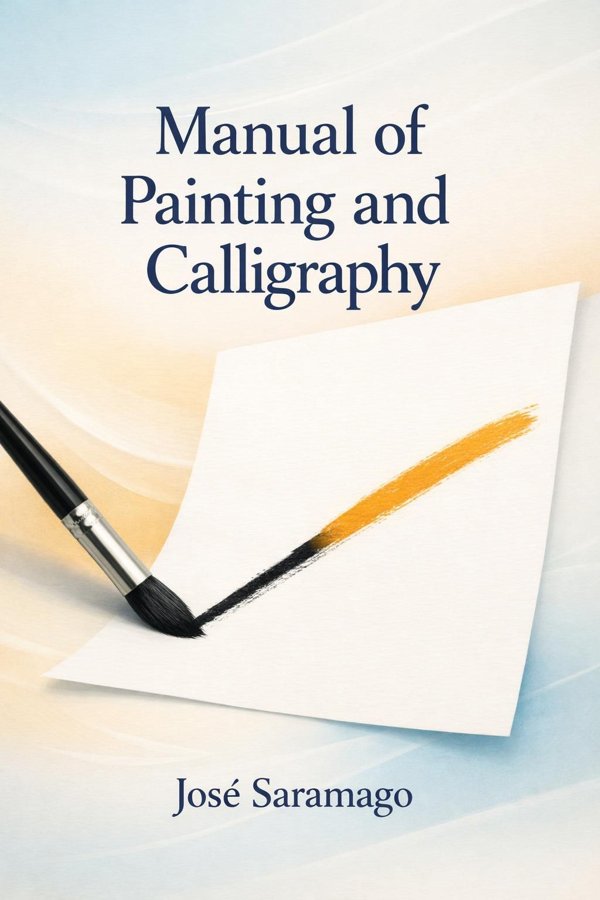
Manual of Painting and Calligraphy: Summary & Key Insights
 10 min8 chaptersAudio available
Key Takeaways from Manual of Painting and Calligraphy
A commissioned portrait is never just a painting; it is a negotiation between truth and expectation.
When official work becomes dishonest, the imagination often creates a hidden rebellion.
Sometimes we discover what we think only when we try to say it.
No portrait is only about an individual; every portrait also reflects the social world that made that individual legible.
A true artistic crisis is often a moral crisis in disguise.
What Is Manual of Painting and Calligraphy About?
Manual of Painting and Calligraphy by José Saramago is a classics book spanning 5 pages. First published in 1977, Manual of Painting and Calligraphy is one of José Saramago’s earliest and most revealing novels: a searching, intellectually alive meditation on what it means to create honestly in a compromised world. The book follows H., a middle-aged portrait painter commissioned to paint a wealthy businessman, S. What begins as a routine professional assignment slowly turns into a crisis of vocation. As H. struggles to produce an acceptable portrait, he also embarks on a second, secret artistic project and begins to write, discovering that the act of describing may reveal more truth than the act of painting. This is not merely a novel about art; it is a novel about conscience, class, self-knowledge, and the uneasy bond between the artist and the society that pays him. In H.’s doubts, Saramago explores questions that would later define his major works: how language shapes reality, how power distorts appearances, and how personal awakening begins in dissatisfaction. Long before winning the Nobel Prize in Literature, Saramago was already probing the moral responsibilities of seeing, interpreting, and telling the truth.
This FizzRead summary covers all 8 key chapters of Manual of Painting and Calligraphy in approximately 10 minutes, distilling the most important ideas, arguments, and takeaways from José Saramago's work. Also available as an audio summary and Key Quotes Podcast.
Manual of Painting and Calligraphy
First published in 1977, Manual of Painting and Calligraphy is one of José Saramago’s earliest and most revealing novels: a searching, intellectually alive meditation on what it means to create honestly in a compromised world. The book follows H., a middle-aged portrait painter commissioned to paint a wealthy businessman, S. What begins as a routine professional assignment slowly turns into a crisis of vocation. As H. struggles to produce an acceptable portrait, he also embarks on a second, secret artistic project and begins to write, discovering that the act of describing may reveal more truth than the act of painting.
This is not merely a novel about art; it is a novel about conscience, class, self-knowledge, and the uneasy bond between the artist and the society that pays him. In H.’s doubts, Saramago explores questions that would later define his major works: how language shapes reality, how power distorts appearances, and how personal awakening begins in dissatisfaction. Long before winning the Nobel Prize in Literature, Saramago was already probing the moral responsibilities of seeing, interpreting, and telling the truth.
Who Should Read Manual of Painting and Calligraphy?
This book is perfect for anyone interested in classics and looking to gain actionable insights in a short read. Whether you're a student, professional, or lifelong learner, the key ideas from Manual of Painting and Calligraphy by José Saramago will help you think differently.
- ✓Readers who enjoy classics and want practical takeaways
- ✓Professionals looking to apply new ideas to their work and life
- ✓Anyone who wants the core insights of Manual of Painting and Calligraphy in just 10 minutes
Want the full summary?
Get instant access to this book summary and 100K+ more with Fizz Moment.
Get Free SummaryAvailable on App Store • Free to download
Key Chapters
A commissioned portrait is never just a painting; it is a negotiation between truth and expectation. At the start of the novel, H. seems to inhabit a familiar professional world. He is an established portrait painter, technically capable, socially acceptable, and accustomed to working within the limits imposed by clients. When he is hired to paint the wealthy businessman S., the arrangement appears straightforward: produce an image that satisfies the patron and confirms his status. Yet H. quickly realizes that the commission asks for more than skill. It asks for compliance.
This is where Saramago’s deeper inquiry begins. The portrait is meant not to discover who S. is, but to reproduce the version of himself that S. wishes to display. H. is expected to translate money and authority into respectable appearance. In other words, the painting becomes an instrument of social performance. H. senses that if he simply does his job well, he may also be helping to conceal something essential.
The conflict feels intensely modern. Professionals in every field face similar pressures: a consultant asked to flatter a client’s strategy, a designer urged to make a weak product look visionary, a writer told to polish a story without questioning its truth. Competence can become complicity when it serves appearance alone.
H.’s discomfort matters because it marks the beginning of consciousness. He starts by noticing the gap between what he is paid to do and what he believes art should do. That gap unsettles him, but it also awakens him. His crisis does not emerge from failure; it emerges from the suspicion that success, on these terms, is itself a form of betrayal.
Actionable takeaway: examine the obligations built into your work and ask where professionalism ends and self-betrayal begins.
When official work becomes dishonest, the imagination often creates a hidden rebellion. Unable to accept the falseness implicit in the commissioned portrait of S., H. begins a second, secret portrait. This clandestine work is crucial because it reveals the artist’s refusal to let external approval define the whole of his practice. If the public portrait must satisfy convention, the private portrait tries to recover truth.
The second portrait is not merely an alternative version. It represents H.’s attempt to paint beyond social masks, beyond wealth, beyond the polished exterior that power presents to the world. In this effort, S. becomes more than a subject. He becomes a test case for the possibility of representation itself. Can an artist depict a person rather than a role? Can one capture inward reality, or only the surfaces by which society recognizes identity?
Saramago does not offer an easy answer. The secret portrait is not a magic path to certainty. H. remains doubtful, divided, and self-questioning. But the hidden work matters because it restores risk to art. In private, he is no longer manufacturing a respectable image; he is investigating. The artistic act becomes less decorative and more ethical.
The idea has broad relevance. Many people maintain two versions of their work: the visible version designed to satisfy institutions, and the private version where they experiment, question, and tell the truth. A teacher may follow the curriculum while privately developing better ways to reach students. A manager may deliver official reports while keeping candid notes about what is actually happening. A writer may publish safe pieces while drafting the work that truly matters.
The danger, of course, is leaving the truthful work permanently hidden. Still, the secret portrait shows that authenticity often begins in protected space before it can face the world.
Actionable takeaway: create a private arena in your work where honesty is possible, even if public demands still constrain you.
Sometimes we discover what we think only when we try to say it. One of the novel’s most important movements is H.’s gradual turn from painting toward writing. As he wrestles with the portrait of S., he begins to keep written reflections, and in doing so he finds a new medium for inquiry. Painting had been his profession, but writing becomes his instrument of self-examination.
This shift is not a rejection of visual art so much as an expansion of consciousness. Painting fixes a moment, a face, a posture. Writing, by contrast, allows H. to trace uncertainty, contradiction, memory, and motive. Through language, he can examine not only his subject but also himself: his resentments, ambitions, insecurities, and changing political awareness. The artist stops being a producer of finished objects and becomes an investigator of experience.
Saramago suggests that authenticity is less a stable possession than an active practice of interrogation. H. does not become more authentic because he suddenly knows the truth. He becomes more authentic because he stops pretending certainty and begins to describe honestly the confusion in which he lives. Writing teaches him to endure complexity rather than reduce it.
This insight applies beyond literature. Journaling, reflective note-taking, or even unsent letters can help people think more clearly than polished speech ever does. A leader facing a difficult decision may discover hidden motives through writing. An employee frustrated with work may identify the real issue only after putting experience into words. Reflection is not a luxury; it is often the path to moral clarity.
In the novel, writing also prepares H. for a broader understanding of society. Once he starts naming what he sees, he can no longer accept appearances so easily. Language becomes a form of awakening.
Actionable takeaway: use writing as a tool for honest self-inquiry, especially when your thoughts feel too tangled to grasp silently.
No portrait is only about an individual; every portrait also reflects the social world that made that individual legible. In painting S., H. is not simply studying one man���s face. He is confronting an entire system of class, power, manners, and privilege. S. embodies a social order in which wealth purchases not only comfort but also representation. To be painted is to be confirmed, archived, and dignified.
H. increasingly understands that art does not hover above society in some pure aesthetic space. It participates in social arrangements. A portrait of a businessman is also a portrait of the values that elevate businessmen. The client’s body, clothes, gestures, and expectations all carry historical meaning. Even the painter’s studio becomes a site where hierarchy is negotiated: who looks, who is looked at, who pays, who interprets.
This realization changes H.’s understanding of himself. He is not an isolated genius making neutral images. He is a worker within a structure. His style, opportunities, income, and recognition are all shaped by class relations. That recognition destabilizes the comforting idea of the autonomous artist but makes possible a more mature self-awareness.
The same dynamic exists in contemporary life. A corporate headshot, a social media profile, a company website, an academic biography, even a curated apartment interior can function as portraits that signal belonging and status. The question is not whether we present ourselves, but whether we understand the social codes embedded in those presentations.
Saramago’s point is subtle and powerful: to know yourself, you must also know the world that teaches others how to read you. Identity is never purely personal. It is socially framed, materially supported, and politically charged.
Actionable takeaway: when evaluating any image of yourself or others, ask what social values and power structures that image quietly reinforces.
A true artistic crisis is often a moral crisis in disguise. As H. moves from painterly observation to written reflection, something deeper than a change of medium occurs: his conscience awakens. He begins to see that the problem with the portrait of S. is not merely technical or aesthetic. It is ethical. He is implicated in a world whose inequalities and falsifications he can no longer ignore.
This awakening is gradual, which makes it believable. H. does not become a heroic rebel overnight. Instead, discomfort accumulates. He notices class differences more sharply. He grows less satisfied with professional routine. He starts to perceive the hidden violence of respectable appearances. Writing gives these perceptions shape, and once articulated, they become harder to dismiss.
Saramago is especially interested in the moment when self-awareness turns outward. H.’s reflections do not remain private psychology. They lead him toward history, politics, and collective life. The artist’s conscience expands from questions like “Am I being honest?” to “What kind of society rewards dishonesty?” This widening of perspective is one of the novel’s major achievements.
For readers, the lesson is practical. Many moments of personal dissatisfaction are treated as private failures: burnout, numbness, lack of motivation, creative stagnation. But these feelings may also signal a conflict between one’s values and the systems one serves. Examining that conflict can turn vague unhappiness into meaningful insight.
Conscience rarely arrives as a grand revelation. More often it appears as irritation with what once seemed normal. H.’s value lies in taking that irritation seriously. He refuses to anesthetize himself with habit.
Actionable takeaway: when recurring dissatisfaction appears in your work, treat it as a clue about your values rather than merely a problem to suppress.
To look at someone is already to begin judging, arranging, and translating them. One of the novel’s quiet but persistent arguments is that perception itself is never neutral. H. does not simply see S.; he interprets him through class assumptions, artistic ambitions, moral suspicion, and personal projection. Likewise, S. does not simply sit for a portrait; he performs an identity he wants recognized. Between them lies a field of mutual construction.
This insight complicates any naive belief in realism. Even the most careful artist cannot capture reality untouched by perspective. Selection, framing, emphasis, omission: these shape every representation. Saramago uses the portrait form to expose this process, but the principle applies everywhere. News reports, performance reviews, dating profiles, recommendation letters, and personal memories are all interpretive acts disguised as straightforward description.
What matters, then, is not achieving impossible neutrality but developing awareness of one’s lenses. H. becomes more interesting as a character when he begins to notice his own involvement in what he sees. He is not outside the picture. His interpretations reveal him as much as they reveal S. This reflexivity is central to intellectual and moral maturity.
In everyday life, we often harden first impressions into convictions. We decide that a colleague is arrogant, a client is shallow, or a leader is trustworthy, then gather evidence to support the story. The novel reminds us that our perceptions may say as much about our needs and fears as about the people before us.
To see better, we must learn to question not only the object of attention but also the observer. That is one reason H.’s written self-scrutiny becomes so important: it interrupts the illusion that his gaze is innocent.
Actionable takeaway: before finalizing a judgment, ask what your perspective adds, filters, or distorts in what you think you see.
Artists often imagine themselves as solitary, but their solitude is always shaped by history. H. spends much of the novel in inward reflection, wrestling with craft, meaning, and self-doubt. Yet his private crisis unfolds within a specific social and political atmosphere. Saramago suggests that the artist’s inner life cannot be separated from the historical conditions under which he works.
This tension gives the novel much of its depth. On one hand, artistic creation requires withdrawal, concentration, and a measure of distance from noise and demand. On the other hand, too much detachment can become evasion. H. gradually senses that the studio is not an escape from the world but one of the places where the world’s values are reproduced or contested. The artist is alone, yes, but never outside history.
That lesson resonates beyond art. Many professionals seek refuge in technical expertise, believing that if they simply do their work well, they can avoid larger moral questions. But engineers build infrastructures shaped by policy; teachers work inside unequal systems; doctors navigate institutions marked by access and privilege. Competence does not exempt anyone from history.
Saramago’s achievement is to show this without turning H. into a slogan. His movement toward social awareness remains conflicted, uneven, and deeply human. He does not solve the tension between contemplation and engagement. Instead, he learns that the tension itself must be inhabited honestly.
For modern readers, this is a liberating idea. You do not need to choose between introspection and responsibility. The challenge is to let private reflection sharpen public awareness rather than replace it.
Actionable takeaway: connect your personal or creative concerns to the larger historical forces shaping the conditions in which you work.
What if the most productive moment in a creative life is the realization that your usual methods no longer suffice? H.’s crisis feels like failure: he cannot complete the commission with conviction, cannot rest inside his old professional identity, and cannot fully trust the meaning of his work. Yet Saramago treats this breakdown not as collapse alone but as the beginning of transformation.
Failure matters here because it disrupts habit. As long as H. could paint competently and be paid, he had little reason to interrogate the assumptions behind his work. Discomfort forces him into reflection. The inability to proceed smoothly becomes evidence that some deeper reorientation is underway. His stalled practice opens space for writing, for political awareness, and for a new relationship to truth.
This pattern is widely recognizable. A career plateau, a rejected proposal, a project that feels empty despite success, or a sudden loss of confidence can all signal not merely deficiency but transition. Modern culture often treats such experiences as problems to fix quickly. Saramago invites a more patient response. Sometimes friction is informative. Sometimes confusion is a sign that old frameworks are dying before better ones are fully formed.
That does not mean romanticizing failure. H.’s uncertainty is painful, economically risky, and psychologically destabilizing. But it becomes fruitful because he studies it instead of fleeing it. He asks what his failure reveals about the kind of artist, and person, he has become.
The novel therefore offers a mature account of growth: not a smooth ascent, but a series of interruptions in which inherited identities stop working. Transformation begins when those interruptions are read as messages rather than disasters.
Actionable takeaway: when your established way of working breaks down, pause to ask what new values or directions the failure may be forcing you to confront.
All Chapters in Manual of Painting and Calligraphy
About the Author
José Saramago (1922–2010) was a Portuguese novelist, essayist, and playwright who won the 1998 Nobel Prize in Literature. Born into a poor rural family in Portugal, he worked as a mechanic, civil servant, editor, and journalist before establishing himself as a major literary figure. Saramago became known for his distinctive prose style, marked by long, flowing sentences, sparse punctuation, irony, and philosophical depth. His best-known works include Blindness, The Gospel According to Jesus Christ, All the Names, and Seeing. Across his fiction, he explored moral responsibility, political power, religion, memory, and the instability of reality. Manual of Painting and Calligraphy, one of his earlier novels, reveals many of the concerns that would later define his career and secure his place as one of the most important writers of modern world literature.
Get This Summary in Your Preferred Format
Read or listen to the Manual of Painting and Calligraphy summary by José Saramago anytime, anywhere. FizzRead offers multiple formats so you can learn on your terms — all free.
Available formats: App · Audio · PDF · EPUB — All included free with FizzRead
Download Manual of Painting and Calligraphy PDF and EPUB Summary
Key Quotes from Manual of Painting and Calligraphy
“A commissioned portrait is never just a painting; it is a negotiation between truth and expectation.”
“When official work becomes dishonest, the imagination often creates a hidden rebellion.”
“Sometimes we discover what we think only when we try to say it.”
“No portrait is only about an individual; every portrait also reflects the social world that made that individual legible.”
“A true artistic crisis is often a moral crisis in disguise.”
Frequently Asked Questions about Manual of Painting and Calligraphy
Manual of Painting and Calligraphy by José Saramago is a classics book that explores key ideas across 8 chapters. First published in 1977, Manual of Painting and Calligraphy is one of José Saramago’s earliest and most revealing novels: a searching, intellectually alive meditation on what it means to create honestly in a compromised world. The book follows H., a middle-aged portrait painter commissioned to paint a wealthy businessman, S. What begins as a routine professional assignment slowly turns into a crisis of vocation. As H. struggles to produce an acceptable portrait, he also embarks on a second, secret artistic project and begins to write, discovering that the act of describing may reveal more truth than the act of painting. This is not merely a novel about art; it is a novel about conscience, class, self-knowledge, and the uneasy bond between the artist and the society that pays him. In H.’s doubts, Saramago explores questions that would later define his major works: how language shapes reality, how power distorts appearances, and how personal awakening begins in dissatisfaction. Long before winning the Nobel Prize in Literature, Saramago was already probing the moral responsibilities of seeing, interpreting, and telling the truth.
More by José Saramago

You Might Also Like




Browse by Category
Ready to read Manual of Painting and Calligraphy?
Get the full summary and 100K+ more books with Fizz Moment.