
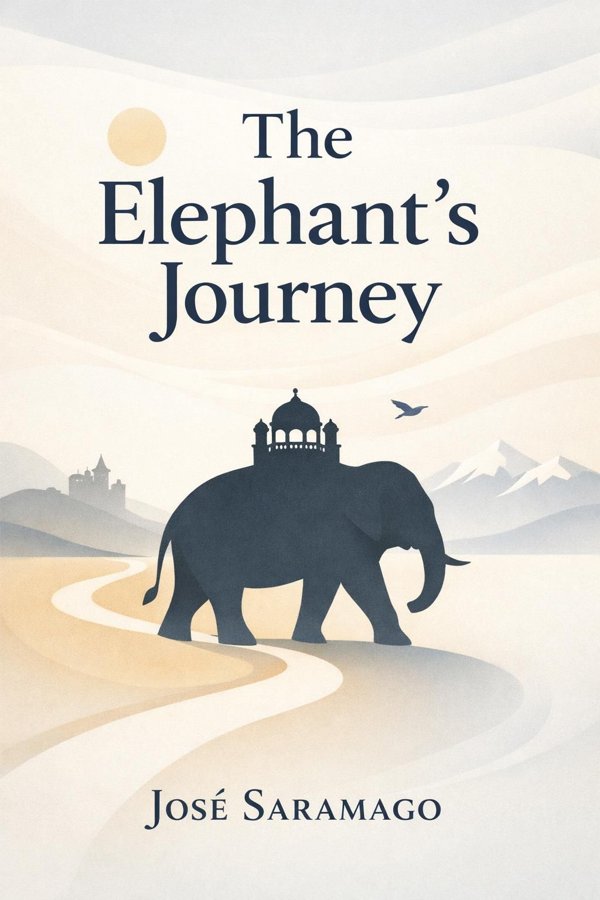
The Elephant's Journey: Summary & Key Insights
 10 min9 chaptersAudio available
Key Takeaways from The Elephant's Journey
Grand gestures often reveal more about the giver than the gift.
The people closest to reality are rarely the people with the highest rank.
A simple task can become a pageant once institutions take hold of it.
Human beings are often drawn to what they do not understand, but they rarely greet it without anxiety.
Belief becomes dangerous when institutions value spectacle more than truth.
What Is The Elephant's Journey About?
The Elephant's Journey by José Saramago is a classics book spanning 8 pages. The Elephant's Journey is José Saramago’s playful, sharp-eyed retelling of a real sixteenth-century episode: an Indian elephant named Solomon is sent from Portugal to the Habsburg court as a diplomatic gift, then marched across Europe from Lisbon to Vienna. What begins as an act of royal generosity quickly reveals itself as a parade of vanity, confusion, spectacle, and accidental wisdom. Along the way, soldiers, priests, nobles, villagers, and the elephant’s keeper all expose the odd machinery of power and the fragile dignity of ordinary life. Saramago uses this unlikely journey to ask serious questions through comic means: who truly understands the world, those who rule it or those who endure it? What do institutions value, and what do they overlook? Why are humans so eager to decorate authority with ceremony while ignoring practical truth? As a Nobel Prize-winning author known for blending irony, philosophy, and humane observation, Saramago turns a historical curiosity into a profound meditation on politics, faith, identity, and mortality. The result is a novel that is funny, moving, and far wiser than its whimsical premise first suggests.
This FizzRead summary covers all 9 key chapters of The Elephant's Journey in approximately 10 minutes, distilling the most important ideas, arguments, and takeaways from José Saramago's work. Also available as an audio summary and Key Quotes Podcast.
The Elephant's Journey
The Elephant's Journey is José Saramago’s playful, sharp-eyed retelling of a real sixteenth-century episode: an Indian elephant named Solomon is sent from Portugal to the Habsburg court as a diplomatic gift, then marched across Europe from Lisbon to Vienna. What begins as an act of royal generosity quickly reveals itself as a parade of vanity, confusion, spectacle, and accidental wisdom. Along the way, soldiers, priests, nobles, villagers, and the elephant’s keeper all expose the odd machinery of power and the fragile dignity of ordinary life. Saramago uses this unlikely journey to ask serious questions through comic means: who truly understands the world, those who rule it or those who endure it? What do institutions value, and what do they overlook? Why are humans so eager to decorate authority with ceremony while ignoring practical truth? As a Nobel Prize-winning author known for blending irony, philosophy, and humane observation, Saramago turns a historical curiosity into a profound meditation on politics, faith, identity, and mortality. The result is a novel that is funny, moving, and far wiser than its whimsical premise first suggests.
Who Should Read The Elephant's Journey?
This book is perfect for anyone interested in classics and looking to gain actionable insights in a short read. Whether you're a student, professional, or lifelong learner, the key ideas from The Elephant's Journey by José Saramago will help you think differently.
- ✓Readers who enjoy classics and want practical takeaways
- ✓Professionals looking to apply new ideas to their work and life
- ✓Anyone who wants the core insights of The Elephant's Journey in just 10 minutes
Want the full summary?
Get instant access to this book summary and 100K+ more with Fizz Moment.
Get Free SummaryAvailable on App Store • Free to download
Key Chapters
Grand gestures often reveal more about the giver than the gift. In The Elephant's Journey, King Dom João III’s decision to send Solomon the elephant to Archduke Maximilian is presented as a diplomatic act, but Saramago quickly exposes the vanity beneath the ceremony. The elephant is not sent because of affection, moral duty, or practical usefulness. He is sent because rulers need symbols, and nothing advertises prestige quite like an exotic creature crossing a continent under royal command.
This opening idea sets the tone for the entire novel. Saramago shows that political life is frequently built on spectacle. The elephant becomes a living emblem of status, a creature transformed into an instrument of policy by people who rarely consider his comfort or the labor required to move him. Around this act of gifting grows a whole apparatus of planning, expense, and public display. What appears noble is also absurd. Yet this absurdity is not limited to kings. Modern life is full of impressive gestures that conceal self-interest: corporate philanthropy designed for headlines, institutions chasing prestige projects, or individuals giving extravagantly for recognition rather than care.
Saramago’s brilliance lies in refusing to make this merely cynical. The gift does have consequences. It creates movement, encounters, and opportunities for unexpected insight. Human vanity may set events in motion, but meaning emerges elsewhere—in the overlooked details, the servants, the animal, the road.
A practical lesson follows from this. When evaluating any impressive gesture, ask what purpose it truly serves and who bears the cost. Is it meant to help, or to be seen helping? The actionable takeaway: look past ceremonial appearances and examine motive, labor, and impact before admiring any display of generosity or power.
The people closest to reality are rarely the people with the highest rank. Subhro, Solomon’s mahout, stands at the moral and intellectual center of the novel precisely because he occupies a low social position while possessing real knowledge. He understands the elephant’s habits, moods, needs, and limits. In practical terms, he knows what keeps the expedition alive. Yet because he is a servant, foreign, and socially marginal, his insight is often undervalued by those who command the journey.
Saramago uses Subhro to challenge assumptions about authority. Nobles, clerics, and officers speak the language of power, but Subhro speaks the language of reality. He knows that an elephant cannot be managed through rhetoric, protocol, or imagination. He must be fed, rested, guided, and respected. That simple fact becomes a quiet rebuke to all systems that confuse status with competence.
Subhro is also emotionally intelligent. He navigates different cultures, tolerates foolishness, and adapts without surrendering his dignity. He is not idealized into a saint. Instead, he appears as someone who survives by observing, understanding, and speaking carefully in a world ruled by others. Many readers will recognize this dynamic in workplaces, governments, and families, where the least celebrated people often carry the most useful knowledge.
The practical application is immediate. In any group, ask who actually knows how things work. It may be the technician rather than the executive, the caregiver rather than the planner, the frontline employee rather than the strategist. Good judgment requires listening downward, not just upward.
The actionable takeaway: identify the “Subhros” in your life and organization, and give serious weight to the voices with lived experience, practical skill, and quiet competence.
A simple task can become a pageant once institutions take hold of it. Getting an elephant from one place to another should be difficult enough on practical grounds alone, but Saramago delights in showing how bureaucracy multiplies difficulty through procedure, hierarchy, and ceremonial fuss. The preparations for departure are not merely logistical. They become a comedy of permissions, planning failures, competing egos, and public performance.
This is one of the novel’s sharpest satirical threads. Bureaucracy is not portrayed as evil so much as self-important. People become attached to forms, ranks, schedules, and appearances in ways that often obscure the actual goal. The elephant needs food, water, space, and competent handling. Instead, attention drifts toward status, protocol, and who gets credit. The machinery of administration creates friction while congratulating itself for functioning.
Saramago’s insight remains strikingly modern. Anyone who has worked inside a large organization knows the feeling: endless meetings to solve straightforward problems, reports that replace action, approvals that delay obvious necessities, and official language that disguises confusion. Bureaucracy has uses, of course. It can create fairness, order, and accountability. But when detached from reality, it becomes theater masquerading as reason.
The elephant’s journey reminds us that systems should serve life, not the reverse. A process is only as good as its ability to help people accomplish real tasks. If a structure creates more vanity than value, it has begun to fail.
The actionable takeaway: whenever a process grows complicated, return to first principles. Ask, what is the real objective, what is necessary to achieve it, and what steps exist only to satisfy appearances? Simplify where you can, and refuse to confuse administration with accomplishment.
Human beings are often drawn to what they do not understand, but they rarely greet it without anxiety. As Solomon passes through villages and towns, he becomes an object of amazement, rumor, delight, and fear. To many onlookers, the elephant is unlike anything they have ever seen. Their reactions reveal not just curiosity about the animal but the deeper habits of the human imagination. We fill gaps in knowledge with fantasy, superstition, and projection.
Saramago captures this beautifully. The elephant is a real, physical creature with ordinary needs, yet people interpret him as a marvel, omen, threat, or sign of distant worlds. This pattern is timeless. New people, technologies, cultures, and ideas are often received in the same way. We romanticize them, demonize them, or exaggerate their meaning before we understand them. The novel shows how easily difference becomes spectacle.
At the same time, these encounters are not merely foolish. They are also deeply human. Wonder can be generous. The villagers’ fascination reminds us that daily life can become numb without occasions for astonishment. The challenge is to remain open without becoming irrational, curious without surrendering judgment.
This has practical value far beyond literature. In workplaces, communities, and public life, unfamiliar people or ideas often trigger both excitement and defensiveness. We can either retreat into prejudice or move toward understanding. Saramago gently encourages the latter by contrasting popular assumptions with the simple reality of the animal before them.
The actionable takeaway: when confronted with something unfamiliar, notice your first reaction, then replace fantasy with attention. Ask what is actually there, what you truly know, and what you are merely projecting onto the unknown.
Belief becomes dangerous when institutions value spectacle more than truth. One of the novel’s most memorable episodes involves religion and the temptation to turn Solomon into evidence of the miraculous. Saramago does not attack faith itself so much as the human tendency to manipulate belief for prestige, influence, and social control. Clergy and authorities are shown as deeply invested in appearances, eager to harness wonder for institutional purposes.
The elephant, by his mere presence, disrupts normal categories. This creates an opportunity: if people are ready to be amazed, someone will try to direct that amazement. Saramago’s irony is precise here. The so-called miracle says less about divine intervention than about human readiness to package, stage, and exploit belief. Religion becomes entangled with vanity in much the same way politics does. Both rely on symbols, audiences, and narratives that elevate authority.
Yet Saramago’s treatment is not simplistic. He understands that people long for meaning, comfort, and transcendence. The problem arises when that longing is manipulated by institutions that prefer obedience to honesty. This is why the episode still resonates. In every age, charisma can impersonate truth, and public emotion can be managed by those who understand theater.
A modern reader can apply this lesson widely. We see secular miracles too: exaggerated claims in media, emotional branding, ideological certainty dressed as moral purity. Whenever a story seems designed to make us surrender judgment in exchange for belonging, caution is needed.
The actionable takeaway: respect sincere belief, but question any authority that demands wonder without evidence. Ask who benefits from the claim, how the story is being staged, and whether emotion is being used to replace critical thought.
Ambition sounds noble until it meets weather, distance, and gravity. As the expedition crosses the Alps, the novel shifts into a harsher register. The mountain passage is physically dangerous, exhausting, and humbling. Here, nature strips away the elegant language of diplomacy and exposes the body-level reality of the journey. Everyone involved must confront cold, risk, fatigue, and the limits of control.
Saramago uses this section to demonstrate how fragile human plans really are. Courts may issue commands, officers may draw routes, and ceremonies may promise order, but mountains do not care about protocol. The elephant’s immense body, once a symbol of grandeur, now becomes a test of endurance and logistics. The crossing dramatizes a central truth of the novel: reality eventually interrupts fantasy. Institutions can narrate events however they please, but the material world insists on its own terms.
This is one of the book’s most practical philosophical insights. Many of our ambitions fail not because they are unworthy, but because we underestimate friction. We imagine outcomes and ignore conditions. We celebrate vision and neglect constraints. Saramago invites us to respect difficulty without surrendering to it. Progress requires humility before facts.
In everyday life, the Alps represent any hard passage: launching a project, caring for a family member, recovering from illness, changing careers, or moving across cultures. The lesson is not to abandon ambition but to pair it with preparation, patience, and realism. Grandeur alone will not carry us through hardship.
The actionable takeaway: before pursuing any major goal, identify the “mountains” in advance—the real obstacles of energy, time, cost, and risk—and build your plans around them rather than around wishful thinking.
Power often begins by renaming what it wants to control. When Subhro becomes Fritz, the change may seem minor, even practical, but Saramago treats it as a revealing moment. A name is never just a label. It carries memory, origin, belonging, and selfhood. To rename someone is to fold them into a new system, often on that system’s terms rather than their own.
The transformation from Subhro to Fritz reflects the larger pressures of assimilation. In order to fit a European courtly environment, the keeper must become more legible to those in power. The change is framed as adjustment, perhaps even convenience, but beneath that lies erasure. His difference is tolerated only once it has been softened, translated, or domesticated. Saramago sees clearly how institutions welcome outsiders while also demanding that they become less fully themselves.
This theme remains intensely relevant. Immigrants, minorities, employees, and students are often encouraged to adapt in ways that go beyond practical communication. They are asked to alter speech, behavior, presentation, or identity to reduce discomfort for the dominant culture. Sometimes compromise is necessary; often the cost is hidden. What gets lost when a person must be remade to be accepted?
Saramago does not present identity as fixed or pure. People do change across borders. But he insists that we notice who has the power to define that change. The question is not whether adaptation happens. It is whether adaptation is mutual, respectful, and chosen.
The actionable takeaway: pay attention to the small ways institutions ask people to become “easier” for others. Whenever possible, preserve names, histories, and forms of self-definition, and make inclusion mean recognition rather than quiet erasure.
Sometimes the most dignified figure in a story is not human at all. Solomon the elephant does not speak, argue, preach, or issue commands, yet his presence continuously exposes the foolishness of those around him. Humans project onto him diplomatic meaning, religious symbolism, social prestige, and public wonder, while he remains what he is: a living creature with needs, instincts, and a quiet indifference to ceremony.
This is one of Saramago’s most elegant strategies. By placing an animal at the center of a human world obsessed with status, he reveals how inflated that world can be. Solomon becomes a mirror in which human vanity looks ridiculous. He does not care about titles. He does not understand noble etiquette. He cannot be persuaded by rhetoric. He reminds everyone that beneath politics and pageantry lies embodiment: hunger, movement, weather, fatigue, care.
There is also compassion in this portrayal. The novel asks us to see animals not as props in human dramas but as beings subject to our decisions. Solomon is admired, but admiration does not protect him from exploitation. This tension encourages ethical reflection. Beauty and fascination are not enough; they must lead to responsibility.
In modern terms, this idea extends to how we treat the natural world more broadly. We celebrate nature in image and language while often organizing society in ways that disregard real ecological and animal needs. Saramago quietly insists that humility begins by recognizing life beyond human prestige systems.
The actionable takeaway: when you find yourself absorbed in symbols, step back and ask what concrete living reality is being overlooked. Let care for actual beings—human or animal—matter more than the status attached to possessing or displaying them.
Every triumphant ending contains the shadow of disappearance. When Solomon finally reaches Vienna, the journey appears complete: the diplomatic gift has arrived, the spectacle has been delivered, and the narrative arc has fulfilled its public purpose. Yet Saramago refuses to let arrival become simple victory. Instead, he turns the ending into a meditation on transience. Ceremonies fade, political meanings shift, and even remarkable journeys are eventually absorbed into silence.
This perspective deepens the entire novel. What seemed like a grand historical event is shown to be temporary, contingent, and vulnerable to forgetting. The elephant who once inspired astonishment will one day become a memory, then a footnote, then perhaps not even that. In this, Saramago is not being bleak. He is reminding us that history is full of episodes that mattered intensely to those who lived them and yet dissolve with time. The same is true of our own accomplishments.
Paradoxically, this awareness can be liberating. If glory is fragile, then perhaps we should invest less in applause and more in conduct. The true value of the journey lies not in courtly recognition but in what it reveals about endurance, absurdity, kindness, and human character under pressure. Meaning survives less in monuments than in moral perception.
Readers can apply this lesson personally. Careers, awards, projects, and public success all have their season, but they do not secure lasting significance on their own. What often remains is how we treated others while pursuing them.
The actionable takeaway: hold achievement lightly. Work hard, but do not build your identity around recognition. Measure a life less by spectacle and more by the integrity, patience, and humanity shown along the road.
All Chapters in The Elephant's Journey
About the Author
José Saramago (1922–2010) was a Portuguese novelist, essayist, and playwright widely regarded as one of the most important literary voices of the modern era. Born into a poor rural family in Portugal, he worked in a variety of jobs before gaining international recognition as a writer. His fiction is known for its long, flowing sentences, ironic narrative voice, and deep engagement with moral, political, and philosophical questions. Saramago often explored the tensions between power and conscience, institutions and individuals, faith and skepticism. In 1998, he received the Nobel Prize in Literature for work that, in the words of the Swedish Academy, gave imaginative life to an elusive reality. His best-known books include Blindness, The Gospel According to Jesus Christ, Baltasar and Blimunda, All the Names, and The Elephant's Journey.
Get This Summary in Your Preferred Format
Read or listen to the The Elephant's Journey summary by José Saramago anytime, anywhere. FizzRead offers multiple formats so you can learn on your terms — all free.
Available formats: App · Audio · PDF · EPUB — All included free with FizzRead
Download The Elephant's Journey PDF and EPUB Summary
Key Quotes from The Elephant's Journey
“Grand gestures often reveal more about the giver than the gift.”
“The people closest to reality are rarely the people with the highest rank.”
“A simple task can become a pageant once institutions take hold of it.”
“Human beings are often drawn to what they do not understand, but they rarely greet it without anxiety.”
“Belief becomes dangerous when institutions value spectacle more than truth.”
Frequently Asked Questions about The Elephant's Journey
The Elephant's Journey by José Saramago is a classics book that explores key ideas across 9 chapters. The Elephant's Journey is José Saramago’s playful, sharp-eyed retelling of a real sixteenth-century episode: an Indian elephant named Solomon is sent from Portugal to the Habsburg court as a diplomatic gift, then marched across Europe from Lisbon to Vienna. What begins as an act of royal generosity quickly reveals itself as a parade of vanity, confusion, spectacle, and accidental wisdom. Along the way, soldiers, priests, nobles, villagers, and the elephant’s keeper all expose the odd machinery of power and the fragile dignity of ordinary life. Saramago uses this unlikely journey to ask serious questions through comic means: who truly understands the world, those who rule it or those who endure it? What do institutions value, and what do they overlook? Why are humans so eager to decorate authority with ceremony while ignoring practical truth? As a Nobel Prize-winning author known for blending irony, philosophy, and humane observation, Saramago turns a historical curiosity into a profound meditation on politics, faith, identity, and mortality. The result is a novel that is funny, moving, and far wiser than its whimsical premise first suggests.
More by José Saramago

You Might Also Like






Browse by Category
Ready to read The Elephant's Journey?
Get the full summary and 100K+ more books with Fizz Moment.