
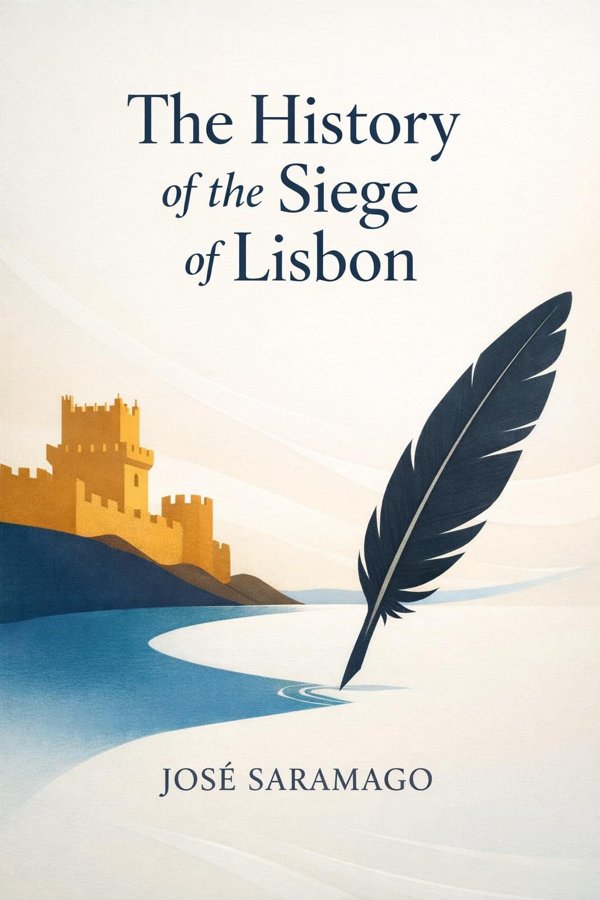
The History of the Siege of Lisbon: Summary & Key Insights
 10 min9 chaptersAudio available
Key Takeaways from The History of the Siege of Lisbon
Sometimes the smallest change reveals the largest illusion.
History becomes most alive when it stops staying politely in the past.
A made-up story can sometimes reveal more than a certified fact.
Sometimes the most radical change in a life does not begin with ideology but with tenderness.
Every history includes an archive of silence.
What Is The History of the Siege of Lisbon About?
The History of the Siege of Lisbon by José Saramago is a classics book spanning 4 pages. What happens when a single word refuses to obey history? In The History of the Siege of Lisbon, José Saramago builds an extraordinary novel around that question. The story follows Raimundo Silva, a meticulous proofreader in contemporary Lisbon who inserts one small word—“not”—into a history book about the 1147 Christian siege of the city. That tiny alteration changes the meaning of the text entirely, opening a space where official history, private imagination, and lived reality begin to mingle. From this deceptively simple act, Saramago creates a rich meditation on how stories are made, who gets to tell them, and why the past is never as fixed as it appears. The novel matters because it turns proofreading into philosophy. Saramago shows that history is not merely discovered; it is arranged, narrated, edited, and believed. At the same time, he gives this intellectual puzzle emotional depth through Silva’s late-blooming inner transformation and a tender, understated love story. Saramago, winner of the 1998 Nobel Prize in Literature, is uniquely suited to this project. His playful, questioning prose and moral seriousness make this novel both a reflection on historical truth and a moving account of personal freedom.
This FizzRead summary covers all 9 key chapters of The History of the Siege of Lisbon in approximately 10 minutes, distilling the most important ideas, arguments, and takeaways from José Saramago's work. Also available as an audio summary and Key Quotes Podcast.
The History of the Siege of Lisbon
What happens when a single word refuses to obey history? In The History of the Siege of Lisbon, José Saramago builds an extraordinary novel around that question. The story follows Raimundo Silva, a meticulous proofreader in contemporary Lisbon who inserts one small word—“not”—into a history book about the 1147 Christian siege of the city. That tiny alteration changes the meaning of the text entirely, opening a space where official history, private imagination, and lived reality begin to mingle. From this deceptively simple act, Saramago creates a rich meditation on how stories are made, who gets to tell them, and why the past is never as fixed as it appears.
The novel matters because it turns proofreading into philosophy. Saramago shows that history is not merely discovered; it is arranged, narrated, edited, and believed. At the same time, he gives this intellectual puzzle emotional depth through Silva’s late-blooming inner transformation and a tender, understated love story. Saramago, winner of the 1998 Nobel Prize in Literature, is uniquely suited to this project. His playful, questioning prose and moral seriousness make this novel both a reflection on historical truth and a moving account of personal freedom.
Who Should Read The History of the Siege of Lisbon?
This book is perfect for anyone interested in classics and looking to gain actionable insights in a short read. Whether you're a student, professional, or lifelong learner, the key ideas from The History of the Siege of Lisbon by José Saramago will help you think differently.
- ✓Readers who enjoy classics and want practical takeaways
- ✓Professionals looking to apply new ideas to their work and life
- ✓Anyone who wants the core insights of The History of the Siege of Lisbon in just 10 minutes
Want the full summary?
Get instant access to this book summary and 100K+ more with Fizz Moment.
Get Free SummaryAvailable on App Store • Free to download
Key Chapters
Sometimes the smallest change reveals the largest illusion. In this novel, the decisive event is not a battle, a coronation, or a grand political decree, but a proofreader’s insertion of a single word: “not.” By altering a sentence so that the Crusaders did not help the Portuguese conquer Lisbon in 1147, Raimundo Silva disrupts the authority of the historical record and exposes how fragile official truth can be.
Saramago’s point is not that facts do not matter. Rather, he asks us to notice how dependent facts are on language, transcription, interpretation, and institutional trust. A history book appears solid because it is printed, cited, and repeated. Yet before it became “history,” it was phrased by someone, selected from competing details, and shaped into a coherent account. Silva’s act is rebellious because it reveals the hidden vulnerability of all written authority: every text could have been otherwise.
This idea has practical force beyond literature. In journalism, law, education, and even workplace communication, a single phrase can redirect meaning. Think of how “may” differs from “must,” or how an omitted clause in a contract changes responsibility. We often treat written language as neutral when in fact it is active and consequential.
Silva’s insertion also becomes an existential act. He is not only changing a book; he is stepping out of passive service to other people’s words and claiming creative power for himself. The correction becomes a declaration that he, too, can shape reality.
Actionable takeaway: the next time you read an “authoritative” account, pause over its wording and ask what assumptions are hidden in the sentence—and how the meaning would change if even one word were different.
History becomes most alive when it stops staying politely in the past. One of the novel’s most distinctive achievements is its dual structure: the story alternates between modern Lisbon, where Raimundo Silva works and gradually awakens to a new life, and the imagined medieval Lisbon of the siege he has rewritten. These are not separate layers placed side by side. They echo, reshape, and illuminate each other.
In the present-day narrative, Silva lives quietly, almost invisibly, enclosed within routine and professional precision. In the medieval strand, the city under siege is uncertain, vulnerable, and full of human contingency. By moving between these worlds, Saramago suggests that the past is not dead material stored in archives. It survives in streets, buildings, habits of thought, and in the stories through which a city understands itself.
This intertwining also dramatizes how imagination works. Silva does not simply invent a parallel historical episode for entertainment. His reconstruction of the siege becomes a way of reading his own life differently. As he imagines hesitation, courage, loyalty, and desire in medieval figures, he discovers those same capacities within himself. The historical and the personal become mirrors.
We see similar dynamics in ordinary life whenever a family story shapes identity, or when a nation’s memory informs current politics. The past influences the present not only through events, but through narratives repeated until they become part of reality.
Saramago’s layered structure invites readers to inhabit time differently. Instead of seeing history as distant and complete, we are asked to feel it as unfinished, conversational, and still open to interpretation.
Actionable takeaway: reflect on one story about your city, family, or profession that you have always accepted; then ask how that inherited narrative still shapes the way you live now.
A made-up story can sometimes reveal more than a certified fact. That paradox lies at the center of Saramago’s novel. After altering the historical record, Raimundo Silva begins to imagine an alternative version of the siege. This act is not presented as a careless escape from reality but as a serious inquiry into possibility, motive, and human complexity.
Saramago challenges the simplistic opposition between fact and fiction. Official history often presents itself as objective, yet it necessarily compresses uncertainty into narrative order. Imagination, by contrast, can reopen that order and restore lost ambiguities. By asking what might have happened if the Crusaders had refused to help, Silva’s invented history reveals how much of real history depends on contingency. Events we later call inevitable were once uncertain.
This is why fiction matters. It does not replace evidence, but it can deepen understanding by exploring interiority, forgotten perspectives, and unrealized alternatives. A military chronicle may tell us who won a battle; a novel can ask what fear, boredom, pride, or desire felt like inside those circumstances. In classrooms, museums, or public discussions, imaginative retellings often make historical experience more human and memorable.
In everyday life, imagination also helps us revise the stories we tell about ourselves. A person who thinks “I have always been timid” may begin to act differently by imagining a different self-narrative. Possibility often begins as fiction before it becomes action.
Silva’s imaginative reconstruction therefore becomes both literary method and personal liberation. He is not falsifying truth so much as searching for a deeper one: that human life always contains roads not taken.
Actionable takeaway: when faced with a fixed narrative—historical or personal—ask not only “What happened?” but also “What else might have been possible, and what does that reveal about the truth I have accepted?”
Sometimes the most radical change in a life does not begin with ideology but with tenderness. Alongside its reflections on history and authorship, The History of the Siege of Lisbon is quietly a love story. Raimundo Silva’s relationship with Maria Sara, the editor who enters his life after his textual transgression is discovered, gives emotional substance to the novel’s philosophical concerns.
At first, Silva is defined by caution. He is solitary, disciplined, and accustomed to inhabiting the margins. Maria Sara’s presence unsettles that enclosed existence. She does not merely approve or condemn his act; she invites him to continue it, to write the alternative history he has implied with his “not.” Her encouragement becomes a form of recognition. She sees in him not just a corrector of other people’s sentences but a creator.
This matters because love in Saramago is linked to permission—the permission to become larger than one’s habits. Through affection, conversation, and mutual curiosity, Silva begins to inhabit language, desire, and time differently. The boundaries between editor and author, reader and writer, past and present, solitude and companionship all become more permeable.
The practical resonance is familiar. Many people remain smaller than they are because no one has ever mirrored back their unrealized capacities. A good relationship—romantic, friendly, or professional—can function as an invitation into possibility. It can call forth authorship where there was only obedience.
Saramago avoids sentimentality. Love does not erase uncertainty; it creates a space in which uncertainty becomes bearable and productive. In that sense, intimacy resembles writing: both require trust in what has not yet fully taken shape.
Actionable takeaway: identify one relationship in your life that encourages your more creative, courageous self—and actively invest in that bond rather than treating it as secondary to your routines.
Every history includes an archive of silence. One of Saramago’s sharpest insights is that official narratives do not simply preserve the past; they prioritize certain voices while excluding others. The siege of Lisbon, as commonly told, becomes a national episode shaped by chroniclers, institutions, and the conventions of heroic storytelling. But whose experiences are missing? The ordinary residents, the hesitant soldiers, the women, the doubters, the unrecorded dead?
By rewriting the siege, Raimundo Silva draws attention to those absences. Saramago does not claim he can perfectly restore forgotten lives. Instead, he reveals the ethical importance of noticing what standard history leaves out. This is a powerful literary and civic lesson. Whenever a nation celebrates its founding myths, it often smooths away contradiction, suffering, and inconvenient complexity in the name of coherence.
The same dynamic operates in contemporary settings. Corporate histories highlight visionaries, not exploited workers. Family legends praise sacrifice but conceal conflict. Social media biographies present polished identities while omitting loneliness, failure, and dependence. In each case, the dominant narrative gains authority by seeming complete.
Reading Saramago trains us to become better listeners to omission. What is absent from the account may matter as much as what is included. This does not mean all versions are equally valid; rather, it means critical reading requires awareness of perspective, power, and exclusion.
Silva’s task as proofreader once made him a servant of textual surface. His deeper transformation begins when he starts hearing the quiet behind the printed sentence. That is where history becomes morally charged.
Actionable takeaway: when encountering any historical or personal narrative, ask two questions: who is speaking, and who is missing? Then seek one additional perspective before deciding the story is complete.
We often imagine creativity as beginning from a blank page, but Saramago shows that revision itself can be inventive. Raimundo Silva is a proofreader, someone professionally tasked with correcting errors and preserving authorial intention. His work is usually invisible, valued precisely when it leaves no trace. Yet the novel transforms this humble labor into a profound metaphor: every act of editing contains interpretive power.
Proofreading is never entirely mechanical. To correct punctuation, syntax, or consistency is already to make judgments about clarity, meaning, and emphasis. Silva’s unauthorized insertion of “not” is extreme, but it dramatizes a truth present in all editorial work: mediators shape messages. Publishers, translators, teachers, curators, and even software designers influence how content appears and how audiences understand it.
This idea has broad application. In meetings, the person who summarizes a discussion effectively “edits” the group’s memory of what happened. In organizations, whoever drafts the final document often controls the narrative. In personal life, the stories we retell about a conflict or success become edited versions of experience, each emphasizing some details and omitting others.
Saramago also dignifies intellectual labor often treated as secondary. Silva begins as someone who polishes others’ words, but through a breach of duty he discovers authorship latent within service. The novel implies that many people who think of themselves as assistants, reviewers, or support staff may possess creative agency they have never claimed.
The danger, of course, is ethical: editors can clarify or distort, protect truth or manipulate it. Creativity without responsibility becomes propaganda. But responsibility without imagination can become sterile obedience.
Actionable takeaway: if your role involves correcting, summarizing, or organizing others’ work, recognize your interpretive power��and use it deliberately, transparently, and with awareness of the meaning you help create.
Not all revolutions announce themselves. In Raimundo Silva, Saramago gives us an unlikely rebel: older, solitary, careful, and professionally devoted to precision. His transgression is almost absurdly modest—one inserted word in a manuscript—yet it alters the course of his inner life. The novel suggests that rebellion often begins not in dramatic confrontation but in a private refusal to continue living entirely within inherited rules.
Silva’s act matters because it breaks a pattern of self-erasure. Before this moment, he exists as a guardian of textual authority rather than a participant in meaning. By violating the system he serves, he risks embarrassment, professional consequence, and moral uncertainty. But he also discovers a self capable of initiative. Rebellion, here, is not nihilism; it is the first assertion of subjectivity.
This insight applies to many forms of change. A person trapped in a stale career may not begin by quitting, but by admitting inwardly that the current script no longer fits. A citizen may challenge public falsehood not through grand speeches but by asking one honest question. A student may reclaim intellectual independence by disagreeing thoughtfully with a textbook rather than memorizing it unquestioningly.
Saramago is attentive to scale. Small acts can be ethically serious because they reshape the actor. The world may not notice at first, but the person who disobeys once can no longer return untouched to pure compliance. Freedom often enters life quietly, before it becomes visible.
At the same time, rebellion requires reflection. Not every refusal is wise. What gives Silva’s act significance is that it opens inquiry rather than merely expressing impulse.
Actionable takeaway: consider one routine in your life where you are obeying automatically; choose one thoughtful, low-risk way to question it, and notice what that reveals about who you have become.
A city is never just a backdrop; it is a layered memory. Lisbon in Saramago’s novel is both physical place and historical palimpsest, a living environment where medieval siege, modern routine, private longing, and national myth coexist. Streets, walls, views, and names carry traces of what has happened before, whether or not contemporary inhabitants consciously feel that weight.
By centering the novel in Lisbon, Saramago explores the relationship between geography and identity. Raimundo Silva does not imagine the siege from nowhere. He inhabits a city whose material presence invites historical meditation. The modern city becomes porous: walking through it is also walking through buried narratives. This gives the novel unusual texture, because history is not presented as a separate academic topic but as something embedded in daily space.
Readers can apply this insight anywhere. Every city contains stories hidden in architecture, monuments, zoning, migration patterns, and place names. A neighborhood may reveal histories of conquest, class change, resistance, or erasure. Paying attention to these layers turns ordinary movement into civic literacy.
Saramago also hints that belonging to a place involves interpretation. To live in a city without curiosity is to inhabit only its surface. To ask how a place came to be what it is opens a richer relation to community and self. In Silva’s case, the city becomes a partner in his imaginative and emotional awakening.
This perspective is especially valuable in an age of speed and abstraction. Physical places can anchor historical consciousness in ways digital information often cannot.
Actionable takeaway: choose one street, building, or district you know well, learn one historical fact about it, and revisit the place with fresh attention to how the past still shapes the present there.
Form is never separate from meaning, and Saramago’s style is part of the novel’s argument. His long, flowing sentences, minimal conventional punctuation, and conversational shifts between narration and dialogue force readers into a different rhythm of attention. Instead of receiving neatly packaged information, we must participate actively, following turns of thought, irony, and association.
This stylistic method matters because the novel is about questioning authority. Traditional formatting can create an illusion of certainty and hierarchy: clear labels, fixed speakers, settled divisions. Saramago loosens these boundaries. Voices mingle, commentary slides into scene, and the narrator often appears playful, skeptical, and intrusive. The reading experience itself becomes a lesson in interpretive vigilance.
For some readers, this style is initially demanding. But that demand is productive. It slows consumption and encourages engagement. We cannot skim passively; we must listen. In that sense, Saramago’s prose enacts the very habit the novel advocates: critical, patient attention to language.
There is a practical lesson here for modern readers accustomed to speed. Difficult style is not always ornament or obscurity. Sometimes it is an ethical invitation to think more carefully. The same applies beyond literature. Complex issues—history, politics, identity—cannot always be reduced to bullet points without loss. Learning to stay with complexity is part of intellectual maturity.
Saramago’s style also rewards rereading. Because meaning unfolds through tone, rhythm, and subtle juxtaposition, readers often discover more on a second pass, much as historians uncover significance through repeated examination of sources.
Actionable takeaway: when a text feels demanding, resist the urge to dismiss it immediately; slow down, read a passage aloud if needed, and ask how the form itself might be shaping the idea being expressed.
All Chapters in The History of the Siege of Lisbon
About the Author
José Saramago (1922–2010) was a Portuguese novelist, essayist, and one of the most original literary voices of the modern era. Born into a rural family in Azinhaga, Portugal, he worked in a variety of jobs before gaining international recognition as a writer. His fiction is celebrated for its philosophical depth, political intelligence, irony, and unmistakable prose style, marked by long sentences and fluid, dialogue-rich narration. Saramago often examined power, morality, religion, history, and the fragility of human certainty. In 1998, he was awarded the Nobel Prize in Literature, becoming the first Portuguese-language writer to receive the honor. His major works include Blindness, The Gospel According to Jesus Christ, Baltasar and Blimunda, The Cave, and The History of the Siege of Lisbon.
Get This Summary in Your Preferred Format
Read or listen to the The History of the Siege of Lisbon summary by José Saramago anytime, anywhere. FizzRead offers multiple formats so you can learn on your terms — all free.
Available formats: App · Audio · PDF · EPUB — All included free with FizzRead
Download The History of the Siege of Lisbon PDF and EPUB Summary
Key Quotes from The History of the Siege of Lisbon
“Sometimes the smallest change reveals the largest illusion.”
“History becomes most alive when it stops staying politely in the past.”
“A made-up story can sometimes reveal more than a certified fact.”
“Sometimes the most radical change in a life does not begin with ideology but with tenderness.”
“Every history includes an archive of silence.”
Frequently Asked Questions about The History of the Siege of Lisbon
The History of the Siege of Lisbon by José Saramago is a classics book that explores key ideas across 9 chapters. What happens when a single word refuses to obey history? In The History of the Siege of Lisbon, José Saramago builds an extraordinary novel around that question. The story follows Raimundo Silva, a meticulous proofreader in contemporary Lisbon who inserts one small word—“not”—into a history book about the 1147 Christian siege of the city. That tiny alteration changes the meaning of the text entirely, opening a space where official history, private imagination, and lived reality begin to mingle. From this deceptively simple act, Saramago creates a rich meditation on how stories are made, who gets to tell them, and why the past is never as fixed as it appears. The novel matters because it turns proofreading into philosophy. Saramago shows that history is not merely discovered; it is arranged, narrated, edited, and believed. At the same time, he gives this intellectual puzzle emotional depth through Silva’s late-blooming inner transformation and a tender, understated love story. Saramago, winner of the 1998 Nobel Prize in Literature, is uniquely suited to this project. His playful, questioning prose and moral seriousness make this novel both a reflection on historical truth and a moving account of personal freedom.
More by José Saramago
You Might Also Like





Browse by Category
Ready to read The History of the Siege of Lisbon?
Get the full summary and 100K+ more books with Fizz Moment.