
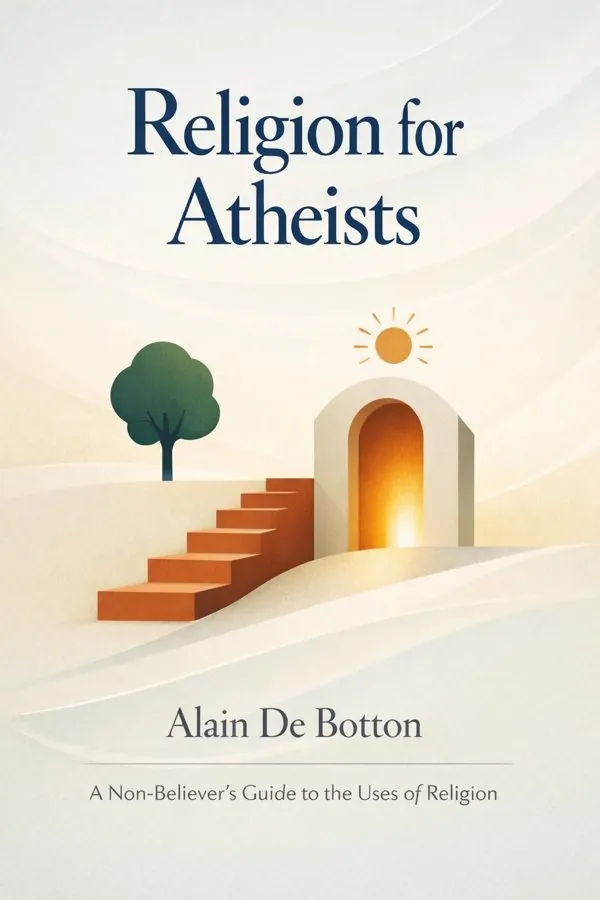
Religion for Atheists: A Non-Believer's Guide to the Uses of Religion: Summary & Key Insights
 10 min8 chaptersAudio available
What Is Religion for Atheists: A Non-Believer's Guide to the Uses of Religion About?
Religion for Atheists: A Non-Believer's Guide to the Uses of Religion by Alain De Botton is a western_phil book spanning 8 pages. In this thought-provoking work, Alain de Botton explores how the secular world can benefit from the moral and communal lessons of religion without subscribing to its supernatural claims. He argues that religious traditions offer valuable insights into community, morality, and emotional well-being, which modern society can adapt to enrich everyday life.
This FizzRead summary covers all 8 key chapters of Religion for Atheists: A Non-Believer's Guide to the Uses of Religion in approximately 10 minutes, distilling the most important ideas, arguments, and takeaways from Alain De Botton's work. Also available as an audio summary and Key Quotes Podcast.
Religion for Atheists: A Non-Believer's Guide to the Uses of Religion
In this thought-provoking work, Alain de Botton explores how the secular world can benefit from the moral and communal lessons of religion without subscribing to its supernatural claims. He argues that religious traditions offer valuable insights into community, morality, and emotional well-being, which modern society can adapt to enrich everyday life.
Who Should Read Religion for Atheists: A Non-Believer's Guide to the Uses of Religion?
This book is perfect for anyone interested in western_phil and looking to gain actionable insights in a short read. Whether you're a student, professional, or lifelong learner, the key ideas from Religion for Atheists: A Non-Believer's Guide to the Uses of Religion by Alain De Botton will help you think differently.
- ✓Readers who enjoy western_phil and want practical takeaways
- ✓Professionals looking to apply new ideas to their work and life
- ✓Anyone who wants the core insights of Religion for Atheists: A Non-Believer's Guide to the Uses of Religion in just 10 minutes
Want the full summary?
Get instant access to this book summary and 100K+ more with Fizz Moment.
Get Free SummaryAvailable on App Store • Free to download
Key Chapters
Secular society prides itself on liberation from religious dogma, yet the moment we achieved that freedom, we found ourselves unanchored. Many people imagine that once the myths fall away, truth alone will suffice. But what we often discover is barrenness—the kind that settles when life’s deeper needs remain unmet. In the absence of shared rituals and stories, individuals drift toward isolation.
In my observations, the secular world has excelled at providing material comfort but failed to supply existential guidance. We have abundant information, but little wisdom. The religious framework once provided moral orientation, a sense of belonging, and a system for emotional education—all of which secularism struggles to replace. As a result, we’ve built societies that value liberty but lack cohesion.
What concerns me most is not that atheists lack faith, but that they lack substitutes for what faith once offered. Without institutions that teach kindness, celebrate togetherness, or console the grieving, modern life can feel brittle. Secularism, if it wishes to endure, must evolve beyond critique. It must become constructive—rebuilding what was once religious into something that nourishes the soul without suspending reason. The secular world’s next task is not to dismiss religion, but to learn from its enduring humanism.
Religion’s greatest genius lies in its ability to create communities. From the synagogue to the church hall, it gathers people not merely to worship but to share life—to eat, sing, and care for one another. These gatherings remind us that we need contact more than privacy. The atheist world, with its emphasis on individual freedom, often neglects that human beings are social by nature.
When I observe religious services, I see an intricate choreography of belonging. There’s an implicit invitation to humility: you leave your ego at the door. You sing in unison, share food, and listen quietly to moral reminders. Secular gatherings—lectures, exhibitions, social media interactions—rarely achieve this depth of connection. They are transient and often transactional.
Imagine if secular society designed spaces that nurtured community with religious intentionality—a weekly meeting, perhaps, devoted not to belief but to reflection. Imagine art, music, and shared meals serving as sacraments of empathy. Such reconstructed rituals could restore what our culture lacks: the feeling that we belong not to ourselves, but to one another. In learning from religion’s communal genius, we would be reclaiming a fundamental truth—that happiness depends not just on freedom, but on solidarity.
+ 6 more chapters — available in the FizzRead app
All Chapters in Religion for Atheists: A Non-Believer's Guide to the Uses of Religion
About the Author
Alain de Botton is a Swiss-born British philosopher and author known for his accessible works on philosophy, love, travel, and modern life. He founded The School of Life, an organization dedicated to developing emotional intelligence through culture and philosophy.
Get This Summary in Your Preferred Format
Read or listen to the Religion for Atheists: A Non-Believer's Guide to the Uses of Religion summary by Alain De Botton anytime, anywhere. FizzRead offers multiple formats so you can learn on your terms — all free.
Available formats: App · Audio · PDF · EPUB — All included free with FizzRead
Download Religion for Atheists: A Non-Believer's Guide to the Uses of Religion PDF and EPUB Summary
Key Quotes from Religion for Atheists: A Non-Believer's Guide to the Uses of Religion
“Secular society prides itself on liberation from religious dogma, yet the moment we achieved that freedom, we found ourselves unanchored.”
“Religion’s greatest genius lies in its ability to create communities.”
Frequently Asked Questions about Religion for Atheists: A Non-Believer's Guide to the Uses of Religion
Religion for Atheists: A Non-Believer's Guide to the Uses of Religion by Alain De Botton is a western_phil book that explores key ideas across 8 chapters. In this thought-provoking work, Alain de Botton explores how the secular world can benefit from the moral and communal lessons of religion without subscribing to its supernatural claims. He argues that religious traditions offer valuable insights into community, morality, and emotional well-being, which modern society can adapt to enrich everyday life.
More by Alain De Botton



You Might Also Like

A Little History of Philosophy
Nigel Warburton
10 min
Areopagitica
John Milton
10 min
How To Think Like A Philosopher: Essential Principles For Clear Thinking
Peter Cave
10 min
Language, Truth and Logic
A. J. Ayer
10 min
The Age of Reason
Thomas Paine
10 min
The Essays
Michel De Montaigne
10 minBrowse by Category
Ready to read Religion for Atheists: A Non-Believer's Guide to the Uses of Religion?
Get the full summary and 100K+ more books with Fizz Moment.