
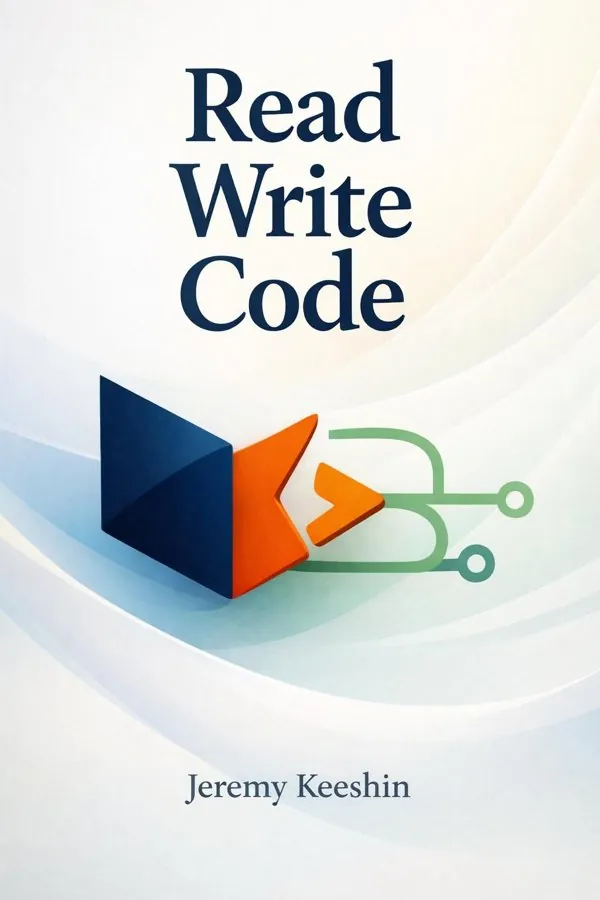
Read Write Code: A Friendly Introduction to the World of Programming: Summary & Key Insights
 10 min10 chaptersAudio available
Key Takeaways from Read Write Code: A Friendly Introduction to the World of Programming
One of the most revealing ways to understand modern life is to see that our world increasingly runs on instructions.
A computer seems intelligent only until you remember that it cannot improvise meaning on its own.
Before coding becomes a technical skill, it begins as a way of thinking.
The most powerful technologies are often the ones we stop noticing.
Many people avoid coding because they assume the entry barrier is impossibly high.
What Is Read Write Code: A Friendly Introduction to the World of Programming About?
Read Write Code: A Friendly Introduction to the World of Programming by Jeremy Keeshin is a education book spanning 10 pages. Read Write Code: A Friendly Introduction to the World of Programming makes a powerful case for treating programming as a modern form of literacy. Rather than presenting coding as a mysterious skill reserved for engineers, Jeremy Keeshin shows that software is now woven into everyday life, shaping how we communicate, learn, work, shop, travel, and participate in society. The book introduces the basic ideas behind programming in plain language, helping beginners understand what code is, how computers follow instructions, and why computational thinking matters far beyond the tech industry. It also explores the broader cultural and educational importance of computer science, arguing that people should not only use technology but also understand and question it. Keeshin writes with the perspective of both an educator and entrepreneur. As the co-founder and CEO of CodeHS, he has spent years helping schools bring computer science into the classroom and making coding approachable for first-time learners. His message is clear and timely: learning to code is not just about career preparation. It is about empowerment, creativity, and active citizenship in a digital world.
This FizzRead summary covers all 10 key chapters of Read Write Code: A Friendly Introduction to the World of Programming in approximately 10 minutes, distilling the most important ideas, arguments, and takeaways from Jeremy Keeshin's work. Also available as an audio summary and Key Quotes Podcast.
Read Write Code: A Friendly Introduction to the World of Programming
Read Write Code: A Friendly Introduction to the World of Programming makes a powerful case for treating programming as a modern form of literacy. Rather than presenting coding as a mysterious skill reserved for engineers, Jeremy Keeshin shows that software is now woven into everyday life, shaping how we communicate, learn, work, shop, travel, and participate in society. The book introduces the basic ideas behind programming in plain language, helping beginners understand what code is, how computers follow instructions, and why computational thinking matters far beyond the tech industry. It also explores the broader cultural and educational importance of computer science, arguing that people should not only use technology but also understand and question it. Keeshin writes with the perspective of both an educator and entrepreneur. As the co-founder and CEO of CodeHS, he has spent years helping schools bring computer science into the classroom and making coding approachable for first-time learners. His message is clear and timely: learning to code is not just about career preparation. It is about empowerment, creativity, and active citizenship in a digital world.
Who Should Read Read Write Code: A Friendly Introduction to the World of Programming?
This book is perfect for anyone interested in education and looking to gain actionable insights in a short read. Whether you're a student, professional, or lifelong learner, the key ideas from Read Write Code: A Friendly Introduction to the World of Programming by Jeremy Keeshin will help you think differently.
- ✓Readers who enjoy education and want practical takeaways
- ✓Professionals looking to apply new ideas to their work and life
- ✓Anyone who wants the core insights of Read Write Code: A Friendly Introduction to the World of Programming in just 10 minutes
Want the full summary?
Get instant access to this book summary and 100K+ more with Fizz Moment.
Get Free SummaryAvailable on App Store • Free to download
Key Chapters
One of the most revealing ways to understand modern life is to see that our world increasingly runs on instructions. Keeshin begins by placing programming in a long human story of invention. Early tools extended physical power, from levers to engines, but computers extended mental power by automating calculation, logic, and decision-making. The first machines were huge, specialized, and difficult to use. Over time, hardware became smaller, cheaper, and more powerful, while software became the layer that gave machines flexibility. That shift matters because it turned technology into something writable. Instead of building a new machine for each task, people could write new instructions for the same machine.
This idea helps explain why software now shapes nearly everything. A phone is not just a device; it is a platform driven by code. A car contains software that manages safety systems and navigation. A school, hospital, bank, and government office all depend on digital systems built from instructions written by people. In that sense, code has become part of society’s infrastructure, much like roads, electricity, or language.
Keeshin’s broader point is that understanding this evolution changes how we see technology. Devices are not magic objects. They are designed systems made by humans, with choices embedded in them. Once readers grasp that, technology feels less intimidating and more open to examination.
A practical way to apply this idea is to start asking, whenever you use an app or website: what instructions and human decisions make this experience possible? That habit builds digital awareness and is the first step toward computational literacy.
A computer seems intelligent only until you remember that it cannot improvise meaning on its own. Keeshin explains that code is simply a precise set of instructions written by humans for machines to execute. Computers are fast and reliable, but they are also literal. They do exactly what they are told, not what the programmer intended. That is why coding is less about machine genius and more about human clarity.
This perspective demystifies programming for beginners. Code is not an abstract force. It is a language-like system for describing actions, conditions, and sequences. If this happens, do that. Repeat this process ten times. Store this information and use it later. Whether someone is building a game, a calculator, or a login page, the underlying principle is the same: break a task into explicit steps.
Keeshin also shows why precision matters. If a recipe leaves out a step, a human cook may guess what to do. A computer will not. A small mistake in syntax or logic can change the outcome completely. Yet that challenge is also educational. It teaches careful thinking, testing, and revision.
Practical examples make this idea concrete. Setting an alarm on a phone, filtering spam in email, or recommending a movie on a streaming platform all depend on coded instructions. Behind the smooth interface is a sequence of rules designed by people.
The actionable takeaway is simple: when learning to code, focus first on the habit of giving exact instructions. Try writing out the steps for a simple everyday activity, such as making tea or logging into an app. That exercise trains the core mindset of programming.
Before coding becomes a technical skill, it begins as a way of thinking. Keeshin emphasizes computational thinking as the mental framework behind programming. This means learning to take a complex problem and make it manageable by breaking it into parts, identifying patterns, removing unnecessary detail, and designing a repeatable process. In other words, coding starts long before anyone opens a laptop.
This approach is useful because many beginners believe programming is mainly about memorizing commands or syntax. Keeshin argues the opposite. Syntax matters, but deeper progress comes from learning how to structure problems. If a student wants to build a simple quiz app, for example, they can break the task into smaller pieces: display a question, collect an answer, check correctness, update the score, and move to the next item. Each subtask is easier to reason about than the whole system at once.
Computational thinking also applies outside computer science. A teacher organizing a grading workflow, a small business owner streamlining customer orders, or a family planning a budget all benefit from process design and logical sequencing. This is one reason the book frames coding as broad literacy rather than narrow job training.
Keeshin’s message is especially encouraging for beginners because it means they may already possess the seeds of programming ability. Anyone who solves puzzles, organizes information, or designs step-by-step plans is practicing related habits.
A strong takeaway is to solve problems on paper before solving them in code. Make a list, sketch a flowchart, or describe the logic in plain English. That discipline reduces confusion and strengthens the kind of thinking that supports every programming language.
The most powerful technologies are often the ones we stop noticing. Keeshin highlights how software has become invisible infrastructure, governing much of daily life in ways users rarely see. Search engines decide what information appears first. Social media platforms influence what people read and share. Navigation apps shape traffic flows. Recommendation systems guide entertainment choices, shopping behavior, and even news exposure.
This matters because software is not neutral in practice. Every digital product reflects choices about goals, incentives, users, and values. A login system defines who gets access. A feed algorithm determines what gets attention. A platform’s design can encourage thoughtful participation or addictive scrolling. By understanding code and software systems, readers gain the ability to look beneath the interface and ask better questions.
Keeshin does not argue that everyone must become a professional engineer to engage with these issues. Instead, he insists that digital citizens should understand enough to recognize that software is made, not given. Consider online banking: behind a few taps on a screen are authentication systems, encryption, databases, error handling, and rules for security. Or consider a school grading portal: its design affects transparency, fairness, and communication between teachers, students, and parents.
Seeing software this way changes a person from passive consumer to informed participant. It also opens opportunities for improvement. If a community identifies a broken process, software may be part of the solution.
The actionable lesson is to examine one digital tool you use daily and ask three questions: what problem does it solve, what rules drive it, and what trade-offs did its designers make? That practice builds critical technological awareness.
Many people avoid coding because they assume the entry barrier is impossibly high. Keeshin directly counters that fear by showing that effective learning begins with simple, manageable steps. You do not start by building a complex app or mastering every concept. You start by writing a few lines, seeing what happens, making mistakes, and trying again. The beginner’s path is not glamorous, but it is highly practical.
The book encourages readers to approach coding as a process of exploration. Early projects might include printing text to the screen, making a basic calculator, drawing shapes, or writing a simple game. These tasks seem small, yet they teach the foundations of variables, loops, conditions, input, output, and debugging. Just as no one learns a spoken language by beginning with advanced literature, no one learns programming by skipping the basics.
Keeshin also stresses the importance of the learning environment. Good tools, supportive communities, and clear curriculum make a major difference. A student who gets quick feedback and sees visible progress is far more likely to persist than one left alone with jargon and confusion. This educational insight reflects his work in making computer science more accessible in schools.
The practical value of this idea is enormous. Instead of waiting until you feel ready, you begin with what you can understand now. A few consistent sessions each week often produce better results than occasional bursts of ambition.
The takeaway is to pick one beginner-friendly language or platform and complete a tiny project within a week. Keep the goal modest. Momentum and confidence grow from finishing small things, not from being overwhelmed by big ones.
A common misconception is that there is one universal way to code. Keeshin explains that programming languages are tools, and different tools are designed for different jobs. Some languages are valued for readability and beginner friendliness, while others are built for speed, system-level control, web development, or data analysis. This diversity is not a barrier; it is evidence that programming adapts to many kinds of problems.
Understanding this reduces anxiety for newcomers. Beginners often worry about choosing the perfect first language. Keeshin suggests that the exact starting point matters less than learning the core ideas shared across languages: variables, logic, functions, data, repetition, and problem decomposition. Once those foundations are in place, switching languages becomes much easier because the underlying concepts remain familiar.
Examples help clarify the landscape. A student building an interactive website may encounter HTML, CSS, and JavaScript. Someone analyzing data may gravitate toward Python. A mobile developer might use languages tailored to iOS or Android. A game developer may work within engines that combine multiple tools. The key insight is that languages reflect context and purpose.
This also encourages flexibility. Programming is not about loyalty to syntax but about selecting an effective means to create something useful. Professionals often learn several languages over time because their work evolves.
The practical takeaway is to choose a language based on your immediate goal rather than abstract prestige. If you want to automate small tasks, try a beginner-friendly scripting language. If you want to build web projects, start with web technologies. Let purpose guide practice, and the learning process becomes more meaningful.
If software shapes modern life, then leaving computer science out of education creates a serious gap in civic and intellectual preparation. Keeshin argues that coding should not be treated as a niche elective only for future specialists. It should be part of a broad educational vision, much like reading, writing, mathematics, and science. The goal is not to turn every student into a programmer, but to ensure every student can understand and engage with the digital systems around them.
This argument rests on both economic and democratic grounds. Economically, many careers now involve digital tools, data, automation, or technical collaboration. Even roles outside traditional tech increasingly benefit from computational fluency. Democratically, citizens need enough understanding to question how algorithms affect privacy, opportunity, communication, and public life. A population that can only consume software without understanding it is at a disadvantage.
Keeshin also sees computer science as educationally rich in itself. It teaches logic, persistence, creativity, and structured problem-solving. Students learn how to test ideas, identify errors, and revise their thinking. Those habits strengthen learning in many other subjects. For example, coding can support math through patterns and abstraction, science through modeling, and art through interactive design.
Importantly, the book advocates accessibility. Computer science education should reach all kinds of learners, not just those already confident or technically inclined. Inclusive curriculum and supportive teaching can open doors for students who might otherwise assume coding is not for them.
The takeaway is to treat coding as part of a well-rounded education. Whether you are a student, parent, or educator, look for one concrete way to bring computer science into learning this year, even if it starts with a short course or club.
Programming is often framed as purely technical work, but Keeshin presents it as a deeply creative activity with broad career relevance. Writing code means imagining something that does not yet exist and then building the rules that bring it to life. That could mean designing a game, developing an educational app, creating music software, automating a business workflow, or building tools for scientific research. In each case, code becomes a medium for expression and problem-solving.
This is an important shift in perspective because many people assume coding belongs only to a narrow group of mathematically gifted specialists. Keeshin widens the picture. Designers, writers, teachers, entrepreneurs, analysts, artists, and community organizers can all benefit from programming knowledge. A nonprofit leader might use software to track impact. A journalist might analyze public data. A teacher might create classroom tools. An entrepreneur might prototype a product without waiting for a full engineering team.
The book also emphasizes that coding careers are not limited to one destination. Some people become software engineers, but others move into product design, data science, technical education, cybersecurity, or startup leadership. Learning to code expands options because it gives people a direct relationship with the digital layer of modern work.
Most importantly, coding can shift a person from consumer to creator. Instead of only using apps, you begin to imagine building your own. That sense of agency is often the spark that sustains long-term learning.
The actionable takeaway is to connect coding to a personal interest. Choose a project related to music, sports, teaching, art, business, or social impact. Motivation becomes much stronger when programming serves something you already care about.
The more powerful software becomes, the more important it is to ask not only what can be built, but what should be built. Keeshin includes ethics as a central part of digital literacy, reminding readers that code has real consequences for privacy, fairness, safety, and access. Algorithms can reinforce bias, data can be misused, and design choices can manipulate behavior. Technical skill without ethical reflection is incomplete.
This idea is especially urgent because software often scales quickly. A flawed decision in one classroom tool affects a few users; a flawed decision in a major platform can affect millions. Consider facial recognition systems that perform unevenly across demographic groups, recommendation systems that amplify harmful content, or educational software that unintentionally excludes students with different needs. These are not just technical bugs. They are human and social issues embedded in technical systems.
Keeshin’s approach suggests that ethical thinking should start early, not be added later as an afterthought. Beginners should learn that programmers make choices about what to measure, what to optimize, what data to collect, and whose needs to prioritize. Those choices shape outcomes.
Ethics also includes responsibility in everyday practice: protecting user information, being transparent about limitations, testing for unintended effects, and listening to the people affected by a product. In that sense, good programming includes humility.
The takeaway is to pair every technical project with at least one ethical question. Ask who benefits, who might be harmed, what assumptions are built into the system, and how you would explain your design choices to the people affected by them.
Literacy once meant the ability to read and write text. Keeshin’s central claim is that in a software-driven age, true literacy must expand to include understanding code and computational systems. This does not mean every person must become an expert programmer. It means that to participate fully in modern life, people should be able to interpret digital structures, understand basic logic, and see how software influences choices and opportunities.
This argument is persuasive because it connects coding to empowerment. A person who can read only the surface of technology remains dependent on others to define how digital tools work. A person with even basic programming knowledge can ask sharper questions, solve problems more independently, and imagine new possibilities. Coding becomes a form of authorship in the digital world.
Keeshin also links this idea to citizenship. Increasingly, public life involves algorithms, data systems, online platforms, and automated decisions. Understanding these systems is part of being informed and capable. Just as traditional literacy helps people analyze arguments and express ideas, digital literacy helps them navigate, critique, and shape technological environments.
The beauty of the book’s message is that it is hopeful rather than alarmist. The future does not belong only to elite technologists. With the right support, many more people can learn enough to participate meaningfully. Coding is not a gatekeeping language but a bridge to agency.
The actionable takeaway is to treat programming as a long-term literacy practice. Read about how software works, experiment with simple code, and build the habit of looking beneath digital interfaces. Small steps now can lead to lasting confidence in a world written increasingly in code.
All Chapters in Read Write Code: A Friendly Introduction to the World of Programming
About the Author
Jeremy Keeshin is an entrepreneur and computer science education advocate best known as the co-founder and CEO of CodeHS, a platform designed to help schools teach coding and computer science. His work has focused on making programming more accessible to students and teachers through curriculum, software tools, and classroom support. Keeshin has been a prominent voice in the movement to expand computer science education, arguing that coding should be treated as a core literacy rather than a niche specialty. In his writing and educational leadership, he combines technical understanding with a clear passion for teaching beginners. Read Write Code reflects that mission by translating programming concepts into approachable ideas and showing why digital literacy matters for creativity, opportunity, and civic participation.
Get This Summary in Your Preferred Format
Read or listen to the Read Write Code: A Friendly Introduction to the World of Programming summary by Jeremy Keeshin anytime, anywhere. FizzRead offers multiple formats so you can learn on your terms — all free.
Available formats: App · Audio · PDF · EPUB — All included free with FizzRead
Download Read Write Code: A Friendly Introduction to the World of Programming PDF and EPUB Summary
Key Quotes from Read Write Code: A Friendly Introduction to the World of Programming
“One of the most revealing ways to understand modern life is to see that our world increasingly runs on instructions.”
“A computer seems intelligent only until you remember that it cannot improvise meaning on its own.”
“Before coding becomes a technical skill, it begins as a way of thinking.”
“The most powerful technologies are often the ones we stop noticing.”
“Many people avoid coding because they assume the entry barrier is impossibly high.”
Frequently Asked Questions about Read Write Code: A Friendly Introduction to the World of Programming
Read Write Code: A Friendly Introduction to the World of Programming by Jeremy Keeshin is a education book that explores key ideas across 10 chapters. Read Write Code: A Friendly Introduction to the World of Programming makes a powerful case for treating programming as a modern form of literacy. Rather than presenting coding as a mysterious skill reserved for engineers, Jeremy Keeshin shows that software is now woven into everyday life, shaping how we communicate, learn, work, shop, travel, and participate in society. The book introduces the basic ideas behind programming in plain language, helping beginners understand what code is, how computers follow instructions, and why computational thinking matters far beyond the tech industry. It also explores the broader cultural and educational importance of computer science, arguing that people should not only use technology but also understand and question it. Keeshin writes with the perspective of both an educator and entrepreneur. As the co-founder and CEO of CodeHS, he has spent years helping schools bring computer science into the classroom and making coding approachable for first-time learners. His message is clear and timely: learning to code is not just about career preparation. It is about empowerment, creativity, and active citizenship in a digital world.
You Might Also Like

Bedtime Biography: Florence Nightingale
Isabel Thomas
10 min
Introduction To Museum Studies
Howard H. Hoyt
10 min
A Mind for Numbers: How to Excel at Math and Science (Even If You Flunked Algebra)
Barbara Oakley
10 min
AI for Educators: Learning Strategies, Teacher Empowerment, and the Future of Education
Matt Miller
10 min
Animation For Beginners
Morr Meroz
10 min
Artificial Intelligence for Learning
Donald Clark
10 minBrowse by Category
Ready to read Read Write Code: A Friendly Introduction to the World of Programming?
Get the full summary and 100K+ more books with Fizz Moment.