
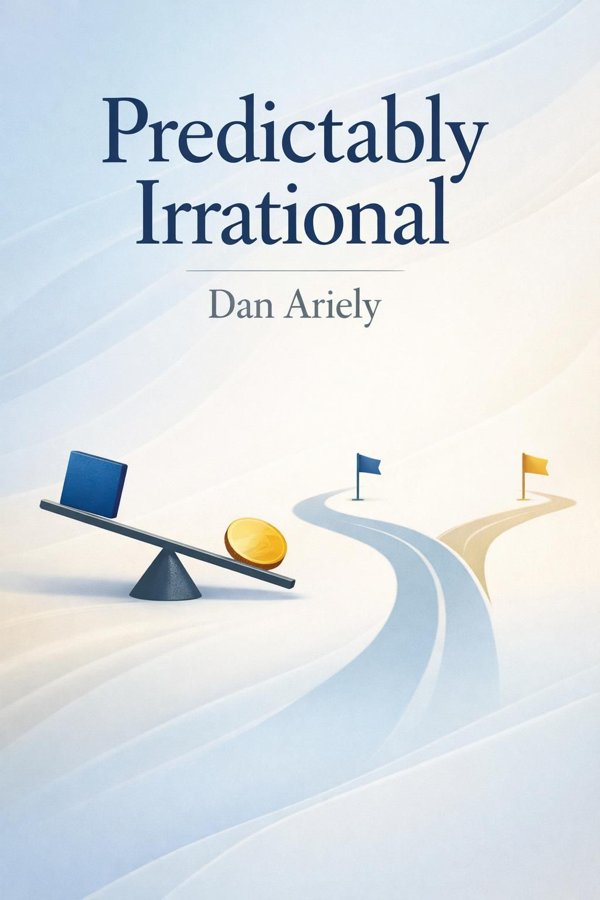
Predictably Irrational: The Hidden Forces That Shape Our Decisions: Summary & Key Insights
by Dan Ariely
 10 min9 chaptersAudio available
Key Takeaways from Predictably Irrational: The Hidden Forces That Shape Our Decisions
Most people assume bad decisions happen because we are tired, uninformed, or careless.
Something does not need to be objectively valuable for us to want it.
A tiny price drop can change behavior.
Human relationships operate by more than one rulebook.
People often imagine freedom leads to better choices.
What Is Predictably Irrational: The Hidden Forces That Shape Our Decisions About?
Predictably Irrational: The Hidden Forces That Shape Our Decisions by Dan Ariely is a economics book. Why do smart people overpay for useless upgrades, procrastinate on important goals, and make choices they later regret? In Predictably Irrational, behavioral economist Dan Ariely argues that these mistakes are not random lapses in judgment. They are systematic, repeatable, and surprisingly predictable. Drawing on inventive experiments and real-world examples, Ariely shows how hidden psychological forces shape the way we buy, compare, delay, value, and justify our decisions. This book matters because it challenges one of the core assumptions of traditional economics: that people act rationally in pursuit of their own best interests. Instead, Ariely reveals that context, emotion, social norms, expectations, and even the presence of a useless option can dramatically change what we choose. These insights help explain everyday behavior in markets, workplaces, relationships, and personal finance. Ariely writes with the authority of both a scholar and a storyteller. As a professor of behavioral economics and a pioneering researcher, he combines rigorous experiments with accessible language and memorable anecdotes. The result is a deeply engaging guide to how we really think—and how we can make better decisions once we understand our irrational patterns.
This FizzRead summary covers all 9 key chapters of Predictably Irrational: The Hidden Forces That Shape Our Decisions in approximately 10 minutes, distilling the most important ideas, arguments, and takeaways from Dan Ariely's work. Also available as an audio summary and Key Quotes Podcast.
Predictably Irrational: The Hidden Forces That Shape Our Decisions
Why do smart people overpay for useless upgrades, procrastinate on important goals, and make choices they later regret? In Predictably Irrational, behavioral economist Dan Ariely argues that these mistakes are not random lapses in judgment. They are systematic, repeatable, and surprisingly predictable. Drawing on inventive experiments and real-world examples, Ariely shows how hidden psychological forces shape the way we buy, compare, delay, value, and justify our decisions.
This book matters because it challenges one of the core assumptions of traditional economics: that people act rationally in pursuit of their own best interests. Instead, Ariely reveals that context, emotion, social norms, expectations, and even the presence of a useless option can dramatically change what we choose. These insights help explain everyday behavior in markets, workplaces, relationships, and personal finance.
Ariely writes with the authority of both a scholar and a storyteller. As a professor of behavioral economics and a pioneering researcher, he combines rigorous experiments with accessible language and memorable anecdotes. The result is a deeply engaging guide to how we really think—and how we can make better decisions once we understand our irrational patterns.
Who Should Read Predictably Irrational: The Hidden Forces That Shape Our Decisions?
This book is perfect for anyone interested in economics and looking to gain actionable insights in a short read. Whether you're a student, professional, or lifelong learner, the key ideas from Predictably Irrational: The Hidden Forces That Shape Our Decisions by Dan Ariely will help you think differently.
- ✓Readers who enjoy economics and want practical takeaways
- ✓Professionals looking to apply new ideas to their work and life
- ✓Anyone who wants the core insights of Predictably Irrational: The Hidden Forces That Shape Our Decisions in just 10 minutes
Want the full summary?
Get instant access to this book summary and 100K+ more with Fizz Moment.
Get Free SummaryAvailable on App Store • Free to download
Key Chapters
Most people assume bad decisions happen because we are tired, uninformed, or careless. Ariely’s central insight is more unsettling and more useful: our mistakes follow patterns. We do not behave irrationally in random bursts. We are predictably irrational, meaning our choices can be influenced in consistent ways by how options are presented, what we compare them to, and what emotions or expectations are activated in the moment.
This idea overturns the standard economic image of the perfectly rational decision-maker. In practice, people routinely pay too much, avoid better options, and cling to poor choices even when evidence says otherwise. But these errors are not just weaknesses of character. They emerge from built-in tendencies in human psychology. Once you recognize those tendencies, behavior that once seemed baffling starts to make sense.
Ariely supports this argument through experiments rather than abstract theory. He demonstrates that small changes in context can alter preferences, spending, and even honesty. That means our environment matters more than we think. A menu, a pricing page, a deadline, or a default setting can shape behavior before conscious reasoning even begins.
In daily life, this explains why consumers fall for promotions, why workers procrastinate, and why people justify questionable actions. In business, it suggests that design choices influence outcomes as much as product quality. In personal life, it means self-awareness is not enough; we also need systems that protect us from our predictable biases.
Actionable takeaway: Stop assuming your decisions reflect pure preference. Examine the context around your choices and redesign it when possible so it supports better outcomes.
Something does not need to be objectively valuable for us to want it. It often just needs to look better than the alternatives nearby. Ariely shows that humans rarely evaluate things in absolute terms. Instead, we judge by comparison. This tendency, called relativity, means our preferences are highly sensitive to what else is placed in front of us.
One of the book’s best-known examples involves subscription pricing. When people are offered a cheap online subscription, a costly print subscription, and a combined print-and-online option priced the same as print alone, the middle option acts as a decoy. It looks obviously inferior, making the combined option appear like a bargain. Remove the decoy, and many people choose differently. The key point is that the inferior option was never meant to be chosen. Its role was to shape perception.
This comparison effect appears everywhere. Retailers place expensive items next to slightly less expensive ones to make the latter seem reasonable. Real estate agents show buyers one unattractive house to make another feel like a smart purchase. Even in social life, people compare careers, lifestyles, and relationships against visible alternatives, often distorting what would actually make them happy.
The danger is that relative thinking can pull us away from our real needs. We start pursuing what looks best in a lineup instead of what serves us best in life. Without noticing, we become vulnerable to marketing, status pressure, and poorly framed choices.
Actionable takeaway: Before deciding, ask yourself whether you truly want an option or whether it merely looks appealing because of the comparison set around it.
A tiny price drop can change behavior. But when the price hits zero, rational evaluation often disappears entirely. Ariely shows that the word free has an emotional force far greater than its economic value. People do not simply see free as cheaper. They see it as riskless, exciting, and impossible to resist.
In one experiment, people chose between a high-quality chocolate at a low price and a lower-quality chocolate at an even lower price. When both items were discounted by the same amount and the cheaper one became free, preferences shifted dramatically. Consumers abandoned the objectively better value and rushed toward the free option. Nothing about the products changed except the psychological impact of zero.
This helps explain why businesses use free shipping, free trials, free gifts, and buy-one-get-one offers so effectively. Consumers often focus on the thrill of getting something for nothing while overlooking hidden costs, subscription traps, or lower overall value. The power of free also affects non-commercial decisions. People may attend events they do not care about, download apps they never use, or accumulate clutter simply because there is no immediate monetary cost.
The problem is not that free offers are always bad. Sometimes they are genuinely useful. The problem is that free can hijack judgment. It narrows attention and makes us less likely to ask whether we need the thing at all.
Actionable takeaway: Whenever you feel drawn to a free offer, pause and evaluate the total cost in time, attention, commitment, and future spending before saying yes.
People often imagine freedom leads to better choices. Ariely shows that too much freedom can make us worse at managing ourselves. Left to our own devices, many of us procrastinate, delay unpleasant tasks, and underestimate the cost of waiting. We know deadlines matter, yet we frequently fail to create or respect them unless external structures force us to do so.
Ariely explored this tendency by allowing students different levels of flexibility with assignment deadlines. Students who had no fixed deadlines often postponed work and performed worse. Those who committed to self-imposed deadlines did better, especially when the deadlines carried consequences. The lesson is not that people are lazy. It is that self-control is limited, and distant rewards lose force against immediate comfort.
This pattern extends far beyond school. People delay saving for retirement, putting off medical appointments, beginning difficult conversations, or working on long-term projects. In each case, the present moment feels manageable while future costs remain abstract. Without a credible commitment device, intentions dissolve.
The practical implication is powerful: structure can be liberating. Automatic transfers, public commitments, scheduled check-ins, and milestone deadlines reduce the burden on willpower. Instead of asking yourself to be consistently disciplined, you design conditions that make discipline easier.
Ariely’s work reminds us that self-knowledge should lead to systems, not self-criticism. Knowing that we procrastinate predictably means we can build guardrails before temptation arrives.
Actionable takeaway: Create external commitments for important goals—deadlines, accountability partners, or automated systems—so your future self is protected from your present self.
The moment something becomes ours, it often seems more valuable than it did before. Ariely examines this endowment effect, a bias that causes ownership to inflate perceived worth. We do not merely possess objects; we become attached to them, and that attachment alters judgment.
A classic example involves tickets, mugs, or other ordinary items. People who own them demand far more to give them up than non-owners are willing to pay to acquire them. From a rational standpoint, the item should have the same market value regardless of who holds it. But psychologically, ownership changes the frame. Giving something up feels like a loss, and losses hurt more than equivalent gains feel good.
This helps explain why sellers overprice homes, why investors hold losing stocks too long, and why consumers cling to subscriptions, products, or habits they no longer use. Once we feel that something belongs to us, parting with it requires more than a neutral evaluation. It feels personal.
The endowment effect also shapes non-material domains. People become attached to ideas, plans, roles, and routines simply because they have invested in them. As a result, they resist better alternatives not because those alternatives are worse, but because change feels like surrender.
Recognizing this bias can improve negotiation, decluttering, investing, and strategic thinking. It encourages us to ask what we would pay for something today if we did not already own it.
Actionable takeaway: When deciding whether to keep, sell, or continue something, reframe the question: If this were not already mine, would I still choose it at this price or level of effort?
What we expect does not just color our interpretation after the fact. It can alter the experience itself. Ariely demonstrates that expectations influence taste, satisfaction, and performance in ways that feel real because they are real to the person experiencing them.
If people believe a product is expensive, prestigious, or effective, they may genuinely enjoy it more or perform better after using it. This is part placebo effect, part expectation bias. In one kind of experiment Ariely discusses, labeling changes how participants judge identical items. A wine described as costly can seem more flavorful than the same wine presented as cheap. The sensory experience is filtered through belief.
This has major implications for branding, medicine, education, and management. A premium label can enhance enjoyment. A trusted teacher can boost confidence and learning. A skeptical mindset can undermine a product or experience before it begins. Expectations also shape self-fulfilling outcomes: if people expect a meeting to be hostile, they may behave defensively and create the very tension they feared.
At the same time, this insight is a warning. Perception can be manipulated. Packaging, storytelling, and reputation can make average products feel exceptional, at least temporarily. Consumers need to distinguish between true quality and expectation-driven satisfaction.
Actionable takeaway: Notice the expectations surrounding your choices. Use positive expectations deliberately to improve performance and motivation, but test important decisions against evidence rather than presentation alone.
Most people like to think honesty is simple: you either cheat or you do not. Ariely offers a more nuanced and troubling view. Many individuals can behave dishonestly while still preserving a positive self-image, especially when cheating is small, indirect, or easy to justify. Rather than acting like pure villains, people often bend rules just enough to benefit without feeling corrupt.
This explains why petty dishonesty can become widespread. If someone takes office supplies, exaggerates an expense report, or rounds numbers in a self-serving way, they may not see themselves as unethical. Because the gain is modest and the act feels common or ambiguous, moral standards loosen. Distance from actual money or direct consequences can also make cheating easier. Tokens, reimbursements, and complex systems create psychological space between action and wrongdoing.
The implication is that ethical behavior depends partly on design. Reminders of moral standards, transparency, and proximity to consequences can reduce dishonest behavior. If people sign a pledge before reporting information rather than after, or if systems reduce ambiguity, honesty improves. Environments matter because they shape how easily people can rationalize.
For leaders, this means culture is not built through slogans alone. It emerges from everyday structures, incentives, and signals. For individuals, it means we should not trust character alone under temptation. We should reduce opportunities for self-justification.
Actionable takeaway: Build honesty safeguards into important decisions—clear rules, visible accountability, and timely ethical reminders—because small rationalizations can grow faster than you expect.
People often plan as if they will make calm, sensible decisions under pressure. Ariely shows that this assumption is dangerously optimistic. In emotionally charged states—whether driven by desire, anger, fear, or excitement—our preferences can shift dramatically. What seemed obvious in a cool moment may vanish in a hot one.
Ariely illustrates this through experiments on arousal and decision-making. Participants asked to predict behavior in a neutral state underestimated how differently they would think and act in an intensified emotional state. Boundaries, risk tolerance, and self-control changed. This gap between our cold-state predictions and hot-state actions reveals why people repeatedly make choices they later find hard to explain.
The lesson applies far beyond the original experiments. Consumers overspend when excited, investors panic when fearful, leaders lash out when angry, and ordinary people break personal rules when temptation becomes immediate. In each case, prior intentions prove weaker than expected because emotion reshapes judgment from the inside.
This does not mean reason is powerless. It means reason must prepare in advance. We are at our wisest when we anticipate future vulnerability and set constraints before emotions intensify. Cooling-off periods, spending limits, content filters, and precommitments are all ways to protect values when mood changes.
Actionable takeaway: Do not rely on your calm self to predict your emotional self. Put safeguards in place ahead of time for situations where desire, stress, or fear could push you into bad decisions.
All Chapters in Predictably Irrational: The Hidden Forces That Shape Our Decisions
About the Author
Dan Ariely is an Israeli-American behavioral economist, professor, and bestselling author known for his pioneering work on irrational decision-making. He has taught at leading universities and built a reputation for turning complex research into clear, engaging insights for general readers. Ariely’s academic work explores how people behave in areas such as honesty, motivation, self-control, pricing, and consumer choice. His interest in human behavior is also shaped by personal experience, which has informed his curiosity about pain, recovery, and the gap between what people intend to do and what they actually do. Through books, lectures, and research projects, he has become one of the most recognizable voices in behavioral economics, helping popularize the idea that our decisions are often biased, emotional, and predictably irrational.
Get This Summary in Your Preferred Format
Read or listen to the Predictably Irrational: The Hidden Forces That Shape Our Decisions summary by Dan Ariely anytime, anywhere. FizzRead offers multiple formats so you can learn on your terms — all free.
Available formats: App · Audio · PDF · EPUB — All included free with FizzRead
Download Predictably Irrational: The Hidden Forces That Shape Our Decisions PDF and EPUB Summary
Key Quotes from Predictably Irrational: The Hidden Forces That Shape Our Decisions
“Most people assume bad decisions happen because we are tired, uninformed, or careless.”
“Something does not need to be objectively valuable for us to want it.”
“But when the price hits zero, rational evaluation often disappears entirely.”
“Human relationships operate by more than one rulebook.”
“People often imagine freedom leads to better choices.”
Frequently Asked Questions about Predictably Irrational: The Hidden Forces That Shape Our Decisions
Predictably Irrational: The Hidden Forces That Shape Our Decisions by Dan Ariely is a economics book that explores key ideas across 9 chapters. Why do smart people overpay for useless upgrades, procrastinate on important goals, and make choices they later regret? In Predictably Irrational, behavioral economist Dan Ariely argues that these mistakes are not random lapses in judgment. They are systematic, repeatable, and surprisingly predictable. Drawing on inventive experiments and real-world examples, Ariely shows how hidden psychological forces shape the way we buy, compare, delay, value, and justify our decisions. This book matters because it challenges one of the core assumptions of traditional economics: that people act rationally in pursuit of their own best interests. Instead, Ariely reveals that context, emotion, social norms, expectations, and even the presence of a useless option can dramatically change what we choose. These insights help explain everyday behavior in markets, workplaces, relationships, and personal finance. Ariely writes with the authority of both a scholar and a storyteller. As a professor of behavioral economics and a pioneering researcher, he combines rigorous experiments with accessible language and memorable anecdotes. The result is a deeply engaging guide to how we really think—and how we can make better decisions once we understand our irrational patterns.
More by Dan Ariely
You Might Also Like
Business Adventures
John Brooks
10 min
Nudge
Richard H. Thaler, Cass R. Sunstein
10 min
The Hitchhiker"s Guide to the Galaxy
Douglas Adams
10 minThe Muqaddimah
Ibn Khaldun
10 minThe Outsiders
William N. Thorndike
10 min
A Little History of Economics
Niall Kishtainy
10 minBrowse by Category
Ready to read Predictably Irrational: The Hidden Forces That Shape Our Decisions?
Get the full summary and 100K+ more books with Fizz Moment.