
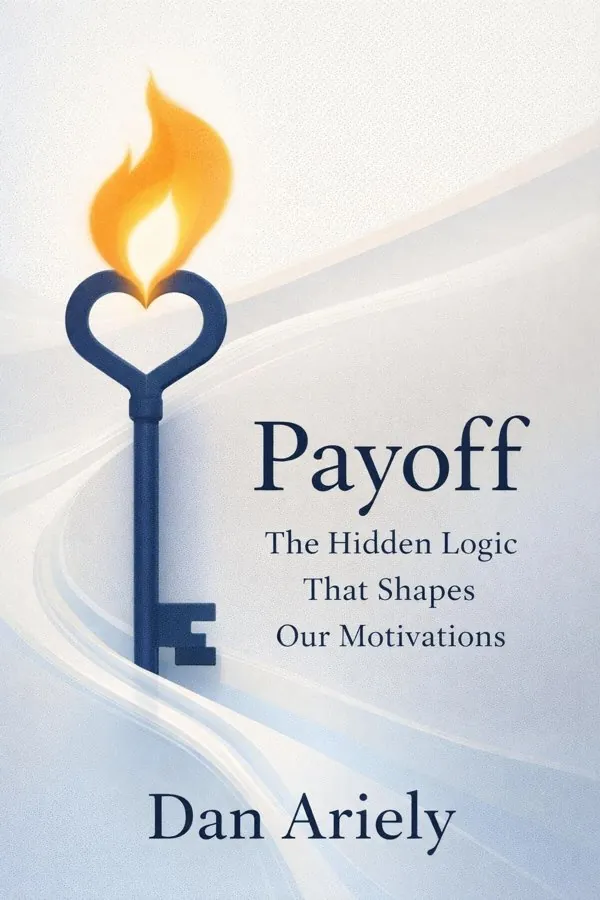
Payoff: The Hidden Logic That Shapes Our Motivations: Summary & Key Insights
by Dan Ariely
 10 min9 chaptersAudio available
Key Takeaways from Payoff: The Hidden Logic That Shapes Our Motivations
One of the strangest truths about human nature is that effort can increase love.
A small moment of recognition can matter more than a large reward.
People can endure difficulty, boredom, and repetition far better than they can endure meaninglessness.
Nothing is more demoralizing than the feeling that your effort disappears into a void.
If money were the whole story, motivation would be easy to engineer: simply pay more and get better effort.
What Is Payoff: The Hidden Logic That Shapes Our Motivations About?
Payoff: The Hidden Logic That Shapes Our Motivations by Dan Ariely is a economics book spanning 8 pages. What really makes people care about their work? Why do some tasks energize us while others drain us, even when the pay is the same? In Payoff, behavioral economist Dan Ariely tackles these questions with his trademark mix of surprising experiments, psychological insight, and practical relevance. Rather than accepting the standard economic view that people are motivated mostly by money, Ariely shows that human beings are driven by a more complex set of forces: meaning, recognition, ownership, progress, and the sense that their effort matters. This short but powerful book matters because motivation sits at the center of modern life. It shapes performance at work, persistence in school, creativity in personal projects, and even the quality of our relationships. Ariely demonstrates that when people feel ignored, disconnected, or unable to see the value of what they do, motivation quickly collapses. But when effort is acknowledged and tied to purpose, engagement rises dramatically. As a leading professor of psychology and behavioral economics, Ariely brings authority to the subject through years of research into irrational behavior. Payoff offers a concise, evidence-based guide for anyone who wants to understand what truly moves people.
This FizzRead summary covers all 9 key chapters of Payoff: The Hidden Logic That Shapes Our Motivations in approximately 10 minutes, distilling the most important ideas, arguments, and takeaways from Dan Ariely's work. Also available as an audio summary and Key Quotes Podcast.
Payoff: The Hidden Logic That Shapes Our Motivations
What really makes people care about their work? Why do some tasks energize us while others drain us, even when the pay is the same? In Payoff, behavioral economist Dan Ariely tackles these questions with his trademark mix of surprising experiments, psychological insight, and practical relevance. Rather than accepting the standard economic view that people are motivated mostly by money, Ariely shows that human beings are driven by a more complex set of forces: meaning, recognition, ownership, progress, and the sense that their effort matters.
This short but powerful book matters because motivation sits at the center of modern life. It shapes performance at work, persistence in school, creativity in personal projects, and even the quality of our relationships. Ariely demonstrates that when people feel ignored, disconnected, or unable to see the value of what they do, motivation quickly collapses. But when effort is acknowledged and tied to purpose, engagement rises dramatically.
As a leading professor of psychology and behavioral economics, Ariely brings authority to the subject through years of research into irrational behavior. Payoff offers a concise, evidence-based guide for anyone who wants to understand what truly moves people.
Who Should Read Payoff: The Hidden Logic That Shapes Our Motivations?
This book is perfect for anyone interested in economics and looking to gain actionable insights in a short read. Whether you're a student, professional, or lifelong learner, the key ideas from Payoff: The Hidden Logic That Shapes Our Motivations by Dan Ariely will help you think differently.
- ✓Readers who enjoy economics and want practical takeaways
- ✓Professionals looking to apply new ideas to their work and life
- ✓Anyone who wants the core insights of Payoff: The Hidden Logic That Shapes Our Motivations in just 10 minutes
Want the full summary?
Get instant access to this book summary and 100K+ more with Fizz Moment.
Get Free SummaryAvailable on App Store • Free to download
Key Chapters
One of the strangest truths about human nature is that effort can increase love. We often assume value is something objective: a product is worth what the market says it is worth. But Ariely shows that people frequently place higher value on things they have helped create. This insight, famously captured in what he calls the IKEA effect, reveals that labor is not just a cost. Under the right conditions, labor creates attachment.
The idea emerged from everyday life. People spend hours assembling furniture that arrives in confusing flat packs, often with frustration and minor injury included. Yet once the bookshelf is standing, they feel oddly proud of it. The object becomes more meaningful because it contains a piece of their effort. Ariely and his colleagues tested this principle experimentally and found that people were willing to value self-made items more highly than identical items made by others.
This helps explain why homemade meals feel special, why children treasure messy school projects, and why employees are more committed to plans they helped shape. Participation turns passive consumers into invested contributors. Effort signals ownership, and ownership deepens care.
But the effect depends on completion. If a person cannot finish the task or feels their effort was wasted, the motivational benefit disappears. The pride comes not just from exertion, but from seeing a finished result that reflects one’s contribution.
In practical terms, this means leaders, teachers, and parents should resist doing everything for others. Give people room to build, shape, and finish something themselves. The more honest effort they invest, the more they will value the outcome. Actionable takeaway: if you want stronger commitment, create opportunities for people to co-create rather than simply consume.
A small moment of recognition can matter more than a large reward. Ariely’s research shows that people do not merely want to work; they want their work to be seen. When effort is acknowledged, motivation rises. When it is ignored, erased, or treated as irrelevant, motivation collapses with startling speed.
In one of Ariely’s memorable experiments, participants were asked to complete simple tasks for pay. The money mattered, but what mattered just as much was what happened to their work afterward. When someone briefly acknowledged their completed pages, participants remained willing to continue. When the pages were taken without comment, motivation dropped. And when the work was visibly destroyed, motivation fell even further. The lesson is clear: people care deeply about whether their effort enters the world as something noticed rather than discarded.
This has obvious workplace implications. Managers often underestimate the motivational power of eye contact, thanks, and visible interest. They assume compensation systems and performance targets are enough. But people are not machines responding only to financial inputs. They are social beings searching for signals that their labor counts.
The same principle applies at home and in education. A child who shows a drawing wants more than evaluation; they want attention. A partner who cooks dinner wants appreciation, not silence. A student who labors over an assignment wants evidence that someone engaged with it.
Acknowledgment does not need to be elaborate. In fact, generic praise can feel empty. What matters is specificity and sincerity: noticing the effort, the detail, or the improvement. Actionable takeaway: make recognition immediate and concrete—show people that you saw what they did and why it mattered.
People can endure difficulty, boredom, and repetition far better than they can endure meaninglessness. Ariely argues that one of the deepest drivers of motivation is the belief that our actions serve a purpose beyond the task itself. When work connects to something significant, we are willing to exert more effort and stay engaged longer.
Meaning does not have to come from grand missions or world-changing goals. It can come from understanding who benefits from the work, how it fits into a larger process, or why the task exists at all. A hospital cleaner who sees their job as helping patients heal may be more motivated than one who thinks they are merely mopping floors. A customer service representative who sees frustrated callers leave relieved may find more energy than one measured only by call duration.
Ariely’s broader body of research reinforces this point: human beings are storytelling creatures. We want to know that our effort adds up to something. Without that narrative, even well-paid work can feel empty.
This insight is especially important in modern organizations, where many people are far removed from the final impact of what they do. If employees only see spreadsheets, tickets, and metrics, their connection to purpose can erode. Leaders need to bridge that gap by showing real outcomes, customers helped, problems solved, and improvements made.
On a personal level, meaning can be strengthened by reframing. Instead of asking, “What do I have to do today?” ask, “Who does this help?” or “What larger result does this support?” Actionable takeaway: regularly connect tasks to beneficiaries, outcomes, or values so that effort feels purposeful rather than merely procedural.
Nothing is more demoralizing than the feeling that your effort disappears into a void. Ariely shows that people lose motivation not only when work is hard or poorly paid, but when it seems pointless. A meaningless task does not just fail to inspire; it actively drains energy and willingness.
This is why some jobs feel exhausting even when they are not physically demanding. If a person repeatedly performs actions that are ignored, undone, or disconnected from any visible result, they begin to question why they should try at all. Ariely illustrates this through experiments in which participants work on tasks that are then dismissed or destroyed. Once people suspect their effort has no lasting value, their motivation drops sharply.
You can see this dynamic in workplaces full of unnecessary meetings, duplicated reporting, or changing priorities that erase yesterday’s labor. Employees may not complain first about salary. They may complain that nothing they do seems to matter. The same thing happens in bureaucracies where people fill out forms no one reads, and in families where chores are expected but never appreciated.
The danger is cumulative. Meaningless work does not simply reduce output in the moment; it teaches people that effort is irrational. Over time, they do less, care less, and bring less creativity. Once that mindset takes hold, restoring engagement becomes difficult.
Preventing this requires more than inspiration. It requires removing obviously pointless processes, clarifying why tasks exist, and ensuring that completed work leads somewhere visible. Even a small sign of consequence can preserve motivation. Actionable takeaway: audit your routines and eliminate or redesign tasks that feel performative, repetitive, or disconnected from real outcomes.
If money were the whole story, motivation would be easy to engineer: simply pay more and get better effort. Ariely argues that this view is too narrow and often dangerously misleading. Compensation matters, of course, but once basic fairness is established, motivation is shaped by many nonfinancial forces that can outweigh pure monetary incentives.
People seek dignity, progress, mastery, autonomy, social connection, and a sense of contribution. In some cases, adding financial incentives can even backfire if it shifts attention away from meaning and turns a valued activity into a transactional one. When people feel that every action is reduced to a price, they may care less rather than more.
This does not mean organizations should underpay employees and substitute praise for compensation. Fair pay is foundational. But beyond that baseline, money often has diminishing returns. Two workplaces with similar salaries can produce dramatically different levels of engagement depending on whether people feel trusted, recognized, and connected to purpose.
The same principle applies personally. Many people chase promotions or projects believing the next financial reward will deliver lasting fulfillment, only to discover that the deeper issue was not income but meaning. If a role offers more money but less ownership, less respect, and less purpose, the motivational gain may be temporary.
Ariely’s contribution is to challenge the simplistic idea that humans are always maximizing financial self-interest. We are motivated by what money can buy, but also by what money cannot provide. Actionable takeaway: use compensation to create fairness and security, then invest just as seriously in recognition, autonomy, and meaningful work.
Motivation is often built slowly but destroyed quickly. Ariely emphasizes how fragile human engagement can be. A person may arrive eager, committed, and willing to contribute, but a few experiences of disrespect, invisibility, or wasted effort can sharply reduce that commitment. This fragility matters because many institutions accidentally undermine the very motivation they depend on.
We tend to think of motivation as a stable trait: some people are driven, others are lazy. Ariely pushes back on that assumption. Context matters enormously. A motivated employee can become indifferent in a system that ignores contribution. A curious student can disengage in a classroom that rewards compliance over understanding. A dedicated volunteer can lose heart when their efforts are poorly organized or taken for granted.
The key problem is asymmetry. Building trust, meaning, and ownership takes repetition. Breaking them can happen in a moment. A manager who publicly dismisses someone’s work, a system that makes effort invisible, or a process that repeatedly nullifies initiative can undo months of goodwill.
This is why motivational design requires vigilance. It is not enough to launch inspiring programs or write value statements. Organizations must notice the daily frictions that sap effort: unclear goals, pointless reporting, delayed feedback, inconsistent recognition, and constant rework. These small wounds accumulate.
For individuals, the lesson is also protective. If you feel your motivation fading, do not assume you have become lazy. Examine the environment. Are your efforts acknowledged? Do you see progress? Does your work have consequence? Actionable takeaway: treat motivation as a delicate asset—identify and remove the everyday practices that quietly erode people’s willingness to care.
People work harder when their effort expresses who they are. Ariely highlights that motivation is not just about external rewards or abstract purpose; it is also about identity. We are deeply motivated when a task allows us to see ourselves in the result, whether as competent, helpful, creative, reliable, or committed.
This is why the same assignment can energize one person and bore another. If a project aligns with someone’s self-concept, it feels meaningful. A designer may thrive on shaping a user experience because it reflects creativity and empathy. A teacher may persist through administrative burdens because educating others is central to their identity. A craftsperson may obsess over details because quality is part of who they believe themselves to be.
Identity also explains why criticism and neglect can sting so deeply at work. When people invest part of themselves in what they do, responses to that work feel personal. Recognition affirms identity; indifference threatens it. This can be a source of strong motivation, but also vulnerability.
Leaders can use this insight constructively by learning what values people bring to their roles. Instead of assigning work only based on efficiency, they can connect responsibilities to strengths and self-image. Individuals can do the same by shaping their jobs, where possible, to include tasks that reflect their core values.
Even in routine roles, identity can be cultivated through standards and stories: “I am the kind of person who makes customers feel respected,” or “I solve messy problems others avoid.” Actionable takeaway: link daily work to the kind of person you want to be, so motivation comes not only from outcomes but from self-expression.
Visible progress is one of the most underrated sources of motivation. Ariely’s ideas fit a broader truth of human behavior: people are more willing to continue when they can see that their effort is leading somewhere. Progress turns effort into momentum.
A task can be difficult and still motivating if movement is visible. Writing a book chapter, learning a language, rebuilding a business process, or training for a race all require sustained effort. What keeps people going is not blind discipline alone, but evidence that today’s work is producing tomorrow’s result. Without signs of advancement, even meaningful projects can start to feel stagnant.
This is especially important in knowledge work, where outcomes are often delayed and invisible. A factory worker may see products moving down a line, but a strategy analyst, software engineer, or policy advisor may spend days in abstraction. In these cases, motivation improves when large goals are broken into smaller milestones that can be completed, reviewed, and celebrated.
Progress also interacts with acknowledgment. When someone notices not just the final result but the steps along the way, people feel their effort is accumulating rather than vanishing. This can be as simple as tracking completed tasks, sharing intermediate wins, or marking stages in a project.
On a personal level, many people underestimate how much motivation can be restored by measuring what has been done instead of focusing only on what remains. Actionable takeaway: design your work so progress is visible—break big goals into concrete milestones, track movement, and celebrate forward motion before the finish line.
The central managerial lesson of Payoff is that motivation should be designed, not assumed. Too many organizations rely on salary, rules, and targets while ignoring the psychological conditions that make people want to contribute. Ariely shows that better systems take human nature seriously.
This starts with acknowledging that employees are not interchangeable units of labor. They care about whether their effort is seen, whether the process makes sense, whether they have some ownership, and whether the work contributes to something worthwhile. An organization that neglects these needs may still get compliance, but it will struggle to get commitment.
Designing for meaning can take many forms: letting employees see the customer impact of their work, involving them in shaping processes, reducing pointless tasks, giving timely recognition, and making progress visible. These are not cosmetic improvements. They directly affect persistence, creativity, and quality.
Ariely’s work is especially relevant in large institutions, where abstraction and bureaucracy can make work feel detached from human consequences. The larger the system, the more intentional leaders must be in reconnecting people to purpose. This might mean sharing real stories from users, simplifying approval chains, or giving teams greater visibility into outcomes.
The lesson extends beyond business. Schools, hospitals, public agencies, and nonprofits all depend on sustained motivation. In each case, the question is the same: does the environment help people feel that their effort matters?
Actionable takeaway: if you lead others, regularly ask four questions—Do people see the purpose? Do they feel ownership? Is their effort acknowledged? Can they see progress? Build your systems around those answers.
All Chapters in Payoff: The Hidden Logic That Shapes Our Motivations
About the Author
Dan Ariely is a professor of psychology and behavioral economics, widely known for his research on how people make decisions in ways that depart from traditional economic logic. He has taught at leading institutions including Duke University and has built a global reputation for translating complex behavioral science into engaging, practical insights. Ariely’s work explores topics such as motivation, honesty, irrationality, self-control, and the hidden forces shaping everyday choices. He is the bestselling author of books including Predictably Irrational, The Upside of Irrationality, and The Honest Truth About Dishonesty. What sets Ariely apart is his ability to combine rigorous experiments with vivid storytelling, making academic findings feel immediately relevant to work, business, and personal life.
Get This Summary in Your Preferred Format
Read or listen to the Payoff: The Hidden Logic That Shapes Our Motivations summary by Dan Ariely anytime, anywhere. FizzRead offers multiple formats so you can learn on your terms — all free.
Available formats: App · Audio · PDF · EPUB — All included free with FizzRead
Download Payoff: The Hidden Logic That Shapes Our Motivations PDF and EPUB Summary
Key Quotes from Payoff: The Hidden Logic That Shapes Our Motivations
“One of the strangest truths about human nature is that effort can increase love.”
“A small moment of recognition can matter more than a large reward.”
“People can endure difficulty, boredom, and repetition far better than they can endure meaninglessness.”
“Nothing is more demoralizing than the feeling that your effort disappears into a void.”
“If money were the whole story, motivation would be easy to engineer: simply pay more and get better effort.”
Frequently Asked Questions about Payoff: The Hidden Logic That Shapes Our Motivations
Payoff: The Hidden Logic That Shapes Our Motivations by Dan Ariely is a economics book that explores key ideas across 9 chapters. What really makes people care about their work? Why do some tasks energize us while others drain us, even when the pay is the same? In Payoff, behavioral economist Dan Ariely tackles these questions with his trademark mix of surprising experiments, psychological insight, and practical relevance. Rather than accepting the standard economic view that people are motivated mostly by money, Ariely shows that human beings are driven by a more complex set of forces: meaning, recognition, ownership, progress, and the sense that their effort matters. This short but powerful book matters because motivation sits at the center of modern life. It shapes performance at work, persistence in school, creativity in personal projects, and even the quality of our relationships. Ariely demonstrates that when people feel ignored, disconnected, or unable to see the value of what they do, motivation quickly collapses. But when effort is acknowledged and tied to purpose, engagement rises dramatically. As a leading professor of psychology and behavioral economics, Ariely brings authority to the subject through years of research into irrational behavior. Payoff offers a concise, evidence-based guide for anyone who wants to understand what truly moves people.
More by Dan Ariely

Predictably Irrational: The Hidden Forces That Shape Our Decisions
Dan Ariely
10 min
The Honest Truth About Dishonesty: How We Lie to Everyone—Especially Ourselves
Dan Ariely
10 min
The Upside of Irrationality: The Unexpected Benefits of Defying Logic at Work and at Home
Dan Ariely
10 minYou Might Also Like
Business Adventures
John Brooks
10 min
Nudge
Richard H. Thaler, Cass R. Sunstein
10 min
The Hitchhiker"s Guide to the Galaxy
Douglas Adams
10 minThe Muqaddimah
Ibn Khaldun
10 minThe Outsiders
William N. Thorndike
10 min
A Little History of Economics
Niall Kishtainy
10 minBrowse by Category
Ready to read Payoff: The Hidden Logic That Shapes Our Motivations?
Get the full summary and 100K+ more books with Fizz Moment.