
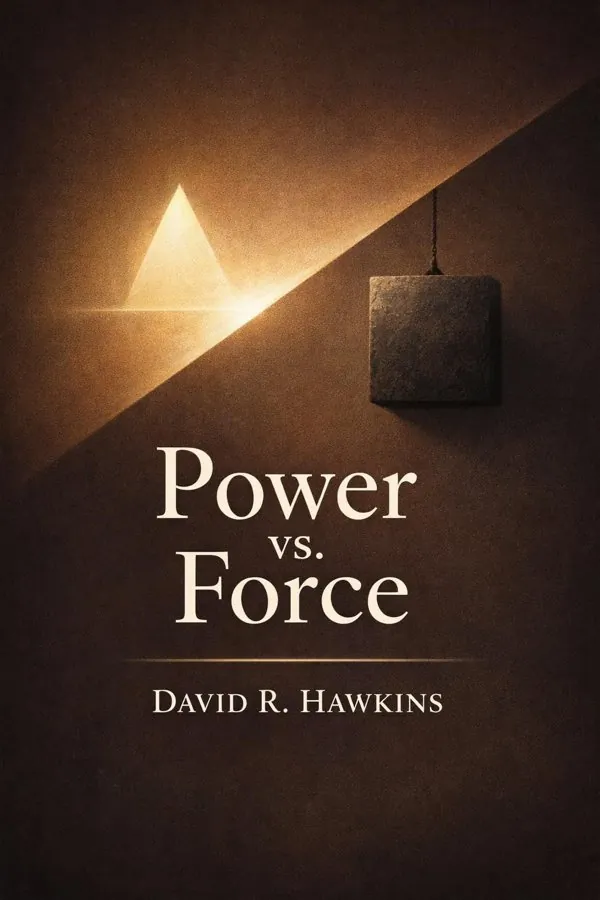
Power vs Force: Summary & Key Insights
 10 min9 chaptersAudio available
Key Takeaways from Power vs Force
Most people judge life by appearances, but Hawkins asks us to look beneath behavior to the level of consciousness driving it.
What if the body reacts differently to truth than it does to falsehood?
Transformation rarely begins at enlightenment; it usually begins at the moment we stop sinking.
Many people assume intelligence is the highest form of development, but Hawkins argues that reason, while powerful, is still not the summit of consciousness.
We often chase power as if it were something to accumulate, but Hawkins points toward a paradox: the highest power emerges when the ego’s need to control begins to dissolve.
What Is Power vs Force About?
Power vs Force by David Hawkins is a self-help book published in 1995 spanning 8 pages. What makes one person quietly influential while another relies on pressure, manipulation, or fear? In Power vs Force, psychiatrist and spiritual teacher David R. Hawkins argues that the difference lies in consciousness itself. He proposes that human thoughts, emotions, motives, and behaviors can be understood on a scale ranging from destructive states like shame and fear to expansive states like love, joy, and peace. According to Hawkins, true power comes from alignment with truth, integrity, and higher awareness, while force depends on control and ultimately weakens both individuals and societies. The book matters because it tries to connect personal growth with ethics, leadership, psychology, and spirituality in a single framework. Rather than treating success as mere ambition or technique, Hawkins asks a deeper question: what kind of inner state produces lasting strength? Drawing on his experience as a clinical psychiatrist, addiction specialist, and spiritual researcher, he presents a model intended to explain why some ideas, people, and institutions elevate life while others drain it. Whether you read it as metaphysics, self-help, or a philosophy of character, Power vs Force invites you to evaluate the quality of your inner life—and the consequences it has in the world.
This FizzRead summary covers all 9 key chapters of Power vs Force in approximately 10 minutes, distilling the most important ideas, arguments, and takeaways from David Hawkins's work. Also available as an audio summary and Key Quotes Podcast.
Power vs Force
What makes one person quietly influential while another relies on pressure, manipulation, or fear? In Power vs Force, psychiatrist and spiritual teacher David R. Hawkins argues that the difference lies in consciousness itself. He proposes that human thoughts, emotions, motives, and behaviors can be understood on a scale ranging from destructive states like shame and fear to expansive states like love, joy, and peace. According to Hawkins, true power comes from alignment with truth, integrity, and higher awareness, while force depends on control and ultimately weakens both individuals and societies.
The book matters because it tries to connect personal growth with ethics, leadership, psychology, and spirituality in a single framework. Rather than treating success as mere ambition or technique, Hawkins asks a deeper question: what kind of inner state produces lasting strength? Drawing on his experience as a clinical psychiatrist, addiction specialist, and spiritual researcher, he presents a model intended to explain why some ideas, people, and institutions elevate life while others drain it. Whether you read it as metaphysics, self-help, or a philosophy of character, Power vs Force invites you to evaluate the quality of your inner life—and the consequences it has in the world.
Who Should Read Power vs Force?
This book is perfect for anyone interested in self-help and looking to gain actionable insights in a short read. Whether you're a student, professional, or lifelong learner, the key ideas from Power vs Force by David Hawkins will help you think differently.
- ✓Readers who enjoy self-help and want practical takeaways
- ✓Professionals looking to apply new ideas to their work and life
- ✓Anyone who wants the core insights of Power vs Force in just 10 minutes
Want the full summary?
Get instant access to this book summary and 100K+ more with Fizz Moment.
Get Free SummaryAvailable on App Store • Free to download
Key Chapters
Most people judge life by appearances, but Hawkins asks us to look beneath behavior to the level of consciousness driving it. His central idea is the Map of Consciousness, a scale that assigns numerical calibrations to emotional and spiritual states. Lower levels include shame, guilt, apathy, grief, fear, desire, anger, and pride. Higher levels include courage, neutrality, willingness, acceptance, reason, love, joy, peace, and enlightenment. The exact numbers matter less than the pattern: some states weaken us, while others strengthen and expand us.
Hawkins presents this map as a way to understand why two people facing the same circumstances may respond so differently. One person meets conflict with resentment and defensiveness; another responds with clarity and compassion. Outwardly, both may appear capable, but inwardly they operate from very different energy fields. In his view, lower levels are associated with contraction, reactivity, and survival, while higher levels create resilience, creativity, and authentic influence.
In practical terms, the map gives readers language for self-observation. A manager may notice that pride makes them rigid and unable to hear feedback. A parent may see how fear-based control harms trust. A student may recognize that courage, even if imperfect, is more life-giving than apathy. The map is not meant to shame people for where they are; it is meant to show that movement upward is possible.
The actionable takeaway: spend a week identifying the emotional state behind your key decisions. Ask not just, “What am I doing?” but “From what level of consciousness am I acting?”
What if the body reacts differently to truth than it does to falsehood? One of Hawkins’s most controversial claims is that the human nervous system can distinguish supportive, life-enhancing input from weakening, untrue, or harmful input. He uses applied kinesiology, or muscle testing, as a method for exploring this idea. In his account, statements, images, substances, and intentions can produce either a strengthening or weakening response in the body.
Hawkins treats this not merely as a clinical tool but as evidence that truth has a measurable quality. If a person becomes physically weaker in response to a lie and stronger in response to truth, then consciousness is not just abstract philosophy; it has practical effects. He extends this logic to books, music, leadership, and even historical movements, arguing that integrity strengthens life while falsehood drains it.
For many readers, this section is the most debated part of the book. Even if one remains skeptical about muscle testing as scientific proof, the deeper principle still invites reflection: the body often senses what the mind rationalizes away. We have all experienced a version of this. A job offer may look impressive on paper but feel wrong in the gut. A flattering relationship may leave us depleted. A difficult truth may sting, yet still bring a feeling of relief and coherence.
The useful application is not to become dogmatic about testing methods, but to cultivate sensitivity to inner congruence. Pay attention to what leaves you clearer, calmer, and stronger versus confused, fragmented, or drained.
The actionable takeaway: before major decisions, pause and ask, “Does this choice leave me feeling expanded or weakened?” Then let that information guide your next step.
Transformation rarely begins at enlightenment; it usually begins at the moment we stop sinking. Hawkins emphasizes that lower states of consciousness—especially shame, guilt, apathy, grief, and fear—create a self-reinforcing cycle. When people live in these states, they tend to see life as hostile, themselves as powerless, and the future as closed. Their behavior reflects that worldview: withdrawal, blame, dependency, avoidance, or emotional paralysis.
Yet Hawkins does not describe these levels to condemn anyone. His point is that awareness of the pattern creates the possibility of change. The crucial turning point on his map is courage. Courage represents the first genuinely empowering level because it allows a person to face life rather than merely react to it. At courage, energy becomes available for growth. People begin taking responsibility, trying again, telling the truth, and learning from failure.
This idea is especially useful because it reframes self-improvement. You do not need to jump from fear to serenity overnight. You may only need to move from apathy to honesty, from shame to willingness, or from grief to one brave conversation. Someone recovering from addiction, for example, may not feel joy at first, but simply admitting the problem is an act of courage. An employee trapped in resentment may not reach love immediately, but can choose accountability over complaint.
Hawkins’s model suggests that real progress is incremental and directional. The goal is not perfection but upward movement into more life-affirming states.
The actionable takeaway: identify one area where you feel stuck and ask, “What would courage look like here today?” Then take the smallest honest action you can.
Many people assume intelligence is the highest form of development, but Hawkins argues that reason, while powerful, is still not the summit of consciousness. Reason organizes facts, builds systems, and helps us think clearly. It is an essential advance over impulsive or emotionally driven living. Yet reason alone can become cold, overly analytical, or disconnected from human wholeness. According to Hawkins, the major breakthrough happens when consciousness rises from intellect into love.
In his framework, love is not sentimentality, romance, or approval. It is a stable way of being grounded in compassion, reverence, and connectedness. A person operating from love does not become passive; they become less defensive and more aligned with reality. They can still set boundaries, make difficult decisions, and confront harm, but they do so without hatred. Beyond love, Hawkins places joy and peace, states marked by deep inner coherence and non-reactive strength.
This idea matters because many high achievers live almost entirely from reason and pride. They are productive but restless, competent but brittle. Their lives are efficient, yet not deeply nourishing. Hawkins suggests that sustainable power comes when the mind serves a larger field of awareness rooted in care and truth.
In daily life, this could mean leading a team with clarity and empathy rather than intimidation. It could mean using logic to solve problems while refusing to dehumanize people. It could also mean asking not only, “Is this effective?” but “Is this aligned with what is good?”
The actionable takeaway: choose one relationship or responsibility this week and bring both reason and compassion to it, instead of relying on analysis or control alone.
We often chase power as if it were something to accumulate, but Hawkins points toward a paradox: the highest power emerges when the ego’s need to control begins to dissolve. At the top of his scale are peace and enlightenment, states associated with profound stillness, unity, and surrender to reality as it is. These levels are rare, but they serve an important function in the book: they reveal the ultimate direction of human development.
For Hawkins, peace is not mere relaxation. It is an unshakable state in which inner conflict subsides and life is no longer filtered through constant fear, craving, or resistance. Enlightenment goes further, representing a direct realization of consciousness beyond the personal self. Whether or not readers accept these descriptions literally, the practical lesson is clear: the more we detach from compulsive ego defenses, the more stable and powerful we become.
In ordinary life, this may show up in subtle ways. A person who no longer needs to win every argument becomes more persuasive. A leader who is not addicted to approval makes cleaner decisions. Someone who can sit with discomfort without immediate reaction develops unusual calm. These are not mystical theatrics; they are signs of decreasing inner friction.
Hawkins invites readers to see spiritual maturity not as performance but as simplification. The less energy wasted on self-importance, resentment, and control, the more energy becomes available for presence, service, and wisdom.
The actionable takeaway: create five minutes of stillness each day with no phone, no task, and no performance. Use that time to notice how often your mind reaches for control, and practice letting go.
One of Hawkins’s most enduring distinctions is the contrast between power and force. Force is coercive, urgent, and dependent on pressure. It pushes, manipulates, threatens, and dominates. Power, by contrast, is intrinsic. It arises from integrity, alignment, truth, and inner coherence. Force can produce immediate results, but it is unstable and costly. Power may seem less dramatic, yet it has endurance and requires far less struggle.
This distinction appears everywhere. In parenting, force says, “Obey because I said so,” while power creates trust, consistency, and respect. In business, force uses fear, office politics, and image management. Power builds credibility, competence, and ethical clarity. In personal habits, force is the harsh inner voice that demands change through self-contempt, whereas power comes from self-respect and honest commitment.
Hawkins argues that force always depends on opposition. It needs an enemy, a problem, or resistance to push against. Power does not. It influences because it is aligned with something deeper than ego. This is why truthful people often feel steady even when they lack status, while manipulative people may appear strong yet are secretly unstable. One is rooted; the other is compensating.
The brilliance of this idea is that it helps readers evaluate not just goals but methods. You may achieve something by intimidation, but what did it cost your relationships, your nervous system, or your integrity? Hawkins invites us to seek forms of effectiveness that do not depend on violence, deception, or chronic strain.
The actionable takeaway: in your next conflict, replace one act of pressure with one act of grounded clarity. Notice whether calm truth is more effective than forceful intensity.
Societies are shaped not only by policies and institutions, but by the consciousness of the people who lead them. Hawkins extends his framework beyond individual psychology to culture, politics, and history. He argues that leaders, movements, and social systems can also be understood in terms of power versus force. Some uplift because they are rooted in truth, service, and moral coherence. Others gain attention through fear, division, propaganda, or domination.
This perspective explains why some organizations look strong from the outside but are brittle within. A company driven by greed and image may grow quickly yet collapse under ethical failure. A government that rules through fear may maintain obedience for a time, but it cannot generate genuine trust or long-term flourishing. By contrast, institutions built on integrity may face slower progress but tend to be more resilient.
The book encourages readers to assess leadership differently. Charisma is not the same as consciousness. Confidence is not the same as wisdom. A truly powerful leader does not merely command; they elevate the field around them. They make others more capable, not more dependent. They do not need constant enemies to sustain relevance.
On a personal level, this concept applies wherever you influence others: family, school, community, management, teaching, or public life. Ethical leadership begins with inner state. If your decisions come from fear, pride, or anger, those energies spread. If they come from steadiness, honesty, and goodwill, that also spreads.
The actionable takeaway: evaluate one leader you admire or follow. Ask whether their influence depends more on fear and pressure, or on integrity and uplift. Then apply the same question to your own leadership style.
One reason Power vs Force continues to provoke debate is that it tries to unite worlds that are often kept apart. Hawkins brings together psychiatry, nonlinear dynamics, consciousness studies, ethics, and spiritual teaching into a single interpretive framework. He does not present spirituality as mere belief, nor science as merely material measurement. Instead, he suggests that consciousness itself may be the missing factor needed to understand human behavior and truth more fully.
This is ambitious, and it explains both the book’s appeal and its controversy. Readers who are tired of strictly mechanical views of human life may find Hawkins refreshing. He takes inner experience seriously and insists that qualities like integrity, compassion, and truth are not vague moral decorations but central forces in reality. At the same time, readers grounded in conventional science may question the methods and claims, especially around calibration and muscle testing.
Still, the practical value of Hawkins’s synthesis does not depend entirely on accepting every claim literally. The book offers a broad lens through which to ask better questions: What is the energetic cost of dishonesty? Why do some environments leave us depleted while others make us more alive? Why do certain teachings produce humility and service while others inflate ego?
Used wisely, the framework can encourage intellectual humility. It reminds us that measurable facts are important, but they do not exhaust human reality. Meaning, motive, and awareness also matter.
The actionable takeaway: read the book with both openness and discernment. Instead of asking only, “Do I agree?” ask, “What in this framework helps me live with greater truth, strength, and responsibility?”
Hawkins’s deepest message is not that consciousness should be admired from afar, but that it can be cultivated through daily life. Every thought entertained, every emotion indulged, every intention chosen, and every action taken either strengthens or weakens our level of consciousness. Growth, then, is not an abstract spiritual ideal. It is the cumulative result of ordinary decisions.
This makes the book surprisingly practical. A person raises consciousness not by pretending to be holy, but by becoming more honest, responsible, forgiving, and aligned. Choosing truth over convenience is a shift. Releasing resentment is a shift. Serving without needing applause is a shift. So is refusing to participate in gossip, exploitation, or self-deception. The upward path is built through repeated micro-decisions that change one’s inner baseline over time.
Hawkins also suggests that environments matter. The books we read, the media we consume, the people we spend time with, and the goals we pursue all influence our consciousness. If we constantly expose ourselves to outrage, vanity, and fear, those patterns become normalized. If we build a life around reflection, meaningful work, gratitude, and integrity, higher states become more accessible.
Readers may not adopt Hawkins’s full spiritual model, yet they can still use this principle effectively: life improves when inner quality improves. Better consciousness often produces better judgment, healthier relationships, and more durable success.
The actionable takeaway: choose one daily practice that supports a higher state—journaling, meditation, honest conversation, gratitude, or reducing toxic input—and commit to it for the next 30 days.
All Chapters in Power vs Force
About the Author
David R. Hawkins (1927–2012) was an American psychiatrist, physician, consciousness researcher, and spiritual teacher. Trained in medicine and psychiatry, he spent years in clinical practice and became known for his work in mental health and addiction recovery. Over time, his interests expanded beyond conventional psychiatry into the study of consciousness, spirituality, and the nature of truth. Hawkins founded the Institute for Spiritual Research and authored several influential books, including Power vs Force, Letting Go, and The Eye of the I. He is best known for creating the Map of Consciousness, a framework that attempts to rank emotional and spiritual states according to their life-enhancing or life-depleting qualities. Though some of his methods remain controversial, Hawkins continues to influence readers interested in self-development, metaphysics, and spiritual growth.
Get This Summary in Your Preferred Format
Read or listen to the Power vs Force summary by David Hawkins anytime, anywhere. FizzRead offers multiple formats so you can learn on your terms — all free.
Available formats: App · Audio · PDF · EPUB — All included free with FizzRead
Download Power vs Force PDF and EPUB Summary
Key Quotes from Power vs Force
“Most people judge life by appearances, but Hawkins asks us to look beneath behavior to the level of consciousness driving it.”
“What if the body reacts differently to truth than it does to falsehood?”
“Transformation rarely begins at enlightenment; it usually begins at the moment we stop sinking.”
“Many people assume intelligence is the highest form of development, but Hawkins argues that reason, while powerful, is still not the summit of consciousness.”
“We often chase power as if it were something to accumulate, but Hawkins points toward a paradox: the highest power emerges when the ego’s need to control begins to dissolve.”
Frequently Asked Questions about Power vs Force
Power vs Force by David Hawkins is a self-help book that explores key ideas across 9 chapters. What makes one person quietly influential while another relies on pressure, manipulation, or fear? In Power vs Force, psychiatrist and spiritual teacher David R. Hawkins argues that the difference lies in consciousness itself. He proposes that human thoughts, emotions, motives, and behaviors can be understood on a scale ranging from destructive states like shame and fear to expansive states like love, joy, and peace. According to Hawkins, true power comes from alignment with truth, integrity, and higher awareness, while force depends on control and ultimately weakens both individuals and societies. The book matters because it tries to connect personal growth with ethics, leadership, psychology, and spirituality in a single framework. Rather than treating success as mere ambition or technique, Hawkins asks a deeper question: what kind of inner state produces lasting strength? Drawing on his experience as a clinical psychiatrist, addiction specialist, and spiritual researcher, he presents a model intended to explain why some ideas, people, and institutions elevate life while others drain it. Whether you read it as metaphysics, self-help, or a philosophy of character, Power vs Force invites you to evaluate the quality of your inner life—and the consequences it has in the world.
You Might Also Like


Featured In
Browse by Category
Ready to read Power vs Force?
Get the full summary and 100K+ more books with Fizz Moment.