
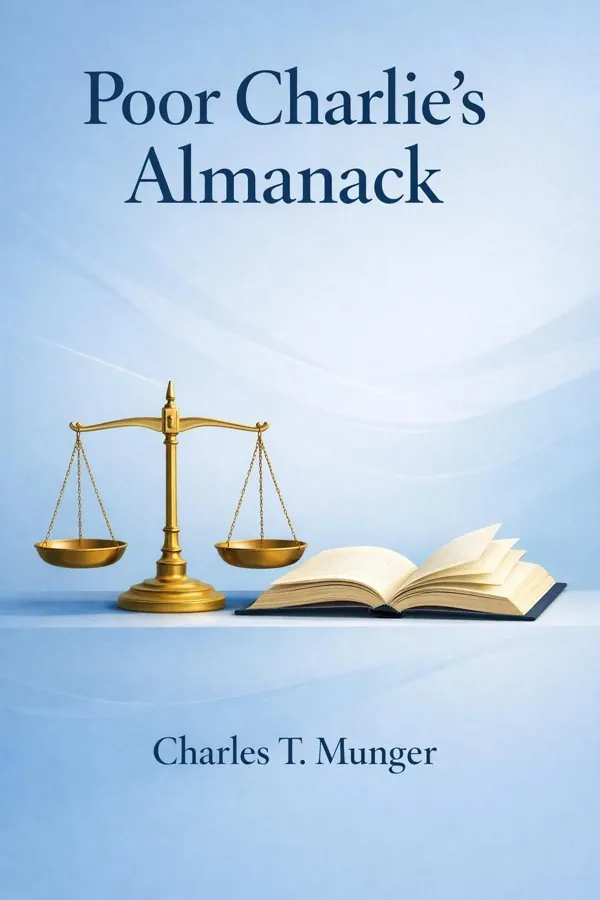
Poor Charlie"s Almanack: Summary & Key Insights
 10 min9 chaptersAudio available
Key Takeaways from Poor Charlie"s Almanack
The most dangerous enemy in decision-making is often not the market, the competition, or bad luck, but the mind itself.
A single big idea is rarely enough to understand a complex world.
Real wisdom does not come from knowing more facts than everyone else; it comes from understanding the enduring patterns that govern life.
Many people separate financial success from moral behavior, but Munger insists that the two are deeply linked over the long run.
In a culture that rewards motion, Munger makes a surprisingly quiet argument: much of great investing and sound decision-making comes from waiting.
What Is Poor Charlie"s Almanack About?
Poor Charlie"s Almanack by Charles T. Munger is a finance book published in 2005 spanning 4 pages. Poor Charlie’s Almanack is far more than a book about investing. It is a practical guide to thinking clearly, judging wisely, and living rationally in a world full of noise, ego, incentives, and error. Compiled by Peter D. Kaufman from Charles T. Munger’s speeches, essays, and public remarks, the book captures the intellectual operating system behind one of the most respected minds in business. Munger, best known as Warren Buffett’s longtime partner at Berkshire Hathaway, argues that success does not come from flashy predictions or complicated formulas. It comes from disciplined reasoning, moral clarity, patience, and a broad understanding of how the world actually works. What makes this book matter is its reach. Munger draws lessons not only from finance, but also from psychology, biology, history, economics, engineering, law, and human behavior. His famous idea of using a “latticework of mental models” offers readers a way to make better decisions in investing, business, and everyday life. Sharp, witty, and often brutally honest, Poor Charlie’s Almanack remains essential reading for anyone who wants to avoid foolish mistakes and build sound judgment over a lifetime.
This FizzRead summary covers all 9 key chapters of Poor Charlie"s Almanack in approximately 10 minutes, distilling the most important ideas, arguments, and takeaways from Charles T. Munger's work. Also available as an audio summary and Key Quotes Podcast.
Poor Charlie"s Almanack
Poor Charlie’s Almanack is far more than a book about investing. It is a practical guide to thinking clearly, judging wisely, and living rationally in a world full of noise, ego, incentives, and error. Compiled by Peter D. Kaufman from Charles T. Munger’s speeches, essays, and public remarks, the book captures the intellectual operating system behind one of the most respected minds in business. Munger, best known as Warren Buffett’s longtime partner at Berkshire Hathaway, argues that success does not come from flashy predictions or complicated formulas. It comes from disciplined reasoning, moral clarity, patience, and a broad understanding of how the world actually works.
What makes this book matter is its reach. Munger draws lessons not only from finance, but also from psychology, biology, history, economics, engineering, law, and human behavior. His famous idea of using a “latticework of mental models” offers readers a way to make better decisions in investing, business, and everyday life. Sharp, witty, and often brutally honest, Poor Charlie’s Almanack remains essential reading for anyone who wants to avoid foolish mistakes and build sound judgment over a lifetime.
Who Should Read Poor Charlie"s Almanack?
This book is perfect for anyone interested in finance and looking to gain actionable insights in a short read. Whether you're a student, professional, or lifelong learner, the key ideas from Poor Charlie"s Almanack by Charles T. Munger will help you think differently.
- ✓Readers who enjoy finance and want practical takeaways
- ✓Professionals looking to apply new ideas to their work and life
- ✓Anyone who wants the core insights of Poor Charlie"s Almanack in just 10 minutes
Want the full summary?
Get instant access to this book summary and 100K+ more with Fizz Moment.
Get Free SummaryAvailable on App Store • Free to download
Key Chapters
The most dangerous enemy in decision-making is often not the market, the competition, or bad luck, but the mind itself. One of Munger’s most famous contributions is his explanation of how cognitive biases systematically distort human judgment. He argues that smart people are not protected from these errors; in many cases, intelligence simply helps them rationalize bad decisions more convincingly.
Munger catalogs common psychological tendencies such as incentive-caused bias, social proof, consistency bias, envy, over-optimism, deprivation superreaction, and authority influence. These tendencies explain why executives manipulate numbers to meet targets, why investors chase bubbles, and why groups can drift into obvious foolishness. For example, if compensation rewards short-term growth at any cost, even ethical people may begin justifying reckless behavior. If everyone around you is buying a fashionable stock, social proof can overwhelm independent judgment.
The value of this framework is practical. Instead of assuming people act rationally, Munger encourages us to ask: what incentives are shaping behavior, what emotional triggers are active, and what biases are likely to cloud the situation? This applies to hiring, investing, negotiating, and even family decisions. A business leader can design compensation systems that reduce distortion. An investor can use checklists before acting on excitement. A consumer can pause before making fear-driven or status-driven purchases.
Munger’s central lesson is humbling: our minds are wired to mislead us, especially when emotion, ego, and incentives combine. The antidote is not confidence but vigilance. Actionable takeaway: before any important decision, deliberately identify at least three psychological biases that could be influencing you and adjust your judgment accordingly.
A single big idea is rarely enough to understand a complex world. Munger’s concept of mental models is his answer to shallow thinking. A mental model is a foundational principle from a discipline such as economics, mathematics, biology, physics, psychology, or engineering that helps explain how reality works. Munger argues that people who rely on only one model become like the proverbial man with a hammer, treating every problem like a nail.
His alternative is a “latticework” of models: a broad, interconnected framework that lets you examine problems from multiple angles. For example, an investor evaluating a company should not only study accounting statements. They should also think about competitive advantages from economics, feedback loops from systems theory, incentives from psychology, scale effects from engineering, and adaptation from biology. A manager deciding whether to expand a business should consider opportunity cost, marginal utility, network effects, regression to the mean, and the limits of forecasting.
This approach matters because reality is multidisciplinary. Business failures often happen when leaders overuse one lens. Lawyers may ignore economics, financiers may ignore psychology, and technical experts may ignore human incentives. Munger repeatedly warns that specialized brilliance can coexist with broad ignorance.
Building mental models takes time. It means reading widely, learning basic concepts deeply, and revisiting timeless ideas until they become instinctive. The payoff is better judgment under uncertainty. You become less vulnerable to trends, simplistic narratives, and false certainty because you can cross-check conclusions through several disciplines.
Munger does not suggest memorizing endless theories. He recommends mastering the few big ideas that truly govern how systems behave. Actionable takeaway: choose five core disciplines relevant to life and work, learn their most important models, and use them together whenever you analyze a major decision.
Real wisdom does not come from knowing more facts than everyone else; it comes from understanding the enduring patterns that govern life. Munger calls this “worldly wisdom,” and he sees it as the product of broad, continuous learning rather than narrow expertise. In his view, the best thinkers are not trapped inside one professional silo. They read across fields, collect durable insights, and gradually assemble a richer map of reality.
This idea explains why Munger admired people who could move comfortably between business, science, history, philosophy, and human nature. A broad learner sees analogies others miss. For instance, the concept of natural selection in biology can help explain why only some businesses survive. The engineering principle of redundancy can illuminate why resilient organizations need backup systems. Historical case studies can show how greed, leverage, and euphoria repeat across generations.
Worldly wisdom is also practical humility. The wider your learning, the more aware you become of complexity and unintended consequences. You are less likely to fall for simplistic slogans or single-cause explanations. In investing, this might mean recognizing that a cheap stock is not necessarily a good business. In life, it may mean seeing that talent alone is not enough without temperament, character, and good habits.
Munger’s method is not about academic collecting for its own sake. He wants readers to absorb ideas that can be used in real situations. That is why he emphasizes inversion, checklists, probability, and incentives alongside literary and historical reading. His kind of education aims to improve judgment, not impress others.
The deeper message is clear: if you want uncommon results, you must develop an uncommon breadth of understanding. Actionable takeaway: create a lifelong reading habit that includes at least one major book each from history, psychology, science, and business every month.
Many people separate financial success from moral behavior, but Munger insists that the two are deeply linked over the long run. His investment philosophy is not only about buying quality businesses at sensible prices; it is also about trusting honest people, avoiding crooked systems, and acting with integrity. He believes durable success comes from a combination of rational analysis, patience, and ethical conduct.
Munger rejects the idea that investing is merely a game of outsmarting others. He prefers straightforward businesses with understandable economics, capable managers, and cultures that do not depend on deception or aggressive accounting. If a business model requires constant promotional spin, fragile leverage, or questionable incentives, he sees that as a warning sign. Ethics, in his framework, are not sentimental extras. They are practical predictors of long-term outcomes.
This perspective also shapes how he thinks about reputation. A company or investor can build trust slowly and destroy it quickly. In business negotiations, capital allocation, and leadership decisions, Munger favors people who consistently do the right thing even when no one is watching. Such behavior lowers friction, reduces hidden risks, and strengthens long-term partnerships.
For individual investors, the lesson is powerful. Avoid enterprises you do not understand, managers you would not admire, and returns that appear to depend on dishonesty. In personal finance, the same principle applies: don’t chase opportunities that require you to suspend your moral instincts. A clean conscience and sound sleep are part of the return.
Munger’s ethics are pragmatic rather than preachy. He sees decency as a competitive advantage because it attracts trust and filters out bad opportunities. Actionable takeaway: when evaluating any investment or business, ask not only “Can this make money?” but also “Would I be proud to own and explain this for ten years?”
In a culture that rewards motion, Munger makes a surprisingly quiet argument: much of great investing and sound decision-making comes from waiting. He believes people often confuse action with progress, especially in markets where prices flicker constantly and news creates pressure to respond. Yet most of the time, the right move is not frantic activity but disciplined patience.
Munger and Buffett became famous for holding cash, ignoring market noise, and acting only when a truly attractive opportunity appeared. This requires emotional strength because inactivity can feel uncomfortable. Investors want to prove they are doing something. Managers want to justify their positions. But Munger reminds readers that every decision carries an opportunity cost. If you act on mediocre opportunities, you may miss the rare outstanding one.
Patience also protects against overtrading, fee drag, and impulsive errors. Consider an investor who jumps in and out of stocks based on headlines. Even if they occasionally guess right, taxes, costs, and poor timing often destroy the advantage. By contrast, a patient investor who waits for a clearly understandable, high-quality opportunity can benefit from compounding with less friction.
This principle extends beyond investing. In hiring, waiting for the right person is often better than rushing into a weak fit. In negotiations, silence can create clarity. In personal life, delaying a reaction can prevent unnecessary conflict. Patience is not laziness; it is selective aggression combined with self-control.
Munger’s version of patience depends on preparation. You study continuously so that when the rare obvious opportunity appears, you can act decisively. Actionable takeaway: define your criteria for a truly exceptional opportunity in advance, and commit to saying no to everything that does not clearly meet that standard.
People often ask how to become brilliant, but Munger prefers a different question: how can we avoid being stupid? This inversion-based approach is one of his most useful habits. Instead of obsessing over extraordinary success, he studies common causes of failure and then works to eliminate them. The idea is simple but powerful: consistently avoiding big mistakes can produce remarkable results.
Munger applies inversion everywhere. In investing, rather than asking only what will make money, ask what could permanently destroy capital: excessive leverage, poor management, fragile business economics, or buying what you do not understand. In career decisions, ask what behaviors reliably produce mediocrity: unreliability, dishonesty, envy, resentment, and refusal to learn. In relationships, ask what habits corrode trust.
This mindset is effective because the world is full of avoidable errors. People borrow too much, chase fads, ignore incentives, overestimate their own ability, and make irreversible decisions under emotional pressure. Munger believes that if you build a life around avoiding these obvious traps, you do not need to be a genius to do well.
A practical example is checklist thinking. Pilots and surgeons use checklists because memory and confidence are unreliable under pressure. Investors and executives can do the same. Before major commitments, they can screen for debt levels, conflicts of interest, valuation risk, downside scenarios, and management integrity. The checklist does not guarantee success, but it reduces preventable disasters.
The beauty of inversion is that it clarifies action. It turns vague ambition into concrete avoidance. Actionable takeaway: make a personal “avoid at all costs” list for money, work, and relationships, then review it before any major commitment.
Show me the incentive, Munger famously says, and I will show you the outcome. Few ideas in the book are as practical or as widely applicable as his focus on incentives. He argues that human behavior is shaped less by stated values or noble intentions than by the rewards, punishments, and pressures embedded in a system.
This insight explains a wide range of real-world behavior. Salespeople paid purely on volume may push unsuitable products. Corporate managers rewarded for quarterly earnings may sacrifice long-term health. Political actors seeking reelection may favor visible short-term wins over sound policy. Even well-meaning people can drift into bad decisions when incentives point in the wrong direction.
Munger urges readers to become students of incentive design. In business, compensation systems should align employees with the health of the enterprise, not encourage manipulation. In investing, one should examine how management is paid and whether their interests truly match shareholders’. In personal life, incentives matter too: if you want to exercise, make it easy and rewarding; if you want to save money, automate transfers so discipline is built into the system.
The lesson is especially important because incentives can hide behind attractive narratives. A persuasive executive may speak of mission and excellence, but if bonuses depend on superficial metrics, the real behavior will follow the pay structure. Munger’s realism cuts through rhetoric.
Understanding incentives does not mean becoming cynical. It means recognizing that systems often overpower intentions. Good design can bring out the best in people, while bad design can corrupt even decent individuals. Actionable takeaway: whenever evaluating a person, organization, or policy, identify the actual incentives at work before trusting the stated story.
A high IQ can impress people, but Munger repeatedly emphasizes that temperament is often the deciding factor in success. By temperament, he means emotional stability, patience, humility, discipline, and the ability to resist crowd pressure. In investing especially, brilliance without self-control can be dangerous.
Munger observed that many intelligent people make terrible financial decisions because they cannot manage fear, greed, envy, and ego. They overtrade when excited, panic when markets fall, and double down on mistakes to protect pride. Meanwhile, less flashy individuals with steady judgment often achieve better long-term results simply by staying rational when others are not.
This insight helps explain Berkshire Hathaway’s style. Munger and Buffett did not build their record through constant innovation or superior forecasting alone. They relied on emotional discipline: ignoring market hysteria, admitting uncertainty, staying within their circle of competence, and refusing to act when conditions were poor. Their advantage was behavioral as much as analytical.
The same principle applies outside finance. A leader with sound temperament can navigate conflict, make measured decisions, and avoid demoralizing teams through emotional volatility. A student with discipline can outperform a more gifted but inconsistent peer. A parent with patience often exercises better judgment than one reacting impulsively.
Temperament can be strengthened through habits. Checklists, precommitments, long time horizons, and deliberate routines all reduce the chance that emotion will hijack judgment. Reflection after mistakes also builds self-awareness. Munger’s message is encouraging because it means excellence is not reserved for prodigies.
If you can stay calm, honest, and patient while others lose balance, you already possess a meaningful edge. Actionable takeaway: identify your most common emotional trigger in decision-making and create one rule that prevents you from acting immediately when that trigger appears.
Munger’s wisdom ultimately points beyond money. Beneath the investing lessons lies a broader philosophy: a good life is built through rationality, integrity, curiosity, and service. He does not treat knowledge as a tool for winning arguments or accumulating status. He treats it as a way to reduce error, improve conduct, and contribute meaningfully over time.
This life philosophy shows up in his respect for simplicity, honesty, and continuous learning. Munger admires people who read widely, speak plainly, and remain teachable late into life. He warns against self-pity, envy, and bitterness because these habits cloud judgment and poison experience. He also encourages people to pursue work with meaning and to surround themselves with trustworthy individuals.
One of his recurring themes is that a reliable life can be built from ordinary virtues practiced consistently. Being dependable, avoiding unnecessary debt, telling the truth, learning from mistakes, and choosing good partners may not sound glamorous, but they compound just like money. Over decades, small acts of rationality and character create exceptional outcomes.
Munger also values cheerfulness and perspective. He recognizes that life includes setbacks, randomness, and unfairness. The mature response is not complaint but adaptation. This stoic strain in his thinking makes the book useful even for readers with no interest in stocks. It is really about how to become less foolish, more useful, and more resilient.
The result is a worldview in which success is measured not just by wealth but by the quality of one’s thinking and conduct. Actionable takeaway: choose three lifelong principles—such as honesty, learning, and patience—and use them as a personal scorecard more often than money or status.
All Chapters in Poor Charlie"s Almanack
About the Author
Charles Thomas Munger was an American investor, businessman, lawyer, and philanthropist best known as the longtime vice chairman of Berkshire Hathaway and Warren Buffett’s closest partner. Born in 1924, Munger studied mathematics and later law, eventually building a distinguished career in investing and business. He became widely respected not only for his financial success but also for his intellectual framework, which emphasized rationality, multidisciplinary thinking, psychological awareness, and ethical conduct. Munger helped shape Berkshire Hathaway’s approach to buying outstanding businesses and holding them for the long term. Through speeches, essays, and interviews, he influenced generations of investors and decision-makers. His legacy extends beyond finance: he is remembered as one of the clearest advocates for lifelong learning, sound judgment, and the disciplined avoidance of foolish mistakes.
Get This Summary in Your Preferred Format
Read or listen to the Poor Charlie"s Almanack summary by Charles T. Munger anytime, anywhere. FizzRead offers multiple formats so you can learn on your terms — all free.
Available formats: App · Audio · PDF · EPUB — All included free with FizzRead
Download Poor Charlie"s Almanack PDF and EPUB Summary
Key Quotes from Poor Charlie"s Almanack
“The most dangerous enemy in decision-making is often not the market, the competition, or bad luck, but the mind itself.”
“A single big idea is rarely enough to understand a complex world.”
“Real wisdom does not come from knowing more facts than everyone else; it comes from understanding the enduring patterns that govern life.”
“Many people separate financial success from moral behavior, but Munger insists that the two are deeply linked over the long run.”
“In a culture that rewards motion, Munger makes a surprisingly quiet argument: much of great investing and sound decision-making comes from waiting.”
Frequently Asked Questions about Poor Charlie"s Almanack
Poor Charlie"s Almanack by Charles T. Munger is a finance book that explores key ideas across 9 chapters. Poor Charlie’s Almanack is far more than a book about investing. It is a practical guide to thinking clearly, judging wisely, and living rationally in a world full of noise, ego, incentives, and error. Compiled by Peter D. Kaufman from Charles T. Munger’s speeches, essays, and public remarks, the book captures the intellectual operating system behind one of the most respected minds in business. Munger, best known as Warren Buffett’s longtime partner at Berkshire Hathaway, argues that success does not come from flashy predictions or complicated formulas. It comes from disciplined reasoning, moral clarity, patience, and a broad understanding of how the world actually works. What makes this book matter is its reach. Munger draws lessons not only from finance, but also from psychology, biology, history, economics, engineering, law, and human behavior. His famous idea of using a “latticework of mental models” offers readers a way to make better decisions in investing, business, and everyday life. Sharp, witty, and often brutally honest, Poor Charlie’s Almanack remains essential reading for anyone who wants to avoid foolish mistakes and build sound judgment over a lifetime.
You Might Also Like



Featured In
Browse by Category
Ready to read Poor Charlie"s Almanack?
Get the full summary and 100K+ more books with Fizz Moment.