
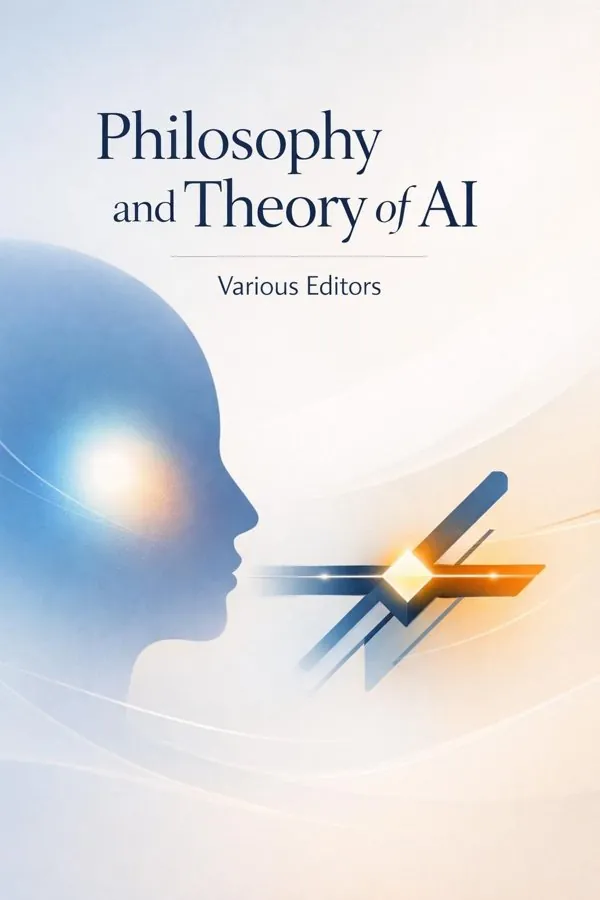
Philosophy and Theory of AI: Summary & Key Insights
 10 min10 chaptersAudio available
What Is Philosophy and Theory of AI About?
Philosophy and Theory of AI by Various Editors is a ai_ml book spanning 10 pages. This academic volume explores the philosophical foundations and theoretical frameworks underlying artificial intelligence. It brings together contributions from scholars in philosophy, cognitive science, and computer science to examine questions about consciousness, ethics, reasoning, and the nature of intelligence in machines.
This FizzRead summary covers all 10 key chapters of Philosophy and Theory of AI in approximately 10 minutes, distilling the most important ideas, arguments, and takeaways from Various Editors's work. Also available as an audio summary and Key Quotes Podcast.
Philosophy and Theory of AI
This academic volume explores the philosophical foundations and theoretical frameworks underlying artificial intelligence. It brings together contributions from scholars in philosophy, cognitive science, and computer science to examine questions about consciousness, ethics, reasoning, and the nature of intelligence in machines.
Who Should Read Philosophy and Theory of AI?
This book is perfect for anyone interested in ai_ml and looking to gain actionable insights in a short read. Whether you're a student, professional, or lifelong learner, the key ideas from Philosophy and Theory of AI by Various Editors will help you think differently.
- ✓Readers who enjoy ai_ml and want practical takeaways
- ✓Professionals looking to apply new ideas to their work and life
- ✓Anyone who wants the core insights of Philosophy and Theory of AI in just 10 minutes
Want the full summary?
Get instant access to this book summary and 100K+ more with Fizz Moment.
Get Free SummaryAvailable on App Store • Free to download
Key Chapters
The intellectual history of artificial intelligence begins with a question older than any computer: can reason itself be mechanized? Early computational theories—rooted in formal logic and cybernetics—arose from the mid-twentieth century fascination with the brain as an information processor. Alan Turing’s 1950 essay, *Computing Machinery and Intelligence*, established the prototype for what would become AI’s defining dilemma: how to recognize intelligence without needing to prove the presence of consciousness. His imitation game provided a test not of being but of behavior, effectively moving philosophy’s focus from mind’s substance to mind’s performance.
In the decades that followed, AI oscillated between symbolic and connectionist paradigms. Classical AI, inspired by logicism, treated intelligence as the manipulation of abstract symbols under definite rules. The work of Herbert Simon, Allen Newell, and John McCarthy exemplified this optimism: intelligence was algorithmic rationality. Yet, even as early as Hubert Dreyfus’s critiques in the 1960s, philosophers pointed out that such symbolic representations lacked the embodied and contextual grounding that human understanding requires. Later, the rise of machine learning and neural networks revived interest in non-symbolic computation—systems capable of adapting to data, not merely executing rules. This transition reframed AI as a problem of emergence and learning rather than explicit reasoning.
The book traces this historical development to emphasize a recurring theme: each generation of AI theory mirrors the philosophical assumptions of its age. From Enlightenment rationalism to twentieth-century cybernetics, and now to twenty-first-century data-driven architectures, our concept of artificial intelligence is less a discovery than a projection of what we believe intelligence must be. Understanding this genealogy is crucial to situating current debates about autonomy, creativity, and moral agency in machines.
At the center of AI philosophy is the tension between functionalism and phenomenology—between seeing the mind as computation and seeing consciousness as irreducibly subjective. In this part of the book, contributors explore whether machines that operate according to sophisticated algorithms could ever achieve anything like genuine understanding. Searle’s Chinese Room argument resurfaces frequently; it highlights the gap between syntactic processing and semantic comprehension. Even if an AI system perfectly manipulates symbols to mimic meaningful responses, does it actually *understand* those symbols?
From my editorial perspective, the importance of this debate lies not in proving that machines are or aren’t conscious, but in clarifying how we use such terms. Philosophers of AI draw us to the distinction between intentionality—the aboutness of mental states—and the mere correlation of patterns. Machine cognition, for all its power, lacks self-directed intentionality; yet, its operations can replicate the functional appearance of it. This paradox forces us to reconsider whether intelligence should be defined by structure, function, or experience.
Through interdisciplinary essays, cognitive scientists bridge this discussion with research on neural networks and embodied cognition. If cognition in humans arises from the integration of perception, action, and environment, then AI designed solely as abstract computation might omit essential features of mind. A truly philosophical AI theory, these chapters propose, must therefore examine embodiment, sensorimotor coupling, and emotional context as prerequisites for understanding—not optional enhancements.
+ 8 more chapters — available in the FizzRead app
All Chapters in Philosophy and Theory of AI
About the Author
The editors are a group of scholars and researchers specializing in philosophy of mind, artificial intelligence, and cognitive science, contributing to interdisciplinary discussions on the conceptual and ethical dimensions of AI.
Get This Summary in Your Preferred Format
Read or listen to the Philosophy and Theory of AI summary by Various Editors anytime, anywhere. FizzRead offers multiple formats so you can learn on your terms — all free.
Available formats: App · Audio · PDF · EPUB — All included free with FizzRead
Download Philosophy and Theory of AI PDF and EPUB Summary
Key Quotes from Philosophy and Theory of AI
“The intellectual history of artificial intelligence begins with a question older than any computer: can reason itself be mechanized?”
“At the center of AI philosophy is the tension between functionalism and phenomenology—between seeing the mind as computation and seeing consciousness as irreducibly subjective.”
Frequently Asked Questions about Philosophy and Theory of AI
Philosophy and Theory of AI by Various Editors is a ai_ml book that explores key ideas across 10 chapters. This academic volume explores the philosophical foundations and theoretical frameworks underlying artificial intelligence. It brings together contributions from scholars in philosophy, cognitive science, and computer science to examine questions about consciousness, ethics, reasoning, and the nature of intelligence in machines.
More by Various Editors




You Might Also Like
Life 3.0
Max Tegmark
10 min
Superintelligence
Nick Bostrom
10 min
TensorFlow in Action
Thushan Ganegedara
10 min
AI Made Simple: A Beginner’s Guide to Generative AI, ChatGPT, and the Future of Work
Rajeev Kapur
10 min
AI Snake Oil
Arvind Narayanan, Sayash Kapoor
10 min
AI Superpowers: China, Silicon Valley, and the New World Order
Kai-Fu Lee
10 minBrowse by Category
Ready to read Philosophy and Theory of AI?
Get the full summary and 100K+ more books with Fizz Moment.