
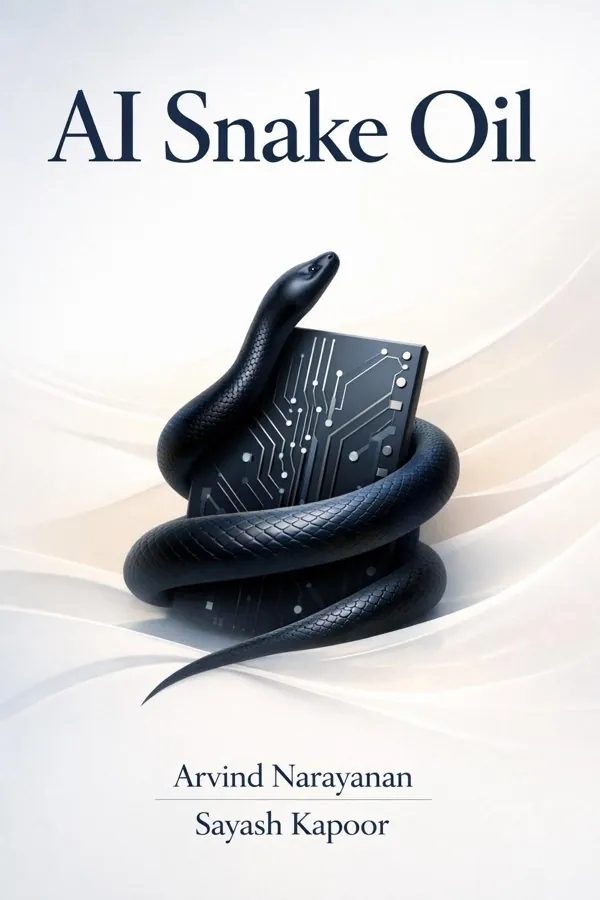
AI Snake Oil: Summary & Key Insights
by Arvind Narayanan, Sayash Kapoor
 10 min11 chaptersAudio available
What Is AI Snake Oil About?
AI Snake Oil by Arvind Narayanan, Sayash Kapoor is a ai_ml book spanning 11 pages. AI Snake Oil is a critical examination of the exaggerated claims surrounding artificial intelligence, particularly in areas such as predictive analytics, hiring, and criminal justice. The authors, computer scientists Arvind Narayanan and Sayash Kapoor, dissect the gap between genuine machine learning capabilities and the hype often used to market AI systems. The book encourages readers to distinguish between legitimate AI applications and misleading or unethical uses.
This FizzRead summary covers all 11 key chapters of AI Snake Oil in approximately 10 minutes, distilling the most important ideas, arguments, and takeaways from Arvind Narayanan, Sayash Kapoor's work. Also available as an audio summary and Key Quotes Podcast.
AI Snake Oil
AI Snake Oil is a critical examination of the exaggerated claims surrounding artificial intelligence, particularly in areas such as predictive analytics, hiring, and criminal justice. The authors, computer scientists Arvind Narayanan and Sayash Kapoor, dissect the gap between genuine machine learning capabilities and the hype often used to market AI systems. The book encourages readers to distinguish between legitimate AI applications and misleading or unethical uses.
Who Should Read AI Snake Oil?
This book is perfect for anyone interested in ai_ml and looking to gain actionable insights in a short read. Whether you're a student, professional, or lifelong learner, the key ideas from AI Snake Oil by Arvind Narayanan, Sayash Kapoor will help you think differently.
- ✓Readers who enjoy ai_ml and want practical takeaways
- ✓Professionals looking to apply new ideas to their work and life
- ✓Anyone who wants the core insights of AI Snake Oil in just 10 minutes
Want the full summary?
Get instant access to this book summary and 100K+ more with Fizz Moment.
Get Free SummaryAvailable on App Store • Free to download
Key Chapters
To understand how AI arrived at this moment of hype and confusion, we must look back at its history—a story defined by recurring cycles of exuberance and disappointment. The dream of artificial intelligence emerged in the mid-20th century, fueled by early visions that computers could emulate human reasoning. These early systems, known as “expert systems,” sought to capture human knowledge through rigid logic: one could encode the rules of medicine, law, or engineering into if-then statements and expect the machine to reason as a professional might.
But that approach quickly hit a wall. Real-world problems are messy, uncertain, and context-dependent—qualities logic alone cannot handle. What followed were the “AI winters,” when research funding evaporated and public interest waned. Yet the dream never died; it adapted. In time, machine learning arose as a new paradigm, powered by data instead of rules. The idea was simple yet revolutionary: instead of teaching machines how to reason explicitly, we let them learn patterns from examples.
From handwriting recognition to the rise of neural networks and deep learning, AI has ridden waves of breakthroughs, each time reigniting excitement that human-like intelligence was near. But each cycle also brought its overclaims: systems touted as understanding language or vision often turned out to exploit statistical shortcuts, not true comprehension. The persistent pattern—a burst of technological advance followed by exaggerated predictions and public disillusionment—is the structural rhythm of AI’s evolution.
This historical perspective reminds us that hype is not a bug in the story of AI; it’s a feature that repeats with each generation. When we understand this rhythm, we become better equipped to recognize today’s exaggerations for what they are: the latest iteration of a long tradition of overpromising. Only when the conversation learns from these past cycles can AI progress align more truthfully with its limitations and potential.
At the core of modern AI lies prediction. When we strip away the marketing gloss, most machine learning models do a single thing: given a set of examples, they infer patterns that help predict future data. Whether it’s forecasting sales, identifying spam, or classifying images, the essence of the system is pattern recognition, not comprehension or reasoning.
This distinction is vital. A predictive model doesn’t understand the world—it approximates correlations within data. If an algorithm learns to predict credit risk, it is not reasoning about economics, ethics, or human behavior; it is merely mapping relationships between input variables and observed outcomes within its training dataset. For narrow, well-defined tasks, this can work remarkably well. Speech recognition, machine translation, and image classification have achieved dazzling technical success through prediction and pattern matching. But outside confined contexts, prediction collapses.
When we expect machines to interpret social or emotional nuance—to decide who deserves a job, a loan, or parole—we cross from prediction into judgment. Judgment demands understanding of motives, fairness, and context, none of which machines possess. This is why we urge readers to separate domains of legitimate predictive modeling (quantifiable, repeatable phenomena) from domains where human interpretation is indispensable.
+ 9 more chapters — available in the FizzRead app
All Chapters in AI Snake Oil
About the Authors
Arvind Narayanan is a professor of computer science at Princeton University known for his work on privacy and fairness in machine learning. Sayash Kapoor is a researcher at Princeton focusing on the social implications of AI and data science.
Get This Summary in Your Preferred Format
Read or listen to the AI Snake Oil summary by Arvind Narayanan, Sayash Kapoor anytime, anywhere. FizzRead offers multiple formats so you can learn on your terms — all free.
Available formats: App · Audio · PDF · EPUB — All included free with FizzRead
Download AI Snake Oil PDF and EPUB Summary
Key Quotes from AI Snake Oil
“To understand how AI arrived at this moment of hype and confusion, we must look back at its history—a story defined by recurring cycles of exuberance and disappointment.”
“At the core of modern AI lies prediction.”
Frequently Asked Questions about AI Snake Oil
AI Snake Oil by Arvind Narayanan, Sayash Kapoor is a ai_ml book that explores key ideas across 11 chapters. AI Snake Oil is a critical examination of the exaggerated claims surrounding artificial intelligence, particularly in areas such as predictive analytics, hiring, and criminal justice. The authors, computer scientists Arvind Narayanan and Sayash Kapoor, dissect the gap between genuine machine learning capabilities and the hype often used to market AI systems. The book encourages readers to distinguish between legitimate AI applications and misleading or unethical uses.
You Might Also Like

Life 3.0
Max Tegmark
10 min
Superintelligence
Nick Bostrom
10 min
TensorFlow in Action
Thushan Ganegedara
10 min
AI Made Simple: A Beginner’s Guide to Generative AI, ChatGPT, and the Future of Work
Rajeev Kapur
10 min
AI Superpowers: China, Silicon Valley, and the New World Order
Kai-Fu Lee
10 min
All-In On AI: How Smart Companies Win Big With Artificial Intelligence
Tom Davenport & Nitin Mittal
10 minFeatured In
Browse by Category
Ready to read AI Snake Oil?
Get the full summary and 100K+ more books with Fizz Moment.