
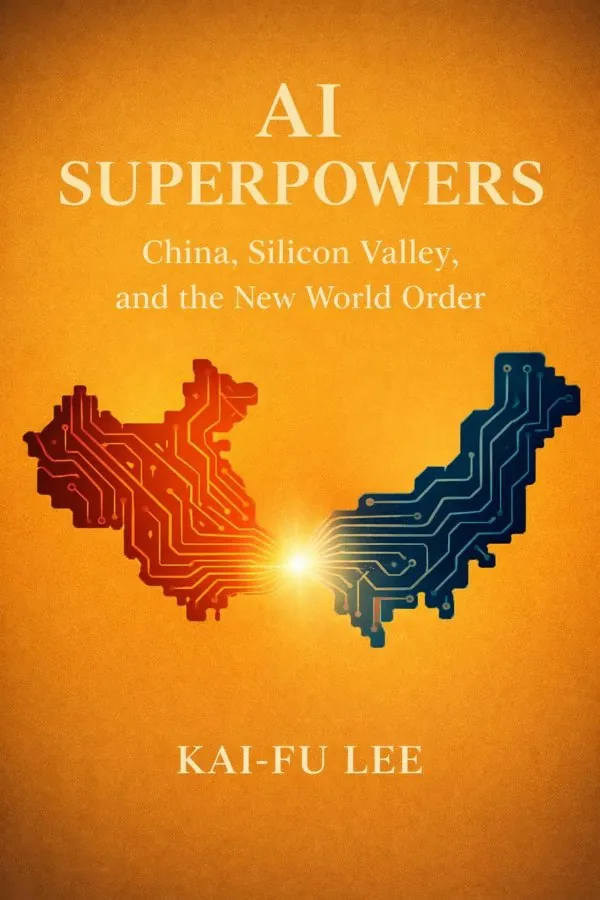
AI Superpowers: China, Silicon Valley, and the New World Order: Summary & Key Insights
by Kai-Fu Lee
 10 min11 chaptersAudio available
What Is AI Superpowers: China, Silicon Valley, and the New World Order About?
AI Superpowers: China, Silicon Valley, and the New World Order by Kai-Fu Lee is a ai_ml book spanning 11 pages. In this influential work, Kai-Fu Lee, a leading expert in artificial intelligence and venture capital, explores the rapid rise of AI in both China and the United States. He examines how these two global powers are shaping the future of technology, economy, and society, and argues that AI will transform every aspect of human life. Drawing on his deep experience in both Silicon Valley and China, Lee provides insights into the competitive dynamics, cultural differences, and ethical challenges that define the AI race.
This FizzRead summary covers all 11 key chapters of AI Superpowers: China, Silicon Valley, and the New World Order in approximately 10 minutes, distilling the most important ideas, arguments, and takeaways from Kai-Fu Lee's work. Also available as an audio summary and Key Quotes Podcast.
AI Superpowers: China, Silicon Valley, and the New World Order
In this influential work, Kai-Fu Lee, a leading expert in artificial intelligence and venture capital, explores the rapid rise of AI in both China and the United States. He examines how these two global powers are shaping the future of technology, economy, and society, and argues that AI will transform every aspect of human life. Drawing on his deep experience in both Silicon Valley and China, Lee provides insights into the competitive dynamics, cultural differences, and ethical challenges that define the AI race.
Who Should Read AI Superpowers: China, Silicon Valley, and the New World Order?
This book is perfect for anyone interested in ai_ml and looking to gain actionable insights in a short read. Whether you're a student, professional, or lifelong learner, the key ideas from AI Superpowers: China, Silicon Valley, and the New World Order by Kai-Fu Lee will help you think differently.
- ✓Readers who enjoy ai_ml and want practical takeaways
- ✓Professionals looking to apply new ideas to their work and life
- ✓Anyone who wants the core insights of AI Superpowers: China, Silicon Valley, and the New World Order in just 10 minutes
Want the full summary?
Get instant access to this book summary and 100K+ more with Fizz Moment.
Get Free SummaryAvailable on App Store • Free to download
Key Chapters
To comprehend where we stand today, we must first understand the four waves of AI—the evolutionary currents that now seep into every industry and human endeavor. The first wave, Internet AI, emerged from the explosion of online data. As billions of users searched, clicked, and engaged, algorithms began to model behavior, predicting what we want before we even articulate the need. Google, Amazon, and Facebook pioneered this wave by linking vast data reservoirs to the ability to personalize content—from search results to ads to news feeds.
The second wave, Business AI, moved beyond the consumer realm into business process optimization. Here, structured data—financial transactions, sales ledgers, inventory records—offered fertile ground for machine learning. Companies began using AI not to entertain users but to increase efficiency, reduce risk, and make real-time decisions. It was the advent of predictive analytics and algorithmic trading—the familiar yet invisible machinery of modern enterprise.
The third wave, Perception AI, broke out of the digital world and engaged physical reality. Machines could now see, hear, and comprehend sensory information. This was the foundation for voice assistants, facial recognition, and autonomous drones. It represented the moment when the divide between humans and machines visibly blurred.
Finally, Autonomous AI arrived—the stage where perception meets action. Self-driving cars, robotic logistics systems, and intelligent manufacturing illustrate how AI now interacts dynamically with the environment. These systems no longer await human commands; they autonomously learn and decide.
Each wave builds upon the previous one, creating a cascade that expands AI’s reach from digital to physical, from data to autonomy. This progression is not a singular triumph of technology—it is a profound shift in societal organization. Industries will rise and fall; new skills will emerge while traditional ones fade. Yet at the center of this storm remains one question: as machines become capable of judgment and control, what becomes of human purpose? This book explores that tension—between expansion and reflection, between power and meaning.
For decades, Silicon Valley was the undisputed champion of AI innovation. Stanford, Carnegie Mellon, and MIT nurtured the scientists who wrote the foundational algorithms. Venture capitalists incentivized risk-taking, while an open culture allowed ideas to flow freely across labs and startups. In the early years, AI was a research discipline—a search for elegant solutions to complex problems. The Valley’s culture of curiosity and rebellion encouraged foundational thinking, resulting in breakthroughs that made machine learning viable.
This spirit of creativity, unburdened by government directives, created a unique ecosystem. Entrepreneurs could dream without fear of failure because failure was accepted as a stepping stone. The Valley’s advantage was not just technological but cultural—a fusion of idealism, experimentation, and tolerance. Collaboration between universities and industry made it the perfect crucible for scientific discovery.
In those years, China was largely an observer, absorbing knowledge exported through academic publications and multinational corporations. The battle for intellectual depth favored the United States because of its abundance of world-class researchers, institutional funding, and openness to global talent.
Yet, as I witnessed, advantages rooted in originality can decline if unaccompanied by scale and adaptability. Silicon Valley produced visionaries, but its obsession with funneled innovation often diverged from mass-market implementation. American labs might build algorithms, but Chinese entrepreneurs were learning how to turn them into everyday applications. This transition, which we will explore next, marked the beginning of a geopolitical rebalancing.
+ 9 more chapters — available in the FizzRead app
All Chapters in AI Superpowers: China, Silicon Valley, and the New World Order
About the Author
Kai-Fu Lee is a Taiwanese-born computer scientist, entrepreneur, and venture capitalist. He has held executive positions at Apple, Microsoft, and Google, and is the founder of Sinovation Ventures, a leading venture capital firm investing in Chinese technology startups. Lee is widely recognized for his contributions to artificial intelligence and his thought leadership on the future of work and technology.
Get This Summary in Your Preferred Format
Read or listen to the AI Superpowers: China, Silicon Valley, and the New World Order summary by Kai-Fu Lee anytime, anywhere. FizzRead offers multiple formats so you can learn on your terms — all free.
Available formats: App · Audio · PDF · EPUB — All included free with FizzRead
Download AI Superpowers: China, Silicon Valley, and the New World Order PDF and EPUB Summary
Key Quotes from AI Superpowers: China, Silicon Valley, and the New World Order
“To comprehend where we stand today, we must first understand the four waves of AI—the evolutionary currents that now seep into every industry and human endeavor.”
“For decades, Silicon Valley was the undisputed champion of AI innovation.”
Frequently Asked Questions about AI Superpowers: China, Silicon Valley, and the New World Order
AI Superpowers: China, Silicon Valley, and the New World Order by Kai-Fu Lee is a ai_ml book that explores key ideas across 11 chapters. In this influential work, Kai-Fu Lee, a leading expert in artificial intelligence and venture capital, explores the rapid rise of AI in both China and the United States. He examines how these two global powers are shaping the future of technology, economy, and society, and argues that AI will transform every aspect of human life. Drawing on his deep experience in both Silicon Valley and China, Lee provides insights into the competitive dynamics, cultural differences, and ethical challenges that define the AI race.
More by Kai-Fu Lee
You Might Also Like
Life 3.0
Max Tegmark
10 min
Superintelligence
Nick Bostrom
10 min
TensorFlow in Action
Thushan Ganegedara
10 min
AI Made Simple: A Beginner’s Guide to Generative AI, ChatGPT, and the Future of Work
Rajeev Kapur
10 min
AI Snake Oil
Arvind Narayanan, Sayash Kapoor
10 min
All-In On AI: How Smart Companies Win Big With Artificial Intelligence
Tom Davenport & Nitin Mittal
10 minFeatured In
Browse by Category
Ready to read AI Superpowers: China, Silicon Valley, and the New World Order?
Get the full summary and 100K+ more books with Fizz Moment.