
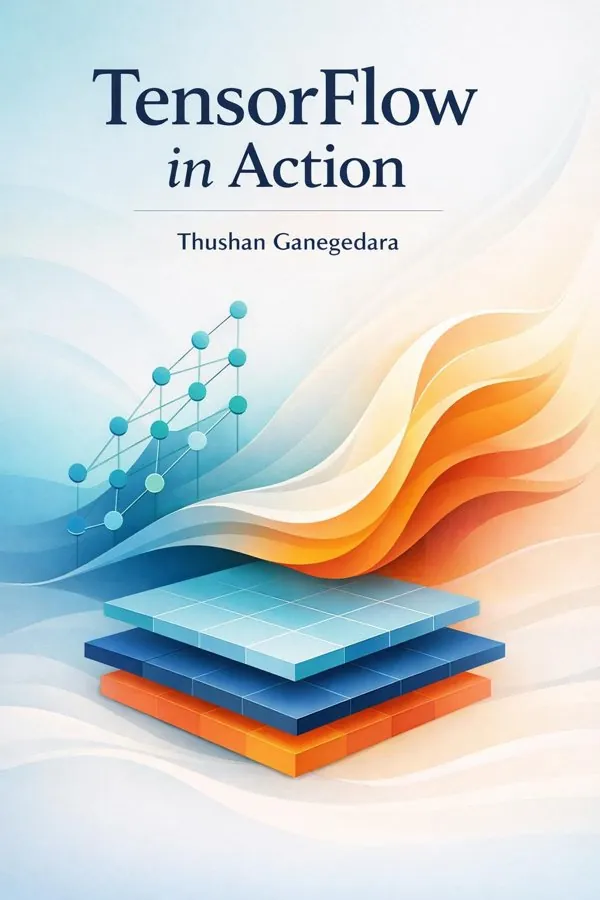
TensorFlow in Action: Summary & Key Insights
 10 min9 chaptersAudio available
Key Takeaways from TensorFlow in Action
The fastest way to understand machine learning is to stop thinking of it as abstract mathematics and start treating it as an engineering discipline.
A machine learning framework is more than a collection of functions; it shapes how you think about computation.
Many beginners believe the magic of AI lies in model architecture, but experienced practitioners know that data usually determines success.
Training a neural network is not a one-time event; it is a process of disciplined experimentation.
There is no universal neural network that solves every problem elegantly.
What Is TensorFlow in Action About?
TensorFlow in Action by Thushan Ganegedara is a ai_ml book. TensorFlow in Action by Thushan Ganegedara is a hands-on guide to understanding how modern machine learning systems are built, trained, and deployed using TensorFlow. Rather than treating artificial intelligence as a mysterious black box, the book breaks complex ideas into practical workflows that readers can apply to real data and real business problems. It moves from foundational concepts such as tensors, computation graphs, and optimization to advanced applications in computer vision, natural language processing, sequence modeling, and reinforcement learning. What makes this book especially valuable is its balance between theory and implementation. Ganegedara does not simply explain what machine learning models are; he shows how to design them, debug them, improve them, and make them useful in production settings. That matters because many learners understand algorithms in principle but struggle when asked to translate concepts into working systems. As a machine learning engineer and educator, Thushan Ganegedara brings technical depth and a practitioner’s mindset to the subject. TensorFlow in Action stands out as a bridge between academic knowledge and applied AI, making it a strong resource for developers, data scientists, and ambitious beginners who want to build intelligent systems with confidence.
This FizzRead summary covers all 9 key chapters of TensorFlow in Action in approximately 10 minutes, distilling the most important ideas, arguments, and takeaways from Thushan Ganegedara's work. Also available as an audio summary and Key Quotes Podcast.
TensorFlow in Action
TensorFlow in Action by Thushan Ganegedara is a hands-on guide to understanding how modern machine learning systems are built, trained, and deployed using TensorFlow. Rather than treating artificial intelligence as a mysterious black box, the book breaks complex ideas into practical workflows that readers can apply to real data and real business problems. It moves from foundational concepts such as tensors, computation graphs, and optimization to advanced applications in computer vision, natural language processing, sequence modeling, and reinforcement learning.
What makes this book especially valuable is its balance between theory and implementation. Ganegedara does not simply explain what machine learning models are; he shows how to design them, debug them, improve them, and make them useful in production settings. That matters because many learners understand algorithms in principle but struggle when asked to translate concepts into working systems.
As a machine learning engineer and educator, Thushan Ganegedara brings technical depth and a practitioner’s mindset to the subject. TensorFlow in Action stands out as a bridge between academic knowledge and applied AI, making it a strong resource for developers, data scientists, and ambitious beginners who want to build intelligent systems with confidence.
Who Should Read TensorFlow in Action?
This book is perfect for anyone interested in ai_ml and looking to gain actionable insights in a short read. Whether you're a student, professional, or lifelong learner, the key ideas from TensorFlow in Action by Thushan Ganegedara will help you think differently.
- ✓Readers who enjoy ai_ml and want practical takeaways
- ✓Professionals looking to apply new ideas to their work and life
- ✓Anyone who wants the core insights of TensorFlow in Action in just 10 minutes
Want the full summary?
Get instant access to this book summary and 100K+ more with Fizz Moment.
Get Free SummaryAvailable on App Store • Free to download
Key Chapters
The fastest way to understand machine learning is to stop thinking of it as abstract mathematics and start treating it as an engineering discipline. One of the central ideas in TensorFlow in Action is that deep learning becomes far more approachable when readers build models step by step instead of memorizing isolated formulas. Ganegedara presents TensorFlow not merely as a software library, but as a framework for translating ideas about learning into computational systems.
The book emphasizes that real understanding emerges from implementation. Concepts such as tensors, variables, placeholders, gradients, and optimization may sound intimidating at first, but they become concrete when attached to a training loop, a dataset, and a measurable objective. By constructing models that classify images, process language, or predict sequences, readers develop intuition for what each component is doing and why it matters.
This approach is especially useful because machine learning often feels fragmented. Many resources explain neural networks in theory and others teach coding tricks, but few connect the two effectively. Ganegedara’s method closes that gap. For example, a reader might learn how a feedforward network minimizes error through backpropagation and then immediately see that process reflected in TensorFlow code, parameter updates, and evaluation metrics.
In practical settings, this build-first mindset mirrors how professionals work. Teams do not debate theory forever; they prototype, test assumptions, inspect outputs, and iterate. Whether creating a spam classifier or an image recognizer, the discipline of implementation reveals the strengths and weaknesses of a model faster than passive study ever can.
Actionable takeaway: When learning any TensorFlow concept, pair each new idea with a small coding experiment so knowledge becomes operational, not just conceptual.
A machine learning framework is more than a collection of functions; it shapes how you think about computation. TensorFlow in Action highlights that TensorFlow trains users to express machine learning problems as structured flows of data, transformations, and optimization. This way of thinking is powerful because it turns messy real-world tasks into organized systems that can be trained, evaluated, and improved.
At the heart of this idea is the tensor, a general-purpose container for numerical data. Images, text embeddings, time-series values, and labels can all be represented as tensors. Once information takes this form, it can move through layers, mathematical operations, and loss functions in a consistent pipeline. The framework encourages users to define relationships between inputs and outputs clearly, making experimentation easier and less error-prone.
Ganegedara shows why this matters in practice. A handwriting recognition task, for example, is not simply a vague AI problem. It becomes an input tensor of pixel values, a sequence of transformations through neural layers, a prediction tensor of probabilities, and a loss function measuring deviation from the correct label. This decomposition makes debugging and scaling more manageable.
The broader lesson is that TensorFlow provides discipline. It forces developers to specify architecture, data flow, and learning objectives explicitly. That clarity helps prevent hidden assumptions and sloppy experimentation. In business environments, where reproducibility and maintainability matter, such structure is essential. Teams need models that can be revisited, audited, retrained, and deployed with confidence.
Actionable takeaway: Before writing model code, sketch your problem as a flow of tensors, transformations, predictions, and loss so your implementation has a clear computational blueprint.
Many beginners believe the magic of AI lies in model architecture, but experienced practitioners know that data usually determines success. TensorFlow in Action repeatedly reinforces the idea that even sophisticated neural networks fail when trained on noisy, biased, poorly labeled, or badly preprocessed data. In other words, model performance is often a reflection of data discipline rather than algorithmic brilliance.
Ganegedara treats data preparation as a first-class part of the machine learning pipeline. This includes cleaning corrupted examples, normalizing features, splitting datasets properly, handling class imbalance, and constructing training batches efficiently. These steps may not seem glamorous, but they often make the difference between a model that converges and one that behaves unpredictably.
Consider an image classification project. If one class has thousands of samples while another has only a few dozen, a model may appear accurate overall while consistently failing on minority categories. Likewise, if pixel values are inconsistently scaled or labels contain hidden mistakes, optimization becomes unstable. Similar issues arise in language tasks, where tokenization choices, vocabulary size, and sequence formatting strongly affect outcomes.
The book’s practical orientation helps readers see data as something to engineer, not merely collect. TensorFlow pipelines are useful because they support repeatable preprocessing and efficient feeding of data into models. In production systems, that repeatability matters as much as raw accuracy. A great model trained on an ad hoc dataset is difficult to trust or reproduce.
Actionable takeaway: Spend as much effort designing your input pipeline, preprocessing rules, and validation strategy as you spend choosing neural network layers.
Training a neural network is not a one-time event; it is a process of disciplined experimentation. One of the book’s most valuable lessons is that good machine learning work resembles scientific testing more than magical automation. TensorFlow in Action teaches readers to treat every model run as an experiment with assumptions, parameters, measurements, and outcomes.
This mindset matters because many factors influence learning: architecture depth, activation functions, batch size, learning rate, regularization, optimizer choice, initialization, and training duration. A model that underperforms may not be fundamentally flawed; it may simply be badly tuned. Ganegedara helps readers understand that optimization is a delicate balance between fitting patterns and avoiding overfitting, between learning quickly and diverging chaotically.
The practical examples in the book encourage systematic comparison. A reader might train a baseline model, record its accuracy and loss curves, then adjust one variable at a time. This approach reveals causal relationships more clearly than random trial and error. For instance, reducing the learning rate may stabilize training, while dropout may improve generalization on unseen data. Visualization tools and evaluation metrics become essential instruments in this process.
In real-world applications, controlled experimentation saves time and money. A company building a recommendation engine cannot afford to guess blindly. It needs reproducible tests, benchmark datasets, and evidence-based improvements. TensorFlow supports this workflow by making model definitions and training procedures explicit and repeatable.
Actionable takeaway: Track each training run like an experiment, documenting hyperparameters, metrics, and observations so you can improve models through evidence rather than intuition alone.
There is no universal neural network that solves every problem elegantly. A core theme in TensorFlow in Action is that architecture should follow the structure of the task. Understanding this principle helps readers move beyond copy-pasting popular models and begin making smarter design choices based on the nature of the data they are handling.
For fixed-size tabular or vector inputs, simple feedforward networks may be sufficient. For image data, convolutional neural networks shine because they exploit spatial locality and shared patterns such as edges, textures, and shapes. For text and time-series tasks, recurrent architectures and sequence models are useful because they preserve order and context across steps. More advanced chapters introduce ideas like autoencoders, embeddings, and reinforcement learning, each tailored to a different kind of learning objective.
Ganegedara’s strength lies in showing these architectures as tools rather than trophies. A convolutional network is not impressive just because it is deep; it is useful because it processes images efficiently. A recurrent model matters not because it sounds advanced, but because language and sequential behavior depend on temporal relationships. This framing helps readers avoid choosing complexity for its own sake.
The practical implication is significant. If you are building an OCR system, CNNs make sense. If you are forecasting demand over time, sequential models may be a better fit. If you are reducing dimensionality or detecting anomalies, autoencoders can be powerful. Matching architecture to data improves both performance and interpretability.
Actionable takeaway: Start each project by asking what structure exists in your data, then choose the simplest architecture that naturally exploits that structure.
A model that looks good in a demo can still fail disastrously in the real world. TensorFlow in Action stresses that meaningful evaluation is essential if machine learning systems are to be trusted. Accuracy alone is rarely enough, and a polished prediction example can hide major weaknesses in robustness, fairness, or generalization.
Ganegedara encourages readers to evaluate models using appropriate metrics for the task. In classification, precision, recall, confusion matrices, and class-wise performance may reveal issues hidden by aggregate accuracy. In sequence tasks, loss trends and output quality matter. In production-oriented contexts, latency, memory usage, and stability under shifting data conditions are also important. The broader point is that metrics should reflect actual goals, not just convenient numbers.
For example, a medical screening model with high overall accuracy could still be dangerous if it misses too many positive cases. A recommendation model may show good offline metrics but frustrate users if it lacks diversity or responsiveness. A language model may generate plausible outputs while making subtle but harmful mistakes. Good evaluation forces practitioners to confront these trade-offs honestly.
The book’s applied focus helps readers see evaluation as an ongoing process rather than a final checkbox. Validation datasets, test sets, training curves, and error analysis all contribute to a better picture of model behavior. This is where machine learning becomes mature engineering rather than novelty.
Actionable takeaway: Define success metrics before training begins, and always inspect failure cases alongside headline performance numbers.
A machine learning model has little impact until it leaves the notebook and enters a usable system. TensorFlow in Action makes an important practical shift from model building to deployment, showing that business value comes not from prototypes alone but from operationalized intelligence. This is where many technically strong learners struggle, and the book addresses that gap directly.
Deployment involves more than saving a trained model. It requires attention to serialization, serving infrastructure, inference speed, hardware constraints, integration with applications, and ongoing monitoring. Ganegedara helps readers appreciate that a model in production must be reliable, maintainable, and responsive. A research-quality result is only the beginning of a much larger engineering lifecycle.
Consider a customer support classifier deployed in a web service. It must process incoming text consistently with the same preprocessing used during training, deliver predictions quickly enough for user-facing systems, and remain stable as language patterns evolve. Likewise, an image recognition model on a mobile device must balance accuracy with memory and compute limits. These are deployment realities, not theoretical side notes.
The book’s emphasis on end-to-end workflows is especially relevant in modern AI practice, where organizations care as much about maintainability and scale as they do about benchmark performance. Building a strong model is valuable; building one that can be updated, audited, and integrated into products is transformative.
Actionable takeaway: Design your model pipeline with deployment in mind from the start, including preprocessing consistency, inference constraints, and a plan for monitoring performance after release.
When a model fails, the worst response is to assume machine learning is mysterious. One of the most grounded lessons in TensorFlow in Action is that debugging neural networks requires patient inspection, structured diagnosis, and a willingness to challenge assumptions. AI systems often fail for understandable reasons if practitioners know where to look.
Ganegedara implicitly teaches a debugging mindset by walking through practical implementations where errors can arise at many levels: malformed input data, shape mismatches, wrong labels, unstable gradients, poor initialization, inadequate capacity, or excessive regularization. TensorFlow gives developers visibility into many of these issues through tensor inspection, logging, summaries, and metric tracking.
This is critical because beginners often respond to poor performance by changing many things at once. That usually makes problems harder to isolate. Effective debugging starts with basics: verify data integrity, confirm that the model can overfit a tiny sample, inspect learning curves, examine predictions on known cases, and test whether loss is moving in the expected direction. Such habits transform confusion into diagnosis.
In applied contexts, debugging also means understanding domain mismatch. A sentiment model trained on movie reviews may fail on financial reports not because the architecture is wrong, but because the language distribution has changed. A vision model may break in new lighting conditions because the training data lacked variety. Technical and contextual debugging go hand in hand.
Actionable takeaway: When a model underperforms, isolate one possible failure point at a time, starting with data correctness and simple baseline checks before making major architectural changes.
The field of machine learning evolves too quickly for static knowledge to remain sufficient. TensorFlow in Action communicates a final, broader lesson: mastering TensorFlow is not about memorizing one version of an API or one set of models, but about developing adaptable thinking that can keep pace with changing tools and methods. The framework is a vehicle for learning how to learn in AI.
Ganegedara equips readers with patterns that outlast individual libraries. These include representing data numerically, defining objective functions, selecting suitable architectures, training through optimization, evaluating rigorously, and deploying responsibly. Even as specific interfaces change, these principles remain central to machine learning practice. That makes the book useful not only as a TensorFlow guide but also as a foundation for long-term technical growth.
This perspective is valuable because many learners worry about falling behind. New architectures, research papers, and software updates appear constantly. Yet professionals stay effective by grounding themselves in core concepts and building fluency through projects. Once someone understands how to structure experiments, diagnose failures, and align models with tasks, they can adapt to new frameworks and ideas far more easily.
In practical terms, the book encourages readers to treat every completed project as a starting point for the next level of mastery. Build a classifier, then improve it. Train a sequence model, then optimize it. Deploy a model, then monitor drift and retrain it. This iterative posture is what turns a learner into a practitioner.
Actionable takeaway: Use TensorFlow not just to complete projects, but to build a repeatable learning process that keeps your machine learning skills current over time.
All Chapters in TensorFlow in Action
About the Author
Thushan Ganegedara is a machine learning engineer, researcher, and technical author with deep expertise in artificial intelligence and applied data science. He is known for translating complex subjects such as deep learning, natural language processing, and neural network design into practical guidance for developers and students. His work reflects a strong combination of theoretical understanding and real-world implementation experience, which makes his teaching especially useful for readers who want to build working AI systems rather than only study concepts in isolation. In TensorFlow in Action, Ganegedara brings that practitioner’s perspective to one of the most important machine learning frameworks, helping readers understand not just how TensorFlow works, but how to use it effectively in actual projects. His writing is valued for its clarity, technical depth, and hands-on orientation.
Get This Summary in Your Preferred Format
Read or listen to the TensorFlow in Action summary by Thushan Ganegedara anytime, anywhere. FizzRead offers multiple formats so you can learn on your terms — all free.
Available formats: App · Audio · PDF · EPUB — All included free with FizzRead
Download TensorFlow in Action PDF and EPUB Summary
Key Quotes from TensorFlow in Action
“The fastest way to understand machine learning is to stop thinking of it as abstract mathematics and start treating it as an engineering discipline.”
“A machine learning framework is more than a collection of functions; it shapes how you think about computation.”
“Many beginners believe the magic of AI lies in model architecture, but experienced practitioners know that data usually determines success.”
“Training a neural network is not a one-time event; it is a process of disciplined experimentation.”
“There is no universal neural network that solves every problem elegantly.”
Frequently Asked Questions about TensorFlow in Action
TensorFlow in Action by Thushan Ganegedara is a ai_ml book that explores key ideas across 9 chapters. TensorFlow in Action by Thushan Ganegedara is a hands-on guide to understanding how modern machine learning systems are built, trained, and deployed using TensorFlow. Rather than treating artificial intelligence as a mysterious black box, the book breaks complex ideas into practical workflows that readers can apply to real data and real business problems. It moves from foundational concepts such as tensors, computation graphs, and optimization to advanced applications in computer vision, natural language processing, sequence modeling, and reinforcement learning. What makes this book especially valuable is its balance between theory and implementation. Ganegedara does not simply explain what machine learning models are; he shows how to design them, debug them, improve them, and make them useful in production settings. That matters because many learners understand algorithms in principle but struggle when asked to translate concepts into working systems. As a machine learning engineer and educator, Thushan Ganegedara brings technical depth and a practitioner’s mindset to the subject. TensorFlow in Action stands out as a bridge between academic knowledge and applied AI, making it a strong resource for developers, data scientists, and ambitious beginners who want to build intelligent systems with confidence.
You Might Also Like
Life 3.0
Max Tegmark
10 min
Superintelligence
Nick Bostrom
10 min
AI Made Simple: A Beginner’s Guide to Generative AI, ChatGPT, and the Future of Work
Rajeev Kapur
10 min
AI Snake Oil
Arvind Narayanan, Sayash Kapoor
10 min
AI Superpowers: China, Silicon Valley, and the New World Order
Kai-Fu Lee
10 min
All-In On AI: How Smart Companies Win Big With Artificial Intelligence
Tom Davenport & Nitin Mittal
10 minBrowse by Category
Ready to read TensorFlow in Action?
Get the full summary and 100K+ more books with Fizz Moment.