
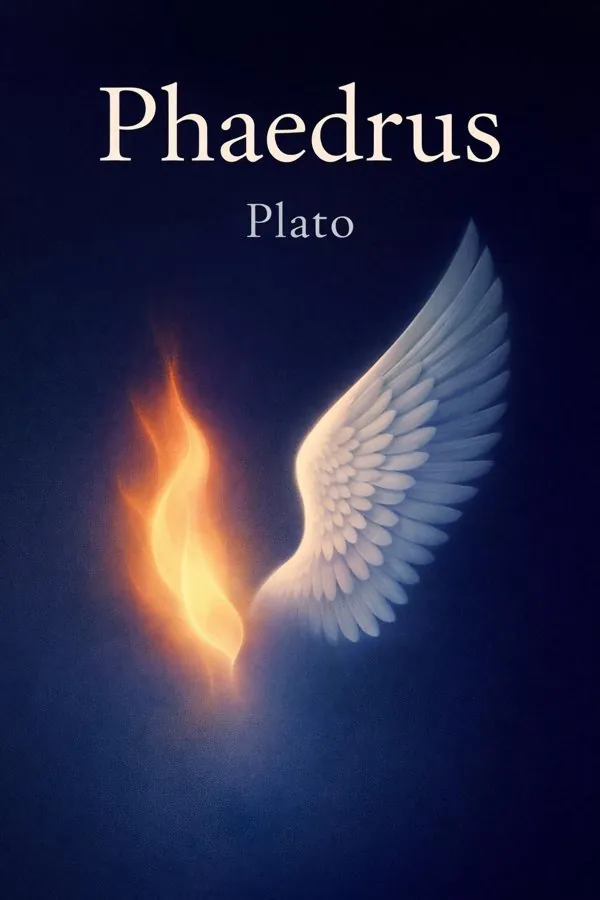
Phaedrus: Summary & Key Insights
by Plato
 10 min9 chaptersAudio available
Key Takeaways from Phaedrus
Great philosophical conversations often begin when ordinary habits are interrupted.
A sharp argument can still be shallow if it sees only one side of human experience.
Not all forms of irrationality are equal; some break us downward, while others awaken us upward.
We understand ourselves better when we stop pretending we are internally simple.
The highest form of love does not end in possession; it becomes a partnership in moral and spiritual transformation.
What Is Phaedrus About?
Phaedrus by Plato is a western_phil book spanning 6 pages. What if love, eloquence, and self-knowledge were all parts of the same philosophical puzzle? In Phaedrus, Plato stages one of his most beautiful and layered dialogues: a conversation between Socrates and the young Athenian Phaedrus that begins with a speech about romantic desire and gradually opens into a profound inquiry into the soul, truth, memory, and the art of persuasion. Set outside Athens, by the river Ilissus, the dialogue combines lyrical imagery with rigorous argument, making it one of Plato’s most literary and philosophically rich works. Its enduring importance lies in the way it asks questions that remain urgent today: What distinguishes manipulation from genuine communication? Can passion elevate us rather than degrade us? And does writing preserve wisdom or merely imitate it? Plato, student of Socrates and founder of the Academy, writes with unmatched authority on these themes because he is not merely discussing rhetoric and philosophy from a distance; he is inventing a form of thought in which conversation itself becomes a path to truth.
This FizzRead summary covers all 9 key chapters of Phaedrus in approximately 10 minutes, distilling the most important ideas, arguments, and takeaways from Plato's work. Also available as an audio summary and Key Quotes Podcast.
Phaedrus
What if love, eloquence, and self-knowledge were all parts of the same philosophical puzzle? In Phaedrus, Plato stages one of his most beautiful and layered dialogues: a conversation between Socrates and the young Athenian Phaedrus that begins with a speech about romantic desire and gradually opens into a profound inquiry into the soul, truth, memory, and the art of persuasion. Set outside Athens, by the river Ilissus, the dialogue combines lyrical imagery with rigorous argument, making it one of Plato’s most literary and philosophically rich works. Its enduring importance lies in the way it asks questions that remain urgent today: What distinguishes manipulation from genuine communication? Can passion elevate us rather than degrade us? And does writing preserve wisdom or merely imitate it? Plato, student of Socrates and founder of the Academy, writes with unmatched authority on these themes because he is not merely discussing rhetoric and philosophy from a distance; he is inventing a form of thought in which conversation itself becomes a path to truth.
Who Should Read Phaedrus?
This book is perfect for anyone interested in western_phil and looking to gain actionable insights in a short read. Whether you're a student, professional, or lifelong learner, the key ideas from Phaedrus by Plato will help you think differently.
- ✓Readers who enjoy western_phil and want practical takeaways
- ✓Professionals looking to apply new ideas to their work and life
- ✓Anyone who wants the core insights of Phaedrus in just 10 minutes
Want the full summary?
Get instant access to this book summary and 100K+ more with Fizz Moment.
Get Free SummaryAvailable on App Store • Free to download
Key Chapters
Great philosophical conversations often begin when ordinary habits are interrupted. Plato places the meeting between Socrates and Phaedrus outside the walls of Athens, in a calm natural setting, and that change of location matters. Phaedrus has been listening to a speech by the famed logographer Lysias and carries a written copy with him. He is excited, impressed, and eager to share it. Socrates, who is usually portrayed as a man of the city and the marketplace, is drawn out into nature by the promise of hearing a speech. This opening scene creates more than a pleasant backdrop. It signals that the dialogue will move beyond convention and force both characters to examine what they usually accept too easily.
Lysias’s speech argues that a person should favor the non-lover over the lover, because the lover is ruled by passion and therefore unstable, jealous, and irrational. Phaedrus is captivated by the cleverness of the argument, especially its polished rhetorical style. Socrates immediately begins to probe the difference between sounding persuasive and being genuinely wise. The issue is not only whether Lysias is right about love, but whether a speech can be judged by elegance alone.
This opening still feels modern. We are constantly exposed to persuasive messages that are well packaged but poorly grounded, from advertising to political messaging to social media commentary. Phaedrus reminds us that fascination with style can distract us from examining truth.
Actionable takeaway: When a message impresses you, pause before agreeing. Ask not only, “Is this eloquent?” but also, “What assumptions does it make, and is it actually true?”
A sharp argument can still be shallow if it sees only one side of human experience. In his first speech, Socrates echoes and improves upon Lysias’s position. He argues that erotic love is a kind of madness that harms both lover and beloved. The lover, driven by desire rather than judgment, becomes possessive, manipulative, and short-sighted. Instead of wanting what is best for the beloved, he seeks private gratification. He discourages the beloved from growing strong, independent, or socially connected, because such growth threatens his control.
Socrates develops the case with more structure than Lysias. He distinguishes rational desire from unruly appetite and shows how passion can distort perception. Under the rule of love, a person praises what serves desire and resents what serves genuine flourishing. What appears as devotion may actually be self-interest in disguise. This is one of Plato’s recurring insights: we often misname our impulses. What we call love may be need, insecurity, vanity, or appetite.
This speech matters because it captures a truth many idealized accounts of love ignore. Attraction can cloud judgment. Charisma can hide selfishness. Emotional intensity is not moral depth. In everyday life, this insight applies to relationships in which admiration turns into dependency, or in which one person subtly limits the other’s freedom under the banner of affection.
Yet Plato does not stop here. The speech is deliberately incomplete, and Socrates soon recognizes that treating all madness as bad is itself a mistake. Before the dialogue can move upward, it must first clear away sentimental illusions.
Actionable takeaway: In any intense relationship, ask whether affection is helping both people grow in freedom, honesty, and character—or merely feeding attachment and control.
Not all forms of irrationality are equal; some break us downward, while others awaken us upward. After delivering his first speech, Socrates feels he has committed an offense against Eros, the god of love. He therefore offers a palinode, a recantation, arguing that certain kinds of madness are divine gifts. Prophecy, ritual inspiration, poetic creativity, and erotic love can each come from the gods and surpass the limits of ordinary calculation. This is one of the dialogue’s most famous reversals: the same phenomenon first condemned as dangerous madness is now reconsidered as a source of spiritual ascent.
Socrates’s new argument is not naive romanticism. He does not claim that every passion is ennobling. Instead, he distinguishes vulgar desire from a love that awakens memory of the divine. When a person encounters beauty in another human being, the experience can stir something ancient within the soul. The lover is shaken because beauty reminds the soul of realities it once beheld before birth. Erotic longing thus becomes, at its best, a confused but powerful response to transcendence.
This idea gives love a philosophical dignity. Deep attraction may reveal that human beings are not satisfied by utility, comfort, or possession alone. We seek something higher through visible forms. In modern life, this can be seen when admiration for another person inspires self-discipline, moral refinement, or a hunger for truth rather than mere conquest.
Plato’s point is subtle: passion becomes noble only when it is educated. Without reflection, desire enslaves. Guided toward the good, it can become the beginning of wisdom.
Actionable takeaway: When strong desire appears, do not ask only what you want. Ask what this longing could teach you about beauty, character, and the kind of person you are becoming.
We understand ourselves better when we stop pretending we are internally simple. Plato’s great image of the soul as a charioteer with two winged horses captures the inner conflict of human life with unmatched psychological power. The charioteer represents reason. One horse is noble, disciplined, and responsive to what is honorable. The other is unruly, impulsive, and drawn toward immediate satisfaction. Human experience is not the smooth rule of one unified self but a struggle among competing tendencies.
In the myth, souls once traveled in the divine procession and glimpsed true reality. But many lost their wings and fell into embodied life. Here, beauty can help wings grow again by reminding the soul of what it once knew. Love becomes the dramatic setting in which the soul’s internal battle is exposed. The base horse lunges toward possession; the noble horse feels reverence; reason must govern both if the soul is to rise rather than collapse into appetite.
This image remains strikingly relevant. Anyone who has tried to resist distraction, addiction, envy, rage, or vanity knows the divided soul. We experience one part of ourselves wanting the better path and another pulling elsewhere. Plato does not treat this conflict as a personal defect unique to a few weak individuals. It is part of the human condition.
The practical force of the image lies in its realism. Self-mastery does not mean killing desire but ordering it. Education, friendship, discipline, and honest self-observation help reason guide the whole person toward what is truly good.
Actionable takeaway: When you feel conflicted, name the forces at work within you. Identifying reason, aspiration, and impulse clearly is the first step toward governing your life rather than being dragged by it.
The ability to persuade is dangerous when it is detached from knowledge. After discussing love, the dialogue turns explicitly to rhetoric, and Plato asks what makes speaking well truly good. Lysias represents a common view: rhetoric is a technique for winning assent, regardless of whether the speaker possesses truth. Socrates rejects this as a fundamentally defective ideal. A genuine art of rhetoric must be rooted in knowledge of reality and in an understanding of the soul of the audience.
This is not an attack on persuasion as such. Plato does not say that rhetoric should disappear. He argues that rhetoric becomes legitimate only when guided by dialectic, the philosophical method of defining things carefully, dividing them correctly, and tracing their relations. A speaker who does not know what justice, goodness, love, or the soul actually are may still move a crowd, but such influence is merely verbal power, not wisdom.
The insight is timeless. Today, public communication often rewards emotional triggers, selective framing, and confident simplification. A speaker may be effective because they know what fears to activate or what hopes to flatter. But effectiveness is not the same as integrity. Persuasion that exploits confusion may produce compliance while leaving people less informed and less free.
Plato also insists that communication must fit the soul of the listener. Good speech is not generic. It requires psychological understanding: who is listening, what they value, what errors they are prone to, and what kind of argument they are able to receive.
Actionable takeaway: Before trying to persuade anyone, ask two questions: Do I actually understand the truth of the matter, and am I speaking in a way that helps this person think more clearly rather than merely agree with me?
Clear thought begins by carving reality at its joints instead of speaking in vague generalities. One of Plato’s most important methodological contributions in Phaedrus is the claim that true rhetoric depends on dialectical skill: the ability to collect scattered particulars into a coherent definition and then divide a topic according to its natural kinds. Socrates praises this intellectual craftsmanship because it prevents confusion, exaggeration, and verbal trickery.
The earlier speeches about love illustrate the point. To say simply that love is good or bad is too crude. One must define what kind of love is being discussed, distinguish madness that degrades from madness that comes from divine inspiration, and understand the soul that experiences it. Without such distinctions, language becomes sloppy and persuasive force replaces careful judgment.
This method has practical reach far beyond ancient philosophy. In work, politics, education, and personal life, disagreements often persist because the participants are using the same words for different things. People argue about freedom, success, fairness, or authenticity without first defining them. Plato’s remedy is disciplined conceptual work. If you can define the issue precisely and break it into meaningful parts, you are already closer to understanding and better communication.
This also helps in self-examination. A person might say, “I’m unhappy,” but this is too broad. Are they lonely, bored, ashamed, exhausted, purposeless, or misaligned with their values? Better distinctions open the possibility of better action.
Actionable takeaway: When a conversation becomes confused, stop and define the central term. Then divide the issue into its main types or causes. Precision is often the fastest route to clarity.
What if the very tool that helps us remember also weakens our ability to truly know? In the dialogue’s most famous critique of writing, Socrates recounts the myth of the god Theuth, who presents writing to King Thamus as a gift that will improve memory and wisdom. Thamus replies that writing will instead produce forgetfulness, because people will rely on external marks rather than cultivating memory within themselves. They will acquire the appearance of wisdom without its reality.
Plato’s point is often misunderstood. He is not simply condemning writing; after all, he writes dialogues. His deeper concern is that written words cannot defend themselves, adapt to the listener, or answer questions as a living speaker can. A text says the same thing to everyone. It can remind someone who already knows, but it cannot replace the active, dialogical process through which understanding is born in the soul.
This insight feels remarkably contemporary in the age of searchable information, notes apps, and endless content. Access to data can create the illusion of understanding. Reading summaries, quotes, or posts may make us feel informed while bypassing the effort of digestion, questioning, and integration. Information stored outside us is useful, but wisdom requires inward work.
Plato is not asking us to reject books or technology. He is warning against mistaking possession of words for possession of insight. The difference between recalling a phrase and embodying a truth is enormous.
Actionable takeaway: Use writing as a prompt for reflection, not a substitute for it. After reading something important, explain it in your own words, question it, and connect it to your lived experience.
The best philosophy ends not in cleverness but in reorientation of the soul. At the close of Phaedrus, Socrates offers a prayer to Pan and the local gods, asking to become beautiful within, and that his outer possessions be in harmony with his inner life. He asks to regard the wise as rich and to possess only as much wealth as a temperate person can bear. This ending is brief, but it reveals the dialogue’s deepest aspiration.
After all the speeches on love, all the reflections on rhetoric, and all the arguments about writing, the final concern is character. Inner beauty matters more than external ornament. True richness is not abundance of possessions, admirers, or verbal skill, but an ordered soul aligned with wisdom. The prayer also ties together the dialogue’s major themes. Love should lead us upward; rhetoric should serve truth; memory should be internalized; and education should produce harmony rather than display.
This conclusion is especially powerful because it shifts philosophy from abstraction to aspiration. Plato does not want readers merely to admire elegant arguments. He wants them to desire a certain kind of self. In modern terms, the prayer asks whether our public image, achievements, and communication are supported by inner substance. Are we becoming admirable in reality, or only appearing so?
The setting outside the city now feels significant in a new way. Removed from noise and competition, Socrates returns to the oldest philosophical question: what kind of person should I be?
Actionable takeaway: Regularly measure success by inner criteria. Ask whether your habits are making you more truthful, self-governed, and inwardly beautiful—not merely more impressive to others.
All Chapters in Phaedrus
About the Author
Plato (c. 427–347 BCE) was an ancient Greek philosopher and one of the foundational thinkers of Western philosophy. Born into an aristocratic family in Athens, he became the most famous student of Socrates, whose trial and execution deeply shaped his intellectual life. Plato later founded the Academy, a pioneering school of higher learning that influenced philosophy, science, mathematics, and political thought for centuries. He wrote in the form of dialogues, many featuring Socrates as the central speaker, allowing philosophical ideas to emerge through questioning and debate. His works explore ethics, politics, metaphysics, epistemology, education, and the soul. Dialogues such as Republic, Symposium, Apology, and Phaedrus remain essential reading because they unite literary artistry with rigorous philosophical inquiry.
Get This Summary in Your Preferred Format
Read or listen to the Phaedrus summary by Plato anytime, anywhere. FizzRead offers multiple formats so you can learn on your terms — all free.
Available formats: App · Audio · PDF · EPUB — All included free with FizzRead
Download Phaedrus PDF and EPUB Summary
Key Quotes from Phaedrus
“Great philosophical conversations often begin when ordinary habits are interrupted.”
“A sharp argument can still be shallow if it sees only one side of human experience.”
“Not all forms of irrationality are equal; some break us downward, while others awaken us upward.”
“We understand ourselves better when we stop pretending we are internally simple.”
“The highest form of love does not end in possession; it becomes a partnership in moral and spiritual transformation.”
Frequently Asked Questions about Phaedrus
Phaedrus by Plato is a western_phil book that explores key ideas across 9 chapters. What if love, eloquence, and self-knowledge were all parts of the same philosophical puzzle? In Phaedrus, Plato stages one of his most beautiful and layered dialogues: a conversation between Socrates and the young Athenian Phaedrus that begins with a speech about romantic desire and gradually opens into a profound inquiry into the soul, truth, memory, and the art of persuasion. Set outside Athens, by the river Ilissus, the dialogue combines lyrical imagery with rigorous argument, making it one of Plato’s most literary and philosophically rich works. Its enduring importance lies in the way it asks questions that remain urgent today: What distinguishes manipulation from genuine communication? Can passion elevate us rather than degrade us? And does writing preserve wisdom or merely imitate it? Plato, student of Socrates and founder of the Academy, writes with unmatched authority on these themes because he is not merely discussing rhetoric and philosophy from a distance; he is inventing a form of thought in which conversation itself becomes a path to truth.
More by Plato
You Might Also Like
A Little History of Philosophy
Nigel Warburton
10 min
Areopagitica
John Milton
10 min
How To Think Like A Philosopher: Essential Principles For Clear Thinking
Peter Cave
10 min
Language, Truth and Logic
A. J. Ayer
10 min
The Age of Reason
Thomas Paine
10 min
The Essays
Michel De Montaigne
10 minBrowse by Category
Ready to read Phaedrus?
Get the full summary and 100K+ more books with Fizz Moment.