
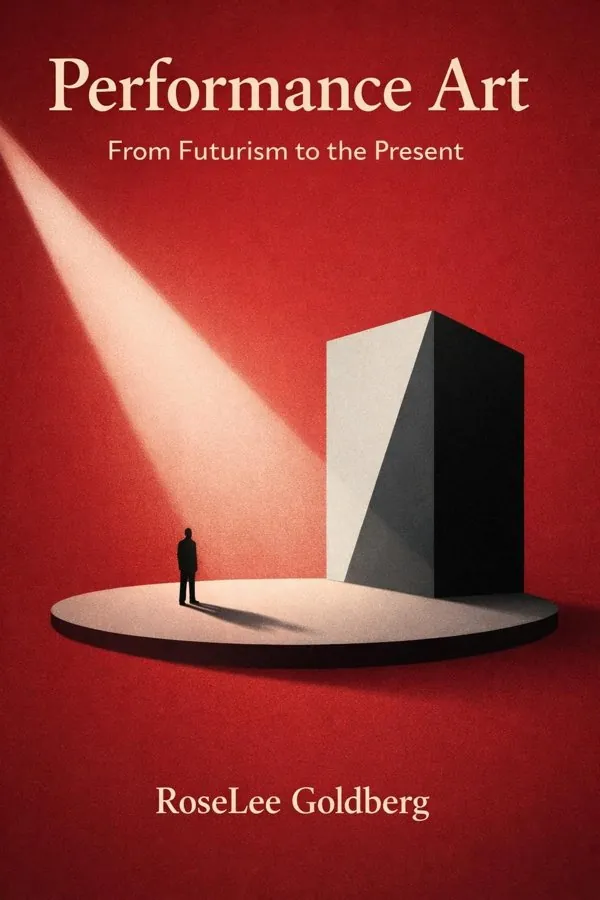
Performance Art: From Futurism to the Present: Summary & Key Insights
 10 min9 chaptersAudio available
Key Takeaways from Performance Art: From Futurism to the Present
One of the most revealing truths about performance art is that it did not emerge from comfort or consensus; it emerged from artists wanting to break art open.
When the world becomes irrational, coherent art can feel dishonest.
Performance art expanded dramatically when artists stopped treating the stage as a fixed theatrical container and began seeing all space as potentially performative.
Perhaps the most radical development in Goldberg’s history is the moment artists stopped merely representing ideas and instead used their own bodies as the site of inquiry.
If performance art is uniquely suited to challenge how bodies are seen, then it is no surprise that feminist artists transformed the field.
What Is Performance Art: From Futurism to the Present About?
Performance Art: From Futurism to the Present by RoseLee Goldberg is a performing_arts book spanning 12 pages. Performance art begins where the stable art object ends. In Performance Art: From Futurism to the Present, RoseLee Goldberg traces a century-long history of artists who turned action, presence, risk, ritual, and the body itself into primary artistic material. Rather than treating performance as a side note to painting, sculpture, or theater, Goldberg shows that it has been one of the central engines of modern and contemporary art. From the explosive provocations of Futurism and Dada to Happenings, body art, feminist interventions, political actions, multimedia work, and global contemporary practices, the book maps how artists repeatedly used live presence to challenge institutions, audiences, and cultural norms. What makes this history so important is that performance art reveals how art responds immediately to its moment: to war, technology, gender politics, mass media, and social change. Goldberg is uniquely qualified to tell this story. A pioneering art historian, critic, curator, and founder of Performa, she has spent decades documenting, contextualizing, and championing performance as a major art form. Her book remains one of the essential guides to understanding how art moved off the wall and into lived experience.
This FizzRead summary covers all 9 key chapters of Performance Art: From Futurism to the Present in approximately 10 minutes, distilling the most important ideas, arguments, and takeaways from RoseLee Goldberg's work. Also available as an audio summary and Key Quotes Podcast.
Performance Art: From Futurism to the Present
Performance art begins where the stable art object ends. In Performance Art: From Futurism to the Present, RoseLee Goldberg traces a century-long history of artists who turned action, presence, risk, ritual, and the body itself into primary artistic material. Rather than treating performance as a side note to painting, sculpture, or theater, Goldberg shows that it has been one of the central engines of modern and contemporary art. From the explosive provocations of Futurism and Dada to Happenings, body art, feminist interventions, political actions, multimedia work, and global contemporary practices, the book maps how artists repeatedly used live presence to challenge institutions, audiences, and cultural norms. What makes this history so important is that performance art reveals how art responds immediately to its moment: to war, technology, gender politics, mass media, and social change. Goldberg is uniquely qualified to tell this story. A pioneering art historian, critic, curator, and founder of Performa, she has spent decades documenting, contextualizing, and championing performance as a major art form. Her book remains one of the essential guides to understanding how art moved off the wall and into lived experience.
Who Should Read Performance Art: From Futurism to the Present?
This book is perfect for anyone interested in performing_arts and looking to gain actionable insights in a short read. Whether you're a student, professional, or lifelong learner, the key ideas from Performance Art: From Futurism to the Present by RoseLee Goldberg will help you think differently.
- ✓Readers who enjoy performing_arts and want practical takeaways
- ✓Professionals looking to apply new ideas to their work and life
- ✓Anyone who wants the core insights of Performance Art: From Futurism to the Present in just 10 minutes
Want the full summary?
Get instant access to this book summary and 100K+ more with Fizz Moment.
Get Free SummaryAvailable on App Store • Free to download
Key Chapters
One of the most revealing truths about performance art is that it did not emerge from comfort or consensus; it emerged from artists wanting to break art open. Goldberg shows that the roots of performance lie in the early twentieth century, especially in Futurism, when artists such as Filippo Tommaso Marinetti rejected the quiet reverence of the museum in favor of noise, aggression, speed, and confrontation. Their serate futuriste, or Futurist evenings, were not simply lectures or theatrical events. They were designed as total provocations in which manifestos were shouted, audiences were antagonized, and art became inseparable from public reaction. In this sense, performance art began as a method of testing where art ends and life begins.
This matters because it redefines artistic creation. Instead of producing a painting to be passively admired, the artist creates an event that unfolds in real time and depends on risk, unpredictability, and participation. A practical modern parallel can be seen in any work that values live interaction over polished completion: protest-based art, site-specific events, or participatory installations all inherit this Futurist impulse to jolt spectators out of routine habits of seeing.
Goldberg’s larger point is that performance was never a minor offshoot of modernism. It was there at the start, helping artists invent new relationships between audience, message, and medium. If you want to understand performance art today, begin by asking a simple question whenever you encounter a work: what conventions is this artist trying to disrupt? That question is often the true beginning of performance thinking.
When the world becomes irrational, coherent art can feel dishonest. That is the insight behind Dada, which Goldberg presents as one of performance art’s most formative turning points. Born amid the devastation of World War I, Dada rejected reason, order, and artistic seriousness. At places like the Cabaret Voltaire in Zurich, artists such as Hugo Ball, Emmy Hennings, Tristan Tzara, and others staged evenings of sound poetry, nonsensical recitations, masks, fragmented movement, and chaotic juxtaposition. These were not merely playful spectacles. They were deliberate attacks on the values of a civilization that had produced mechanized slaughter.
Goldberg also connects Dada to Surrealist experimentation, where performance became a way to access dream logic, erotic tension, and unconscious impulses. If Futurism attacked the past with speed and noise, Dada and Surrealism undermined meaning itself. Performance became a tool for exposing how fragile cultural systems really are.
This legacy remains deeply practical. Contemporary artists, comedians, activists, and digital creators frequently use absurdity to reveal truths that direct argument cannot. Satirical interventions, anti-narrative performances, or deliberately awkward public actions often derive their force from this Dadaist strategy: make the familiar strange so people can no longer ignore it.
Goldberg’s lesson is that nonsense can be intellectually serious. Performance does not always persuade through clarity; sometimes it works by destabilizing assumptions. A useful takeaway is to pay attention not only to what a performance says, but to how it scrambles language, logic, or etiquette. Confusion, in performance art, is often the message.
Performance art expanded dramatically when artists stopped treating the stage as a fixed theatrical container and began seeing all space as potentially performative. Goldberg traces this shift through Constructivism, the Bauhaus, and postwar avant-garde experimentation. In Soviet Constructivism, artists sought to merge art with social utility, redesigning movement, design, and public communication for a new society. At the Bauhaus, figures such as Oskar Schlemmer explored costume, geometry, choreography, and architecture as an integrated language. The performer became part sculpture, part design element, part moving idea.
These experiments mattered because they broke down disciplinary borders. Dance was no longer only dance, theater no longer only theater, and visual art no longer confined to still objects. After World War II, this spirit evolved further in the work of artists associated with Black Mountain College, John Cage, Merce Cunningham, and later Happenings. Silence, chance, movement, instruction, and environment all became legitimate compositional tools. A performance might consist of simple actions, overlapping events, or carefully structured indeterminacy.
In practical terms, this history helps explain why contemporary performance can happen in galleries, warehouses, streets, classrooms, or online spaces. The medium is not defined by a proscenium stage but by an arrangement of bodies, actions, time, and perception. Event-based exhibitions, immersive experiences, and interdisciplinary festivals all owe something to this reimagining of artistic space.
The actionable takeaway is this: when evaluating a performance, look at the whole environment. Ask how costume, architecture, sound, audience placement, and movement shape meaning. In performance art, space is never neutral; it is one of the work’s most active materials.
Perhaps the most radical development in Goldberg’s history is the moment artists stopped merely representing ideas and instead used their own bodies as the site of inquiry. In the 1960s and 1970s, body art and conceptual performance transformed live art into an arena for endurance, vulnerability, sexuality, pain, repetition, and direct confrontation. Artists explored what happens when the body is not depicted but activated under real conditions of time and risk. The artwork became inseparable from physical presence.
Goldberg shows that this move was tied to broader conceptual art, where the idea often mattered more than a durable object. But in performance, concept and body met in a charged form. The artist’s actions could test limits, expose social codes, or challenge the viewer’s ethical role. Endurance works demonstrated how time alters meaning. Repetitive gestures turned ordinary action into meditation. Self-exposure questioned spectatorship itself: what does it mean to watch another person submit to discomfort, stillness, or danger?
This remains highly relevant today, not only in art but in wellness culture, sports, activism, and digital self-presentation. We are constantly asked to think about bodies as messages. Performance art reminds us that embodiment is never neutral; it is political, emotional, and historically shaped.
For creators and viewers alike, a useful application is to consider what your body communicates before you say anything. Posture, duration, restraint, and repetition all carry meaning. Goldberg’s larger insight is that performance art made visible what daily life often hides: the body is not just a vessel for art. It is one of art’s most powerful and contested mediums.
If performance art is uniquely suited to challenge how bodies are seen, then it is no surprise that feminist artists transformed the field. Goldberg gives major importance to artists who used performance to confront the historical objectification of women, the invisibility of women in art history, and the social scripts imposed on femininity, labor, sexuality, and domestic life. Rather than accepting inherited roles, feminist performers exposed and re-staged them, often with irony, intensity, ritual, or direct address.
What made feminist performance so powerful was its ability to turn lived experience into critical form. Everyday gestures such as cleaning, dressing, speaking, or sitting at a table could become politically charged when reframed as art. Personal memory became public testimony. The female body, so often treated in traditional art as an object to be looked at, became an agent that looks back, resists, narrates, and confronts. This was not only a change in subject matter; it was a change in who gets to define meaning.
Goldberg also suggests that feminist performance expanded the possibilities of collectivity and consciousness-raising. Group performances, collaborations, and activist interventions showed that performance can create temporary communities around shared recognition. Today, many practices addressing gender identity, reproductive rights, care work, or intersectionality continue this lineage.
A practical takeaway is to notice how a performance frames labor, voice, and visibility. Ask whose experience is centered and who controls the terms of representation. Goldberg’s account makes clear that feminist performance did not simply add women to existing art history. It altered the very grammar of performance by insisting that embodiment, biography, and politics are inseparable.
Art can comment on politics from a distance, but performance often refuses distance altogether. Goldberg emphasizes that many artists turned to performance because it allowed immediate engagement with censorship, war, race, state violence, class inequality, and public memory. Since performance happens in real time and often in shared space, it can function as testimony, protest, intervention, or social ritual. The artist does not merely depict a political issue; the artist stages a relation to it.
This directness helps explain why performance has flourished in moments of crisis. Public actions, street performances, activist theater, and socially engaged works can interrupt routine behavior and force attention onto neglected realities. A performance in a gallery may challenge institutional privilege; a performance in a square may reclaim public space; a performance using symbols of mourning or endurance may make collective trauma visible. Goldberg’s history suggests that performance is especially powerful when traditional channels of communication feel compromised or insufficient.
The practical implications are broad. Educators use performative exercises to discuss difficult histories. Activists choreograph visibility through marches, die-ins, and symbolic actions. Museums increasingly present works that encourage viewers to consider their own role within social systems. Performance art offers tools for embodied civic awareness.
The actionable takeaway is simple but important: treat public behavior as meaningful form. When you encounter a socially charged performance, ask not only what issue it references, but what kind of relationship it asks the audience to enter. Does it call for witnessing, complicity, discomfort, solidarity, or action? For Goldberg, performance becomes political not just by naming power, but by reorganizing how people gather, watch, and respond.
A paradox sits at the center of performance art: if the work disappears when it ends, how does it enter history? Goldberg addresses this challenge by showing how documentation and institutionalization reshaped the field. Performance originally defined itself in part against collectible objects and permanent forms. Yet photographs, scripts, scores, films, reviews, and later video became crucial for preserving, circulating, and interpreting performances. Without documentation, much of the history would be lost; with documentation, however, the performance risks being transformed into something else.
This tension is one of the book’s most important contributions. A photograph of a live action can become iconic, but it may flatten duration, atmosphere, audience interaction, or improvisation. Museum acquisition and academic study help legitimize performance art, but they can also tame its unruly, anti-institutional energy. Goldberg does not treat this as a simple contradiction to solve. Instead, she shows it as a productive condition of the medium. Performance is both event and archive, live encounter and mediated trace.
This issue is even more relevant now, in an age of smartphones, livestreams, social media clips, and endlessly reproducible content. Many people experience performance secondhand through documentation rather than in person. That shift expands access, but also changes perception.
A useful takeaway is to distinguish between the live work and its record. When studying performance, ask what the documentation reveals and what it cannot capture. If you are a creator, think intentionally about whether documentation is evidence, artwork, promotion, or extension. Goldberg’s history reminds us that in performance art, preservation is never neutral; it becomes part of the work’s meaning.
Performance art has always adapted to the tools of its time, and Goldberg shows that technology did not replace live presence so much as complicate it. As video, film, sound design, television, and later digital media entered artistic practice, performance expanded beyond the immediate physical encounter between artist and audience. Multimedia works layered projected images, recorded voices, remote communication, and electronic processing onto live action, creating hybrid forms that challenged older distinctions between theater, installation, dance, and visual art.
This development matters because it reveals that liveness is not a fixed condition. A performance can be live and mediated, intimate and technologically amplified, site-specific and globally distributed. Artists in the 1980s and 1990s especially explored media saturation, celebrity culture, surveillance, identity construction, and virtuality. Performance became a way to investigate how technology shapes perception and behavior. The body remained central, but now often in dialogue with screens, machines, and mediated doubles.
Today this insight feels almost unavoidable. Online performances, livestreamed works, motion capture, VR experiences, and social-media-based actions all extend the field Goldberg describes. Even non-art contexts, from remote teaching to influencer culture, raise performance questions about staging, persona, and audience feedback.
The practical takeaway is to stop seeing technology and presence as opposites. Instead, ask how a given tool alters attention, intimacy, and control. Does the screen distance us or create a new kind of closeness? Does recording make the action more performative? Goldberg helps readers see that performance’s history is not a nostalgic defense of pure liveness. It is a record of artists continually reinventing what presence can mean.
One of Goldberg’s most significant achievements is showing that performance art did not end with the heroic avant-garde moments of Europe and America. It became a global language, adapted by artists across different cultures, political systems, and social realities. As the field expanded in the late twentieth century and beyond, performance responded to postcolonial identities, migration, memory, religion, urbanization, and local histories that could not be reduced to a single Western narrative. The result is not one unified tradition, but many intersecting genealogies of live art.
This broader perspective changes how we understand the medium. Performance is especially flexible because it requires fewer material resources than some art forms and can be deeply responsive to specific places and communities. It can appear in biennials, activist networks, informal public gatherings, artist-run spaces, or digital platforms. Goldberg’s account of contemporary directions suggests that performance thrives precisely because it can absorb contradiction: ritual and critique, spectacle and intimacy, institution and improvisation, local specificity and global circulation.
For readers today, this is perhaps the most practical lesson. To understand contemporary art, you must be prepared to think comparatively and contextually. A performance’s meaning often depends on cultural codes, political history, and audience expectations unique to its setting. What looks minimal in one context may be radical in another.
The actionable takeaway is to approach performance with historical curiosity rather than universal assumptions. Ask where the work is taking place, what traditions it draws on, and what local urgencies it addresses. Goldberg ultimately shows that performance art persists because it remains one of the most adaptable ways artists can think in public, with their bodies, in time.
All Chapters in Performance Art: From Futurism to the Present
About the Author
RoseLee Goldberg is an art historian, critic, curator, and one of the most important voices in the study of performance art. Born in South Africa and later based in New York, she helped establish performance as a central subject within modern and contemporary art history rather than a marginal experimental form. Her book Performance Art: From Futurism to the Present became a foundational text for students, artists, and curators. Goldberg is also the founder of Performa, the influential New York organization and biennial devoted to live performance by contemporary artists, which has played a major role in expanding public understanding of the medium. In addition to her writing, she has taught, curated internationally, and championed interdisciplinary practices that connect visual art, dance, theater, music, and media.
Get This Summary in Your Preferred Format
Read or listen to the Performance Art: From Futurism to the Present summary by RoseLee Goldberg anytime, anywhere. FizzRead offers multiple formats so you can learn on your terms — all free.
Available formats: App · Audio · PDF · EPUB — All included free with FizzRead
Download Performance Art: From Futurism to the Present PDF and EPUB Summary
Key Quotes from Performance Art: From Futurism to the Present
“One of the most revealing truths about performance art is that it did not emerge from comfort or consensus; it emerged from artists wanting to break art open.”
“When the world becomes irrational, coherent art can feel dishonest.”
“Performance art expanded dramatically when artists stopped treating the stage as a fixed theatrical container and began seeing all space as potentially performative.”
“Perhaps the most radical development in Goldberg’s history is the moment artists stopped merely representing ideas and instead used their own bodies as the site of inquiry.”
“If performance art is uniquely suited to challenge how bodies are seen, then it is no surprise that feminist artists transformed the field.”
Frequently Asked Questions about Performance Art: From Futurism to the Present
Performance Art: From Futurism to the Present by RoseLee Goldberg is a performing_arts book that explores key ideas across 9 chapters. Performance art begins where the stable art object ends. In Performance Art: From Futurism to the Present, RoseLee Goldberg traces a century-long history of artists who turned action, presence, risk, ritual, and the body itself into primary artistic material. Rather than treating performance as a side note to painting, sculpture, or theater, Goldberg shows that it has been one of the central engines of modern and contemporary art. From the explosive provocations of Futurism and Dada to Happenings, body art, feminist interventions, political actions, multimedia work, and global contemporary practices, the book maps how artists repeatedly used live presence to challenge institutions, audiences, and cultural norms. What makes this history so important is that performance art reveals how art responds immediately to its moment: to war, technology, gender politics, mass media, and social change. Goldberg is uniquely qualified to tell this story. A pioneering art historian, critic, curator, and founder of Performa, she has spent decades documenting, contextualizing, and championing performance as a major art form. Her book remains one of the essential guides to understanding how art moved off the wall and into lived experience.
You Might Also Like
Harriet Tubman: Live in Concert
Bob the Drag Queen
10 min
The Art of Stagecraft
Robert Edmond Jones
10 min
The Art of Stop-Motion Animation
Ken A. Priebe
10 min
Thunderstorm
Cao Yu
10 min
Acting In Film: An Actor's Take on Movie Making
Michael Caine
10 min
Character Animation Crash Course!
Eric Goldberg
10 minBrowse by Category
Ready to read Performance Art: From Futurism to the Present?
Get the full summary and 100K+ more books with Fizz Moment.