
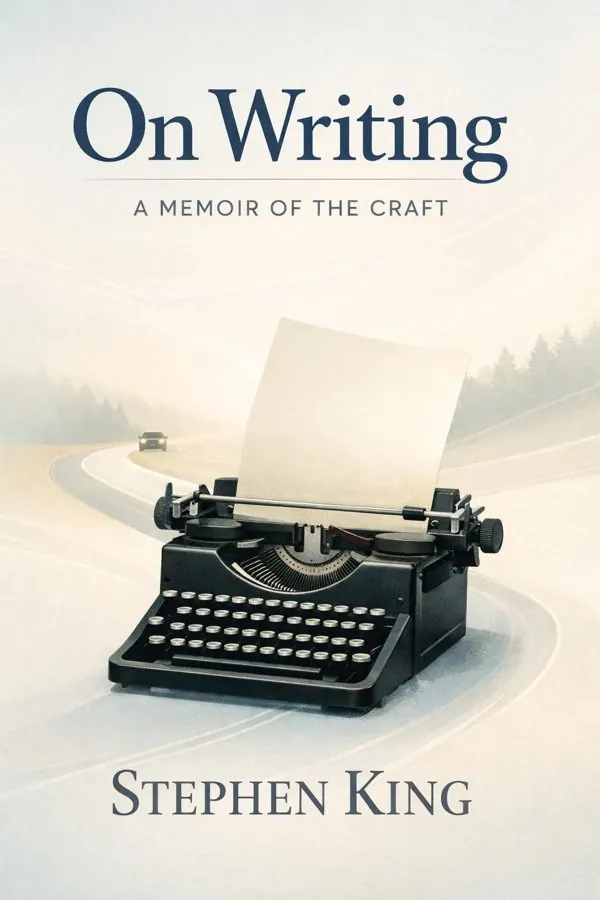
On Writing: A Memoir of the Craft: Summary & Key Insights
by Stephen King
 10 min9 chaptersAudio available
Key Takeaways from On Writing: A Memoir of the Craft
Many writers begin long before they understand what writing is.
The first things most writers produce are not brilliant; they are necessary.
Inspiration matters less than routine.
Breakthroughs often look sudden from the outside, but they are usually built on years of unseen effort.
Good writing is not magic; it is skilled labor supported by tools.
What Is On Writing: A Memoir of the Craft About?
On Writing: A Memoir of the Craft by Stephen King is a writing book spanning 12 pages. On Writing: A Memoir of the Craft is far more than a guide for aspiring authors. It is Stephen King’s candid account of how a writer is formed: through childhood obsessions, early failures, relentless practice, hard-earned discipline, and an enduring love of language. Blending memoir with practical instruction, King moves from stories about his upbringing and publishing struggles to clear, often blunt advice about style, revision, reading, and the writer’s daily habits. The result is a book that feels both deeply personal and immediately useful. What makes this work matter is its refusal to romanticize creativity. King presents writing not as a mystical gift reserved for a few, but as a craft built through effort, attention, and honesty. He shows that good writing grows from clarity, vocabulary, observation, and the courage to cut what is unnecessary. His authority comes not only from literary fame, but from decades of steady production, editorial experience, and survival through both rejection and physical trauma. For writers, readers, and anyone curious about how stories are made, On Writing remains one of the most memorable and practical books ever written about the creative life.
This FizzRead summary covers all 9 key chapters of On Writing: A Memoir of the Craft in approximately 10 minutes, distilling the most important ideas, arguments, and takeaways from Stephen King's work. Also available as an audio summary and Key Quotes Podcast.
On Writing: A Memoir of the Craft
On Writing: A Memoir of the Craft is far more than a guide for aspiring authors. It is Stephen King’s candid account of how a writer is formed: through childhood obsessions, early failures, relentless practice, hard-earned discipline, and an enduring love of language. Blending memoir with practical instruction, King moves from stories about his upbringing and publishing struggles to clear, often blunt advice about style, revision, reading, and the writer’s daily habits. The result is a book that feels both deeply personal and immediately useful.
What makes this work matter is its refusal to romanticize creativity. King presents writing not as a mystical gift reserved for a few, but as a craft built through effort, attention, and honesty. He shows that good writing grows from clarity, vocabulary, observation, and the courage to cut what is unnecessary. His authority comes not only from literary fame, but from decades of steady production, editorial experience, and survival through both rejection and physical trauma. For writers, readers, and anyone curious about how stories are made, On Writing remains one of the most memorable and practical books ever written about the creative life.
Who Should Read On Writing: A Memoir of the Craft?
This book is perfect for anyone interested in writing and looking to gain actionable insights in a short read. Whether you're a student, professional, or lifelong learner, the key ideas from On Writing: A Memoir of the Craft by Stephen King will help you think differently.
- ✓Readers who enjoy writing and want practical takeaways
- ✓Professionals looking to apply new ideas to their work and life
- ✓Anyone who wants the core insights of On Writing: A Memoir of the Craft in just 10 minutes
Want the full summary?
Get instant access to this book summary and 100K+ more with Fizz Moment.
Get Free SummaryAvailable on App Store • Free to download
Key Chapters
Many writers begin long before they understand what writing is. In On Writing, Stephen King shows how the foundations of his craft were laid in childhood, through comic books, radio shows, horror movies, paperbacks, and a fascination with the strange lurking beneath ordinary life. What matters here is not simply that he loved stories, but that he absorbed them constantly. He paid attention to tone, pacing, suspense, and the emotional effect stories had on him. Long before he had refined technique, he was training his instincts.
King’s early life also reveals an important truth: imagination often grows in imperfect conditions. His family struggled financially, and his life was not organized around literary ambition. Yet that environment sharpened his powers of observation. He learned to notice how people talk, what they fear, and what they hide. These details later became the raw material of fiction. A writer does not need an ideal upbringing; a writer needs curiosity and receptiveness.
For modern readers, this idea is liberating. You do not need elite credentials or a lifelong master plan to begin writing. Your influences may come from novels, films, games, news stories, family arguments, or local gossip. The question is whether you are collecting these impressions consciously. Keep a notebook. Pay attention to what disturbs, delights, or surprises you. Notice the stories you return to and the kinds of scenes that stay in your head.
Actionable takeaway: treat your tastes, memories, and obsessions as part of your writer’s education. Start building an “influence inventory” of stories, images, and experiences that have shaped how you see the world.
The first things most writers produce are not brilliant; they are necessary. King is refreshingly honest about his early stories being awkward imitations of better writers. He copied tones he admired, leaned on familiar tropes, and made mistakes in structure and style. But instead of seeing those failed attempts as proof he lacked talent, he treated them as training. That mindset is one of the book’s most valuable lessons.
Writing improves through repetition, not wishful thinking. Every weak story teaches something: how a scene collapses without tension, how dialogue sounds false when overexplained, how an ending fails when it is forced. King’s early submissions and rejections were not detours from becoming a writer; they were the path itself. He learned by sending work out, getting turned down, and writing more.
This is especially important for aspiring writers who expect immediate quality from first drafts. Perfectionism often disguises fear. Many people stop because their early work does not match their ambitions. King’s example suggests the opposite response: write badly, but write fully. Finish stories. Learn where your instincts are weak. Develop stamina. Revision can improve pages, but only if pages exist.
In practical terms, beginners can mimic this process by setting small output goals. Write one short story a month. Submit pieces to magazines or workshops. Save rejection emails, not as trophies of suffering, but as evidence that you are participating in the profession. Improvement often comes invisibly until enough work has accumulated.
Actionable takeaway: stop waiting to write something great. Commit to finishing imperfect work on a regular schedule and use each piece as a lesson in craft, not a referendum on your talent.
Inspiration matters less than routine. One of King’s clearest arguments is that writing is sustained by discipline, not by waiting for the perfect mood. He describes a life shaped by persistence: balancing jobs, family responsibilities, and financial uncertainty while continuing to write whenever possible. Before success arrived, he was not living some glamorous artistic existence. He was making time, protecting energy, and refusing to let discouragement become an excuse.
This is where On Writing quietly challenges the myth of the naturally gifted genius. Talent helps, but habit multiplies talent. King recommends writing regularly, setting word-count goals, and treating the work with seriousness. The point is not to become mechanical. The point is to create the conditions under which imagination can reliably appear. A writer who only writes when inspired may produce occasional sparks; a writer who works consistently builds a body of work.
Discipline also creates psychological resilience. When writing becomes part of daily life, setbacks hurt less because they do not stop the process. Rejection, criticism, or a difficult scene no longer feel like catastrophic judgments. They become ordinary obstacles within an ongoing practice.
For anyone struggling to maintain momentum, the lesson is practical. Create a repeatable ritual: same chair, same time, same target. Turn off distractions. Set a realistic quota, whether that is 500 words or 2,000. Measure progress by showing up, not by whether the session felt magical.
Actionable takeaway: design a writing routine that can survive ordinary life. Choose a daily or weekly word goal, protect a specific block of time, and follow it long enough for consistency to matter more than motivation.
Breakthroughs often look sudden from the outside, but they are usually built on years of unseen effort. King’s account of writing and nearly abandoning Carrie illustrates how fragile success can be. He initially threw the draft away, unconvinced by the material. His wife, Tabitha, rescued the pages and encouraged him to continue. That moment became a turning point, eventually launching his career. Yet the deeper lesson is not simply that Carrie succeeded. It is that important work may first appear small, awkward, or unpromising.
Writers often misjudge their own material. A story that feels unusual or difficult may be exactly the one worth pursuing. Doubt is not a reliable editor. King’s experience also highlights the importance of trusted readers. Tabitha did not flatter him vaguely; she saw potential where he saw failure. Creative work benefits from a small circle of people who can respond honestly and constructively.
There is another lesson here about career development. Publication is not entirely controllable. A writer can control effort, revision, submission, and openness to feedback. King kept writing through uncertainty, and when one book connected, he was ready. Persistence created the opportunity for luck to matter.
For working writers, this idea has obvious application. Do not discard a project too quickly just because it feels strange or because your confidence dips mid-draft. Seek feedback from readers who understand your goals. Stay with the work long enough to discover what it wants to become.
Actionable takeaway: before abandoning a draft, share it with one or two trusted readers and ask what feels alive in it. Sometimes the project you distrust most is the one that can change your direction.
Good writing is not magic; it is skilled labor supported by tools. King’s famous toolbox metaphor frames craft as something practical and expandable. In the top tray are the essentials: vocabulary and grammar. Lower levels hold style, structure, paragraphing, and all the finer instruments a writer develops over time. The image is powerful because it removes mystique. A carpenter learns tools and uses them with judgment; a writer should do the same.
King is especially strong on demystifying language. He argues that writers do not need inflated vocabulary or fancy constructions to sound intelligent. What they need is the right word, the clean sentence, and the confidence to communicate directly. Grammar matters not because rules are sacred, but because control creates clarity. If a writer lacks command of basic tools, even strong ideas arrive on the page weakened.
The toolbox also implies gradual growth. No one begins with every instrument. Writers acquire them by reading, drafting, revising, and noticing what works. One writer may need to sharpen dialogue; another may need better scene transitions; another may need to understand pacing. The task is diagnostic as much as expressive.
A practical way to apply this is to evaluate your current toolkit honestly. Are your sentences cluttered? Do your scenes drift? Is your dialogue too explanatory? Choose one technical area at a time and study it intentionally. Read authors who excel in that skill. Copy paragraphs by hand to understand rhythm. Revise with one clear focus.
Actionable takeaway: identify the three weakest tools in your writing toolbox and work on them deliberately over the next month through targeted reading, practice, and revision.
Clarity is not the enemy of artistry; it is one of its foundations. King repeatedly argues that strong writing usually favors simplicity, precision, and momentum over ornament. He is skeptical of adverbs, bloated sentences, and needless displays of literary self-importance. His point is not that style should be plain in a dull way. It is that language should serve the story rather than call attention to the writer’s vanity.
This advice matters because many developing writers confuse sophistication with complication. They overwrite emotions that could be implied, explain what dialogue already shows, or decorate scenes with adjectives that add noise rather than meaning. King urges writers to trust strong verbs, vivid nouns, and straightforward syntax. When prose is clear, readers enter the fictional dream more easily. When prose is overworked, they begin noticing the machinery.
He also emphasizes honesty in description. Instead of reaching for abstract grandness, a writer should describe what is actually seen, heard, felt, and feared. Concrete detail is memorable because it anchors emotion in experience. A child’s dirty sneaker on a porch may say more than a paragraph of mood-setting generalities.
In practice, this means revising at the sentence level with ruthless attention. Cut unnecessary qualifiers. Replace weak verb-adverb combinations with better verbs. Read your work aloud to hear where it swells artificially. Ask whether each line advances image, character, or movement.
Actionable takeaway: revise one page of your writing by removing every unnecessary adverb, trimming excess description, and replacing vague phrases with concrete details. Then compare the energy and clarity of the result.
Stories often reveal themselves through movement, not planning alone. King describes a writing process rooted in discovery: begin with a situation, follow the characters honestly, and see where the story leads. This approach does not reject structure, but it resists over-controlling a draft before it has life. For King, the first draft is a private act of momentum. The writer should move quickly, stay immersed, and avoid premature interference from outside opinions.
Then comes revision. King’s practical formula, often summarized as “second draft equals first draft minus ten percent,” captures his broader philosophy: revision clarifies, tightens, and strengthens what discovery has produced. The goal is not to sterilize the draft, but to remove dullness, repetition, and self-indulgence. He also recommends putting the draft away for a period so the writer can return with fresher eyes.
This two-stage model solves a common problem. Many writers try to draft and edit simultaneously, which kills flow. Others refuse to revise deeply, mistaking spontaneity for quality. King proposes a balance: draft with freedom, revise with discipline. After the cooling-off period, he shares the work with a carefully chosen first reader or small group, using feedback to identify blind spots.
Writers can apply this immediately. Draft a story quickly without line-editing every paragraph. Finish it. Let it rest. Then review it as a reader would, asking where interest fades, where logic breaks, and where emotion feels false. Cut aggressively where needed.
Actionable takeaway: separate drafting from editing. Finish your next piece quickly, set it aside for at least a few days, then revise with one goal: make every page more necessary than it was before.
If writing is the output, reading is the input that makes it possible. King insists that writers must read a lot and read broadly. This is not optional enrichment; it is essential training. Through reading, writers internalize rhythm, narrative structure, character development, pacing, and the countless subtle decisions that make prose effective. Reading also teaches by contrast. Bad books can be as educational as good ones because they reveal common failures.
King’s advice pushes against the excuse that there is no time to read. If you want to write well, reading is part of the job. It enlarges vocabulary, sharpens judgment, and exposes the writer to possibilities beyond personal habit. It also helps prevent stylistic isolation. Writers who read only themselves tend to repeat their strengths and weaknesses unconsciously.
Importantly, reading should not become passive consumption. Writers read with double vision: immersed as readers, alert as apprentices. How did the author open this chapter? Why does this dialogue sound natural? Why does this scene drag? What makes this character vivid after only three lines? Those questions turn reading into craft study.
A practical reading life can include variety: literary fiction, genre fiction, essays, journalism, biography, and poetry. Each offers different lessons. Mystery may teach pacing, poetry may sharpen image, memoir may strengthen voice.
Actionable takeaway: create a reading plan that supports your writing. Keep one book for pleasure and one for craft study, and after each reading session, jot down one technique you admired or one mistake you want to avoid in your own work.
A writing life is tested not only by craft problems, but by suffering. King writes about rejection early in his career and, later, about the near-fatal 1999 accident that left him in severe pain and forced a long recovery. These experiences deepen the book’s message: writing is not just a profession or ambition; for many writers, it becomes a way of remaining psychologically intact. Returning to the desk after trauma was agonizing for King, but it was also restorative. Work helped rebuild meaning.
This final lesson matters because it shows the emotional seriousness of creative practice. Rejection hurts because writing is personal. Illness, grief, financial pressure, and physical pain can interrupt even strong routines. Yet King does not present resilience as glamorous heroism. It is more stubborn and ordinary than that. You work when you can. You begin again badly. You tolerate reduced capacity. You keep faith with the craft until strength returns.
For writers, this is an important corrective to all-or-nothing thinking. A difficult season does not erase your identity as a writer. Productivity may drop. Confidence may vanish. But continuity can survive in smaller forms: journaling, reading, sketching scenes, revising one page, dictating notes. The point is not perfection. It is return.
King’s closing reflections suggest that writing is ultimately about truthfulness, devotion, and the joy of making something real from language. Success may fluctuate; the practice remains.
Actionable takeaway: define your “minimum viable writing habit” for hard times, whether that is ten minutes a day or a paragraph each morning. Build a version of the craft you can return to even when life becomes painful or chaotic.
All Chapters in On Writing: A Memoir of the Craft
About the Author
Stephen King is an American author whose work has shaped modern horror, suspense, fantasy, and popular fiction for more than five decades. Born in Portland, Maine, in 1947, he developed an early love of storytelling and began publishing fiction after years of financial struggle and persistence. His breakthrough came with Carrie in 1974, followed by landmark novels such as The Shining, The Stand, Misery, It, and Pet Sematary. King is known for combining gripping plots with vivid characters, psychological insight, and an eye for the fears hidden inside ordinary life. In addition to his fiction, he has written essays and nonfiction, including On Writing, one of the most admired books ever written about the writer’s craft. He remains one of the world’s most influential and widely read authors.
Get This Summary in Your Preferred Format
Read or listen to the On Writing: A Memoir of the Craft summary by Stephen King anytime, anywhere. FizzRead offers multiple formats so you can learn on your terms — all free.
Available formats: App · Audio · PDF · EPUB — All included free with FizzRead
Download On Writing: A Memoir of the Craft PDF and EPUB Summary
Key Quotes from On Writing: A Memoir of the Craft
“Many writers begin long before they understand what writing is.”
“The first things most writers produce are not brilliant; they are necessary.”
“One of King’s clearest arguments is that writing is sustained by discipline, not by waiting for the perfect mood.”
“Breakthroughs often look sudden from the outside, but they are usually built on years of unseen effort.”
“Good writing is not magic; it is skilled labor supported by tools.”
Frequently Asked Questions about On Writing: A Memoir of the Craft
On Writing: A Memoir of the Craft by Stephen King is a writing book that explores key ideas across 9 chapters. On Writing: A Memoir of the Craft is far more than a guide for aspiring authors. It is Stephen King’s candid account of how a writer is formed: through childhood obsessions, early failures, relentless practice, hard-earned discipline, and an enduring love of language. Blending memoir with practical instruction, King moves from stories about his upbringing and publishing struggles to clear, often blunt advice about style, revision, reading, and the writer’s daily habits. The result is a book that feels both deeply personal and immediately useful. What makes this work matter is its refusal to romanticize creativity. King presents writing not as a mystical gift reserved for a few, but as a craft built through effort, attention, and honesty. He shows that good writing grows from clarity, vocabulary, observation, and the courage to cut what is unnecessary. His authority comes not only from literary fame, but from decades of steady production, editorial experience, and survival through both rejection and physical trauma. For writers, readers, and anyone curious about how stories are made, On Writing remains one of the most memorable and practical books ever written about the creative life.
More by Stephen King
You Might Also Like
The Art of Perspective
Christopher Castellani
10 min
Making a Point: The Persnickety Story of English Punctuation
David Crystal
10 min
The Elements Of Eloquence: How To Turn The Perfect English Phrase
Mark Forsyth
10 min
The Pocket Muse: Ideas and Inspirations for Writing
Monica Wood
10 min
A Little Book on Form: An Exploration into the Formal Imagination of Poetry
Robert Hass
10 min
Adventures In The Screen Trade: A Personal View Of Hollywood And Screenwriting
William Goldman
10 minBrowse by Category
Ready to read On Writing: A Memoir of the Craft?
Get the full summary and 100K+ more books with Fizz Moment.