
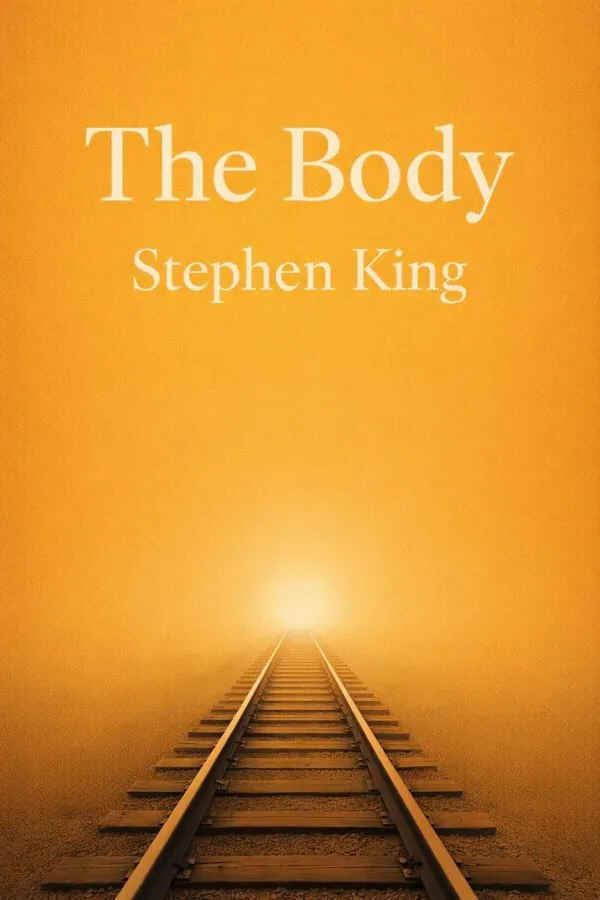
The Body: Summary & Key Insights
by Stephen King
 10 min9 chaptersAudio available
Key Takeaways from The Body
Growing up rarely happens all at once; it arrives through a series of shocks that make the world feel permanently different.
Some of the most important relationships in our lives do not last forever, yet they define us permanently.
Children do not enter the world as blank slates; communities assign them stories before they are old enough to challenge them.
People do not tell stories only for entertainment; they tell them to organize fear, grief, humiliation, and hope.
Boys are often taught to perform toughness long before they know how to process pain.
What Is The Body About?
The Body by Stephen King is a classics book. Stephen King’s The Body is far more than a story about four boys walking through the Maine woods in search of a dead body. Set in the early 1960s, this novella follows Gordie Lachance, Chris Chambers, Teddy Duchamp, and Vern Tessio as they leave their small town behind and enter a world where childhood innocence collides with fear, violence, loyalty, and grief. On the surface, it is an adventure. Beneath that surface, it is a deeply observant portrait of friendship, class, memory, and the moment when children begin to understand the harsh truths of adulthood. What makes The Body endure is its emotional honesty. King captures the raw intensity of boyhood with remarkable precision: the humor, the bravado, the insecurity, the longing to be seen, and the quiet terror of growing up. Best known for horror, King proves here that his greatest gift may be his understanding of ordinary people under emotional pressure. This novella matters because it speaks to universal experiences: losing innocence, choosing who to become, and realizing that the friends who shape us most often belong to a brief, unforgettable season of life.
This FizzRead summary covers all 9 key chapters of The Body in approximately 10 minutes, distilling the most important ideas, arguments, and takeaways from Stephen King's work. Also available as an audio summary and Key Quotes Podcast.
The Body
Stephen King’s The Body is far more than a story about four boys walking through the Maine woods in search of a dead body. Set in the early 1960s, this novella follows Gordie Lachance, Chris Chambers, Teddy Duchamp, and Vern Tessio as they leave their small town behind and enter a world where childhood innocence collides with fear, violence, loyalty, and grief. On the surface, it is an adventure. Beneath that surface, it is a deeply observant portrait of friendship, class, memory, and the moment when children begin to understand the harsh truths of adulthood.
What makes The Body endure is its emotional honesty. King captures the raw intensity of boyhood with remarkable precision: the humor, the bravado, the insecurity, the longing to be seen, and the quiet terror of growing up. Best known for horror, King proves here that his greatest gift may be his understanding of ordinary people under emotional pressure. This novella matters because it speaks to universal experiences: losing innocence, choosing who to become, and realizing that the friends who shape us most often belong to a brief, unforgettable season of life.
Who Should Read The Body?
This book is perfect for anyone interested in classics and looking to gain actionable insights in a short read. Whether you're a student, professional, or lifelong learner, the key ideas from The Body by Stephen King will help you think differently.
- ✓Readers who enjoy classics and want practical takeaways
- ✓Professionals looking to apply new ideas to their work and life
- ✓Anyone who wants the core insights of The Body in just 10 minutes
Want the full summary?
Get instant access to this book summary and 100K+ more with Fizz Moment.
Get Free SummaryAvailable on App Store • Free to download
Key Chapters
Growing up rarely happens all at once; it arrives through a series of shocks that make the world feel permanently different. In The Body, the boys begin their journey with the excitement of a secret mission, but what they really encounter is the end of a simpler understanding of life. The trip becomes a threshold experience, forcing them to confront death, cruelty, social hierarchy, and their own vulnerability. What looks like a boyhood adventure slowly reveals itself as an initiation into reality.
Stephen King shows that loss of innocence is not only about seeing something disturbing. It is also about recognizing that adults are flawed, families can fail, and the future is not equally open to everyone. Gordie carries grief over his brother’s death and the emotional neglect that follows. Chris understands that in his town, reputation can harden into fate. Teddy hides pain behind reckless performance. Vern wants safety but follows the others because belonging matters more than comfort. Each boy is already being shaped by forces larger than himself.
This idea remains practical because modern readers also go through gradual awakenings. A teenager may realize that talent alone is not enough without support. An adult may discover that family stories are incomplete or misleading. A friend group may drift as people face realities they can no longer ignore. These moments feel private, but they are universal.
The Body reminds us that maturity begins when we stop assuming life will protect us from pain and start deciding how we will respond to it. Actionable takeaway: Reflect on one moment that changed how you saw the world, and ask how it still influences your choices, fears, and values today.
Some of the most important relationships in our lives do not last forever, yet they define us permanently. One of the deepest truths in The Body is that the bond between the four boys is both intense and temporary. They are united by age, geography, need, and circumstance, but the novella never pretends that such closeness can remain untouched by time. In fact, part of its emotional power comes from knowing that childhood friendships often burn brightly and then disappear.
King presents friendship not as a sentimental ideal but as a force that helps people survive difficult environments. Gordie and Chris share a connection rooted in mutual recognition. Chris sees Gordie’s intelligence and sensitivity when others overlook him. Gordie sees Chris’s moral seriousness beneath his bad reputation. Teddy brings raw energy and a desperate hunger for loyalty. Vern adds fear, humor, and humanity. Together they form a fragile community where each boy is accepted more fully than he is at home.
This matters beyond fiction because many people underestimate the value of friends who show up during formative years. A classmate who believed in your talent, a teammate who stood by you, or a friend who listened during family turmoil may shape your confidence for decades. Even if you lose touch, the emotional imprint remains.
The novella also teaches that friendship is not measured only by duration. Some relationships matter because they arrive at exactly the right time. They help us become ourselves, then life carries us elsewhere. Actionable takeaway: Think of one person whose friendship changed you, and honor that influence by reaching out, expressing gratitude, or paying that same belief forward to someone else.
Children do not enter the world as blank slates; communities assign them stories before they are old enough to challenge them. In The Body, Stephen King explores how class and reputation shape the boys’ lives long before adulthood. Chris Chambers is intelligent, thoughtful, and morally perceptive, yet he is trapped under the weight of his family name. Because he comes from a family associated with trouble, adults assume he will become trouble. That expectation is one of the novella’s most painful and realistic observations.
King’s insight is that social judgment often becomes self-reinforcing. When authority figures expect failure, they notice mistakes more than potential. When a child is treated as suspect, he may eventually act out the role he has been assigned. Chris understands this system clearly, which is why his bond with Gordie matters so much. Gordie offers him something rare: the possibility of being seen as he truly is rather than as his town defines him.
This theme has practical relevance in schools, workplaces, and families. A student labeled lazy may actually be discouraged. A new employee from a less prestigious background may be underestimated despite strong ability. A younger sibling may inherit a family narrative that limits self-belief. Labels become dangerous when they replace curiosity.
The Body urges readers to notice how quickly people are reduced to shorthand. More importantly, it suggests that one person’s faith can interrupt a destructive pattern. Gordie’s recognition does not erase Chris’s circumstances, but it gives him a different mirror. Actionable takeaway: Identify one label you have accepted about yourself or someone else, and replace it with a more specific, evidence-based understanding.
People do not tell stories only for entertainment; they tell them to organize fear, grief, humiliation, and hope. In The Body, storytelling is central to how Gordie understands himself and the world. He is not just a participant in the journey. He is also the one who transforms experience into narrative. This matters because King presents storytelling as an act of survival. To tell a story is to take chaos and give it shape.
Gordie’s gift for observation separates him from the others, but it also isolates him. His family, especially after his brother’s death, does not fully see his value. Writing becomes a way for him to claim identity when emotional support is scarce. The novella suggests that creativity is not a luxury. For some people, it is the means by which pain becomes bearable and memory becomes meaningful.
This insight applies widely. Journaling after a breakup, making art after loss, or speaking honestly about a difficult childhood can all function as forms of narrative repair. Even in professional life, people use stories to make sense of setbacks: why a business failed, what a career change meant, how a challenge changed priorities. When experience remains unspoken, it often stays overwhelming. When it is articulated, it can become understandable.
King also reminds us that stories are selective. Memory reshapes events, emphasizing what matters emotionally rather than documenting everything neutrally. That does not make a story false. It makes it human. Actionable takeaway: Write down a difficult experience from your life in a clear beginning-middle-end form, and notice how turning it into a story changes your understanding of it.
Boys are often taught to perform toughness long before they know how to process pain. In The Body, each of the four friends uses some version of masculine performance to hide fear, shame, or loneliness. They joke, brag, insult one another, and act brave, yet beneath that behavior are children desperate for protection and respect. King’s portrayal is nuanced because he does not mock them for this. He shows how limited emotional tools produce defensive behavior.
Teddy is the clearest example. His volatility and bravado are ways of managing deep trauma. Chris acts mature and controlled, but he carries hurt and anger about the role society has imposed on him. Gordie often appears observant and calm, yet he is grieving and unsure of his worth. Even Vern’s comic nervousness reflects a basic truth: fear is everywhere, but few of them know how to name it directly.
This theme remains highly relevant. Many adults still struggle to express sadness, insecurity, or tenderness without feeling exposed. In workplaces, this can appear as aggression instead of stress. In friendships, it can appear as teasing instead of honesty. In families, it can appear as silence instead of care. Emotional illiteracy is not harmless; it creates distance and misunderstanding.
The Body suggests that genuine courage is not just facing danger. It is also allowing yourself to be known. Chris and Gordie’s conversations are powerful because they move beyond performance into real feeling. That honesty creates trust. Actionable takeaway: In your next meaningful conversation, replace one defensive joke or vague answer with a direct statement about what you actually feel.
When people leave familiar settings, their values become easier to see. The journey in The Body is physically simple but morally revealing. As the boys move farther from town, stripped of adult supervision and ordinary routines, their deeper selves emerge. Fear, loyalty, selfishness, tenderness, and conscience all become visible through small decisions. The walk to find the body is therefore not just a plot device. It is a test.
King uses the road structure to show that character is often exposed through pressure rather than intention. People may think of themselves as brave until danger appears. They may claim loyalty until loyalty becomes costly. Chris repeatedly demonstrates an inner decency and seriousness that contrast with his reputation. Gordie reveals a strong moral core as he becomes less passive and more self-aware. Even conflicts among the boys show how group dynamics shape individual behavior.
This idea is practical because modern life offers many smaller journeys of the same kind: a stressful project, a family crisis, a difficult trip, or a period of uncertainty. Under pressure, our habits become visible. Do we become generous or controlling? Honest or evasive? Supportive or self-protective? We often learn who we are not from abstract values but from lived moments.
The novella also warns that moral courage is not always dramatic. Sometimes it appears as restraint, compassion, or refusal to humiliate someone weaker. Actionable takeaway: After your next challenging experience, review your actions honestly and ask which moments reflected the person you want to be and which ones need conscious correction.
The past does not return to us as a neutral recording; it comes back colored by longing, regret, tenderness, and loss. The Body is told through an older Gordie looking back, and that perspective matters enormously. The story is not simply about what happened on one summer journey. It is about how memory preserves certain moments because they continue to explain who we became. King understands that memory is less about exact detail than emotional truth.
This gives the novella its reflective tone. The adult narrator knows things the boys do not: how short that period of closeness will be, how life will separate them, and how difficult it is to recover the intensity of youth. That hindsight creates both beauty and sadness. The remembered world is vivid, but it is also unreachable. The very act of remembering becomes a recognition of loss.
Readers can apply this insight in everyday life by examining how their own memories function. We often revisit adolescence, first friendships, family homes, or pivotal failures not because we want factual replay but because those moments still hold unresolved meaning. A place may seem larger, warmer, or more painful in memory because emotion magnifies it. Understanding this can make us more compassionate toward ourselves and others. People are often arguing not about facts alone but about the emotional meanings attached to them.
The Body does not treat memory as unreliable in a cynical way. Instead, it suggests that memory reveals what mattered most. Actionable takeaway: Revisit one important memory and ask not only, “What happened?” but also, “Why does this still matter to me now?”
Nothing exposes the fragility of childhood more clearly than the presence of death. In The Body, the boys’ quest centers on finding a dead body, but the deeper role of death in the novella is psychological and symbolic. It stands at the edge of their adolescence, forcing them to confront what cannot be joked away or outrun. Their curiosity begins almost as spectacle, yet it becomes an encounter with the finality and seriousness of life.
For Gordie especially, death is not abstract. He is still living in the shadow of his brother’s loss, and that grief shapes how he sees himself. The search for the body therefore echoes his private emotional landscape. King uses this connection to show that grief often distorts identity. When a family loses someone, surviving children may feel invisible, compared, or emotionally abandoned. Gordie’s pain is sharpened by the sense that his brother was valued in ways he is not.
This theme has real-life power because many people first understand mortality not through philosophy but through a specific loss: a grandparent, a sibling, a friend, even the public tragedy that suddenly feels personal. Such moments rearrange priorities. They can create fear, but they can also create urgency, empathy, and seriousness.
The novella does not offer easy comfort about death. Instead, it suggests that facing mortality can deepen life. It makes friendship matter more, words matter more, and choices matter more. Actionable takeaway: Use awareness of life’s limits to clarify one priority you have been postponing, and take one concrete step toward it this week.
We inherit families, towns, reputations, and wounds, but eventually we must decide whether they will define the rest of our lives. The Body is powerful because it understands both sides of this truth. The boys are undeniably shaped by their environments, yet the novella also asks whether they can move beyond what has been assigned to them. This tension between fate and self-determination gives the story much of its emotional depth.
Gordie’s path depends on recognizing that his sensitivity and talent are strengths, not liabilities. Chris’s struggle is even harder: he must believe in his own worth despite social forces constantly telling him otherwise. King does not romanticize escape. Leaving behind a limiting identity is difficult, especially when institutions, family history, and community expectations work against you. Still, the book insists that moments of recognition matter. A conversation, a mentor, an act of courage, or a decision to pursue education can open a different future.
This applies widely. People often stay trapped in old roles: the irresponsible one, the quiet one, the failure, the caretaker, the angry one. Those identities may begin as reactions to circumstance, but they harden through repetition. Change starts when we see those roles as patterns rather than essence.
The Body offers a sober but hopeful message: your origins matter, but they are not your full story. Becoming yourself requires both honesty about damage and refusal to be reduced by it. Actionable takeaway: Name one inherited narrative that limits you, then define one behavior that would begin proving a different story true.
All Chapters in The Body
About the Author
Stephen King is an American author born in Portland, Maine, in 1947. He is one of the most successful and influential writers of contemporary fiction, known primarily for horror, suspense, and supernatural novels, though his work also includes fantasy, crime, and literary coming-of-age stories. His breakthrough came with Carrie in 1974, and he went on to write major bestsellers such as The Shining, Salem’s Lot, It, Misery, and 11/22/63. King is celebrated for his memorable characters, sharp ear for everyday speech, and ability to reveal emotional truth beneath extraordinary situations. The Body demonstrates his range especially well, showing his talent for intimate, deeply humane storytelling about friendship, grief, and youth. Many of his works have been adapted into acclaimed films and television series.
Get This Summary in Your Preferred Format
Read or listen to the The Body summary by Stephen King anytime, anywhere. FizzRead offers multiple formats so you can learn on your terms — all free.
Available formats: App · Audio · PDF · EPUB — All included free with FizzRead
Download The Body PDF and EPUB Summary
Key Quotes from The Body
“Growing up rarely happens all at once; it arrives through a series of shocks that make the world feel permanently different.”
“Some of the most important relationships in our lives do not last forever, yet they define us permanently.”
“Children do not enter the world as blank slates; communities assign them stories before they are old enough to challenge them.”
“People do not tell stories only for entertainment; they tell them to organize fear, grief, humiliation, and hope.”
“Boys are often taught to perform toughness long before they know how to process pain.”
Frequently Asked Questions about The Body
The Body by Stephen King is a classics book that explores key ideas across 9 chapters. Stephen King’s The Body is far more than a story about four boys walking through the Maine woods in search of a dead body. Set in the early 1960s, this novella follows Gordie Lachance, Chris Chambers, Teddy Duchamp, and Vern Tessio as they leave their small town behind and enter a world where childhood innocence collides with fear, violence, loyalty, and grief. On the surface, it is an adventure. Beneath that surface, it is a deeply observant portrait of friendship, class, memory, and the moment when children begin to understand the harsh truths of adulthood. What makes The Body endure is its emotional honesty. King captures the raw intensity of boyhood with remarkable precision: the humor, the bravado, the insecurity, the longing to be seen, and the quiet terror of growing up. Best known for horror, King proves here that his greatest gift may be his understanding of ordinary people under emotional pressure. This novella matters because it speaks to universal experiences: losing innocence, choosing who to become, and realizing that the friends who shape us most often belong to a brief, unforgettable season of life.
More by Stephen King

You Might Also Like





Browse by Category
Ready to read The Body?
Get the full summary and 100K+ more books with Fizz Moment.