
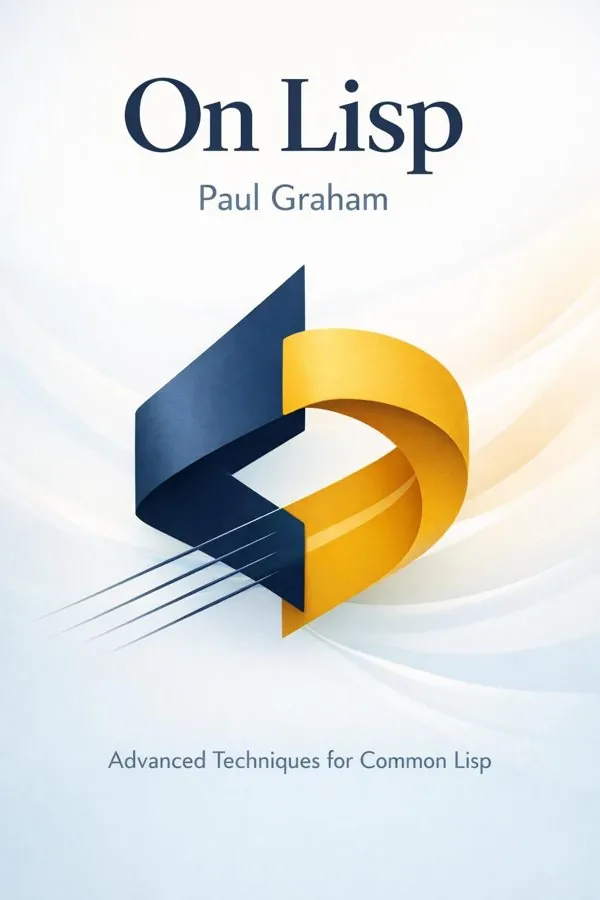
On Lisp: Advanced Techniques for Common Lisp: Summary & Key Insights
by Paul Graham
 10 min6 chaptersAudio available
What Is On Lisp: Advanced Techniques for Common Lisp About?
On Lisp: Advanced Techniques for Common Lisp by Paul Graham is a programming book spanning 6 pages. On Lisp is a comprehensive exploration of advanced programming techniques in Common Lisp. Paul Graham delves into the power of Lisp macros, functional programming, and metaprogramming, demonstrating how Lisp’s flexibility enables programmers to create expressive and extensible code. The book is widely regarded as a classic in Lisp literature, offering deep insights into abstraction, code generation, and the philosophy of programming.
This FizzRead summary covers all 6 key chapters of On Lisp: Advanced Techniques for Common Lisp in approximately 10 minutes, distilling the most important ideas, arguments, and takeaways from Paul Graham's work. Also available as an audio summary and Key Quotes Podcast.
On Lisp: Advanced Techniques for Common Lisp
On Lisp is a comprehensive exploration of advanced programming techniques in Common Lisp. Paul Graham delves into the power of Lisp macros, functional programming, and metaprogramming, demonstrating how Lisp’s flexibility enables programmers to create expressive and extensible code. The book is widely regarded as a classic in Lisp literature, offering deep insights into abstraction, code generation, and the philosophy of programming.
Who Should Read On Lisp: Advanced Techniques for Common Lisp?
This book is perfect for anyone interested in programming and looking to gain actionable insights in a short read. Whether you're a student, professional, or lifelong learner, the key ideas from On Lisp: Advanced Techniques for Common Lisp by Paul Graham will help you think differently.
- ✓Readers who enjoy programming and want practical takeaways
- ✓Professionals looking to apply new ideas to their work and life
- ✓Anyone who wants the core insights of On Lisp: Advanced Techniques for Common Lisp in just 10 minutes
Want the full summary?
Get instant access to this book summary and 100K+ more with Fizz Moment.
Get Free SummaryAvailable on App Store • Free to download
Key Chapters
To begin unraveling the power of Lisp, you must understand its evaluation model—the beating heart of the language. In Lisp, every expression is a list, and every list can be evaluated. This simple truth is what opens the door to metaprogramming.
Unlike most languages, where code and data inhabit separate realms, in Lisp they are made of the same stuff: S-expressions. This unity allows a program not just to run code but to treat code as manipulable data. You can construct, deconstruct, and transform programs exactly as you would any other list. This is the conceptual foundation that makes Lisp macros possible.
When you evaluate an expression in Lisp, the interpreter applies a set of rules. If the expression is atomic—a symbol or a number—it evaluates to its bound value. If it’s a list, Lisp treats the first element as a function or operator, and the rest as arguments. What’s remarkable is that these same lists can represent unevaluated code. Thus, you can write programs that generate new programs, a concept I emphasize throughout *On Lisp* as the ultimate form of abstraction.
Metaprogramming in Lisp is not an exotic trick. It’s the natural consequence of Lisp’s simplicity. The boundary between writing code and writing code that writes code dissolves. Where most languages use rigid syntax trees and opaque compilation steps, Lisp offers transparent structures—lists—that can be composed at runtime.
This design gives rise to one of Lisp’s most consequential insights: programs are data. Once you internalize this truth, your relationship to programming changes. You stop thinking in terms of static instructions and begin sculpting dynamic expressions. You stop fighting syntax and start shaping semantics.
That’s why I say Lisp’s evaluation model is the foundation of metaprogramming. It invites you to think of the language as a mirror of your own reasoning process. As your ideas evolve, your programs can literally reshape themselves.
At the heart of Lisp’s expressive power lies functional programming—the discipline of treating functions as first-class citizens. Functions in Lisp aren’t just tools for computation; they are composable abstractions that represent transformations of thought.
You include functions wherever you would include data. You pass them to other functions, return them from computations, and store them in variables. This capability lets you build higher-order functions—functions that operate on other functions. It’s these that allow Lisp to transcend simple procedural logic and reach a level of expressiveness usually reserved for mathematical reasoning.
Recursion, one of Lisp’s oldest and most beautiful techniques, replaces loops with self-reference. It may seem inefficient until you realize that recursion mirrors the way we conceptualize problems: breaking a task into similar subtasks until reaching a base case. Lisp’s functional style, combined with closures—functions that remember their lexical environment—makes it possible to write code that naturally captures state without depending on mutable variables.
Functional programming in Lisp cultivates an attitude of composability: the belief that small, pure transformations can be combined to express vast complexity. In *On Lisp*, I explore how higher-order functions become reusable patterns—the precursors of macros, but at the functional level. When you understand how functional abstractions accumulate into expressive constructs, you’re prepared to reach the next level: building new syntactic forms through macros.
In the Lisp world, each layer of abstraction builds upon the previous ones. Functional programming gives you the discipline of abstraction, while macros give you the freedom of creation. Together, they form the living architecture of Lisp.
+ 4 more chapters — available in the FizzRead app
All Chapters in On Lisp: Advanced Techniques for Common Lisp
About the Author
Paul Graham is a computer scientist, entrepreneur, and essayist known for his work on Lisp, startups, and programming languages. He co-founded Viaweb, one of the first web-based applications, which later became Yahoo! Store, and later co-founded Y Combinator, a leading startup accelerator. His writings on technology and entrepreneurship have influenced generations of programmers and founders.
Get This Summary in Your Preferred Format
Read or listen to the On Lisp: Advanced Techniques for Common Lisp summary by Paul Graham anytime, anywhere. FizzRead offers multiple formats so you can learn on your terms — all free.
Available formats: App · Audio · PDF · EPUB — All included free with FizzRead
Download On Lisp: Advanced Techniques for Common Lisp PDF and EPUB Summary
Key Quotes from On Lisp: Advanced Techniques for Common Lisp
“To begin unraveling the power of Lisp, you must understand its evaluation model—the beating heart of the language.”
“At the heart of Lisp’s expressive power lies functional programming—the discipline of treating functions as first-class citizens.”
Frequently Asked Questions about On Lisp: Advanced Techniques for Common Lisp
On Lisp: Advanced Techniques for Common Lisp by Paul Graham is a programming book that explores key ideas across 6 chapters. On Lisp is a comprehensive exploration of advanced programming techniques in Common Lisp. Paul Graham delves into the power of Lisp macros, functional programming, and metaprogramming, demonstrating how Lisp’s flexibility enables programmers to create expressive and extensible code. The book is widely regarded as a classic in Lisp literature, offering deep insights into abstraction, code generation, and the philosophy of programming.
More by Paul Graham
You Might Also Like
ANSI Common Lisp
Paul Graham
10 min
Automate the Boring Stuff with Python: Practical Programming for Total Beginners
Al Sweigart
10 min
Black Hat Python: Python Programming for Hackers and Pentesters
Justin Seitz
10 min
Building Microservices: Designing Fine-Grained Systems
Sam Newman
10 min
C++ Primer
Stanley B. Lippman, Josée Lajoie, Barbara E. Moo
10 min
Clean Code: A Handbook of Agile Software Craftsmanship
Robert C. Martin
10 minBrowse by Category
Ready to read On Lisp: Advanced Techniques for Common Lisp?
Get the full summary and 100K+ more books with Fizz Moment.