
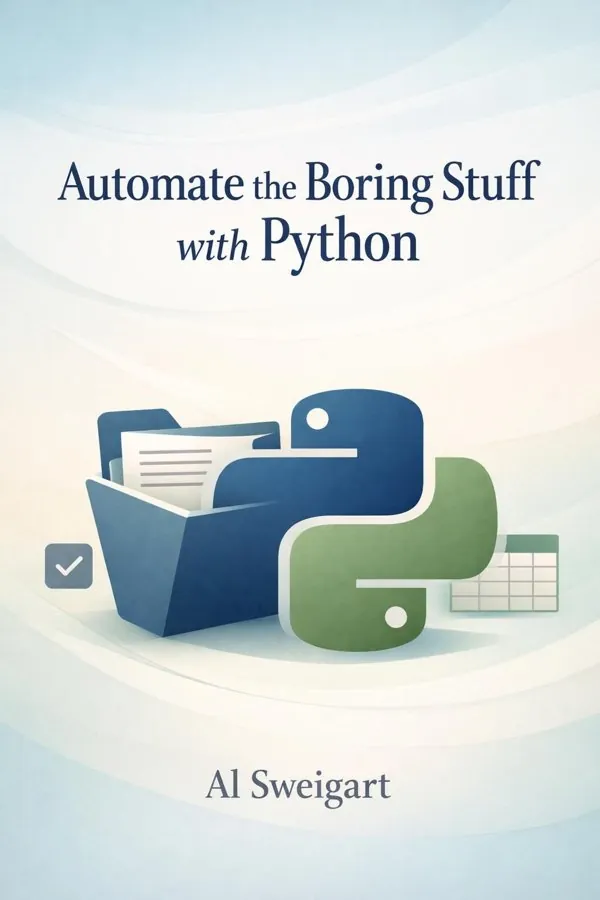
Automate the Boring Stuff with Python: Practical Programming for Total Beginners: Summary & Key Insights
by Al Sweigart
 10 min10 chaptersAudio available
Key Takeaways from Automate the Boring Stuff with Python: Practical Programming for Total Beginners
The most powerful discovery in this book is that automation is not reserved for professional programmers.
A computer is only as useful as the instructions it can follow, and the real magic begins when code can make decisions.
Many repetitive tasks are not difficult because they are complex; they are difficult because they involve too much information.
A surprising amount of office work, admin work, and digital housekeeping comes down to one thing: manipulating text.
If you want an immediate payoff from learning Python, few areas are more satisfying than automating files and folders.
What Is Automate the Boring Stuff with Python: Practical Programming for Total Beginners About?
Automate the Boring Stuff with Python: Practical Programming for Total Beginners by Al Sweigart is a programming book spanning 7 pages. Most people do not start learning programming because they dream of building complex software. They start because they are tired of doing the same dull computer tasks over and over again. Automate the Boring Stuff with Python meets that need perfectly. In this practical, beginner-friendly book, Al Sweigart shows how Python can be used to handle repetitive tasks such as renaming files, filling spreadsheets, scraping websites, sending emails, generating documents, and even controlling the mouse and keyboard. Instead of teaching coding as an abstract academic subject, he teaches it as a tool for solving everyday problems. That approach is what makes the book so valuable. Readers learn fundamental programming concepts, but they learn them in the context of useful, real-world projects. The result is motivating: you can see quickly how even a few lines of code can save hours of manual effort. Sweigart is especially effective as a guide because he writes for complete beginners. As a software developer and educator known for accessible programming books, he has a talent for making intimidating ideas feel manageable. This book matters because it turns coding from a mystery into a practical life skill.
This FizzRead summary covers all 10 key chapters of Automate the Boring Stuff with Python: Practical Programming for Total Beginners in approximately 10 minutes, distilling the most important ideas, arguments, and takeaways from Al Sweigart's work. Also available as an audio summary and Key Quotes Podcast.
Automate the Boring Stuff with Python: Practical Programming for Total Beginners
Most people do not start learning programming because they dream of building complex software. They start because they are tired of doing the same dull computer tasks over and over again. Automate the Boring Stuff with Python meets that need perfectly. In this practical, beginner-friendly book, Al Sweigart shows how Python can be used to handle repetitive tasks such as renaming files, filling spreadsheets, scraping websites, sending emails, generating documents, and even controlling the mouse and keyboard. Instead of teaching coding as an abstract academic subject, he teaches it as a tool for solving everyday problems.
That approach is what makes the book so valuable. Readers learn fundamental programming concepts, but they learn them in the context of useful, real-world projects. The result is motivating: you can see quickly how even a few lines of code can save hours of manual effort. Sweigart is especially effective as a guide because he writes for complete beginners. As a software developer and educator known for accessible programming books, he has a talent for making intimidating ideas feel manageable. This book matters because it turns coding from a mystery into a practical life skill.
Who Should Read Automate the Boring Stuff with Python: Practical Programming for Total Beginners?
This book is perfect for anyone interested in programming and looking to gain actionable insights in a short read. Whether you're a student, professional, or lifelong learner, the key ideas from Automate the Boring Stuff with Python: Practical Programming for Total Beginners by Al Sweigart will help you think differently.
- ✓Readers who enjoy programming and want practical takeaways
- ✓Professionals looking to apply new ideas to their work and life
- ✓Anyone who wants the core insights of Automate the Boring Stuff with Python: Practical Programming for Total Beginners in just 10 minutes
Want the full summary?
Get instant access to this book summary and 100K+ more with Fizz Moment.
Get Free SummaryAvailable on App Store • Free to download
Key Chapters
The most powerful discovery in this book is that automation is not reserved for professional programmers. Many people assume coding is too technical, too mathematical, or too advanced for everyday use, but Al Sweigart dismantles that belief from the beginning. Python works especially well for beginners because its syntax is readable, its commands often resemble plain English, and it allows you to get useful results quickly. Instead of spending weeks on theory, readers can begin by making the computer perform practical tasks.
Sweigart frames programming as a way to eliminate friction in daily life. If you regularly rename batches of files, copy data between folders, clean up text, or pull information from websites, those are not just chores; they are opportunities for automation. Python becomes less of a programming language and more of a productivity partner. This shift in mindset is crucial because it changes the question from “Can I learn to code?” to “What annoying task can I teach my computer to do for me?”
The book also introduces the basic tools needed to begin: installing Python, using the interactive shell, writing simple scripts, and understanding how code is executed. These early steps matter because they make readers feel capable fast. Once you see your first program run, programming stops being abstract and becomes concrete.
A practical example is writing a tiny script that prints a greeting, performs arithmetic, or repeats a task automatically. These seem simple, but they create confidence and momentum. The takeaway is clear: start with one repetitive task in your own digital life and treat it as your first automation project.
A computer is only as useful as the instructions it can follow, and the real magic begins when code can make decisions. That is why flow control is one of the most important foundations in the book. Sweigart explains that programs become powerful when they can respond differently depending on conditions, repeat actions when needed, and group steps into reusable functions.
He introduces core logic tools such as Boolean values, comparison operators, if statements, while loops, for loops, and functions. These are not taught as dry syntax rules but as ways of thinking. An if statement answers a practical question: if this condition is true, what should happen next? A loop addresses repetition: how can the computer do something 1,000 times without complaint? A function addresses structure: how can a useful task be packaged once and reused many times?
Imagine checking a folder every day and moving files based on file type. A script can inspect each filename, decide whether it is an image, a document, or a spreadsheet, and then sort it into the right location. The sorting behavior depends on conditions, and the repeated checking depends on loops. Or consider a script that scans a list of sales numbers and flags only values above a target threshold. Flow control makes that possible.
The broader lesson is that programming is structured problem-solving. You break a task into small decisions and repeated actions, then express those clearly in code. That mental model matters far beyond Python itself. The actionable takeaway is to take one repetitive process you do manually and write down its decisions and repeated steps before trying to code it.
Many repetitive tasks are not difficult because they are complex; they are difficult because they involve too much information. Names, numbers, files, addresses, prices, dates, and messages quickly become overwhelming when handled one item at a time. Sweigart shows that data structures are what allow programmers to manage that information efficiently. Lists, dictionaries, strings, and tuples become practical containers for the raw material of automation.
Lists are useful when you need to store ordered collections, such as filenames in a folder or products in an inventory. Dictionaries are ideal when values need labels, such as matching employee names to email addresses or product codes to prices. Strings matter because so much everyday automation involves text: editing, searching, splitting, joining, and cleaning written content. Once readers understand these structures, tasks that seemed chaotic become organized and programmable.
One of the book’s strengths is how it connects these concepts to ordinary computer work. If you want to pull phone numbers from a text file, standardize inconsistent naming patterns, or search emails for key phrases, you are working with text and collections of data. Even something as simple as counting how often a word appears in a document becomes easy when the data is stored well.
Sweigart also emphasizes that data cleaning is often where much of real automation happens. Before a task can be automated, information often needs to be converted into a format the script can reliably process.
The practical takeaway is to stop treating data as a pile of isolated items. When you face a repetitive task involving names, files, or text, first decide what structure fits it best: a list for sequences, a dictionary for labeled information, or a string method for text cleanup.
A surprising amount of office work, admin work, and digital housekeeping comes down to one thing: manipulating text. Sweigart makes this point through one of the book’s most useful themes, showing that text processing can eliminate countless small frustrations. Whether you are cleaning copied data, searching documents, formatting names, or extracting patterns from large blocks of text, Python can do in seconds what would take a person much longer by hand.
This is where string methods and regular expressions become especially valuable. Basic string tools let you change capitalization, remove extra spaces, split text into pieces, and combine fragments into a clean format. Regular expressions go further by helping you detect structured text patterns, such as phone numbers, email addresses, dates, or invoice codes. What appears messy to the human eye often follows hidden patterns, and Python can be trained to recognize them.
Consider a practical example: you copy customer information from multiple sources, and every entry uses a slightly different phone number format. One has parentheses, another uses hyphens, another has spaces. A Python script can scan all of them, extract the numbers, and convert them into a single consistent style. Similarly, a script can parse a long report and pull every email address into a clean contact list.
This matters because small text tasks often consume more time than people realize. They interrupt focus and create avoidable errors. The actionable takeaway is to identify one recurring text-cleaning annoyance in your workflow and automate it with string methods first, then use regular expressions when pattern matching is required.
If you want an immediate payoff from learning Python, few areas are more satisfying than automating files and folders. Sweigart shows that the operating system is full of repetitive work: renaming files, moving documents, creating backups, deleting duplicates, generating folders, and checking whether files exist. These are exactly the kinds of tasks computers should handle better than humans.
The book explains how Python interacts with the file system using modules that let scripts inspect directories, build file paths, copy items, move them, and delete them safely. This is not glamorous programming, but it is deeply useful. Anyone who has ever manually sorted downloads, archived old reports, or renamed hundreds of image files knows how tedious this work can be.
The real strength of this section is that it teaches readers to think operationally. A folder is not just a place where files sit; it is a system that can be monitored and maintained. A script can check for missing files, create timestamped backups every day, move screenshots into organized folders, or rename scanned receipts according to a clear pattern. Even a simple script that deletes files older than a certain date can save substantial manual effort.
Sweigart also subtly teaches caution here. Automation should reduce risk, not create it, so scripts that modify files should be tested carefully. That habit is essential for beginner programmers.
The practical takeaway is to choose one recurring file-management chore, such as sorting downloads or backing up documents, and build a small script that performs it automatically on a test folder before applying it to real files.
One reason this book resonates so strongly with working professionals is that it addresses two major sources of modern busywork: spreadsheets and websites. Sweigart shows that many people spend hours copying values between cells, updating records, checking pages for information, or collecting data from online sources. Python can turn these routines into repeatable systems.
When working with spreadsheets, Python can read data, write updates, modify worksheets, and generate reports. This is incredibly useful for finance tasks, inventories, attendance logs, budget tracking, or sales summaries. Instead of manually opening a spreadsheet and applying the same edits line by line, a script can process every row consistently. That reduces both time and mistakes.
On the web side, the book introduces the basics of scraping pages and interacting with online information. A script can download a webpage, locate specific elements, and extract useful content such as headlines, prices, or links. This is powerful for research, monitoring competitors, collecting job postings, or tracking product availability. The key lesson is that if the information is public and structured, it can often be gathered automatically.
Sweigart presents these skills in a practical way, not as advanced data engineering but as beginner-friendly automation. The point is not to build massive systems; it is to eliminate repetitive browsing and manual data transfer.
The actionable takeaway is to identify one spreadsheet process or website-checking routine you do repeatedly and ask whether the data could be read, updated, or collected automatically with a short Python script.
Not every task has a clean file format, a convenient API, or an accessible spreadsheet. Sometimes the only way to perform a task is to click buttons, type into forms, and interact with software exactly as a person would. This is where GUI automation becomes so compelling. Sweigart shows that Python can control the mouse and keyboard, open programs, fill forms, and navigate repetitive on-screen tasks.
This idea feels almost magical to beginners because it makes automation visible. Instead of hidden code quietly processing data, you can watch the computer move the cursor, type text, and interact with applications. For many readers, this is the moment when programming starts to feel genuinely transformative.
GUI automation is especially helpful in environments where no direct integration exists. Imagine generating invoices in a legacy desktop app, entering repeated data into an internal tool, or clicking through the same sequence in a browser-based system every morning. If a human can perform those steps consistently, Python can often replicate them. That said, Sweigart also makes clear that GUI automation can be fragile. If screen layouts change or windows move, scripts may fail. Reliability requires careful testing and sometimes safety controls such as pauses or fail-safe triggers.
The broader lesson is that automation exists on a spectrum. Some tasks are best solved through direct data processing, while others need visible interface control. The actionable takeaway is to reserve GUI automation for repetitive, rule-based tasks that cannot be handled more directly, and always test with safeguards before relying on it in real workflows.
Many of the most draining forms of knowledge work are not intellectually hard; they are administratively repetitive. Writing routine emails, generating standardized documents, organizing PDFs, and running the same process on a schedule can consume more time than people expect. Sweigart demonstrates that Python can automate these tasks too, extending automation beyond data cleanup into day-to-day professional communication and document handling.
This section of the book highlights a crucial principle: automation becomes exponentially more useful when it works in the background. A script that sends reminder emails, updates a report every morning, or generates a templated document from a data source does more than save time once. It removes a recurring obligation. That mental relief can be as valuable as the time savings themselves.
Practical examples include filling out Word documents from templates, extracting or combining PDF content, sending emails automatically, and scheduling scripts to run at specific times. A small business owner could automatically generate invoices. A teacher might create individualized feedback documents. An office administrator could send routine weekly updates without rebuilding the message from scratch every time.
What makes these automations effective is consistency. Computers do not forget attachments, mistype names when properly programmed, or skip scheduled steps because they are distracted.
The actionable takeaway is to look for recurring communications or document tasks in your week. If a message, report, or form follows a repeatable pattern, it is a strong candidate for template-based automation combined with scheduled execution.
One of the most reassuring messages in the book is that errors are not a sign you are bad at programming. They are part of programming. Beginners often imagine experienced coders write perfect scripts on the first try, but Sweigart presents a healthier and more realistic view: writing code means testing assumptions, finding mistakes, and improving your script step by step.
This section covers debugging techniques, error handling, and the importance of reading error messages carefully. Rather than panicking when a program crashes, readers are encouraged to treat the error as information. What line failed? What data caused the issue? Did a variable hold an unexpected value? This mindset turns frustration into investigation.
The book also introduces ways to make programs more robust. Error handling allows scripts to respond gracefully when something goes wrong, such as a missing file, a broken network connection, or invalid user input. This matters greatly in automation, because unattended scripts will eventually encounter edge cases. A script that fails safely and reports the issue is far better than one that silently causes damage.
Sweigart’s approach helps beginners understand that debugging is not separate from programming; it is programming. Reliable automation requires not just writing code that works in ideal conditions, but writing code that survives real conditions.
The practical takeaway is to build the habit of testing scripts on small samples first, reading error messages fully, and adding checks for common failure points. Every bug you investigate carefully strengthens both your code and your problem-solving ability.
The deeper argument of Automate the Boring Stuff with Python is not merely that Python can save time. It is that practical projects are the best way to learn programming. Sweigart consistently teaches through useful applications, showing that motivation grows when learners can connect code to visible results. This project-first style is especially effective for total beginners because it replaces abstract intimidation with immediate usefulness.
When readers complete a script that renames files, extracts phone numbers, updates a spreadsheet, or sends an automated email, they experience a shift in identity. They stop seeing themselves as someone “trying to learn programming” and start seeing themselves as someone who can build solutions. That psychological change is essential. Confidence does not come from memorizing syntax; it comes from solving problems.
The book also shows that small projects compound. A reader might begin with a script that cleans text, then add file handling, then connect it to spreadsheet input, then schedule it to run automatically. What begins as a simple utility becomes a mini system. That progression teaches one of programming’s most important lessons: meaningful tools are built incrementally.
This project-based mindset also makes learning sustainable. Instead of waiting until you feel fully prepared, you learn by doing, revising, and extending. Each project becomes both a useful tool and a lesson.
The actionable takeaway is to keep a running list of annoying digital chores in your life. Choose one that is small, specific, and repetitive, build a simple script to handle part of it, and let each finished project become the foundation for the next.
All Chapters in Automate the Boring Stuff with Python: Practical Programming for Total Beginners
About the Author
Al Sweigart is a software developer and programming educator best known for writing beginner-friendly books that make coding practical and approachable. He has earned a wide audience by focusing on hands-on projects, clear explanations, and real-world applications rather than abstract theory. His work often centers on Python and automation, helping readers use programming to solve everyday problems such as file management, text processing, and repetitive office tasks. Sweigart’s teaching style is especially popular with self-taught learners and complete beginners because he explains technical concepts in an encouraging, accessible way. Through books, tutorials, and educational resources, he has helped countless readers take their first steps into programming and discover that coding can be both useful and enjoyable.
Get This Summary in Your Preferred Format
Read or listen to the Automate the Boring Stuff with Python: Practical Programming for Total Beginners summary by Al Sweigart anytime, anywhere. FizzRead offers multiple formats so you can learn on your terms — all free.
Available formats: App · Audio · PDF · EPUB — All included free with FizzRead
Download Automate the Boring Stuff with Python: Practical Programming for Total Beginners PDF and EPUB Summary
Key Quotes from Automate the Boring Stuff with Python: Practical Programming for Total Beginners
“The most powerful discovery in this book is that automation is not reserved for professional programmers.”
“A computer is only as useful as the instructions it can follow, and the real magic begins when code can make decisions.”
“Many repetitive tasks are not difficult because they are complex; they are difficult because they involve too much information.”
“A surprising amount of office work, admin work, and digital housekeeping comes down to one thing: manipulating text.”
“If you want an immediate payoff from learning Python, few areas are more satisfying than automating files and folders.”
Frequently Asked Questions about Automate the Boring Stuff with Python: Practical Programming for Total Beginners
Automate the Boring Stuff with Python: Practical Programming for Total Beginners by Al Sweigart is a programming book that explores key ideas across 10 chapters. Most people do not start learning programming because they dream of building complex software. They start because they are tired of doing the same dull computer tasks over and over again. Automate the Boring Stuff with Python meets that need perfectly. In this practical, beginner-friendly book, Al Sweigart shows how Python can be used to handle repetitive tasks such as renaming files, filling spreadsheets, scraping websites, sending emails, generating documents, and even controlling the mouse and keyboard. Instead of teaching coding as an abstract academic subject, he teaches it as a tool for solving everyday problems. That approach is what makes the book so valuable. Readers learn fundamental programming concepts, but they learn them in the context of useful, real-world projects. The result is motivating: you can see quickly how even a few lines of code can save hours of manual effort. Sweigart is especially effective as a guide because he writes for complete beginners. As a software developer and educator known for accessible programming books, he has a talent for making intimidating ideas feel manageable. This book matters because it turns coding from a mystery into a practical life skill.
You Might Also Like
ANSI Common Lisp
Paul Graham
10 min
Black Hat Python: Python Programming for Hackers and Pentesters
Justin Seitz
10 min
Building Microservices: Designing Fine-Grained Systems
Sam Newman
10 min
C++ Primer
Stanley B. Lippman, Josée Lajoie, Barbara E. Moo
10 min
Clean Code: A Handbook of Agile Software Craftsmanship
Robert C. Martin
10 min
Cloud Native Patterns: Designing Change-Tolerant Software
Cornelia Davis
10 minBrowse by Category
Ready to read Automate the Boring Stuff with Python: Practical Programming for Total Beginners?
Get the full summary and 100K+ more books with Fizz Moment.