
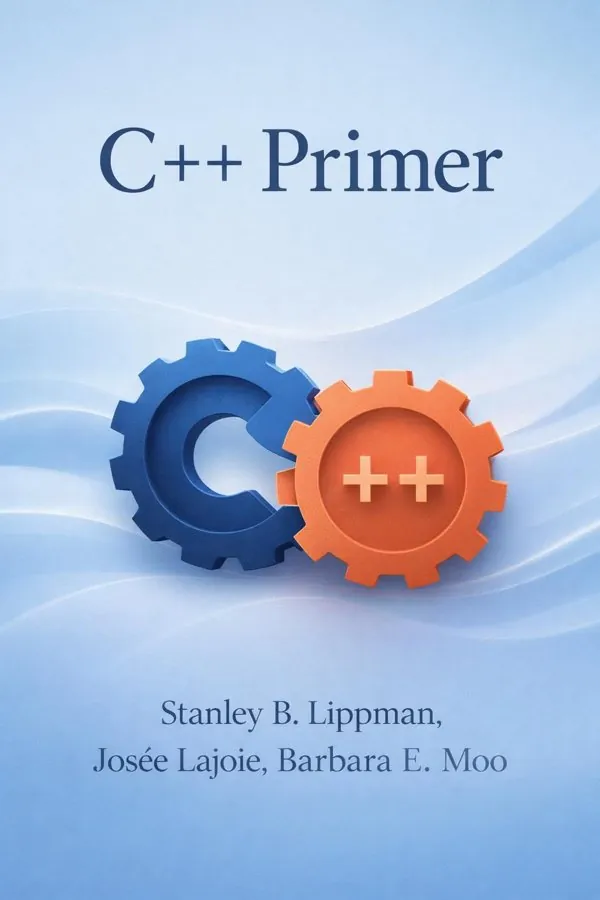
C++ Primer: Summary & Key Insights
by Stanley B. Lippman, Josée Lajoie, Barbara E. Moo
 10 min9 chaptersAudio available
Key Takeaways from C++ Primer
Every programming language makes a trade-off, but C++ is unusual because it refuses to choose between efficiency and expressiveness.
A tiny program can reveal the philosophy of an entire language.
Programs fail less often when developers understand what their data really is.
Complex software becomes manageable only when ideas are given names and boundaries.
Good programmers do not prove their skill by rebuilding what already exists; they prove it by knowing when to rely on trusted tools.
What Is C++ Primer About?
C++ Primer by Stanley B. Lippman, Josée Lajoie, Barbara E. Moo is a programming book spanning 15 pages. C++ Primer is one of the most respected introductions to the C++ programming language because it does far more than teach syntax. It guides readers through the logic of the language itself: how C++ balances low-level control with high-level abstraction, why its features exist, and how to use them to write code that is clear, efficient, and reliable. The book begins with the basics of compiling and running simple programs, then steadily builds toward classes, generic programming, object-oriented design, dynamic memory, and the Standard Library. What makes it especially valuable is its emphasis on modern C++ practices rather than outdated habits carried over from C. The book matters because C++ remains essential in systems programming, game development, finance, embedded software, high-performance computing, and large-scale application development. Learning it well opens doors to understanding both software architecture and machine-level efficiency. Stanley B. Lippman, Josée Lajoie, and Barbara E. Moo bring rare authority to the subject: they are not only experienced educators and developers, but contributors to the evolution of C++ itself. The result is a rigorous, practical, and highly trusted guide for anyone serious about mastering the language.
This FizzRead summary covers all 9 key chapters of C++ Primer in approximately 10 minutes, distilling the most important ideas, arguments, and takeaways from Stanley B. Lippman, Josée Lajoie, Barbara E. Moo's work. Also available as an audio summary and Key Quotes Podcast.
C++ Primer
C++ Primer is one of the most respected introductions to the C++ programming language because it does far more than teach syntax. It guides readers through the logic of the language itself: how C++ balances low-level control with high-level abstraction, why its features exist, and how to use them to write code that is clear, efficient, and reliable. The book begins with the basics of compiling and running simple programs, then steadily builds toward classes, generic programming, object-oriented design, dynamic memory, and the Standard Library. What makes it especially valuable is its emphasis on modern C++ practices rather than outdated habits carried over from C.
The book matters because C++ remains essential in systems programming, game development, finance, embedded software, high-performance computing, and large-scale application development. Learning it well opens doors to understanding both software architecture and machine-level efficiency. Stanley B. Lippman, Josée Lajoie, and Barbara E. Moo bring rare authority to the subject: they are not only experienced educators and developers, but contributors to the evolution of C++ itself. The result is a rigorous, practical, and highly trusted guide for anyone serious about mastering the language.
Who Should Read C++ Primer?
This book is perfect for anyone interested in programming and looking to gain actionable insights in a short read. Whether you're a student, professional, or lifelong learner, the key ideas from C++ Primer by Stanley B. Lippman, Josée Lajoie, Barbara E. Moo will help you think differently.
- ✓Readers who enjoy programming and want practical takeaways
- ✓Professionals looking to apply new ideas to their work and life
- ✓Anyone who wants the core insights of C++ Primer in just 10 minutes
Want the full summary?
Get instant access to this book summary and 100K+ more with Fizz Moment.
Get Free SummaryAvailable on App Store • Free to download
Key Chapters
Every programming language makes a trade-off, but C++ is unusual because it refuses to choose between efficiency and expressiveness. That is the starting insight of C++ Primer: C++ was designed to preserve the speed and control of C while adding tools that help programmers manage complexity in larger systems. This combination is why the language remains central in domains where performance matters and software must still be maintainable.
The book explains that C++ evolved from "C with Classes" into a multi-paradigm language. You can write procedural code, object-oriented code, generic code with templates, and modern resource-safe code using the standard library. Instead of forcing one style, C++ gives you a toolkit. That flexibility is powerful, but also dangerous if used without discipline. A beginner can easily mix raw pointers, manual memory management, and inconsistent abstractions, creating code that is fragile. The authors therefore present C++ as a language whose true strength emerges when features are used intentionally and together.
In practice, this means understanding not just what a feature does, but when it should be preferred. For example, you can store text as a C-style character array, but std::string is usually safer and easier. You can manage dynamic memory manually with new and delete, but standard library containers and modern ownership tools reduce errors dramatically. You can write repetitive code for each type, or use templates to build reusable components.
The larger lesson is that C++ rewards thoughtful design. It lets you get close to the machine when necessary, but also gives you abstraction mechanisms to avoid drowning in detail. Actionable takeaway: treat C++ as a language of deliberate choices, and prefer the highest-level feature that solves the problem without sacrificing needed performance.
A tiny program can reveal the philosophy of an entire language. C++ Primer uses the classic "Hello, World!" example not as a ritual, but as a doorway into compilation, namespaces, library usage, statements, and program structure. What looks trivial at first becomes a map of how C++ programs are built and executed.
The book breaks down the anatomy of a simple program: the include directive brings in declarations from the standard library, main marks the program’s entry point, std::cout writes output, and return reports success. Even this first example introduces a key C++ truth: useful programs are built from your code plus reusable library components. From the beginning, the reader learns that writing software is not about inventing everything from scratch, but about composing reliable parts.
This chapter also introduces core habits that matter later. Compilation errors are not merely obstacles; they are feedback. Syntax matters because C++ is precise. Scope matters because names live in specific contexts. Types matter because the compiler uses them to enforce correctness and generate efficient code. Even basic input and output begin training the reader to think about interfaces between a program and the outside world.
A practical example is reading two numbers from standard input and printing their sum. This small exercise teaches variables, stream extraction, program flow, and testing with actual user input. It also demonstrates that programming becomes understandable when broken into tiny verifiable steps.
The deeper message is that early simplicity is not childish; it is foundational. Most bugs in advanced software still come from misunderstood basics: type errors, wrong assumptions, bad input handling, and unclear structure. Actionable takeaway: whenever learning a new C++ concept, build a minimal working example first and use it to inspect how the language behaves.
Programs fail less often when developers understand what their data really is. One of the strongest contributions of C++ Primer is its careful treatment of types, expressions, statements, strings, vectors, arrays, and control flow. Before readers can write elegant abstractions, they must understand the building blocks that every abstraction depends on.
The book explains fundamental types such as integers, floating-point values, characters, booleans, and references, then moves into the mechanics of initialization, assignment, arithmetic, and logical evaluation. This matters because C++ gives the programmer a great deal of control, but with that control comes responsibility. An uninitialized variable, a mismatched type conversion, or an out-of-bounds array access can produce subtle defects. The authors consistently emphasize safer and clearer alternatives, such as preferring std::string to raw character arrays and std::vector to fixed arrays for dynamic collections.
Expressions and statements are presented not as isolated grammar rules, but as the machinery of computation. Conditionals decide which branch runs; loops process repeated work; operators combine values into results. For example, a program that counts word frequencies from user input relies on strings for text, vectors for storage, loops for scanning, comparisons for matching, and expressions for updating counts. The reader begins to see that real programs are just combinations of a few deeply understood parts.
The chapter also teaches the discipline of writing code the compiler can help verify. Clear initialization, explicit conditions, and standard library types make programs easier to reason about. This is especially important in C++, where weak habits can scale into hard-to-find errors.
Actionable takeaway: become fluent in fundamental types and basic control structures before chasing advanced features, because most C++ bugs are ultimately mistakes in data handling and expression logic.
Complex software becomes manageable only when ideas are given names and boundaries. C++ Primer shows that functions and classes are not merely syntax for structuring code; they are tools for structuring thinking. A function captures a single operation. A class captures a concept along with the data and behavior that define it.
The discussion of functions begins with parameter passing, return values, overloading, inline functions, and const correctness. These details matter because a good function interface communicates intent. A parameter passed by const reference tells the caller that the function needs access without modification or copying. An overloaded function lets the same conceptual operation work naturally with different inputs. A carefully chosen return type can express ownership, success, or computed value.
Classes extend this idea into modeling. Instead of scattering related data and procedures across a program, a class bundles them into one coherent abstraction. The book demonstrates how constructors establish valid initial state, member functions define behavior, and access control protects invariants. For example, a Sales_data class might hold book identifiers, units sold, and revenue, while member functions compute average price or combine records safely. This makes code easier to test, reuse, and evolve.
The authors also stress copy control, which is a signature C++ topic. If a class manages resources, then copying, assignment, and destruction must be defined carefully. This is not just technical bookkeeping. It is part of answering a deeper design question: what does it mean to duplicate or transfer an object?
In everyday programming, functions and classes reduce duplication, clarify responsibility, and localize change. When requirements shift, well-designed abstractions absorb change instead of spreading it everywhere. Actionable takeaway: whenever code feels repetitive or a data structure has rules attached to it, turn that repeated logic into a function or class with a clear, minimal interface.
Good programmers do not prove their skill by rebuilding what already exists; they prove it by knowing when to rely on trusted tools. C++ Primer consistently teaches that mastery of C++ includes mastery of the standard library. The IO library, sequential containers, associative containers, strings, iterators, and generic algorithms are not optional conveniences. They are the foundation of productive, modern C++ practice.
The IO library introduces stream-based input and output, enabling programs to read from files, console input, and memory buffers through a unified interface. Containers such as vector, list, deque, map, set, and unordered_map let programmers store data according to usage patterns rather than inventing custom storage for every task. Algorithms such as sort, find, copy, accumulate, and transform separate the operation from the data structure, making code more reusable and expressive.
A simple example makes the point: if you need to count how many times each word appears in a text file, you can combine ifstream, std::string, and std::map in a few clear steps. If you need to filter and sort values, you can store them in a vector and call standard algorithms rather than writing manual loops with indexing and temporary bookkeeping. The result is often shorter, faster, and less error-prone code.
The library also encourages a more abstract style of thought. Instead of asking, "How do I manually move through this array?" you ask, "What container expresses my data, and what algorithm expresses my intention?" That shift is central to becoming effective in C++.
Actionable takeaway: before writing custom data structures or loops, check whether a standard container, iterator pattern, or algorithm already solves the problem more clearly and safely.
Many programmers learn C++ syntax quickly but never truly master the language because they never master ownership. C++ Primer makes dynamic memory and copy control central because memory management is where the language’s power and risk become most visible. Understanding how objects are created, copied, moved, shared, and destroyed is essential to writing robust software.
The book explains stack allocation versus heap allocation, raw pointers, references, object lifetimes, constructors, destructors, and the effects of copying. It then connects these topics to classes that manage resources. If an object owns dynamic memory, a file handle, or some other resource, then careless copying can create leaks, double deletions, dangling pointers, or inconsistent state. This is why copy constructors, copy assignment operators, and destructors matter: they define what object identity and ownership mean.
The authors also steer readers toward safer patterns. Standard library containers automatically manage their own memory. Smart pointers and resource-managing classes express ownership more clearly than raw pointers do. This reflects one of the deepest lessons of modern C++: resources should be tied to object lifetimes so cleanup happens automatically and predictably.
Consider a text editor buffering document lines. Storing lines in a std::vector<std::string> avoids manual memory bookkeeping entirely. If a larger design needs shared access to a document object, ownership choices become explicit and testable rather than hidden in ad hoc pointer usage.
This topic is not only about avoiding crashes. It is about designing programs where responsibility is clear. Who owns this resource? When should it be released? Can it be copied, or only moved? Mature C++ code answers these questions in the type system and object model. Actionable takeaway: whenever you use dynamic resources, define ownership first and prefer automatic resource management over manual new/delete.
A program becomes easier to extend when its structure reflects the ideas in the problem domain. C++ Primer introduces object-oriented programming not as a fashionable doctrine, but as a practical way to model variation, hierarchy, and shared behavior. Through inheritance, virtual functions, and dynamic binding, C++ allows programmers to write code that works with families of related types through a common interface.
The core idea is substitution. A base class defines what operations clients may rely on, while derived classes provide specialized behavior. For example, in a document-rendering system, a base DisplayObject might define a draw function, while TextBox, Image, and Chart each implement drawing differently. Client code can operate on references or pointers to the base class without caring about the exact concrete type until runtime. This decouples interface from implementation and makes systems easier to expand.
The book also warns against shallow use of inheritance. Inheritance should represent a genuine "is-a" relationship and be used when polymorphic behavior is needed. Otherwise, composition is often better. This distinction matters because bad inheritance designs create brittle hierarchies where small changes ripple through the system. The authors emphasize virtual destructors, access control, and the careful design of public interfaces so that object-oriented code remains safe and understandable.
In practice, object-oriented design is valuable when building frameworks, GUIs, simulation engines, or business logic layers where multiple related entities share common operations. It lets new types be introduced with minimal changes to existing code if the abstractions are sound.
Actionable takeaway: use inheritance only when multiple types must be treated through a common interface, and design base classes around stable behavior rather than implementation details.
The most durable code often describes a pattern rather than a single case. C++ Primer shows that templates and generic programming are among C++’s greatest strengths because they let programmers write algorithms and data structures in terms of requirements rather than specific types. Instead of writing one function for integers, another for doubles, and another for strings, you define the operation once and let the compiler generate the appropriate version.
Templates work because many computations depend on capabilities, not exact types. A sorting algorithm, for instance, needs elements that can be compared and moved; it does not care whether those elements are numbers, strings, or user-defined objects. The standard library embodies this philosophy through generic algorithms and iterator-based design. Functions like sort, find, and copy operate across containers because they rely on abstract interfaces provided by iterators.
The book explains both the power and discipline of templates. Generic code is highly reusable, but it must be designed with clear assumptions. Error messages can become difficult when template requirements are vague. Good generic programming therefore means documenting expectations, choosing names well, and relying on standard conventions when possible. For example, a custom type meant to work with standard algorithms should support the operations those algorithms expect.
Templates also encourage better software architecture. They help eliminate duplication without sacrificing performance because type-specific code is generated at compile time. This is one reason C++ remains dominant in high-performance libraries: abstraction need not cost speed.
In real-world terms, templates are what make containers like vector and map broadly useful, and what allow businesses to build reusable frameworks without committing to one data type too early. Actionable takeaway: whenever you notice the same logic repeated for multiple types, ask whether the code should be expressed as a template or generic algorithm.
Knowing many language features is not the same as writing good C++. One of the book’s strongest underlying messages is that style and discipline matter as much as capability. C++ Primer consistently nudges readers toward modern, safer, and clearer practices: prefer standard library abstractions, use const to express intent, avoid needless manual memory management, separate interface from implementation, and let types carry meaning.
This approach is important because C++ has accumulated features over decades, and not all common habits are equally wise. Older C-style techniques may still compile, but they often create unnecessary risk. Raw arrays can decay into pointers and lose size information. Manual memory handling creates opportunities for leaks and lifetime bugs. Overuse of macros obscures meaning. By contrast, standard strings, vectors, algorithms, and resource-managing objects reduce accidental complexity.
The book also teaches a mindset of incremental reasoning. Write code that is easy to test in small pieces. Let the compiler catch as much as possible. Keep object invariants strong. Choose abstractions that make invalid states harder to represent. For example, instead of passing unrelated variables around a program, package them into a class whose constructor enforces valid initialization. Instead of exposing internal data structures everywhere, provide a focused interface.
These habits matter in teams as much as in solo projects. Readable code lowers onboarding costs, reduces defect rates, and makes maintenance feasible years later. In industries where C++ software may outlive its original authors, this is a competitive advantage.
Actionable takeaway: measure your C++ quality not by how many advanced tricks you know, but by whether your code is easier to understand, safer to modify, and harder to misuse.
All Chapters in C++ Primer
About the Authors
Stanley B. Lippman, Josée Lajoie, and Barbara E. Moo are among the most respected names in C++ education. Lippman was a software engineer at Bell Laboratories and one of the early developers and evangelists of C++, giving him direct insight into the language’s foundations and evolution. Lajoie played an important role in C++ standardization and is widely recognized for her expertise in language design and advanced C++ programming. Moo is a software developer and educator known for her ability to explain complex technical concepts with clarity and precision. Together, they combine deep practical experience, standards-level knowledge, and exceptional teaching skill. Their collaboration on C++ Primer helped establish it as a definitive guide for programmers seeking a rigorous, modern, and trustworthy introduction to C++.
Get This Summary in Your Preferred Format
Read or listen to the C++ Primer summary by Stanley B. Lippman, Josée Lajoie, Barbara E. Moo anytime, anywhere. FizzRead offers multiple formats so you can learn on your terms — all free.
Available formats: App · Audio · PDF · EPUB — All included free with FizzRead
Download C++ Primer PDF and EPUB Summary
Key Quotes from C++ Primer
“Every programming language makes a trade-off, but C++ is unusual because it refuses to choose between efficiency and expressiveness.”
“A tiny program can reveal the philosophy of an entire language.”
“Programs fail less often when developers understand what their data really is.”
“Complex software becomes manageable only when ideas are given names and boundaries.”
“Good programmers do not prove their skill by rebuilding what already exists; they prove it by knowing when to rely on trusted tools.”
Frequently Asked Questions about C++ Primer
C++ Primer by Stanley B. Lippman, Josée Lajoie, Barbara E. Moo is a programming book that explores key ideas across 9 chapters. C++ Primer is one of the most respected introductions to the C++ programming language because it does far more than teach syntax. It guides readers through the logic of the language itself: how C++ balances low-level control with high-level abstraction, why its features exist, and how to use them to write code that is clear, efficient, and reliable. The book begins with the basics of compiling and running simple programs, then steadily builds toward classes, generic programming, object-oriented design, dynamic memory, and the Standard Library. What makes it especially valuable is its emphasis on modern C++ practices rather than outdated habits carried over from C. The book matters because C++ remains essential in systems programming, game development, finance, embedded software, high-performance computing, and large-scale application development. Learning it well opens doors to understanding both software architecture and machine-level efficiency. Stanley B. Lippman, Josée Lajoie, and Barbara E. Moo bring rare authority to the subject: they are not only experienced educators and developers, but contributors to the evolution of C++ itself. The result is a rigorous, practical, and highly trusted guide for anyone serious about mastering the language.
You Might Also Like

ANSI Common Lisp
Paul Graham
10 min
Automate the Boring Stuff with Python: Practical Programming for Total Beginners
Al Sweigart
10 min
Black Hat Python: Python Programming for Hackers and Pentesters
Justin Seitz
10 min
Building Microservices: Designing Fine-Grained Systems
Sam Newman
10 min
Clean Code: A Handbook of Agile Software Craftsmanship
Robert C. Martin
10 min
Cloud Native Patterns: Designing Change-Tolerant Software
Cornelia Davis
10 minBrowse by Category
Ready to read C++ Primer?
Get the full summary and 100K+ more books with Fizz Moment.