
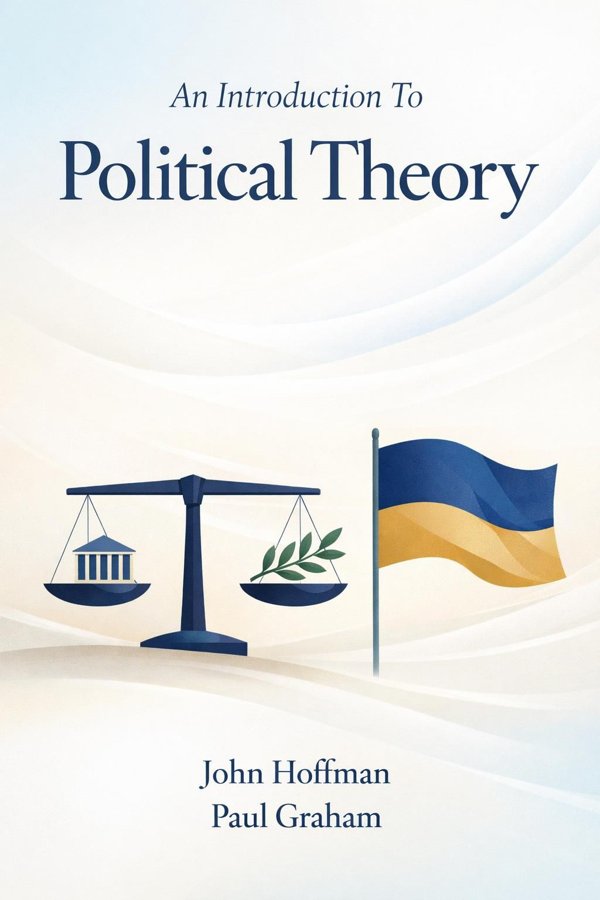
An Introduction To Political Theory: Summary & Key Insights
 10 min9 chaptersAudio available
What Is An Introduction To Political Theory About?
An Introduction To Political Theory by John Hoffman, Paul Graham is a politics book spanning 9 pages. An Introduction to Political Theory provides a comprehensive overview of the key concepts, ideologies, and debates that shape modern political thought. It explores fundamental ideas such as liberty, equality, justice, rights, and democracy, while engaging with both classical and contemporary theorists. The book is widely used in undergraduate political science courses for its clarity and balanced approach to complex theoretical issues.
This FizzRead summary covers all 9 key chapters of An Introduction To Political Theory in approximately 10 minutes, distilling the most important ideas, arguments, and takeaways from John Hoffman, Paul Graham's work. Also available as an audio summary and Key Quotes Podcast.
An Introduction To Political Theory
An Introduction to Political Theory provides a comprehensive overview of the key concepts, ideologies, and debates that shape modern political thought. It explores fundamental ideas such as liberty, equality, justice, rights, and democracy, while engaging with both classical and contemporary theorists. The book is widely used in undergraduate political science courses for its clarity and balanced approach to complex theoretical issues.
Who Should Read An Introduction To Political Theory?
This book is perfect for anyone interested in politics and looking to gain actionable insights in a short read. Whether you're a student, professional, or lifelong learner, the key ideas from An Introduction To Political Theory by John Hoffman, Paul Graham will help you think differently.
- ✓Readers who enjoy politics and want practical takeaways
- ✓Professionals looking to apply new ideas to their work and life
- ✓Anyone who wants the core insights of An Introduction To Political Theory in just 10 minutes
Want the full summary?
Get instant access to this book summary and 100K+ more with Fizz Moment.
Get Free SummaryAvailable on App Store • Free to download
Key Chapters
Political theory begins with a distinction. It is not merely empirical, as political science often is, nor purely speculative, as philosophy can be. It occupies a middle ground—concerned with values, power, and legitimacy as they apply to actual human societies. To study political theory is to engage both the ‘ought’ and the ‘is’. We question what governments do and what they should do, how citizens behave and how they ought to behave.
In our book, we present political theory as fundamentally a normative enterprise. It deals with questions such as ‘What is the right way to govern?’ and ‘How should society allocate goods and responsibilities?’ The theorist does not merely observe systems but evaluates them against standards derived from justice, equality, liberty, and other ethical concepts.
We also emphasize that political theory is historical. It evolves through dialogue among thinkers who respond to the conditions of their time: Plato reacts to the collapse of Athenian democracy; Locke to the English Civil War; Marx to the industrial revolution; and contemporary theorists to globalization and ecological crisis. Thus, political theory never stands still—it develops through engagement with real experience.
Rather than treating the field as an archive of frozen ideas, we invite readers to see it as a living discourse. Theory provides the lens through which the meaning of politics itself is refracted. It shapes how we understand power, justice, and participation. Political theory insists that no political reality is neutral—it always reflects assumptions about human nature and social order. That insight, we believe, is its deepest contribution.
Few words inspire as many passions or provoke as many disputes as liberty. In our discussion, we distinguish between negative and positive liberty following Isaiah Berlin’s influential framework. Negative liberty refers to freedom from interference—‘I am free when no one prevents me from doing what I wish.’ Positive liberty is freedom to self-realize—‘I am free when I am my own master.’
Each form of liberty carries political implications. Negative liberty underpins liberal and libertarian thought, emphasizing minimal government and protection from coercion. Positive liberty, by contrast, undergirds traditions that view freedom as empowerment, achievable through collective control over social conditions.
We explore how these competing understandings shape institutions. A liberal democracy protects civil rights and limits state power in the name of negative freedom. A social democracy expands access to education, healthcare, and welfare in pursuit of positive freedom. Neither is inherently superior; both reveal tensions inherent in our conceptions of autonomy.
We also engage with critics who question the boundaries of freedom. Marx argued that formal liberty is meaningless without material capability; feminists have shown how social norms can constrain individuals more effectively than laws. Through these perspectives, liberty emerges not as isolation but as interdependence—our ability to act freely depends upon the social structures that enable choice.
In political life, recognizing this dual nature of liberty challenges us to balance autonomy with solidarity. To defend freedom is not only to resist tyranny but also to create conditions where everyone can participate meaningfully in the life of the community.
+ 7 more chapters — available in the FizzRead app
All Chapters in An Introduction To Political Theory
About the Authors
John Hoffman is a political theorist and former lecturer at the University of Leicester, known for his work on political theory and social philosophy. Paul Graham is a senior lecturer in politics at London Metropolitan University, specializing in political theory and the history of political thought.
Get This Summary in Your Preferred Format
Read or listen to the An Introduction To Political Theory summary by John Hoffman, Paul Graham anytime, anywhere. FizzRead offers multiple formats so you can learn on your terms — all free.
Available formats: App · Audio · PDF · EPUB — All included free with FizzRead
Download An Introduction To Political Theory PDF and EPUB Summary
Key Quotes from An Introduction To Political Theory
“Political theory begins with a distinction.”
“Few words inspire as many passions or provoke as many disputes as liberty.”
Frequently Asked Questions about An Introduction To Political Theory
An Introduction To Political Theory by John Hoffman, Paul Graham is a politics book that explores key ideas across 9 chapters. An Introduction to Political Theory provides a comprehensive overview of the key concepts, ideologies, and debates that shape modern political thought. It explores fundamental ideas such as liberty, equality, justice, rights, and democracy, while engaging with both classical and contemporary theorists. The book is widely used in undergraduate political science courses for its clarity and balanced approach to complex theoretical issues.
You Might Also Like

Antifa: The Anti-Fascist Handbook
Mark Bray
10 min
Attack from Within: How Disinformation Is Sabotaging America
Barbara McQuade
10 min
Coercion, Capital, and European States, AD 990–1992
Charles Tilly
10 min
Digital Democracy: Concepts, Methodologies, Tools, and Applications
Various Authors
10 min
Fascism
Stanley G. Payne
10 min
Fire And Fury: Inside The Trump White House
Michael Wolff
10 minBrowse by Category
Ready to read An Introduction To Political Theory?
Get the full summary and 100K+ more books with Fizz Moment.