
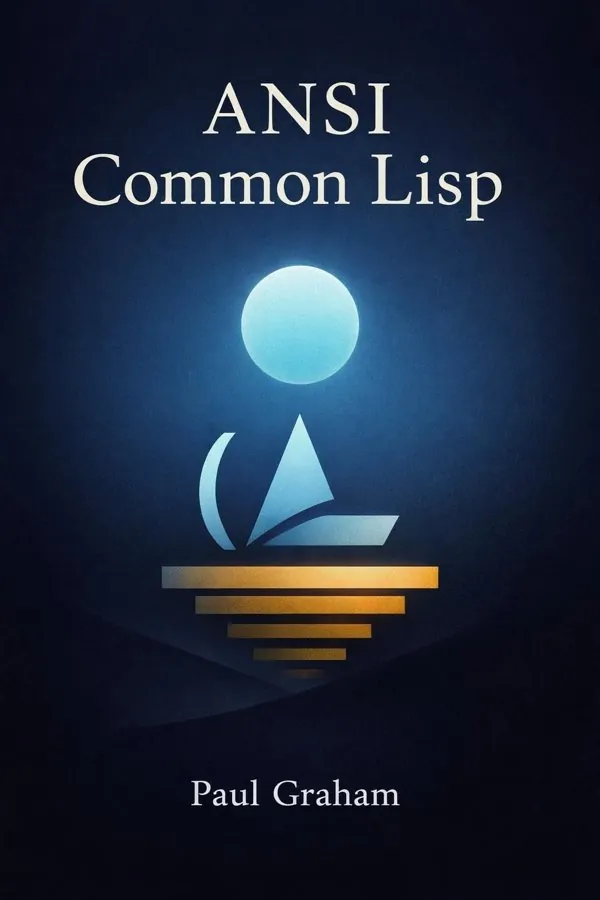
ANSI Common Lisp: Summary & Key Insights
by Paul Graham
 10 min9 chaptersAudio available
Key Takeaways from ANSI Common Lisp
Some programming languages are built to manage hardware efficiently; Lisp was built to express thought.
The deepest power in Lisp begins with a deceptively simple idea: code and data share the same basic form.
A language becomes elegant when a small number of rules can explain a wide range of behavior.
Good programmers do not merely store data; they choose representations that make the problem easier to solve.
Many programmers learn recursion as a technical trick; Lisp invites you to see it as a way of modeling structure.
What Is ANSI Common Lisp About?
ANSI Common Lisp by Paul Graham is a programming book spanning 7 pages. ANSI Common Lisp is Paul Graham’s clear, rigorous, and unusually elegant introduction to one of programming’s most influential languages. More than a syntax guide, the book teaches readers how to think in Lisp: how to represent ideas as data, build programs from small composable functions, and extend the language itself through macros. Graham starts with the fundamentals—atoms, lists, evaluation, variables, functions, and control structures—then moves into richer territory such as data structures, recursion, object-oriented programming with CLOS, and symbolic computing. What makes the book matter is not only that it explains Common Lisp well, but that it reveals why Lisp has shaped generations of programmers, language designers, and AI researchers. Common Lisp remains a language for people who care about abstraction, flexibility, and expressive power. Graham writes with the authority of a practitioner who has used Lisp to build real systems, not just study them academically. For readers who want to understand both a language and a programming philosophy, ANSI Common Lisp is a foundational text.
This FizzRead summary covers all 9 key chapters of ANSI Common Lisp in approximately 10 minutes, distilling the most important ideas, arguments, and takeaways from Paul Graham's work. Also available as an audio summary and Key Quotes Podcast.
ANSI Common Lisp
ANSI Common Lisp is Paul Graham’s clear, rigorous, and unusually elegant introduction to one of programming’s most influential languages. More than a syntax guide, the book teaches readers how to think in Lisp: how to represent ideas as data, build programs from small composable functions, and extend the language itself through macros. Graham starts with the fundamentals—atoms, lists, evaluation, variables, functions, and control structures—then moves into richer territory such as data structures, recursion, object-oriented programming with CLOS, and symbolic computing. What makes the book matter is not only that it explains Common Lisp well, but that it reveals why Lisp has shaped generations of programmers, language designers, and AI researchers. Common Lisp remains a language for people who care about abstraction, flexibility, and expressive power. Graham writes with the authority of a practitioner who has used Lisp to build real systems, not just study them academically. For readers who want to understand both a language and a programming philosophy, ANSI Common Lisp is a foundational text.
Who Should Read ANSI Common Lisp?
This book is perfect for anyone interested in programming and looking to gain actionable insights in a short read. Whether you're a student, professional, or lifelong learner, the key ideas from ANSI Common Lisp by Paul Graham will help you think differently.
- ✓Readers who enjoy programming and want practical takeaways
- ✓Professionals looking to apply new ideas to their work and life
- ✓Anyone who wants the core insights of ANSI Common Lisp in just 10 minutes
Want the full summary?
Get instant access to this book summary and 100K+ more with Fizz Moment.
Get Free SummaryAvailable on App Store • Free to download
Key Chapters
Some programming languages are built to manage hardware efficiently; Lisp was built to express thought. That difference explains why Common Lisp feels so distinctive. Originating in John McCarthy’s late-1950s work on symbolic computation, Lisp treated programs not merely as sequences of machine instructions but as symbolic expressions that could be manipulated, evaluated, and transformed. Common Lisp later emerged as a standardized effort to unify multiple Lisp dialects, preserving Lisp’s expressive core while making it practical for serious software development.
Paul Graham presents this history not as trivia, but as a clue to the language’s character. Common Lisp is unusually flexible because its foundations were designed around abstraction. Its syntax is minimal, its semantics are powerful, and its treatment of code as data opens doors that many mainstream languages keep closed. This is why Lisp became central in areas such as artificial intelligence, theorem proving, language design, and rapid prototyping. It lets programmers work at the level of concepts rather than getting trapped in rigid syntax or low-level ceremony.
A practical example is the way Lisp code can be generated by other Lisp programs. In many languages, building a mini-language for rules, workflows, or query construction is painful. In Lisp, that same task often feels natural because the language already represents programs in a uniform, manipulable structure. The result is a language that supports both experimentation and precision.
The actionable takeaway is to approach Common Lisp not just as a tool to learn, but as a model of how programming languages can amplify human thought.
The deepest power in Lisp begins with a deceptively simple idea: code and data share the same basic form. In Common Lisp, atoms—such as numbers, symbols, and strings—and lists form the building blocks of nearly everything. A list can represent raw data, a function call, a configuration, or even an entire program fragment. This uniformity is one of Lisp’s greatest strengths because it reduces the distance between thinking about a problem and expressing it in code.
Graham shows that learning Lisp means becoming comfortable with symbolic expressions, or s-expressions. Instead of scattered syntax rules, Lisp uses a consistent prefix notation. For example, (+ 2 3) is a list whose first element is the function + and whose remaining elements are arguments. Once this model clicks, programs become easier to parse mentally because they are built from nested structures rather than many special-case forms.
This matters in practice when building programs that inspect or generate structure. Suppose you are writing a rule engine for discounts in an online store. In many languages you might invent a custom parser. In Lisp, rules can be represented directly as lists, transformed with ordinary functions, and then evaluated or compiled. The same representation can be printed, stored, edited, and analyzed.
Beginners often focus too much on the parentheses and miss the larger lesson. The parentheses are not clutter; they reveal structure explicitly. The actionable takeaway is to practice reading and writing small expressions until you can see every Lisp program as a tree of meaning rather than a wall of punctuation.
A language becomes elegant when a small number of rules can explain a wide range of behavior. In Common Lisp, much of that elegance comes from understanding how values are bound, how functions are called, and how expressions are evaluated. Graham introduces variables, lexical scope, function definitions, and control constructs in a way that makes clear that Lisp is both disciplined and flexible.
Functions are central. You define behavior with defun, pass arguments, return values naturally, and often compose small functions into larger ones. Variables can be introduced with let for local bindings, which encourages clarity and modular reasoning. Lexical scope matters because it makes code predictable: a variable refers to the binding visible where the function was defined, not where it is later called. This supports abstraction and reduces surprising interactions.
Control flow in Lisp is similarly expressive. Conditionals like if, cond, and when handle branching cleanly. Iteration can be written using constructs such as do, dolist, dotimes, or loop, while recursion remains a natural fit for many problems. A practical example might be processing a list of orders: one function filters unpaid orders, another computes totals, and a conditional applies shipping rules. The code stays close to the problem because functions are lightweight and control forms are explicit.
The larger lesson is that Common Lisp gives you powerful building blocks without forcing one style. You can write procedural code, functional code, or hybrids as needed. The actionable takeaway is to master lexical scoping and small function composition first; they are the habits that make the rest of Lisp feel coherent.
Good programmers do not merely store data; they choose representations that make the problem easier to solve. ANSI Common Lisp emphasizes this through its coverage of lists, arrays, structures, and hash tables. Common Lisp is often associated with linked lists, but Graham is careful to show that the language offers a broad set of practical data structures suitable for real applications.
Lists are ideal when you want recursive processing, symbolic manipulation, or dynamic composition. They are natural for representing expressions, trees, and pipelines of transformations. Arrays are useful when indexed access matters, such as grids, matrices, or performance-sensitive buffers. Hash tables excel at quick lookup tasks, from caching computed results to tracking user sessions or word frequencies. Structures and other composite forms let you group related fields into readable, maintainable units.
Imagine building a text analysis tool. A list might represent tokenized sentences, a hash table could count word occurrences, and an array might store feature vectors for later classification. In Lisp, these structures coexist easily, and the language provides operations for traversing, updating, and transforming them without excessive ceremony. This is one reason Lisp remains effective for exploratory work: you can change representation as your understanding evolves.
Graham’s broader point is that expressive languages still reward disciplined engineering. Just because Lisp is flexible does not mean every problem should be solved with lists alone. The actionable takeaway is to ask, for every new task: what operations must be fast, what representation is most natural, and what structure will make future code simplest to understand?
Many programmers learn recursion as a technical trick; Lisp invites you to see it as a way of modeling structure. Because lists and trees are naturally recursive, operations on them often become clearer when written recursively. A function that sums a list, searches a tree, or transforms nested expressions can mirror the shape of the data itself. Graham uses this to show that recursion in Lisp is not ornamental—it often produces the most direct explanation of a problem.
At the same time, Common Lisp is not dogmatic. It supports robust iteration constructs as well, and Graham does not pretend that everything should be recursive. For tasks like counting, scanning arrays, or looping over collections with accumulators, iterative constructs may be more readable. The point is not to choose one camp but to understand when each style better captures the problem.
Consider a simple expression evaluator. A recursive function can process atoms directly and descend into lists when it encounters compound expressions. By contrast, a report generator that walks through thousands of customer records might be cleaner as an iteration with explicit state. Lisp gives you both options without making either awkward.
This flexibility is part of the Lisp mindset: let the problem shape the form of the solution. Recursion is especially powerful when the input is hierarchical; iteration shines when the task is linear or stateful. The actionable takeaway is to practice rewriting the same small program both recursively and iteratively, then choose the version whose structure best matches the data and intent.
The most famous Lisp insight is also the one that changes how programmers think forever: if code is data, then programs can write programs. Macros are the mechanism that makes this practical. In Common Lisp, macros let you define new syntactic forms that are expanded before evaluation, allowing you to shape the language around your domain instead of squeezing every idea into existing constructs.
Graham treats macros not as a clever hack but as a disciplined tool for abstraction. A macro can remove repetitive boilerplate, create safer APIs, or embed a mini-language for a specific task. For example, if your application repeatedly needs to open a file, process it, and ensure cleanup even on error, a macro can package that pattern into a single clear form. Similarly, testing frameworks, database query DSLs, and rule systems often become more expressive when implemented with macros.
The danger, of course, is misuse. Bad macros create confusion by hiding control flow or inventing syntax that readers cannot easily understand. Graham’s approach encourages restraint: use macros when ordinary functions cannot do the job, especially when you need control over evaluation or want to create a new form that reads naturally in the problem domain.
A practical use case is building a domain-specific language for business rules, where stakeholders think in terms like when, unless, or with-discount. A well-designed macro layer can make those concepts first-class. The actionable takeaway is simple: learn functions first, then use macros to capture patterns of code, not merely to show off metaprogramming power.
Object-oriented programming in Common Lisp feels different because it was designed with extensibility in mind rather than bolted onto the language as a rigid worldview. The Common Lisp Object System, or CLOS, provides classes, generic functions, methods, inheritance, and powerful method dispatch. Graham introduces CLOS as a system that supports modular design while preserving Lisp’s flexibility.
One key difference from many mainstream object systems is the importance of generic functions. Instead of attaching behavior strictly inside classes, Common Lisp lets methods be defined on combinations of argument types. This encourages a more open style of design. You can add new behavior to existing classes or define operations that naturally involve multiple kinds of objects without forcing everything into a single class hierarchy.
Imagine a graphics system with circles, rectangles, and groups. A generic function like render can dispatch appropriately based on the object type, while another function like intersect might dispatch on two shapes at once. This can produce designs that are easier to extend than deeply nested object-oriented code in other languages.
CLOS also supports method combinations and metaobject capabilities that make advanced frameworks possible. But even at a basic level, it teaches an important lesson: object orientation need not mean inflexible encapsulation. The actionable takeaway is to see CLOS as a tool for organizing evolving systems—especially when you expect new types and behaviors to be added over time.
Productive programming is not just about writing correct code; it is about recovering intelligently when code is wrong. One of Common Lisp’s enduring strengths is its interactive development environment and sophisticated approach to debugging and error handling. Graham’s presentation helps readers appreciate that Lisp was designed for a conversational style of programming in which code is developed, tested, inspected, and revised continuously.
The REPL—read, eval, print loop—is central to this workflow. You can define a function, call it immediately, inspect values, redefine it, and continue without restarting an entire application. This short feedback loop encourages experimentation and deeper understanding. Combined with the condition system, Common Lisp goes beyond simple exceptions. Instead of merely aborting when something goes wrong, Lisp can signal conditions and offer structured restarts, allowing a program or developer to choose how to proceed.
In practice, this is valuable in long-running systems, data-processing pipelines, or exploratory programming sessions. Suppose a parser encounters malformed input. Rather than crashing completely, it may offer options to skip the item, substitute a default, or retry after correction. That style of recovery can make software more robust and developer workflows more efficient.
The broader idea is that powerful languages should support not only expression, but correction. Lisp’s tools make debugging part of the programming process rather than an afterthought. The actionable takeaway is to work interactively whenever possible: test small pieces at the REPL, inspect intermediate values, and treat debugging tools as part of your design method.
Lisp’s reputation in artificial intelligence did not arise by accident. It comes from the language’s unusual fit for symbolic computation—tasks where the program manipulates expressions, rules, formulas, or structured knowledge rather than only numbers or strings. Graham uses this area to show what Lisp is uniquely good at: representing ideas in a form that can be analyzed, transformed, and reasoned about by other programs.
A symbolic algebra system is a classic example. An expression like (+ (* 2 x) 3) can be represented directly as a Lisp list, traversed by ordinary functions, simplified through transformation rules, and printed back in readable form. The same principle applies to expert systems, theorem provers, compilers, query planners, and AI prototypes. Because code and symbolic data share structural similarity, Lisp reduces the friction involved in building systems that operate on meaning-rich representations.
Even outside traditional AI, this matters. Configuration engines, workflow systems, recommendation rules, and template processors all benefit when complex logic can be represented as data and manipulated systematically. Common Lisp makes those designs approachable because it does not force a divide between language machinery and application logic.
Graham’s larger message is that Lisp encourages a mindset of abstraction. Instead of asking only, “How do I execute this procedure?” you begin asking, “How should this idea be represented so the machine can reason about it?” The actionable takeaway is to practice modeling one nontrivial domain—such as rules, formulas, or expressions—as symbolic structures in Lisp and then write functions that transform them.
All Chapters in ANSI Common Lisp
About the Author
Paul Graham is a computer scientist, programmer, entrepreneur, and essayist whose work has influenced both software development and startup culture. Trained in computer science, he became widely known for his advocacy of Lisp and for demonstrating its practical power in real-world systems. He co-founded Viaweb, an early web application company that helped pioneer online commerce software and was later acquired by Yahoo. Graham later co-founded Y Combinator, which became one of the world’s most influential startup accelerators. Alongside his entrepreneurial work, he has written widely read essays on programming, technology, education, and ambition. His writing combines technical precision with intellectual curiosity, making complex ideas accessible without oversimplifying them.
Get This Summary in Your Preferred Format
Read or listen to the ANSI Common Lisp summary by Paul Graham anytime, anywhere. FizzRead offers multiple formats so you can learn on your terms — all free.
Available formats: App · Audio · PDF · EPUB — All included free with FizzRead
Download ANSI Common Lisp PDF and EPUB Summary
Key Quotes from ANSI Common Lisp
“Some programming languages are built to manage hardware efficiently; Lisp was built to express thought.”
“The deepest power in Lisp begins with a deceptively simple idea: code and data share the same basic form.”
“A language becomes elegant when a small number of rules can explain a wide range of behavior.”
“Good programmers do not merely store data; they choose representations that make the problem easier to solve.”
“Many programmers learn recursion as a technical trick; Lisp invites you to see it as a way of modeling structure.”
Frequently Asked Questions about ANSI Common Lisp
ANSI Common Lisp by Paul Graham is a programming book that explores key ideas across 9 chapters. ANSI Common Lisp is Paul Graham’s clear, rigorous, and unusually elegant introduction to one of programming’s most influential languages. More than a syntax guide, the book teaches readers how to think in Lisp: how to represent ideas as data, build programs from small composable functions, and extend the language itself through macros. Graham starts with the fundamentals—atoms, lists, evaluation, variables, functions, and control structures—then moves into richer territory such as data structures, recursion, object-oriented programming with CLOS, and symbolic computing. What makes the book matter is not only that it explains Common Lisp well, but that it reveals why Lisp has shaped generations of programmers, language designers, and AI researchers. Common Lisp remains a language for people who care about abstraction, flexibility, and expressive power. Graham writes with the authority of a practitioner who has used Lisp to build real systems, not just study them academically. For readers who want to understand both a language and a programming philosophy, ANSI Common Lisp is a foundational text.
More by Paul Graham

You Might Also Like
Automate the Boring Stuff with Python: Practical Programming for Total Beginners
Al Sweigart
10 min
Black Hat Python: Python Programming for Hackers and Pentesters
Justin Seitz
10 min
Building Microservices: Designing Fine-Grained Systems
Sam Newman
10 min
C++ Primer
Stanley B. Lippman, Josée Lajoie, Barbara E. Moo
10 min
Clean Code: A Handbook of Agile Software Craftsmanship
Robert C. Martin
10 min
Cloud Native Patterns: Designing Change-Tolerant Software
Cornelia Davis
10 minBrowse by Category
Ready to read ANSI Common Lisp?
Get the full summary and 100K+ more books with Fizz Moment.