
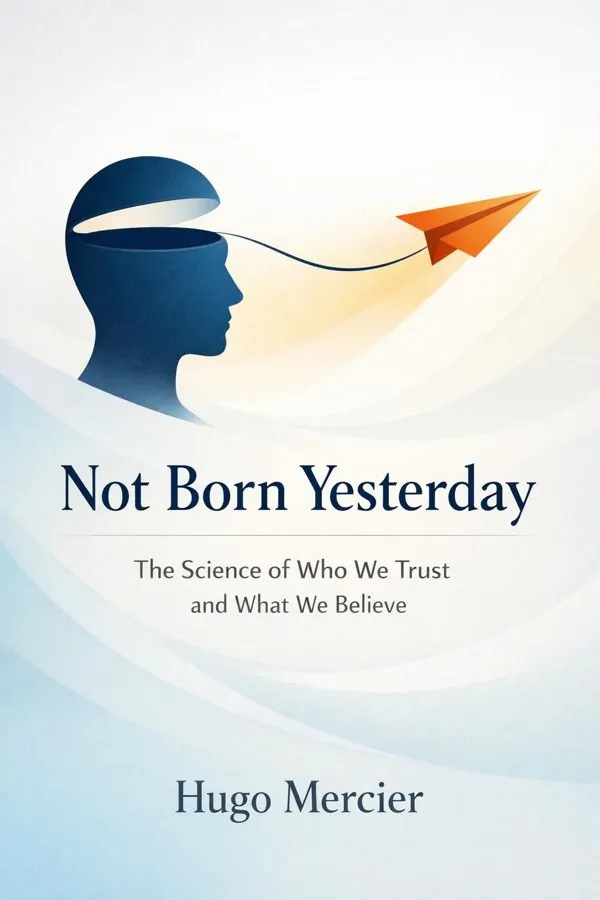
Not Born Yesterday: The Science of Who We Trust and What We Believe: Summary & Key Insights
by Hugo Mercier
 10 min11 chaptersAudio available
What Is Not Born Yesterday: The Science of Who We Trust and What We Believe About?
Not Born Yesterday: The Science of Who We Trust and What We Believe by Hugo Mercier is a cognition book spanning 11 pages. In this book, cognitive scientist Hugo Mercier challenges the common belief that humans are gullible and easily deceived. Drawing on research in psychology, anthropology, and evolutionary theory, Mercier argues that people are generally good at evaluating information and that our trust in others is guided by sophisticated cognitive mechanisms. He explores how communication, persuasion, and misinformation work in real-world contexts, showing that our minds are better equipped for critical thinking than often assumed.
This FizzRead summary covers all 11 key chapters of Not Born Yesterday: The Science of Who We Trust and What We Believe in approximately 10 minutes, distilling the most important ideas, arguments, and takeaways from Hugo Mercier's work. Also available as an audio summary and Key Quotes Podcast.
Not Born Yesterday: The Science of Who We Trust and What We Believe
In this book, cognitive scientist Hugo Mercier challenges the common belief that humans are gullible and easily deceived. Drawing on research in psychology, anthropology, and evolutionary theory, Mercier argues that people are generally good at evaluating information and that our trust in others is guided by sophisticated cognitive mechanisms. He explores how communication, persuasion, and misinformation work in real-world contexts, showing that our minds are better equipped for critical thinking than often assumed.
Who Should Read Not Born Yesterday: The Science of Who We Trust and What We Believe?
This book is perfect for anyone interested in cognition and looking to gain actionable insights in a short read. Whether you're a student, professional, or lifelong learner, the key ideas from Not Born Yesterday: The Science of Who We Trust and What We Believe by Hugo Mercier will help you think differently.
- ✓Readers who enjoy cognition and want practical takeaways
- ✓Professionals looking to apply new ideas to their work and life
- ✓Anyone who wants the core insights of Not Born Yesterday: The Science of Who We Trust and What We Believe in just 10 minutes
Want the full summary?
Get instant access to this book summary and 100K+ more with Fizz Moment.
Get Free SummaryAvailable on App Store • Free to download
Key Chapters
Trust is not a naive leap of faith; it’s an outcome of millions of years of social evolution. As humans moved from solitary survival toward cooperative living, trust became the cornerstone of group success. But here’s the crucial insight: evolution designed trust not as blind acceptance but as calibrated discernment. It’s selective, context-sensitive, and grounded in experience.
In small hunter-gatherer groups, trust allowed individuals to share food, care for offspring, and collaborate in hunting — all tasks impossible without social reliability. Yet, at the same time, mistrust evolved to protect against exploitation. The balance between the two formed the adaptive landscape for human social cognition. Trust became conditional, guided by reputation, past behavior, and visible signs of competence. Anthropological evidence from societies worldwide shows that even the most communal cultures have intricate systems to evaluate sincerity and punish deceit.
When I describe trust as an evolutionary mechanism, I’m pointing to its role as a tuning system. It helps each of us decide when cooperation is safe, when information is reliable, and when emotion should be tempered by skepticism. This is the immune system of the mind — ever watchful, evolving to ward off the microbial threats of misinformation.
Understanding this gives us perspective: our inclination to trust is not weakness. It’s a strength shaped by countless interactions in the evolutionary past, leaving us with minds equipped to assess truth through layers of social signal and credibility.
Belief isn’t an on-off switch activated by exposure to a statement. When we encounter new information, our cognitive system immediately begins asking: Who said it? Why? Does it fit with what I already know? Our minds are not empty vessels but evaluators, comparing incoming data with stored knowledge and integrating it where consistency arises.
Research in cognitive science shows that belief formation is largely a social process. We don’t validate facts in isolation but in context — often by assessing the intentions and reliability of the speaker. This is why credibility and trustworthiness matter so much more than mere repetition. People are adept at distinguishing between sincere belief and manipulative rhetoric, between honest mistakes and deliberate deceit.
In this book, I show that belief formation relies on three intertwined mechanisms: the evaluation of source motives, the consistency of message with prior understanding, and the feedback we get from peers. These mechanisms explain why most propaganda fails, why elementary scams rarely succeed, and why even young children learn early on to question dubious claims.
Think of your beliefs as a living ecosystem. New ideas enter, but only those that harmonize with existing structures survive. Others are rejected or revised through reasoning and dialogue. Contrary to the cliché that people ‘believe whatever they are told,’ humans are selective consumers of information. We are skeptical by design, guided by an evolved instinct for truth discernment.
+ 9 more chapters — available in the FizzRead app
All Chapters in Not Born Yesterday: The Science of Who We Trust and What We Believe
About the Author
Hugo Mercier is a French cognitive scientist known for his research on reasoning, communication, and social cognition. He is a researcher at the Institut Jean Nicod in Paris and co-author of 'The Enigma of Reason'. His work focuses on how humans evaluate information and make decisions in social contexts.
Get This Summary in Your Preferred Format
Read or listen to the Not Born Yesterday: The Science of Who We Trust and What We Believe summary by Hugo Mercier anytime, anywhere. FizzRead offers multiple formats so you can learn on your terms — all free.
Available formats: App · Audio · PDF · EPUB — All included free with FizzRead
Download Not Born Yesterday: The Science of Who We Trust and What We Believe PDF and EPUB Summary
Key Quotes from Not Born Yesterday: The Science of Who We Trust and What We Believe
“Trust is not a naive leap of faith; it’s an outcome of millions of years of social evolution.”
“Belief isn’t an on-off switch activated by exposure to a statement.”
Frequently Asked Questions about Not Born Yesterday: The Science of Who We Trust and What We Believe
Not Born Yesterday: The Science of Who We Trust and What We Believe by Hugo Mercier is a cognition book that explores key ideas across 11 chapters. In this book, cognitive scientist Hugo Mercier challenges the common belief that humans are gullible and easily deceived. Drawing on research in psychology, anthropology, and evolutionary theory, Mercier argues that people are generally good at evaluating information and that our trust in others is guided by sophisticated cognitive mechanisms. He explores how communication, persuasion, and misinformation work in real-world contexts, showing that our minds are better equipped for critical thinking than often assumed.
You Might Also Like
A Field Guide to Lies: Critical Thinking in the Information Age
Daniel J. Levitin
10 min
A Theory of Cognitive Dissonance
Leon Festinger
10 min
Black-And-White Thinking: The Burden of a Binary Brain in a Complex World
Kevin Dutton
10 min
Born Liars: Why We Can’t Live Without Deceit
Ian Leslie
10 min
Collective Illusions: Conformity, Complicity, and the Science of Why We Make Bad Decisions
Todd Rose
10 min
Concrete Mathematics: A Foundation for Computer Science
Ronald L. Graham, Donald E. Knuth, Oren Patashnik
10 minBrowse by Category
Ready to read Not Born Yesterday: The Science of Who We Trust and What We Believe?
Get the full summary and 100K+ more books with Fizz Moment.