
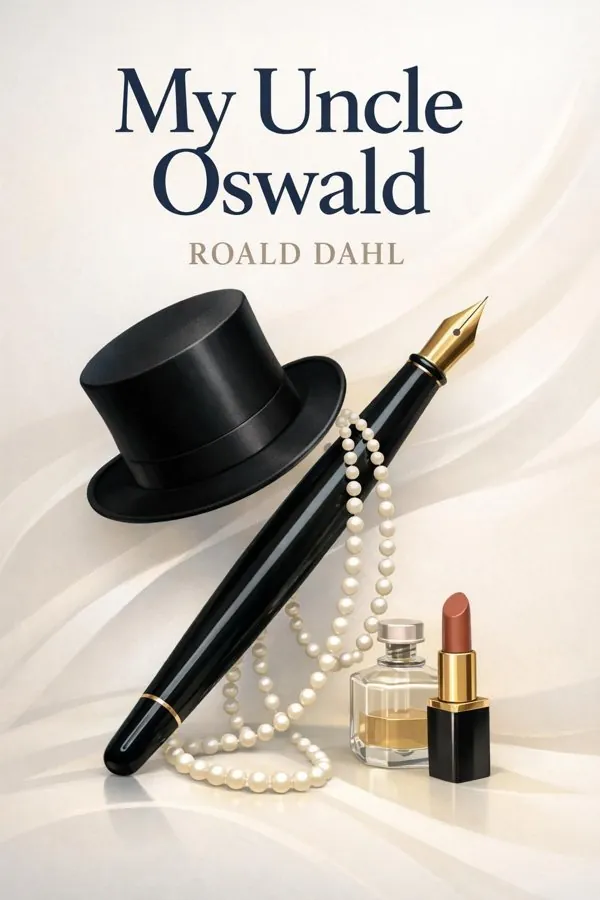
My Uncle Oswald: Summary & Key Insights
by Roald Dahl
 10 min9 chaptersAudio available
Key Takeaways from My Uncle Oswald
A charming narrator can be more dangerous than an obvious villain.
Civilization can be overturned by one small discovery.
Beauty in satire is rarely innocent.
Some of the boldest schemes begin when someone treats the unthinkable as logistics.
The famous are often most vulnerable where they believe themselves strongest.
What Is My Uncle Oswald About?
My Uncle Oswald by Roald Dahl is a bestsellers book spanning 6 pages. Roald Dahl’s My Uncle Oswald is a wickedly entertaining novel that reveals a very different side of the author many readers know from his children’s classics. First published in 1979, this adult comic novel follows Oswald Hendryks Cornelius, a flamboyant rogue who treats the world as a playground for appetite, profit, and elegant deceit. Together with the dazzling and calculating Yasmin Howcomely, Oswald devises an outrageous plan involving seduction, blackmail, and the harvesting of genetic material from some of history’s most celebrated men. The result is a gleeful blend of satire, erotic farce, social comedy, and moral mischief. What makes the book memorable is not just its scandalous plot, but Dahl’s precision as a storyteller. He skewers class snobbery, masculine vanity, celebrity worship, and the illusion that genius is somehow noble. Beneath the laughter lies a sharp critique of greed and human weakness. Dahl’s authority comes from his unmatched control of tone: he can make the absurd feel plausible and the indecent feel strangely elegant. My Uncle Oswald matters because it shows how brilliantly Dahl could write for adults—boldly, cynically, and with perfect comic timing.
This FizzRead summary covers all 9 key chapters of My Uncle Oswald in approximately 10 minutes, distilling the most important ideas, arguments, and takeaways from Roald Dahl's work. Also available as an audio summary and Key Quotes Podcast.
My Uncle Oswald
Roald Dahl’s My Uncle Oswald is a wickedly entertaining novel that reveals a very different side of the author many readers know from his children’s classics. First published in 1979, this adult comic novel follows Oswald Hendryks Cornelius, a flamboyant rogue who treats the world as a playground for appetite, profit, and elegant deceit. Together with the dazzling and calculating Yasmin Howcomely, Oswald devises an outrageous plan involving seduction, blackmail, and the harvesting of genetic material from some of history’s most celebrated men. The result is a gleeful blend of satire, erotic farce, social comedy, and moral mischief.
What makes the book memorable is not just its scandalous plot, but Dahl’s precision as a storyteller. He skewers class snobbery, masculine vanity, celebrity worship, and the illusion that genius is somehow noble. Beneath the laughter lies a sharp critique of greed and human weakness. Dahl’s authority comes from his unmatched control of tone: he can make the absurd feel plausible and the indecent feel strangely elegant. My Uncle Oswald matters because it shows how brilliantly Dahl could write for adults—boldly, cynically, and with perfect comic timing.
Who Should Read My Uncle Oswald?
This book is perfect for anyone interested in bestsellers and looking to gain actionable insights in a short read. Whether you're a student, professional, or lifelong learner, the key ideas from My Uncle Oswald by Roald Dahl will help you think differently.
- ✓Readers who enjoy bestsellers and want practical takeaways
- ✓Professionals looking to apply new ideas to their work and life
- ✓Anyone who wants the core insights of My Uncle Oswald in just 10 minutes
Want the full summary?
Get instant access to this book summary and 100K+ more with Fizz Moment.
Get Free SummaryAvailable on App Store • Free to download
Key Chapters
A charming narrator can be more dangerous than an obvious villain. That is the first lesson of My Uncle Oswald. Oswald Hendryks Cornelius introduces himself not as a hero seeking truth or justice, but as a wealthy sensualist who openly worships pleasure, money, and style. He is witty, self-aware, and shameless. Instead of hiding his vices, he frames them as marks of sophistication. This makes him fascinating because readers are drawn into his worldview before they have fully judged it.
Dahl uses Oswald to parody the memoir tradition. Rather than presenting a life of noble achievement, Oswald offers a confession of appetite and opportunism. He sees other people less as individuals than as instruments for amusement or gain. Yet his refined voice and comic self-confidence make him oddly likable. This tension is central to the novel: we are entertained by behavior we would condemn in real life.
In practical terms, Oswald demonstrates how charisma often masks predation. In business, media, or politics, people frequently excuse bad conduct when it comes packaged in confidence, polish, and humor. We meet individuals who appear harmless because they are witty or well-spoken, only to realize that charm has been used strategically. Dahl exaggerates this truth into farce, but the underlying insight is realistic.
The novel also asks readers to question first-person storytelling itself. When a narrator is intelligent and funny, we may accept his judgments too easily. Oswald’s elegance becomes a form of manipulation, shaping our response to every outrageous event that follows.
Actionable takeaway: whenever someone’s charm makes questionable behavior seem acceptable, pause and separate style from substance before deciding whether admiration is deserved.
Civilization can be overturned by one small discovery. In Oswald’s case, that discovery is the Sudanese blister beetle, a seemingly insignificant creature whose processed essence acts as an extraordinarily powerful aphrodisiac. Dahl takes a bizarre biological fact and turns it into the engine of high comedy, but the beetle also symbolizes something larger: how a single advantage, especially one tied to desire, can disrupt social order.
Oswald’s reaction to the beetle reveals his character instantly. He does not ask how it might be used responsibly, medically, or ethically. He sees only commercial and erotic potential. The aphrodisiac becomes an opportunity to control situations, exploit weakness, and unlock hidden appetites in others. This is classic Dahl: a grotesque object introduced with scientific seriousness, then transformed into a tool of absurd human corruption.
The beetle matters because it exposes how fragile self-discipline can be. Respectable men, intellectual giants, and public figures all become vulnerable when a private craving is heightened. The novel suggests that social status does not erase instinct; it merely dresses instinct in better tailoring. In modern terms, the beetle stands for any unfair leverage—inside information, addictive technology, compromising data, or psychological insight—that can be used to manipulate behavior.
A practical way to read this episode is as a warning about tools that intensify existing impulses. Whether it is a product designed to capture attention or a tactic meant to lower someone’s judgment, the pattern is the same: small interventions can produce outsized consequences when they target desire directly.
Actionable takeaway: be especially cautious around anything that promises to bypass judgment and amplify impulse, because the most dangerous forms of influence often arrive disguised as harmless novelty.
Beauty in satire is rarely innocent. Yasmin Howcomely enters My Uncle Oswald as one of Dahl’s most dazzling creations: glamorous, intelligent, poised, and every bit as calculating as Oswald himself. She is not merely an accessory to his adventures. She is the operational genius who makes the central scheme possible. If Oswald supplies appetite and audacity, Yasmin supplies discipline, performance, and tactical precision.
What makes Yasmin interesting is that Dahl refuses to let her be passive. She understands exactly how men see her and turns that gaze into leverage. The novel uses her beauty as a comic weapon, but it also highlights her observational intelligence. She reads vanity, insecurity, and weakness with remarkable speed. In many scenes, she is the more competent partner because she knows that seduction is not only physical. It involves timing, language, staging, and the ability to make another person feel exceptional.
This dynamic has broader relevance. In real life, influence often belongs to those who understand perception. Some people command rooms through credentials; others do so through emotional intelligence, presentation, and strategic self-awareness. Yasmin exemplifies the power of knowing how others think and using that knowledge deliberately.
At the same time, Dahl keeps the portrait satirical. Yasmin’s brilliance serves a morally dubious enterprise, reminding us that skill is ethically neutral. Intelligence can illuminate, but it can also manipulate. Admiring competence should never mean overlooking its purpose.
For readers, Yasmin offers a useful lens on personal influence. Presentation matters. Preparation matters. Reading people matters. But these strengths become admirable only when aligned with integrity rather than exploitation.
Actionable takeaway: develop the kind of social intelligence that helps you understand people clearly, but use it to build trust and opportunity, not to turn human weakness into personal advantage.
Some of the boldest schemes begin when someone treats the unthinkable as logistics. Once Oswald and Yasmin recognize the commercial possibilities of their aphrodisiac and Yasmin’s powers of seduction, they construct an enterprise that is as outrageous as it is methodical. Their target is not anonymous desire, but the vanity of famous men. By collecting the semen of celebrated figures and selling the prospect of distinguished offspring, they transform sex, celebrity, and status into a black-market business model.
Dahl’s brilliance lies in making the scheme sound almost corporate. There is market positioning, brand value, client psychology, supply management, and elite customer targeting. The absurdity is the point. The novel mocks the tendency to rationalize anything if enough money is involved. Once greed wears the language of strategy, even grotesque ideas can begin to sound efficient.
This theme reaches far beyond the novel’s scandalous premise. In the modern world, many ethically questionable ventures survive because they are framed as innovation, disruption, or premium service. When a process becomes systematized, people can forget to ask whether it should exist at all. My Uncle Oswald satirizes exactly that mindset.
The book also exposes the economics of prestige. Customers in Oswald’s world are not buying biology alone. They are buying association with greatness, the fantasy that status can be inherited or purchased. This resembles modern obsessions with elite schools, luxury brands, curated genetics, and celebrity proximity.
Actionable takeaway: whenever a venture sounds clever, profitable, and efficient, ask the simplest question first—what human weakness is this business exploiting, and what values are being sacrificed to make it work?
The famous are often most vulnerable where they believe themselves strongest. One of Dahl’s sharpest comic moves in My Uncle Oswald is his treatment of historical celebrities and intellectual giants. Instead of presenting famous men as untouchable figures of discipline or superior character, he reduces them to bodies, egos, and appetites. Their genius may be real, but it offers no immunity from vanity or sexual temptation.
This is a central satirical achievement of the novel. By targeting well-known public figures, Dahl punctures the myth that talent and virtue naturally belong together. A brilliant writer, scientist, or artist may produce extraordinary work and still behave foolishly in private. Oswald’s scheme works because renown often amplifies self-regard. Men who are admired in one domain may begin to believe themselves irresistible in all others.
The modern application is obvious. We still confuse accomplishment with wisdom and public prestige with moral reliability. Celebrities are elevated into symbols, then audiences are shocked when ordinary weakness appears. Dahl’s novel reminds us that fame is often just a spotlight, not a purification process.
There is also a subtler point: greatness can become commodified. In Oswald’s plan, the public reputation of genius becomes raw material for sales. That is funny, but also deeply cynical. The book suggests that society’s reverence for greatness is so shallow that it can be redirected into consumer fantasy.
Readers can use this idea as a guardrail against idol worship. Admire achievements, certainly. Learn from excellence. But never assume that distinction in one area guarantees integrity in another.
Actionable takeaway: respect talent without surrendering judgment, and evaluate admired people by their conduct as well as their accomplishments.
Schemes built on exploitation rarely collapse because of conscience; they collapse because the schemers eventually turn on one another. As Oswald’s criminal enterprise grows more ambitious, the novel shifts from playful audacity toward rivalry, mistrust, and betrayal. Success does not make the players safer. It makes them greedier, more suspicious, and more determined to secure a larger share of the spoils.
Dahl understands a simple truth about immoral partnerships: they depend on mutual self-interest, not loyalty. That means every alliance contains the seed of its own destruction. If people are willing to deceive strangers for profit, there is no strong reason to believe they will remain honest with each other when more money or power is available. My Uncle Oswald dramatizes this beautifully. The very cleverness that fuels the scheme also fuels paranoia.
This has practical significance in any setting where incentives are misaligned. Teams fail when individuals optimize only for themselves. Businesses fracture when short-term gain overrides trust. Friendships erode when transaction replaces respect. Dahl heightens these patterns to comic extremes, but the psychology is accurate.
The book also suggests that greed narrows perception. Characters become so focused on acquisition that they underestimate risk, overestimate control, and ignore warning signs. They mistake temporary success for invulnerability. This is one reason frauds, bubbles, and unethical ventures often grow bolder just before they implode.
For readers, the message is not merely that greed is bad. It is that greed distorts judgment and corrodes cooperation from within. A system without ethical boundaries becomes unstable even for its beneficiaries.
Actionable takeaway: if a partnership depends entirely on appetite and advantage, assume it will fail under pressure and build your life around relationships grounded in trust rather than opportunism.
One reason My Uncle Oswald leaves such a strong impression is that it operates in a world where vice is narrated with the delight usually reserved for virtue. Dahl inverts the moral tone of traditional storytelling. Instead of rewarding innocence, he celebrates nerve. Instead of condemning corruption solemnly, he treats it as material for elegant laughter. This inversion is not accidental. It is the mechanism through which the novel satirizes polite society.
Dahl had long excelled at exposing cruelty, hypocrisy, and appetite beneath respectable surfaces. In his adult fiction, he simply removes the protective veil. The result is a tone that feels shocking and playful at once. Readers laugh even as they recognize how indecent the events are. That discomfort is part of the design. Dahl wants us to see how easily style can seduce us into complicity.
This technique has practical value for readers because satire sharpens perception. By exaggerating vice, the novel helps us notice the smaller, socially acceptable versions around us: vanity dressed as refinement, exploitation framed as opportunity, and selfishness excused as sophistication. Comedy can reveal truths that moral sermons often fail to deliver.
The novel also demonstrates that laughter is not always harmless. Sometimes it is a way of lowering defenses so that uncomfortable truths can enter more effectively. Dahl’s command of tone allows him to entertain while smuggling in a bleak view of human motives.
Actionable takeaway: when a story makes wrongdoing feel stylish or funny, enjoy the wit but also ask what hidden social truth the humor is exposing about power, desire, and hypocrisy.
People often imagine that intelligence protects them from foolishness, but desire has a way of humiliating intellect. Throughout My Uncle Oswald, Dahl returns to this idea again and again. Men who command respect in public become ridiculous in private because erotic desire strips away ceremony and self-image. The aphrodisiac simply intensifies what is already there: vanity, longing, fantasy, and the wish to be admired.
This is why the book feels more than merely outrageous. Beneath the farce lies an old and durable insight about human behavior. Rationality is often weaker than we think when identity, sex, status, or fantasy are involved. People make reckless decisions not because they lack information, but because they badly want a certain version of themselves or of the moment to be true.
In everyday life, this extends far beyond sexuality. Desire can mean craving approval, prestige, revenge, validation, or belonging. Once emotionally invested, people become easier to manipulate. They ignore inconsistencies, discount risk, and mistake wishful thinking for evidence. Dahl turns that process into broad comedy, but he captures the mechanism precisely.
A practical reading of this theme is that self-knowledge matters more than self-image. It is not enough to think of yourself as disciplined or intelligent. You must know what consistently weakens your judgment. Everyone has a pressure point, and maturity means identifying it before someone else does.
The novel is cynical, but its lesson can be constructive. By recognizing how desire operates, readers can build better boundaries, make slower decisions, and become less vulnerable to manipulation.
Actionable takeaway: identify the cravings that most distort your judgment, and create habits—delay, reflection, outside advice—that protect you when those cravings are activated.
By the end of My Uncle Oswald, what remains is not triumph, but a glittering aftertaste of absurdity. Oswald may be clever, wealthy, and magnificently shameless, yet his story ultimately reads as a meditation on folly. He has spent his life pursuing sensation, profit, and elegant misconduct, and he narrates it all with unfailing confidence. But confidence is not the same as wisdom. Dahl allows Oswald to sound victorious while quietly revealing the emptiness and instability beneath the performance.
This ending matters because it reframes the novel. What first seems like a celebration of audacious living becomes a satire of appetite without limit. Oswald’s adventures are entertaining precisely because they are excessive, but excess has a cost. It distorts relationships, reduces people to commodities, and leaves behind little that can be called meaningful. The laughter remains, yet so does the sense that cleverness alone is a poor substitute for principle.
In practical life, this is a useful distinction. Many people chase outcomes that look glamorous from a distance—money, conquest, influence, notoriety—without asking what kind of self is being built in the process. My Uncle Oswald suggests that a life can appear full while being morally and emotionally thin.
Dahl does not end with a sermon. He ends with irony, which is more effective. Readers are free to enjoy Oswald’s wit while also recognizing that he is not a model to imitate. He is a caution wrapped in silk.
Actionable takeaway: pursue pleasure and ambition with humor if you like, but measure success by the quality of your character and relationships, not just by how entertaining your exploits sound in retrospect.
All Chapters in My Uncle Oswald
About the Author
Roald Dahl (1916–1990) was a British novelist, short story writer, screenwriter, and wartime pilot whose work spans children’s fantasy, macabre adult fiction, and screenplay adaptation. He became one of the world’s most beloved authors through books such as Charlie and the Chocolate Factory, Matilda, Fantastic Mr Fox, and The BFG, all known for their imaginative plots, dark humor, and sharp understanding of childhood fears and desires. Alongside these classics, Dahl wrote acclaimed adult stories and novels filled with irony, cruelty, sensuality, and twist endings. His prose is distinctive for its clarity, rhythm, and mischievous precision. My Uncle Oswald showcases his lesser-known adult voice: bold, satirical, and gleefully irreverent, proving that his storytelling brilliance extended far beyond children’s literature.
Get This Summary in Your Preferred Format
Read or listen to the My Uncle Oswald summary by Roald Dahl anytime, anywhere. FizzRead offers multiple formats so you can learn on your terms — all free.
Available formats: App · Audio · PDF · EPUB — All included free with FizzRead
Download My Uncle Oswald PDF and EPUB Summary
Key Quotes from My Uncle Oswald
“A charming narrator can be more dangerous than an obvious villain.”
“Civilization can be overturned by one small discovery.”
“Yasmin Howcomely enters My Uncle Oswald as one of Dahl’s most dazzling creations: glamorous, intelligent, poised, and every bit as calculating as Oswald himself.”
“Some of the boldest schemes begin when someone treats the unthinkable as logistics.”
“The famous are often most vulnerable where they believe themselves strongest.”
Frequently Asked Questions about My Uncle Oswald
My Uncle Oswald by Roald Dahl is a bestsellers book that explores key ideas across 9 chapters. Roald Dahl’s My Uncle Oswald is a wickedly entertaining novel that reveals a very different side of the author many readers know from his children’s classics. First published in 1979, this adult comic novel follows Oswald Hendryks Cornelius, a flamboyant rogue who treats the world as a playground for appetite, profit, and elegant deceit. Together with the dazzling and calculating Yasmin Howcomely, Oswald devises an outrageous plan involving seduction, blackmail, and the harvesting of genetic material from some of history’s most celebrated men. The result is a gleeful blend of satire, erotic farce, social comedy, and moral mischief. What makes the book memorable is not just its scandalous plot, but Dahl’s precision as a storyteller. He skewers class snobbery, masculine vanity, celebrity worship, and the illusion that genius is somehow noble. Beneath the laughter lies a sharp critique of greed and human weakness. Dahl’s authority comes from his unmatched control of tone: he can make the absurd feel plausible and the indecent feel strangely elegant. My Uncle Oswald matters because it shows how brilliantly Dahl could write for adults—boldly, cynically, and with perfect comic timing.
More by Roald Dahl
You Might Also Like
The Godfather
Mario Puzo
10 min
The Handmaid's Tale
Margaret Atwood
10 min
The Hunger Games
Suzanne Collins
10 min
The Nightingale
Kristin Hannah
10 min
The Seven Husbands of Evelyn Hugo
Taylor Jenkins Reid
10 min
Backwater Justice
Fern Michaels
10 minBrowse by Category
Ready to read My Uncle Oswald?
Get the full summary and 100K+ more books with Fizz Moment.