
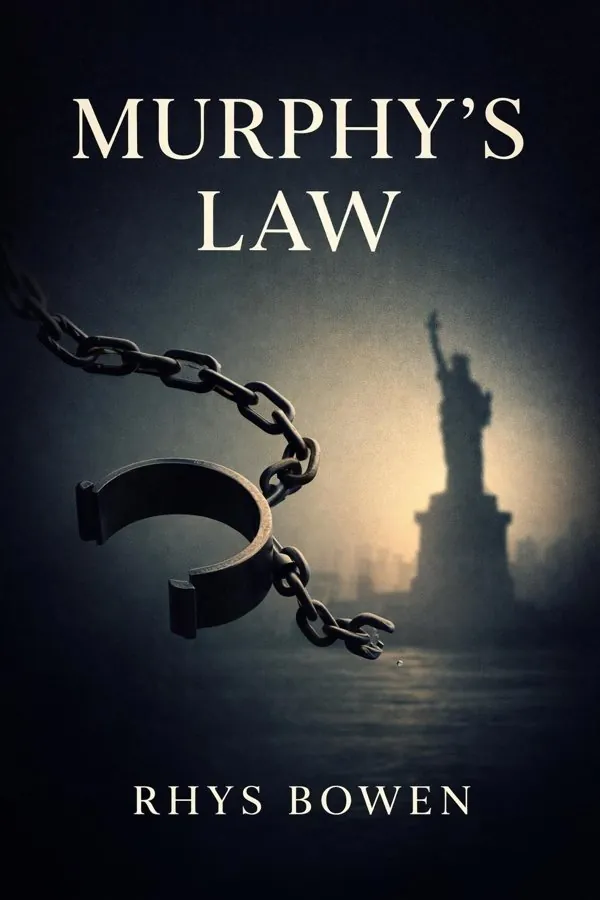
Murphy’s Law: Summary & Key Insights
by Rhys Bowen
 10 min8 chaptersAudio available
Key Takeaways from Murphy’s Law
Sometimes a person’s first act of freedom looks, to the outside world, like a crime.
A gateway can also be a gauntlet.
Justice is rarely handed over cleanly; more often, it must be uncovered by those whom the world underestimates.
Starting over is exciting in theory and exhausting in reality.
The most memorable protagonists are often the ones who decline the role society has written for them.
What Is Murphy’s Law About?
Murphy’s Law by Rhys Bowen is a mystery book spanning 3 pages. What happens when the promise of a new life collides with the danger of being misunderstood? In Murphy’s Law, Rhys Bowen launches her beloved Molly Murphy mystery series with a heroine who is as sharp-tongued as she is brave. Set in 1901, the novel follows Molly, a young Irish woman forced to flee her homeland after killing a man in self-defense. America is supposed to offer safety and reinvention, but the moment she reaches Ellis Island, she finds herself caught up in another suspicious death. Instead of disappearing quietly into immigrant New York, Molly must defend herself all over again. What makes this novel stand out is the way Bowen blends a satisfying murder mystery with a vivid portrait of immigration, class tension, and female independence at the dawn of the twentieth century. The book is not just about solving a crime; it is about survival in a world built to doubt and constrain women like Molly. Rhys Bowen, an award-winning master of historical mystery, brings both atmosphere and emotional intelligence to the story, creating a series opener that is suspenseful, witty, and deeply human.
This FizzRead summary covers all 8 key chapters of Murphy’s Law in approximately 10 minutes, distilling the most important ideas, arguments, and takeaways from Rhys Bowen's work. Also available as an audio summary and Key Quotes Podcast.
Murphy’s Law
What happens when the promise of a new life collides with the danger of being misunderstood? In Murphy’s Law, Rhys Bowen launches her beloved Molly Murphy mystery series with a heroine who is as sharp-tongued as she is brave. Set in 1901, the novel follows Molly, a young Irish woman forced to flee her homeland after killing a man in self-defense. America is supposed to offer safety and reinvention, but the moment she reaches Ellis Island, she finds herself caught up in another suspicious death. Instead of disappearing quietly into immigrant New York, Molly must defend herself all over again.
What makes this novel stand out is the way Bowen blends a satisfying murder mystery with a vivid portrait of immigration, class tension, and female independence at the dawn of the twentieth century. The book is not just about solving a crime; it is about survival in a world built to doubt and constrain women like Molly. Rhys Bowen, an award-winning master of historical mystery, brings both atmosphere and emotional intelligence to the story, creating a series opener that is suspenseful, witty, and deeply human.
Who Should Read Murphy’s Law?
This book is perfect for anyone interested in mystery and looking to gain actionable insights in a short read. Whether you're a student, professional, or lifelong learner, the key ideas from Murphy’s Law by Rhys Bowen will help you think differently.
- ✓Readers who enjoy mystery and want practical takeaways
- ✓Professionals looking to apply new ideas to their work and life
- ✓Anyone who wants the core insights of Murphy’s Law in just 10 minutes
Want the full summary?
Get instant access to this book summary and 100K+ more with Fizz Moment.
Get Free SummaryAvailable on App Store • Free to download
Key Chapters
Sometimes a person’s first act of freedom looks, to the outside world, like a crime. That paradox defines Molly Murphy from the opening pages. Raised in rural Ireland, Molly has grown up under the weight of poverty, convention, and the narrow expectations placed on young women. Her world is one in which class matters, reputation can determine a future, and obedience is treated as virtue. Yet Molly has an independent spirit that refuses to stay contained.
When a violent confrontation leaves a man dead, Molly is forced to run. The killing is an act of self-defense, but in a society shaped by male power and social prejudice, truth alone is not enough to protect her. Bowen uses this turning point to establish Molly not as a passive victim, but as someone who makes hard decisions under impossible pressure. Her journey across the Atlantic is not merely a geographical escape; it is a moral and psychological crossing from dependence into self-determination.
This opening also gives the novel its emotional engine. Molly’s defiance is not romanticized as easy courage. It is tangled with fear, guilt, exhaustion, and uncertainty. That complexity makes her compelling. She is not fearless; she acts despite fear. Readers can apply this insight beyond the novel: moments of reinvention often begin in crisis, and resilience rarely looks polished while it is happening.
In practical terms, Molly’s story reminds us that identity is often forged when old structures collapse. Whether someone is changing careers, leaving a toxic environment, or starting over in an unfamiliar place, the first skill required is not confidence but movement. Molly survives because she refuses to freeze.
Actionable takeaway: When circumstances force change, focus less on appearing certain and more on taking the next necessary step forward.
A gateway can also be a gauntlet. Ellis Island, often remembered as a symbol of American opportunity, appears in Murphy’s Law as something more complicated: a place where hope is processed through scrutiny, bureaucracy, illness checks, and suspicion. For Molly, arriving in New York should mark the end of danger. Instead, it becomes the site of another ordeal when she is drawn into a murder investigation almost as soon as she steps ashore.
Bowen brilliantly turns Ellis Island into more than a historical backdrop. It becomes a pressure chamber in which class, nationality, and vulnerability are intensified. Immigrants are exhausted, frightened, and eager to pass inspection. Officials wield power over futures in a matter of minutes. In such an environment, misunderstanding spreads easily, and anyone without status or protection can quickly become a suspect. Molly, already carrying the burden of a secret past, understands that one accusation could destroy her chance at a new life.
The setting also highlights one of the novel’s central themes: institutions are rarely neutral for the powerless. What is supposed to be a system of entry becomes, for many, an experience of judgment. Bowen captures the noise, confusion, and human desperation of the place while showing how observant Molly is under pressure. She notices details others miss, and that talent begins to transform her from fugitive into investigator.
There is a broader lesson here about transitional spaces. Airports, job interviews, courtrooms, hospitals, and immigration offices all share a common emotional logic: they expose how much can depend on being correctly seen. Molly’s ability to remain alert rather than collapse into panic gives her an edge.
Actionable takeaway: In high-pressure environments, pay close attention to details and power dynamics; clear observation can be your strongest form of protection.
Justice is rarely handed over cleanly; more often, it must be uncovered by those whom the world underestimates. As Murphy’s Law develops, Molly’s involvement in the Ellis Island death forces her to move beyond mere self-preservation. She is no longer only trying to avoid suspicion. She begins actively following clues, reading motives, and testing appearances. In doing so, she discovers a deeper form of independence: not just physical escape from Ireland, but intellectual confidence in her own judgment.
Bowen structures the mystery so that official explanations never feel fully secure. The people in authority may possess rank, but they do not always possess insight. Molly’s outsider status becomes an advantage. Because she is not invested in preserving social appearances, she notices contradictions and emotional truths that others dismiss. This pattern becomes foundational to the series: Molly solves problems not through institutional power, but through persistence, curiosity, and an unwillingness to accept the easiest answer.
Importantly, justice in the novel is not presented as abstract legal neatness. It is tied to dignity. To clear her name and understand the truth, Molly must claim that her perceptions matter. That is a powerful message in a historical setting where women, immigrants, and the poor were often expected to remain silent. Her emerging investigative identity is therefore also a political one, even if the novel wears that idea lightly.
Readers can draw a practical lesson from this. Independence is not simply earning money or living alone; it also means trusting your capacity to evaluate situations for yourself. In workplaces, family conflicts, or community disputes, people often defer too quickly to confident voices. Molly reminds us that social authority and actual understanding are not the same thing.
Actionable takeaway: When something feels unresolved, do not accept the first convenient explanation; ask better questions until the truth becomes clear.
Starting over is exciting in theory and exhausting in reality. One of the novel’s strongest achievements is its portrayal of immigrant reinvention as both possibility and hardship. New York in 1901 pulses with movement, commerce, ambition, and overcrowding. For Molly, the city offers anonymity and freedom unavailable in rural Ireland. At the same time, it demands resourcefulness at every turn. She must find lodging, work, allies, and a way to navigate a culture that promises welcome while constantly sorting people by accent, class, and usefulness.
Bowen avoids sentimentalizing the immigrant experience. America is not presented as a magical clean slate. Molly arrives with little money, no secure network, and a dangerous past she cannot fully reveal. Her success depends on quick thinking and social agility. She has to read rooms, judge whom to trust, and balance honesty with discretion. This gives the novel a practical realism beneath its charm and suspense.
What makes Molly effective is not simply bravery, but adaptability. She can speak plainly when necessary, bluff when cornered, and learn new social codes without losing her core identity. That combination is the essence of reinvention: changing strategy without surrendering self-respect. Many readers will recognize this dynamic from modern experiences of relocation, migration, career change, or entering unfamiliar institutions.
The book also suggests that reinvention often requires accepting temporary instability. Molly cannot wait until she feels completely prepared. She must act while uncertain, build relationships while vulnerable, and make choices before guarantees exist. That is a deeply contemporary insight, even in a historical mystery.
Actionable takeaway: If you are building a new life in unfamiliar territory, treat adaptability as a skill; keep your values steady, but let your methods evolve with the situation.
The most memorable protagonists are often the ones who decline the role society has written for them. Molly Murphy is introduced into a world with clear expectations for women: be modest, be grateful, be quiet, and above all, be manageable. She refuses each of these in her own way. She is outspoken, observant, emotionally direct, and unwilling to pretend that male authority is automatically legitimate.
This resistance is central to the novel’s appeal. Bowen does not turn Molly into a modern character awkwardly dropped into the past. Instead, she lets Molly’s independence arise naturally from her circumstances, temperament, and Irish background. Molly understands the risks of nonconformity, which makes her choices feel earned rather than performative. She pushes back because submission has never truly kept her safe.
The novel repeatedly shows how gender shapes danger. Molly’s vulnerability is not only physical; it is interpretive. Men may speak for her, define her motives, or dismiss her intelligence. Yet she counters this through wit, self-possession, and refusal to internalize inferiority. Her strength lies partly in recognizing that respectability can be a trap when the rules are designed to exclude you.
This idea has practical resonance. Many readers know what it means to be underestimated in meetings, ignored in negotiations, or judged by stereotype rather than substance. Molly’s example is not that one should oppose everything, but that it matters to identify which expectations are protective and which are limiting. She survives because she knows the difference.
Actionable takeaway: Examine the roles others expect you to play, then consciously keep the ones that serve you and reject the ones that shrink your voice.
Good detectives do not merely collect facts; they notice what everyone else has decided to ignore. Although Murphy’s Law is the first Molly Murphy novel, Bowen already establishes the investigative style that makes Molly compelling. She is not armed with formal training, official credentials, or scientific tools. Her greatest assets are attention, intuition, and the courage to follow discomfort instead of avoiding it.
The mystery unfolds through social reading as much as physical clues. Molly watches how people speak, what they conceal, how fear alters behavior, and where stories fail to line up. Because she has spent much of her life navigating unequal power, she is sensitive to subtext. She knows that what people say in public and what they mean in private are often very different. This makes her particularly strong at uncovering motive.
Bowen’s approach offers a useful reminder that investigation is often an interpretive act. In everyday life, too, problems are rarely solved by information alone. Context matters. A missed deadline may signal incompetence, but it may also reveal miscommunication or pressure from above. A polished narrative may sound convincing while hiding key omissions. Molly succeeds because she asks not only what happened, but why a person wants events understood in a certain way.
This style of mystery also keeps the novel engaging for readers who enjoy character as much as plot. The clues are embedded in relationships, social tensions, and the emotional logic of the setting. Solving the crime becomes inseparable from understanding people.
Actionable takeaway: When assessing a confusing situation, look beyond surface facts and ask what motives, pressures, or hidden interests might be shaping the story you are being told.
A mystery becomes far more memorable when suspense is balanced by human charm. One reason Murphy’s Law works so well as a series opener is that Bowen infuses the novel with wit, lively dialogue, and flashes of warmth even as Molly faces serious danger. This tonal balance prevents the story from becoming oppressive and makes Molly an especially appealing guide through uncertainty.
Molly’s humor is not ornamental. It is a survival strategy. Her quick remarks and internal sharpness help her maintain dignity when others patronize or threaten her. Humor allows her to create breathing room in difficult interactions, test the intentions of strangers, and hold onto herself when circumstances become dehumanizing. In this sense, levity is one of the novel’s tools of resilience.
Bowen also uses warmth to deepen the immigrant setting. The kindness of certain secondary characters, the small moments of assistance or companionship, and the hints of future community remind readers that survival is rarely solitary. Even a fiercely independent heroine needs connection. This prevents the novel’s emphasis on self-reliance from becoming simplistic. Molly’s strength includes her ability to recognize decency and accept help when it matters.
In everyday terms, the lesson is clear: endurance is easier when tension is not allowed to consume the whole emotional landscape. People navigating crises often need not only plans and discipline, but also perspective, humor, and human contact. These are not distractions from survival; they are part of it.
Actionable takeaway: In stressful periods, actively preserve moments of humor and connection; they strengthen judgment, restore energy, and make resilience sustainable.
All Chapters in Murphy’s Law
About the Author
Rhys Bowen is a British-born author celebrated for her bestselling historical mysteries, especially the Molly Murphy Mysteries and the Royal Spyness series. She is known for combining richly researched settings with lively plots, memorable heroines, and a warm, witty narrative style. Bowen’s fiction often places independent women at the center of social worlds shaped by class expectations, political tension, and hidden danger. Her work has earned wide critical acclaim as well as major genre honors, including Agatha and Anthony Awards. In Murphy’s Law, she demonstrates the qualities that define her writing at its best: historical atmosphere, emotional intelligence, and a strong sense of storytelling momentum. Her novels appeal to readers who want both an engaging mystery and a vivid journey into the past.
Get This Summary in Your Preferred Format
Read or listen to the Murphy’s Law summary by Rhys Bowen anytime, anywhere. FizzRead offers multiple formats so you can learn on your terms — all free.
Available formats: App · Audio · PDF · EPUB — All included free with FizzRead
Download Murphy’s Law PDF and EPUB Summary
Key Quotes from Murphy’s Law
“Sometimes a person’s first act of freedom looks, to the outside world, like a crime.”
“Justice is rarely handed over cleanly; more often, it must be uncovered by those whom the world underestimates.”
“Starting over is exciting in theory and exhausting in reality.”
“The most memorable protagonists are often the ones who decline the role society has written for them.”
“Good detectives do not merely collect facts; they notice what everyone else has decided to ignore.”
Frequently Asked Questions about Murphy’s Law
Murphy’s Law by Rhys Bowen is a mystery book that explores key ideas across 8 chapters. What happens when the promise of a new life collides with the danger of being misunderstood? In Murphy’s Law, Rhys Bowen launches her beloved Molly Murphy mystery series with a heroine who is as sharp-tongued as she is brave. Set in 1901, the novel follows Molly, a young Irish woman forced to flee her homeland after killing a man in self-defense. America is supposed to offer safety and reinvention, but the moment she reaches Ellis Island, she finds herself caught up in another suspicious death. Instead of disappearing quietly into immigrant New York, Molly must defend herself all over again. What makes this novel stand out is the way Bowen blends a satisfying murder mystery with a vivid portrait of immigration, class tension, and female independence at the dawn of the twentieth century. The book is not just about solving a crime; it is about survival in a world built to doubt and constrain women like Molly. Rhys Bowen, an award-winning master of historical mystery, brings both atmosphere and emotional intelligence to the story, creating a series opener that is suspenseful, witty, and deeply human.
More by Rhys Bowen




You Might Also Like






Browse by Category
Ready to read Murphy’s Law?
Get the full summary and 100K+ more books with Fizz Moment.