
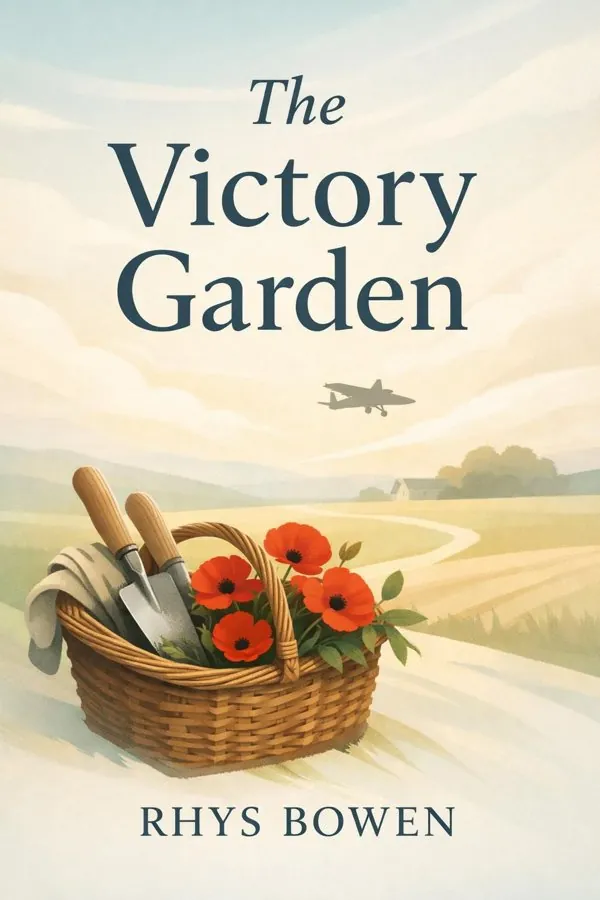
The Victory Garden: Summary & Key Insights
by Rhys Bowen
 10 min8 chaptersAudio available
Key Takeaways from The Victory Garden
Sometimes the greatest upheaval in life begins not with a dramatic choice, but with the slow realization that the life prepared for you does not fully belong to you.
Meaningful work can alter identity just as powerfully as love or loss.
Grief does not simply end a chapter; it often rearranges the meaning of every chapter that follows.
History often changes fastest when necessity outruns tradition.
Comfort can preserve social distance, but shared labor has a way of making artificial hierarchies look fragile.
What Is The Victory Garden About?
The Victory Garden by Rhys Bowen is a bestsellers book spanning 3 pages. The Victory Garden by Rhys Bowen is a moving historical novel set in England during the First World War, where private lives are reshaped by public catastrophe. At its center is Emily Bryce, a sheltered young woman from a respectable family whose future seems neatly arranged until war tears apart every assumption she has been taught to trust. When her fiancé goes to the front, Emily leaves behind drawing rooms and expectations to join the Women’s Land Army, discovering hard labor, emotional uncertainty, and a deeper sense of self in the countryside. What unfolds is not just a wartime romance, but a story about identity, endurance, grief, and the quiet forms of heroism that rarely make headlines. The novel matters because it illuminates a side of war often overshadowed by battle narratives: the transformation of women who stepped into new roles and never fully returned to the old world. Rhys Bowen, celebrated for her richly detailed historical fiction and strong female protagonists, brings authority, warmth, and emotional intelligence to this portrait of change, making the novel both intimate and historically resonant.
This FizzRead summary covers all 8 key chapters of The Victory Garden in approximately 10 minutes, distilling the most important ideas, arguments, and takeaways from Rhys Bowen's work. Also available as an audio summary and Key Quotes Podcast.
The Victory Garden
The Victory Garden by Rhys Bowen is a moving historical novel set in England during the First World War, where private lives are reshaped by public catastrophe. At its center is Emily Bryce, a sheltered young woman from a respectable family whose future seems neatly arranged until war tears apart every assumption she has been taught to trust. When her fiancé goes to the front, Emily leaves behind drawing rooms and expectations to join the Women’s Land Army, discovering hard labor, emotional uncertainty, and a deeper sense of self in the countryside. What unfolds is not just a wartime romance, but a story about identity, endurance, grief, and the quiet forms of heroism that rarely make headlines. The novel matters because it illuminates a side of war often overshadowed by battle narratives: the transformation of women who stepped into new roles and never fully returned to the old world. Rhys Bowen, celebrated for her richly detailed historical fiction and strong female protagonists, brings authority, warmth, and emotional intelligence to this portrait of change, making the novel both intimate and historically resonant.
Who Should Read The Victory Garden?
This book is perfect for anyone interested in bestsellers and looking to gain actionable insights in a short read. Whether you're a student, professional, or lifelong learner, the key ideas from The Victory Garden by Rhys Bowen will help you think differently.
- ✓Readers who enjoy bestsellers and want practical takeaways
- ✓Professionals looking to apply new ideas to their work and life
- ✓Anyone who wants the core insights of The Victory Garden in just 10 minutes
Want the full summary?
Get instant access to this book summary and 100K+ more with Fizz Moment.
Get Free SummaryAvailable on App Store • Free to download
Key Chapters
Sometimes the greatest upheaval in life begins not with a dramatic choice, but with the slow realization that the life prepared for you does not fully belong to you. At the beginning of The Victory Garden, Emily Bryce is a product of her class and upbringing: refined, obedient, and expected to move smoothly from daughterhood into marriage. Her world is orderly on the surface, yet that order depends on a narrow vision of what a woman should be. Bowen uses Emily’s early life to show how social respectability can become a form of confinement, especially when a person has never been encouraged to test her own strength.
War disrupts this arrangement. With her fiancé gone and the familiar rhythms of home unsettled, Emily is forced to examine the assumptions she once accepted automatically. She begins to notice the limits imposed by family expectations, class behavior, and the idea that women exist mainly to wait, support, and endure in silence. What makes this transformation compelling is that it does not happen instantly. Emily remains uncertain, vulnerable, and at times afraid. Her growth feels credible because it emerges through discomfort rather than sudden courage.
This idea reaches beyond the novel. Many people live inside inherited identities: the responsible child, the perfect partner, the agreeable employee. Crisis often reveals whether those roles express who we truly are or merely what others expect. Emily’s journey reminds readers that growth frequently starts with disorientation. We do not become stronger by avoiding disruption, but by allowing it to expose hidden capacities.
A practical application is to examine one role in your own life that feels fixed. Ask which parts reflect your values and which parts are performances designed to keep others comfortable. The actionable takeaway: when circumstances shift, treat uncertainty not only as loss, but as an invitation to discover who you are beyond expectation.
Meaningful work can alter identity just as powerfully as love or loss. Emily’s decision to join the Women’s Land Army is one of the novel’s defining turning points, because it changes not only what she does each day, but how she understands herself. Instead of living in a protected domestic sphere, she enters a world of physical labor, discipline, and collective effort. The work is exhausting, unfamiliar, and often uncomfortable, yet it brings a kind of liberation she has never known.
Bowen shows that the Land Army is important on two levels. Historically, it represents the practical necessity of women sustaining food production while men fight abroad. Emotionally, it becomes a space where women step outside prescribed boundaries and prove themselves capable in ways society had denied or ignored. Emily learns to work with her hands, endure hardship, and contribute to something larger than her own future. Her relationship to labor changes from avoidance to pride. This is crucial because it reveals how competence builds confidence. She is no longer simply waiting for life to happen to her; she is participating in the making of it.
The Land Army also exposes class tensions. Physical work had long been associated with lower status, and Emily must confront both her own assumptions and those of others. In doing so, she comes to respect forms of knowledge and resilience that polite society often overlooks. Readers can connect this to modern experiences in which unfamiliar work environments broaden empathy and dismantle prejudice.
In practical terms, the lesson is that capability grows through doing difficult things, not through imagining them from a safe distance. Volunteering, learning a manual skill, or joining a demanding team can reveal strengths hidden by comfort. The actionable takeaway: if you feel stuck in a narrow definition of yourself, seek out work that challenges your body, your habits, and your assumptions.
Grief does not simply end a chapter; it often rearranges the meaning of every chapter that follows. One of the most affecting aspects of The Victory Garden is how it treats loss not as a single tragic event, but as an ongoing force that reshapes identity, relationships, and hope. Emily’s world, like that of so many during wartime, is marked by uncertainty. Love is fragile, plans are provisional, and every letter can alter the future. Bowen captures the peculiar emotional climate of war, where people must continue living, working, and caring even when dread hangs over ordinary days.
Emily’s experience of loss is transformative because it strips away illusions without destroying her capacity for tenderness. She suffers, but she is not reduced to suffering. Instead, the novel explores how pain can deepen a person’s understanding of what matters. The metaphor of the garden becomes especially powerful here: growth and decay coexist; cultivation requires patience; and new life often emerges from disturbed ground. Renewal is not presented as forgetting or replacing what was lost. It is the more difficult act of carrying grief forward while still choosing life.
This theme has broad relevance. People often believe healing means returning to the person they were before hardship, yet that is rarely possible. More often, healing means becoming someone new who can hold sorrow without being defined entirely by it. Emily’s path suggests that resilience is not hardness but adaptability.
A practical way to apply this insight is to create rituals that honor what has been lost while making room for what is still possible: journaling, tending a garden, preserving letters, or beginning a new project in memory of a turning point. The actionable takeaway: when loss changes your life, do not ask how to erase the wound; ask how to grow a meaningful future around it.
History often changes fastest when necessity outruns tradition. In The Victory Garden, the First World War is not only a military conflict but a social earthquake that forces England to rely on women in new and visible ways. Emily’s story illustrates how war opened doors that had long been closed, even if those openings were shaped by emergency rather than justice. As men leave for the front, women move into spaces of labor, responsibility, and autonomy that challenge old assumptions about weakness, dependence, and propriety.
Bowen does not romanticize this shift. The opportunities available to women arise from crisis, loss, and national strain. Yet the novel makes clear that once women experience competence and independence, they cannot easily return to unquestioned subordination. Emily’s life in the countryside teaches her practical self-reliance, but it also changes her expectations. She begins to see that the world’s earlier limits were not natural facts; they were social decisions. This recognition is one of the novel’s quiet political achievements.
The story also reminds readers that social change is often incomplete. Institutions may temporarily welcome women’s contribution while still withholding full respect or long-term equality. That tension feels strikingly modern. Even today, many organizations celebrate inclusion in moments of need while resisting deeper structural change.
Readers can apply this idea by noticing where necessity has revealed hidden talent in their own workplaces or communities. Who steps up when conditions become difficult? Which contributions are treated as exceptional when they should be treated as normal? The actionable takeaway: when circumstances prove that people are capable of more than tradition allowed, do not let that lesson disappear when the crisis ends.
War exposes whether love is built on fantasy, convenience, duty, or genuine mutual recognition. In The Victory Garden, romance is never a simple refuge from hardship. Instead, Bowen presents love as something altered by distance, danger, uncertainty, and personal transformation. Emily begins the story with a conventional expectation of romantic fulfillment, but wartime life complicates what devotion really means. Separation tests emotional bonds, and her growing independence changes the kind of partnership she can accept.
What makes the novel’s treatment of love compelling is that it refuses sentimentality. Affection is shaped by context. Letters become lifelines. Silences become ominous. Promise and fear coexist. Emily’s emotional life matures as she learns that being loved is not the same as being known, and that commitment must make room for who a person is becoming, not just who they once appeared to be. In this sense, romance becomes part of her education rather than the endpoint of it.
Readers can draw a broader lesson here about relationships during periods of change. Whether the pressure comes from war, illness, relocation, parenthood, or professional upheaval, stress reveals hidden assumptions inside intimacy. Some bonds deepen because both people grow honestly; others weaken because they were sustained more by routine than truth.
To apply this insight, evaluate your closest relationships during demanding seasons. Do they allow room for change? Are expectations based on mutual understanding or on old roles that no longer fit? Meaningful love requires communication, flexibility, and the courage to see each other clearly. The actionable takeaway: judge a relationship not only by how it feels in stable times, but by whether it can honor growth and uncertainty without demanding that either person stay unchanged.
When history becomes violent and unstable, the natural world can provide a form of sanity that is not escapist, but grounding. The garden in The Victory Garden is more than a setting or a wartime necessity. It functions as a symbolic and emotional counterpoint to destruction. While war tears bodies, families, and nations apart, the work of planting, tending, and harvesting asks for patience, attention, and trust in cycles larger than immediate fear. For Emily, the land becomes both workplace and teacher.
Bowen uses the garden to show that care is a serious form of resistance. To cultivate food during war is practical, but it is also moral. It says that life must be sustained even when death dominates the headlines. The natural world does not erase grief, yet it offers continuity. Seasons move forward. Seeds respond to labor. Growth is slow, vulnerable, and real. This steadiness helps Emily regain perspective when human institutions feel unpredictable and fragile.
The lesson resonates today in an age of constant crisis and digital overload. People often seek relief through distraction, but nature offers something different: rhythm. Gardening, walking, observing weather, or tending plants can reconnect us to processes that are neither instant nor controllable. That can reduce anxiety and restore focus.
A practical application is to build a small habit of cultivation into your week. Grow herbs on a windowsill, care for a patch of soil, or simply walk outdoors without headphones and pay attention to seasonal change. Such practices do not solve large problems, but they strengthen emotional endurance. The actionable takeaway: when life feels chaotic, turn toward a living process that requires care, patience, and presence.
The most important bravery in life is often quiet enough to be overlooked. One of Rhys Bowen’s central achievements in The Victory Garden is her refusal to define courage only through battlefield heroics. The novel honors forms of endurance that happen far from military glory: waking up to hard work, carrying grief privately, facing social disapproval, adapting to uncomfortable duties, and continuing to care for others when one’s own heart is uncertain. Emily’s growth is built from these modest but demanding acts.
This broader understanding of courage matters because it restores value to experiences often dismissed as secondary. Wartime home-front labor, emotional resilience, and domestic responsibility are not lesser forms of contribution; they are part of how societies survive catastrophe. Bowen makes readers feel the moral weight of persistence. Emily does not become admirable because she is fearless. She becomes admirable because she acts despite fear, confusion, and sorrow.
The idea applies well beyond historical fiction. Many people imagine courage as a rare moment of dramatic action, which can make their own daily struggles seem insignificant. But raising children under pressure, caring for aging parents, starting over after loss, speaking honestly in a rigid environment, or showing up consistently to difficult work all require courage. Recognizing this can be deeply affirming.
To use this insight, redefine what bravery means in your own life. Instead of waiting for a grand test, notice the recurring acts of steadiness you already perform or need to begin. Keep a list for one week of moments when you chose responsibility over avoidance. The actionable takeaway: respect daily endurance as a genuine form of courage, and act today in one small way that your fear has been postponing.
All Chapters in The Victory Garden
About the Author
Rhys Bowen is a British-born, internationally bestselling author celebrated for her historical mysteries and emotionally rich fiction. She is best known for the Molly Murphy and Royal Spyness series, both of which showcase her talent for blending vivid period detail, suspense, humor, and memorable heroines. Bowen has won multiple major honors, including Agatha and Anthony Awards, and has built a wide readership through her accessible yet carefully researched storytelling. In her standalone historical novels, she often explores women’s lives during times of social upheaval, bringing overlooked corners of history to life with warmth and insight. Her work is especially admired for its strong sense of place, engaging characters, and ability to connect intimate personal journeys with larger historical forces.
Get This Summary in Your Preferred Format
Read or listen to the The Victory Garden summary by Rhys Bowen anytime, anywhere. FizzRead offers multiple formats so you can learn on your terms — all free.
Available formats: App · Audio · PDF · EPUB — All included free with FizzRead
Download The Victory Garden PDF and EPUB Summary
Key Quotes from The Victory Garden
“Sometimes the greatest upheaval in life begins not with a dramatic choice, but with the slow realization that the life prepared for you does not fully belong to you.”
“Meaningful work can alter identity just as powerfully as love or loss.”
“Grief does not simply end a chapter; it often rearranges the meaning of every chapter that follows.”
“History often changes fastest when necessity outruns tradition.”
“Comfort can preserve social distance, but shared labor has a way of making artificial hierarchies look fragile.”
Frequently Asked Questions about The Victory Garden
The Victory Garden by Rhys Bowen is a bestsellers book that explores key ideas across 8 chapters. The Victory Garden by Rhys Bowen is a moving historical novel set in England during the First World War, where private lives are reshaped by public catastrophe. At its center is Emily Bryce, a sheltered young woman from a respectable family whose future seems neatly arranged until war tears apart every assumption she has been taught to trust. When her fiancé goes to the front, Emily leaves behind drawing rooms and expectations to join the Women’s Land Army, discovering hard labor, emotional uncertainty, and a deeper sense of self in the countryside. What unfolds is not just a wartime romance, but a story about identity, endurance, grief, and the quiet forms of heroism that rarely make headlines. The novel matters because it illuminates a side of war often overshadowed by battle narratives: the transformation of women who stepped into new roles and never fully returned to the old world. Rhys Bowen, celebrated for her richly detailed historical fiction and strong female protagonists, brings authority, warmth, and emotional intelligence to this portrait of change, making the novel both intimate and historically resonant.
More by Rhys Bowen

You Might Also Like

The Godfather
Mario Puzo
10 min
The Handmaid's Tale
Margaret Atwood
10 min
The Hunger Games
Suzanne Collins
10 min
The Nightingale
Kristin Hannah
10 min
The Seven Husbands of Evelyn Hugo
Taylor Jenkins Reid
10 min
Backwater Justice
Fern Michaels
10 minBrowse by Category
Ready to read The Victory Garden?
Get the full summary and 100K+ more books with Fizz Moment.