
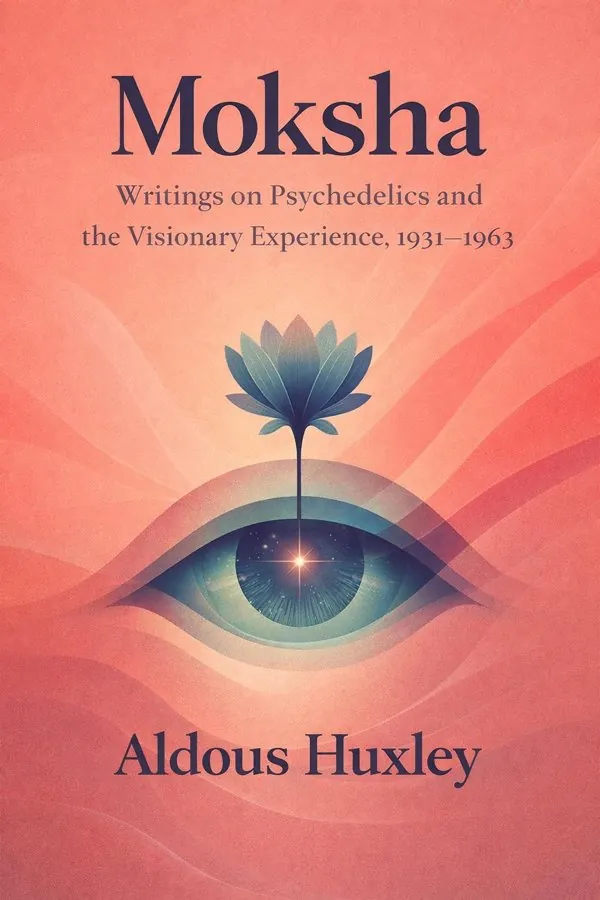
Moksha: Writings on Psychedelics and the Visionary Experience, 1931–1963: Summary & Key Insights
 10 min9 chaptersAudio available
Key Takeaways from Moksha: Writings on Psychedelics and the Visionary Experience, 1931–1963
What if ordinary consciousness is not a clear window onto reality, but a survival-oriented reduction of it?
Across religions, languages, and centuries, why do mystics often sound as if they have touched the same truth?
Sometimes a single altered experience can reorganize a lifetime of thought.
A profound experience is not necessarily a beneficial one.
The deepest trap in spiritual seeking is to confuse extraordinary moments with actual freedom.
What Is Moksha: Writings on Psychedelics and the Visionary Experience, 1931–1963 About?
Moksha: Writings on Psychedelics and the Visionary Experience, 1931–1963 by Aldous Huxley is a western_phil book spanning 6 pages. Moksha is not a single argument so much as a lifelong record of Aldous Huxley’s attempt to understand what human consciousness is capable of becoming. Gathered from essays, letters, lectures, and previously scattered writings, this collection traces Huxley’s evolving reflections on perception, mystical experience, mescaline, LSD, death, art, and spiritual liberation. The title itself points to his central concern: moksha, a Sanskrit term for release or liberation, becomes a way of asking whether the mind can move beyond its ordinary filters and encounter reality more directly. What makes the book enduring is that Huxley never treats psychedelics as mere novelty or rebellion. He approaches them as philosophical instruments, spiritual provocations, and psychological challenges. Long before today’s renewed interest in psychedelic therapy and altered states, he was wrestling with questions that still matter: Are our everyday perceptions incomplete? Can visionary experience deepen moral life? What separates insight from illusion? As one of the twentieth century’s most intellectually adventurous writers, Huxley brings unusual authority to these questions, combining literary brilliance, comparative religion, scientific curiosity, and personal experience into a work that remains both provocative and deeply relevant.
This FizzRead summary covers all 9 key chapters of Moksha: Writings on Psychedelics and the Visionary Experience, 1931–1963 in approximately 10 minutes, distilling the most important ideas, arguments, and takeaways from Aldous Huxley's work. Also available as an audio summary and Key Quotes Podcast.
Moksha: Writings on Psychedelics and the Visionary Experience, 1931–1963
Moksha is not a single argument so much as a lifelong record of Aldous Huxley’s attempt to understand what human consciousness is capable of becoming. Gathered from essays, letters, lectures, and previously scattered writings, this collection traces Huxley’s evolving reflections on perception, mystical experience, mescaline, LSD, death, art, and spiritual liberation. The title itself points to his central concern: moksha, a Sanskrit term for release or liberation, becomes a way of asking whether the mind can move beyond its ordinary filters and encounter reality more directly.
What makes the book enduring is that Huxley never treats psychedelics as mere novelty or rebellion. He approaches them as philosophical instruments, spiritual provocations, and psychological challenges. Long before today’s renewed interest in psychedelic therapy and altered states, he was wrestling with questions that still matter: Are our everyday perceptions incomplete? Can visionary experience deepen moral life? What separates insight from illusion? As one of the twentieth century’s most intellectually adventurous writers, Huxley brings unusual authority to these questions, combining literary brilliance, comparative religion, scientific curiosity, and personal experience into a work that remains both provocative and deeply relevant.
Who Should Read Moksha: Writings on Psychedelics and the Visionary Experience, 1931–1963?
This book is perfect for anyone interested in western_phil and looking to gain actionable insights in a short read. Whether you're a student, professional, or lifelong learner, the key ideas from Moksha: Writings on Psychedelics and the Visionary Experience, 1931–1963 by Aldous Huxley will help you think differently.
- ✓Readers who enjoy western_phil and want practical takeaways
- ✓Professionals looking to apply new ideas to their work and life
- ✓Anyone who wants the core insights of Moksha: Writings on Psychedelics and the Visionary Experience, 1931–1963 in just 10 minutes
Want the full summary?
Get instant access to this book summary and 100K+ more with Fizz Moment.
Get Free SummaryAvailable on App Store • Free to download
Key Chapters
What if ordinary consciousness is not a clear window onto reality, but a survival-oriented reduction of it? That is one of Huxley’s most persistent and provocative insights. In his early essays of the 1930s, before his famous psychedelic experiments, he was already fascinated by the limits of perception. Human beings, he argued, do not simply see the world as it is. We inherit habits of attention from biology, language, education, and culture. These filters help us function efficiently, but they also narrow the range of what we notice and value.
For Huxley, this means that everyday awareness is practical rather than complete. We tend to register objects in terms of use: a chair to sit on, a road to travel, a face to identify. But this utilitarian mode may conceal the intrinsic richness of existence. Art, contemplation, and certain altered states can interrupt this automatic labeling and reveal the world as vivid, mysterious, and astonishingly present.
This idea has practical implications far beyond psychedelic inquiry. It suggests that many of our disagreements, anxieties, and blind spots arise because we mistake our conditioned perspective for reality itself. A manager may see an employee as a function, a parent may see a child through old expectations, and a society may define normality too narrowly. By recognizing perception as filtered, we become more curious, less dogmatic, and more open to transformation.
Huxley’s point is not that all filters are bad. Without them, daily life would become overwhelming. His argument is subtler: our default mode is useful, but incomplete. Wisdom begins when we realize that our familiar world is partly constructed.
Actionable takeaway: Once a day, pause before naming or judging what you see. Spend two minutes observing an ordinary object, place, or person with fresh attention, as if your habitual categories had briefly fallen away.
Sometimes a single altered experience can reorganize a lifetime of thought. Huxley’s mescaline experiment, later described in The Doors of Perception, became exactly that kind of event. In Moksha, these writings remain central because they show him moving from theoretical speculation to first-hand encounter. Under the influence of mescaline, he reports not fantasy or escapism, but an intensified perception of what is already there: colors become radiant, objects seem to possess their own being, and the ordinary world appears saturated with significance.
The crucial claim is that mescaline did not make reality unreal. Instead, Huxley felt it temporarily reduced what he elsewhere called the brain’s “reducing valve,” the filtering function that ordinarily limits consciousness to what is biologically useful. In everyday life, this reduction helps us survive. In visionary states, some of that narrowing relaxes, allowing a less utilitarian and more contemplative relation to the world.
A famous aspect of Huxley’s account is his attention to seemingly simple things: a chair, folds of trousers, flowers, light. This emphasis matters. The visionary is not necessarily exotic. The extraordinary can emerge within the mundane when instrumental thinking loosens its grip. That idea helps explain why so many readers find these passages moving even if they have never used psychedelics.
At the same time, Huxley does not present mescaline as a guaranteed revelation machine. The set, setting, temperament, and interpretation all matter. A chemical opening does not automatically produce wisdom. The experience must be reflected on, integrated, and placed in a larger ethical and spiritual context.
Actionable takeaway: Practice seeing one ordinary element of your environment without asking what it is for. Let your attention rest on color, texture, form, and presence rather than utility for five uninterrupted minutes.
A profound experience is not necessarily a beneficial one. Huxley repeatedly returns to this caution: if psychedelics open the mind, what enters that opening depends greatly on the person, the environment, and the moral framework surrounding the experience. He was interested in LSD and mescaline because they could disclose unusual dimensions of consciousness, but he resisted treating them as casual entertainment or automatic shortcuts to enlightenment.
For Huxley, preparation matters because the psyche is not a neutral space. It carries fears, desires, unresolved conflicts, beliefs, and expectations. Entering an altered state without care can produce confusion, inflation, or panic. By contrast, a setting shaped by calm, beauty, trust, and thoughtful guidance can make insight more likely. His letters and reflections suggest that he anticipated ideas now common in psychedelic research: the importance of set and setting, the need for intentionality, and the value of post-experience integration.
Ethics matter just as much. If a person seeks visionary states only for excitement, status, or escape, the experience may reinforce ego rather than loosen it. Huxley’s deeper hope was that opening perception could foster humility, compassion, and reverence. In other words, the test of a psychedelic experience is not how intense it felt, but what kind of person it helps one become.
This insight applies broadly, even outside psychedelics. Retreats, breathwork, meditation intensives, and other transformative practices also require structure and moral seriousness. Human beings often crave breakthrough experiences, but breakthrough without grounding can become fragmentation.
Huxley’s emphasis on responsibility remains especially relevant today, when altered states are often commercialized. He reminds readers that consciousness is not a toy. It is a domain that deserves discipline and care.
Actionable takeaway: Before pursuing any mind-altering or deeply transformative practice, write down your intention, your support system, and your plan for integration. Treat insight as a responsibility, not just an experience.
The deepest trap in spiritual seeking is to confuse extraordinary moments with actual freedom. Huxley’s use of the word moksha points beyond temporary ecstasy toward liberation in a fuller sense. In Indian traditions, moksha refers to release from ignorance, bondage, and false identification. Huxley adopts the term not as exotic decoration, but as a way to ask whether visionary glimpses can be integrated into ordinary life.
This is a crucial distinction. A person may have a dazzling experience of unity, beauty, or self-transcendence and still return to old habits of fear, vanity, resentment, and distraction. Huxley knew that one insight, however luminous, does not dissolve conditioning by itself. The challenge is not merely to touch the extraordinary, but to let that contact transform perception, relationships, and conduct over time.
In practical terms, this means the visionary state should not become a collectible trophy. Huxley warns, implicitly and sometimes explicitly, against spiritual consumerism before the phrase existed. The point of altered consciousness is not to accumulate stories about one’s experiences, but to become less imprisoned by narrow selfhood. If a revelation does not deepen kindness, patience, or realism, its significance remains incomplete.
This idea can guide anyone interested in growth. We live in a culture that often mistakes peak experiences for progress. A retreat, a breakthrough therapy session, or a moment of awe can matter greatly, but only if followed by changes in attention and action. Liberation must descend into habits.
Huxley’s broader vision is humane rather than grandiose. He does not ask readers to become saints overnight. He asks them to consider whether their glimpses of truth are making daily life more lucid and loving.
Actionable takeaway: After any meaningful inner experience, identify one concrete behavioral change that would honor it—such as listening more attentively, simplifying one habit, or reducing one recurring resentment.
Few topics test a philosophy of mind more seriously than death. In Moksha, Huxley’s reflections on mortality, continuity of consciousness, and the final stages of life reveal how closely his psychedelic interests were tied to existential questions. He was not merely curious about unusual states for their own sake. He wanted to know whether consciousness might be larger than the ordinary ego and whether altered states could help human beings approach death with less fear and more openness.
This concern becomes especially poignant in light of Huxley’s own final days and his interest in using LSD near death. The underlying intuition is that if the mind can experience forms of reality not normally accessible, then perhaps dying should not be understood only as annihilation from the standpoint of the everyday self. He does not offer a dogmatic proof of life after death, but he does suggest that rigid materialist assumptions may be too narrow to account for the full range of human experience.
Importantly, Huxley treats death not only as a metaphysical puzzle but as a practical spiritual teacher. Awareness of mortality strips away trivial concerns and asks what kind of consciousness we are cultivating now. If the ego loosens in mystical or psychedelic states, death may appear less as pure negation and more as a transition into a reality we are poorly equipped to conceptualize.
Modern readers can apply this insight without accepting any particular doctrine. Serious reflection on death can reduce vanity, sharpen priorities, and deepen appreciation. It can also encourage more compassionate care for the dying, including openness to practices that reduce fear and increase peace.
Actionable takeaway: Spend ten minutes writing about what changes if you view consciousness as larger than your daily anxieties. Then ask which present fear would lose power if mortality were faced more honestly.
Before and alongside his psychedelic explorations, Huxley saw art as one of the most reliable ways to loosen habitual perception. Painting, music, literature, and sacred architecture can reveal dimensions of experience that practical consciousness ignores. This is why so many of his descriptions of visionary states sound aesthetic as well as spiritual: he believed beauty can function as a doorway to a more attentive and less possessive way of seeing.
Art matters in Moksha because it prepares the imagination for depth without requiring a chemical catalyst. A great painting does not merely depict an object; it can disclose radiance, stillness, form, and presence. A piece of music can suspend the ordinary sense of time. Poetry can momentarily free language from mere information and return it to wonder. For Huxley, these are not decorative pleasures. They are disciplines of perception.
This helps explain why he often links visionary consciousness to the appreciation of color, texture, light, and pattern. The mind that has learned to perceive aesthetically is less confined to utility. It can dwell, receive, and contemplate. In this sense, art becomes a democratic route toward the kinds of attentiveness that psychedelics sometimes intensify.
The practical value of this idea is significant. Not everyone will pursue altered states, but everyone can cultivate richer perception. Visiting a museum slowly, listening to a symphony without multitasking, or reading a poem aloud can become exercises in presence. Even arranging one’s home with care, light, and simplicity can shape consciousness.
Huxley invites us to treat beauty as nourishment rather than luxury. In a distracted culture, aesthetic seriousness becomes a quiet form of resistance.
Actionable takeaway: Choose one artwork, piece of music, or poem this week and give it full, undivided attention for ten minutes. Notice how sustained aesthetic focus changes your state of mind.
One of Huxley’s enduring strengths is that he refuses a simplistic war between scientific inquiry and spiritual insight. Moksha is full of attempts to think across boundaries: psychology, pharmacology, religion, literature, and metaphysics all meet in his effort to understand consciousness. He respected scientific investigation, yet he also believed that a purely reductionist framework could fail to honor the qualitative depth of lived experience.
This balancing act is central to the book’s importance. Huxley does not want mystical language to become vague sentiment, nor does he want science to become intellectually imperialistic. If a substance changes consciousness in systematic ways, science should study it carefully. But if those changed states include meaning, sacredness, unity, and transformed value perception, then dismissing them as mere chemical noise may be too quick. Description and explanation are not the same thing.
This remains a pressing issue in current debates about psychedelics. Neuroscience can map brain activity, measure therapeutic outcomes, and analyze mechanisms. Yet first-person reports still matter because consciousness is experienced from within. Huxley anticipated this need for a more complete conversation, one that joins empirical rigor with phenomenological honesty.
The broader lesson is useful in many fields. Human realities such as love, grief, beauty, and awe can be studied scientifically, but they are not exhausted by data. We need methods that are precise without becoming reductive, and reflective without becoming anti-scientific.
Huxley’s model is intellectual hospitality. He asks readers to hold evidence and mystery together without collapsing either side. That posture is rare and valuable.
Actionable takeaway: When confronting a complex human experience, ask two questions instead of one: What are its measurable mechanisms, and what is it like from the inside? Refuse explanations that erase either dimension.
A civilization can be materially advanced and spiritually impoverished at the same time. Huxley’s broader social critique runs quietly beneath Moksha: modern life trains people to be efficient, distracted, externally oriented, and increasingly cut off from contemplative depth. If perception is already reduced by biology, industrial society reduces it further through speed, conformity, and instrumental thinking.
This helps explain why visionary experience mattered so much to him. It was not simply private curiosity, but a counterweight to a culture that confuses productivity with reality. In a world dominated by consumption, bureaucracy, and mass media, people can lose contact with silence, wonder, and inwardness. Psychedelics interested Huxley partly because they could interrupt the trance of ordinary social conditioning and remind individuals that consciousness need not remain trapped within approved routines.
Yet his critique is not anti-modern romanticism. He was not calling for a retreat into fantasy or irrationalism. Rather, he wanted a richer civilization, one that could integrate scientific progress with spiritual maturity and aesthetic sensitivity. Without that balance, societies become powerful but shallow.
Readers can apply this insight by examining the structures that shape attention today: constant notifications, entertainment saturation, status comparison, and endless busyness. These forces make sustained perception difficult. A person need not use psychedelics to resist them. Deliberate silence, nature, art, contemplative practice, and deep reading can all reopen dimensions of experience that modern systems tend to flatten.
Huxley’s warning is that a culture may normalize spiritual numbness without recognizing it as loss. The first step toward recovery is noticing how much of life is lived automatically.
Actionable takeaway: Design one regular period each week free from screens, noise, and productivity goals. Use it for silence, reading, art, or nature, and observe how your sense of reality shifts when stimulation decreases.
All Chapters in Moksha: Writings on Psychedelics and the Visionary Experience, 1931–1963
About the Author
Aldous Huxley (1894–1963) was an English novelist, essayist, and philosopher whose work ranged across literature, politics, science, religion, and psychology. Born into a distinguished intellectual family, he became internationally famous for Brave New World, his dystopian critique of technological and social control. Over time, however, his attention shifted increasingly toward the study of consciousness, mysticism, and human transformation. Huxley explored the common insights of religious traditions, wrote influential works such as The Perennial Philosophy and The Doors of Perception, and became one of the earliest major literary voices to examine psychedelic experience with philosophical seriousness. His writing is known for combining clarity, wit, and breadth of learning. Today he remains a central figure in discussions of modernity, spirituality, and the hidden possibilities of the mind.
Get This Summary in Your Preferred Format
Read or listen to the Moksha: Writings on Psychedelics and the Visionary Experience, 1931–1963 summary by Aldous Huxley anytime, anywhere. FizzRead offers multiple formats so you can learn on your terms — all free.
Available formats: App · Audio · PDF · EPUB — All included free with FizzRead
Download Moksha: Writings on Psychedelics and the Visionary Experience, 1931–1963 PDF and EPUB Summary
Key Quotes from Moksha: Writings on Psychedelics and the Visionary Experience, 1931–1963
“What if ordinary consciousness is not a clear window onto reality, but a survival-oriented reduction of it?”
“Across religions, languages, and centuries, why do mystics often sound as if they have touched the same truth?”
“Sometimes a single altered experience can reorganize a lifetime of thought.”
“A profound experience is not necessarily a beneficial one.”
“The deepest trap in spiritual seeking is to confuse extraordinary moments with actual freedom.”
Frequently Asked Questions about Moksha: Writings on Psychedelics and the Visionary Experience, 1931–1963
Moksha: Writings on Psychedelics and the Visionary Experience, 1931–1963 by Aldous Huxley is a western_phil book that explores key ideas across 9 chapters. Moksha is not a single argument so much as a lifelong record of Aldous Huxley’s attempt to understand what human consciousness is capable of becoming. Gathered from essays, letters, lectures, and previously scattered writings, this collection traces Huxley’s evolving reflections on perception, mystical experience, mescaline, LSD, death, art, and spiritual liberation. The title itself points to his central concern: moksha, a Sanskrit term for release or liberation, becomes a way of asking whether the mind can move beyond its ordinary filters and encounter reality more directly. What makes the book enduring is that Huxley never treats psychedelics as mere novelty or rebellion. He approaches them as philosophical instruments, spiritual provocations, and psychological challenges. Long before today’s renewed interest in psychedelic therapy and altered states, he was wrestling with questions that still matter: Are our everyday perceptions incomplete? Can visionary experience deepen moral life? What separates insight from illusion? As one of the twentieth century’s most intellectually adventurous writers, Huxley brings unusual authority to these questions, combining literary brilliance, comparative religion, scientific curiosity, and personal experience into a work that remains both provocative and deeply relevant.
More by Aldous Huxley

You Might Also Like
A Little History of Philosophy
Nigel Warburton
10 min
Areopagitica
John Milton
10 min
How To Think Like A Philosopher: Essential Principles For Clear Thinking
Peter Cave
10 min
Language, Truth and Logic
A. J. Ayer
10 min
The Age of Reason
Thomas Paine
10 min
The Essays
Michel De Montaigne
10 minBrowse by Category
Ready to read Moksha: Writings on Psychedelics and the Visionary Experience, 1931–1963?
Get the full summary and 100K+ more books with Fizz Moment.