
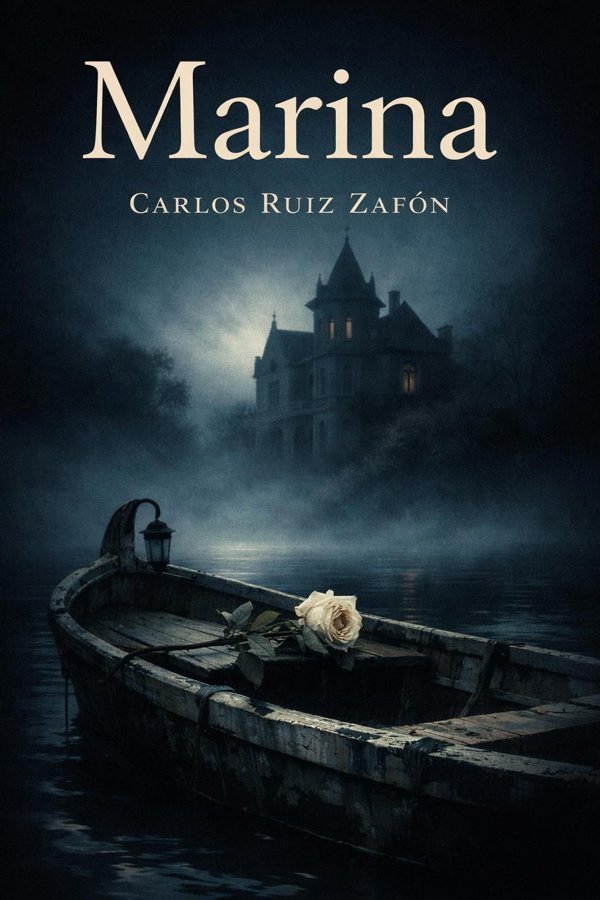
Marina: Summary & Key Insights
 10 min8 chaptersAudio available
Key Takeaways from Marina
Some places do not simply contain stories—they seem to whisper them into the lives of those willing to listen.
Mystery often begins not with a loud event, but with a quiet ritual no one can explain.
Behind every monster, there is often a human dream that went terribly wrong.
Truth is rarely discovered in comfort; more often, it is found by descending into places we would rather avoid.
We do not merely remember loss; loss quietly teaches us who we are.
What Is Marina About?
Marina by Carlos Ruiz Zafón is a bestsellers book spanning 5 pages. Set in Barcelona at the end of the 1970s, Marina is Carlos Ruiz Zafón’s haunting coming-of-age novel about first love, buried grief, and the dangerous pull of the past. The story follows Óscar Drai, a lonely boarding-school student who wanders into a crumbling mansion and meets Marina and her enigmatic father, Germán. What begins as an intense teenage friendship soon becomes an investigation into a decades-old secret involving a mysterious woman in black, a neglected cemetery, and a legacy of obsession that refuses to die. As Óscar and Marina search for answers, they enter a world where beauty and decay, innocence and horror, memory and loss exist side by side. What makes Marina so memorable is not just its suspenseful plot, but the emotional depth beneath it: Zafón turns mystery into a meditation on how the past shapes identity and how love often arrives entangled with sorrow. Written before his global fame with The Shadow of the Wind, the novel already displays his signature gifts—atmospheric settings, gothic intrigue, and a deep reverence for stories that linger like ghosts.
This FizzRead summary covers all 8 key chapters of Marina in approximately 10 minutes, distilling the most important ideas, arguments, and takeaways from Carlos Ruiz Zafón's work. Also available as an audio summary and Key Quotes Podcast.
Marina
Set in Barcelona at the end of the 1970s, Marina is Carlos Ruiz Zafón’s haunting coming-of-age novel about first love, buried grief, and the dangerous pull of the past. The story follows Óscar Drai, a lonely boarding-school student who wanders into a crumbling mansion and meets Marina and her enigmatic father, Germán. What begins as an intense teenage friendship soon becomes an investigation into a decades-old secret involving a mysterious woman in black, a neglected cemetery, and a legacy of obsession that refuses to die. As Óscar and Marina search for answers, they enter a world where beauty and decay, innocence and horror, memory and loss exist side by side. What makes Marina so memorable is not just its suspenseful plot, but the emotional depth beneath it: Zafón turns mystery into a meditation on how the past shapes identity and how love often arrives entangled with sorrow. Written before his global fame with The Shadow of the Wind, the novel already displays his signature gifts—atmospheric settings, gothic intrigue, and a deep reverence for stories that linger like ghosts.
Who Should Read Marina?
This book is perfect for anyone interested in bestsellers and looking to gain actionable insights in a short read. Whether you're a student, professional, or lifelong learner, the key ideas from Marina by Carlos Ruiz Zafón will help you think differently.
- ✓Readers who enjoy bestsellers and want practical takeaways
- ✓Professionals looking to apply new ideas to their work and life
- ✓Anyone who wants the core insights of Marina in just 10 minutes
Want the full summary?
Get instant access to this book summary and 100K+ more with Fizz Moment.
Get Free SummaryAvailable on App Store • Free to download
Key Chapters
Some places do not simply contain stories—they seem to whisper them into the lives of those willing to listen. In Marina, Barcelona is not just a backdrop but a living force, full of abandoned mansions, silent avenues, hidden courtyards, and fading memories. Through Óscar Drai, a restless student who often escapes his boarding school to wander alone, we discover a city suspended between beauty and ruin. His accidental visit to a decaying house introduces him to Germán and Marina, and that encounter changes everything. Zafón shows how chance meetings are rarely random in stories shaped by memory and longing; the city itself appears to guide Óscar toward truths he is not yet ready to understand.
This opening idea matters because it establishes one of the novel’s deepest patterns: curiosity is both an invitation and a risk. Óscar’s wandering reflects a universal impulse. Many people, especially in adolescence, feel drawn to what lies beyond rules, routines, and safe explanations. The unknown promises freedom, identity, and meaning. In practical terms, this theme applies to real life whenever we step outside our familiar habits—exploring a new neighborhood, entering an unfamiliar community, or speaking to someone whose life seems entirely different from our own. Such moments often become turning points.
Zafón also captures the emotional power of setting. We remember certain streets, buildings, and rooms because they become attached to who we were when we first entered them. Barcelona in Marina functions exactly that way: as a map of emotion. The city teaches Óscar how to look, not just at surfaces, but at hidden histories.
Actionable takeaway: Pay attention to the places and encounters that draw your curiosity—they may reveal more about your inner life than your routines ever will.
Mystery often begins not with a loud event, but with a quiet ritual no one can explain. One of Marina’s most unforgettable scenes occurs when Marina leads Óscar to a secluded cemetery where, once a month, a veiled woman visits a grave marked only by a black butterfly. She leaves a single red rose and disappears without a word. The image is simple, almost theatrical, but that simplicity gives it enormous power. It awakens the two teenagers’ curiosity and launches the investigation that drives the novel forward.
What makes this episode so compelling is that it dramatizes a core human instinct: we cannot resist patterns when we do not know their meaning. A repeated act, especially one charged with grief or secrecy, demands interpretation. Óscar and Marina are not merely trying to solve a puzzle. They are trying to enter a hidden emotional reality. Who is this woman? Why this grave? Why the black butterfly? Their questions transform them from passive observers into participants in a much darker story.
In everyday life, we experience smaller versions of this impulse. Family silences, recurring behaviors, or objects kept for reasons no one explains can become emotional mysteries. When approached thoughtfully, such mysteries can reveal inherited pain, forgotten relationships, or unresolved conflict. But Marina also warns that investigation has consequences. Once curiosity becomes commitment, innocence is lost.
The cemetery scene further introduces one of the novel’s strongest symbols: remembrance as ritual. The red rose is not only a clue; it is a sign that love and mourning often survive long after language fails.
Actionable takeaway: When something repeated but unexplained captures your attention, do not dismiss it—ask what hidden story, grief, or longing may be asking to be understood.
Behind every monster, there is often a human dream that went terribly wrong. As Óscar and Marina follow the trail left by the woman in black, they uncover the history of Mijail Kolvenik, a brilliant industrialist and inventor whose ambition, deformity, loneliness, and obsession reshape him into something almost mythic. Kolvenik is one of Zafón’s most fascinating creations because he is not evil in a simple sense. He is tragic, grotesque, brilliant, and broken all at once. His story blends science, vanity, love, and self-hatred until the boundary between man and machine begins to dissolve.
Kolvenik represents the danger of trying to conquer vulnerability through control. He wants to overcome weakness, escape mortality, and build a future in which imperfection can be engineered away. Yet the more he tries to master life, the less human he becomes. This gives the novel a deeper resonance beyond gothic suspense. It becomes a meditation on obsession—especially the kind that begins with pain but turns into domination.
The character remains relevant because modern life often celebrates relentless optimization: better bodies, sharper productivity, total reinvention. Marina asks what happens when the desire to improve ourselves becomes a refusal to accept our wounded humanity. In practical terms, ambition is valuable, but it becomes destructive when it erases empathy, relationship, and limits.
Kolvenik’s tragedy also reminds readers that external monstrosity often mirrors internal despair. His transformation is not only physical; it is emotional and moral, born from isolation and unprocessed suffering.
Actionable takeaway: Pursue growth and innovation, but never let the fear of weakness push you into sacrificing your humanity, relationships, or moral center.
Truth is rarely discovered in comfort; more often, it is found by descending into places we would rather avoid. As the mystery deepens, Óscar and Marina move through abandoned greenhouses, forgotten neighborhoods, hidden archives, and terrifying spaces tied to Kolvenik’s legacy. The plot becomes darker and more dangerous, but this descent is not merely physical. It is psychological and emotional. Each revelation forces the young protagonists to confront how desire, grief, vanity, and guilt can survive across decades and infect later generations.
This section of the novel shows Zafón’s skill at pacing suspense while preserving emotional meaning. The clues are not random twists. They form a chain that reveals how people remake reality to avoid unbearable pain. Characters conceal identities, reinvent narratives, and cling to impossible hopes. The final revelations matter because they expose not just what happened, but why people needed secrecy in the first place.
In life, difficult truths often emerge in similar ways. We begin by investigating one problem—a conflict, a family pattern, a personal anxiety—and gradually uncover deeper causes beneath it. Real understanding requires patience and the willingness to enter emotionally uncomfortable territory. Marina suggests that the path to truth is not clean or linear. It is messy, frightening, and often heartbreaking.
For readers, this idea offers more than suspense. It encourages maturity. To grow, we must tolerate ambiguity long enough for deeper patterns to reveal themselves. Avoidance preserves ignorance, but courage opens the way to wisdom.
Actionable takeaway: When faced with a troubling mystery in your life, resist the urge to settle for easy answers—stay with the discomfort long enough to uncover the deeper truth.
We do not merely remember loss; loss quietly teaches us who we are. At its emotional core, Marina is a novel about memory’s power to preserve and wound at the same time. Óscar narrates the story from a distance, looking back on the unforgettable year when he met Marina. That framing matters. From the very beginning, we understand that what he is recounting has marked him permanently. The mystery may provide the plot, but memory provides the soul.
Zafón treats remembrance as both sanctuary and burden. Characters are haunted not only by dead loved ones, but by the versions of themselves that existed before tragedy. Memory keeps love alive, yet it can also trap people in unfinished grief. This is especially visible in the older generation, whose lives are distorted by what they cannot release. For Óscar, however, memory becomes initiation. By remembering Marina, he preserves a part of himself that would otherwise vanish with youth.
This idea resonates because everyone builds identity through selective remembrance. We tell ourselves stories about first friendships, betrayals, illnesses, departures, and moments of wonder. These memories become internal architecture. In practical terms, reflecting on formative loss can clarify why we fear certain endings, pursue certain relationships, or cling to specific dreams.
Marina does not advise forgetting pain. Instead, it suggests that grief becomes bearable when transformed into narrative, tenderness, and meaning. To remember fully is painful, but to refuse remembrance is to lose part of one’s own history.
Actionable takeaway: Revisit the memories that shaped you—not to remain trapped in them, but to understand how they continue to influence your choices, fears, and capacity to love.
The intensity of first love comes from its innocence, but also from its inability to protect itself against reality. The relationship between Óscar and Marina is one of the novel’s most moving elements because it captures adolescent intimacy without reducing it to sentimentality. They are drawn together by loneliness, intelligence, imagination, and a shared appetite for mystery. Their bond feels immediate and electric, yet it is also hesitant, shaped by what remains unsaid. Zafón understands that first love is often less about possession than about awakening—suddenly seeing the world as charged with meaning because another person now inhabits it.
What gives this love story its emotional force is its fragility. Óscar and Marina do not exist in a protected realm. Their connection unfolds in the shadow of family secrets, illness, mortality, and the disturbing history they uncover. The novel therefore refuses the fantasy that love can isolate us from pain. Instead, it presents love as the very thing that makes loss more devastating and life more vivid.
This idea applies beyond romance. Many formative relationships—first close friendships, mentors, creative collaborators—carry the same quality. They open emotional capacities we did not know we possessed. Even if they end, they alter our sense of self permanently. That is why early attachments remain unforgettable: they do not simply accompany identity formation; they participate in creating it.
Marina reminds readers that vulnerability is not a flaw in love but its defining condition. To love deeply is to accept uncertainty, impermanence, and emotional exposure.
Actionable takeaway: Value the relationships that awaken your emotional life, even if they are fragile, because their meaning often lies in how they change you rather than how long they last.
One of Zafón’s greatest artistic gifts is his ability to make ruin beautiful without denying its darkness. Throughout Marina, decaying houses, foggy streets, broken statues, abandoned factories, and neglected gardens create an atmosphere in which beauty and corruption exist side by side. This is not decorative gothic style for its own sake. It expresses the novel’s central truth: life is most haunting when elegance and deterioration occupy the same frame.
This coexistence shapes how readers understand both the city and the characters. Marina herself embodies this tension—radiant, intelligent, and captivating, yet surrounded by sadness and impermanence. Germán’s home is filled with refinement, art, and memory, but also loneliness and decline. Kolvenik’s world fuses brilliance with horror. Again and again, the novel asks us to look at what is damaged without turning away from what remains luminous.
In practical terms, this idea offers a mature way of seeing. Many people are taught to divide experience into clean opposites: success or failure, youth or aging, joy or grief. Marina rejects that simplicity. A family can be loving and broken. A city can be magnificent and wounded. A memory can be painful and precious at once. This perspective encourages emotional nuance, especially when evaluating one’s own life.
There is also comfort here. If beauty can survive within decay, then meaning can survive within hardship. We do not need perfect circumstances for wonder, tenderness, or truth to appear. Often they emerge precisely where things are falling apart.
Actionable takeaway: Train yourself to notice what remains beautiful in imperfect, aging, or painful situations—this habit deepens resilience and emotional honesty.
Human beings cannot defeat death, but they can resist oblivion through storytelling. Marina is structured as an act of remembrance: an older Óscar recounts the events of his youth because forgetting them would mean losing something essential. This narrative choice reveals one of the novel’s most powerful convictions—that stories are a way of granting continued life to people, places, and moments that physical time has taken away.
Zafón would later become famous for celebrating books, archives, and literary memory, and Marina already contains that sensibility. Characters are constantly tracing fragments: photographs, names, rumors, letters, grave markers, and testimonies. The mystery advances because stories, however partial, survive in material and emotional traces. Each recovered narrative pushes back against disappearance.
This matters in practical life as well. Families preserve themselves through repeated anecdotes. Communities hold identity through shared histories. Individuals process grief by writing journals, making albums, recording conversations, or simply telling the same important stories to trusted listeners. These acts do more than document events; they organize meaning and keep relationships present in memory.
The novel also warns that untold stories can become ghosts. Secrets do not vanish simply because they are hidden. They return as confusion, fear, shame, or inherited silence. To tell the truth, even imperfectly, is often an act of liberation.
For readers, Marina becomes more than a mystery novel. It becomes a reflection on why we narrate the past at all: not to escape loss, but to ensure that love, suffering, and beauty do not dissolve without witness.
Actionable takeaway: Preserve the people and experiences that matter to you by telling their stories—write them, share them, and let memory become something living rather than private and fading.
All Chapters in Marina
About the Author
Carlos Ruiz Zafón (1964–2020) was a Spanish novelist born in Barcelona and one of the most internationally acclaimed literary voices of the modern Spanish language. Before achieving global success with The Shadow of the Wind and the Cemetery of Forgotten Books series, he wrote several novels for younger readers, including Marina, which already showcased his signature style: atmospheric settings, intricate mysteries, tragic romance, and a deep fascination with memory and storytelling. His fiction often blends gothic tension with historical texture and emotional intimacy, making cities, buildings, and books feel like living presences. Zafón later lived in Los Angeles, where he also worked in screenwriting. His novels have been translated widely and continue to attract readers for their lyrical prose, haunting plots, and enduring love of stories.
Get This Summary in Your Preferred Format
Read or listen to the Marina summary by Carlos Ruiz Zafón anytime, anywhere. FizzRead offers multiple formats so you can learn on your terms — all free.
Available formats: App · Audio · PDF · EPUB — All included free with FizzRead
Download Marina PDF and EPUB Summary
Key Quotes from Marina
“Some places do not simply contain stories—they seem to whisper them into the lives of those willing to listen.”
“Mystery often begins not with a loud event, but with a quiet ritual no one can explain.”
“Behind every monster, there is often a human dream that went terribly wrong.”
“Truth is rarely discovered in comfort; more often, it is found by descending into places we would rather avoid.”
“We do not merely remember loss; loss quietly teaches us who we are.”
Frequently Asked Questions about Marina
Marina by Carlos Ruiz Zafón is a bestsellers book that explores key ideas across 8 chapters. Set in Barcelona at the end of the 1970s, Marina is Carlos Ruiz Zafón’s haunting coming-of-age novel about first love, buried grief, and the dangerous pull of the past. The story follows Óscar Drai, a lonely boarding-school student who wanders into a crumbling mansion and meets Marina and her enigmatic father, Germán. What begins as an intense teenage friendship soon becomes an investigation into a decades-old secret involving a mysterious woman in black, a neglected cemetery, and a legacy of obsession that refuses to die. As Óscar and Marina search for answers, they enter a world where beauty and decay, innocence and horror, memory and loss exist side by side. What makes Marina so memorable is not just its suspenseful plot, but the emotional depth beneath it: Zafón turns mystery into a meditation on how the past shapes identity and how love often arrives entangled with sorrow. Written before his global fame with The Shadow of the Wind, the novel already displays his signature gifts—atmospheric settings, gothic intrigue, and a deep reverence for stories that linger like ghosts.
More by Carlos Ruiz Zafón

You Might Also Like
The Godfather
Mario Puzo
10 min
The Handmaid's Tale
Margaret Atwood
10 min
The Hunger Games
Suzanne Collins
10 min
The Nightingale
Kristin Hannah
10 min
The Seven Husbands of Evelyn Hugo
Taylor Jenkins Reid
10 min
Backwater Justice
Fern Michaels
10 minBrowse by Category
Ready to read Marina?
Get the full summary and 100K+ more books with Fizz Moment.