
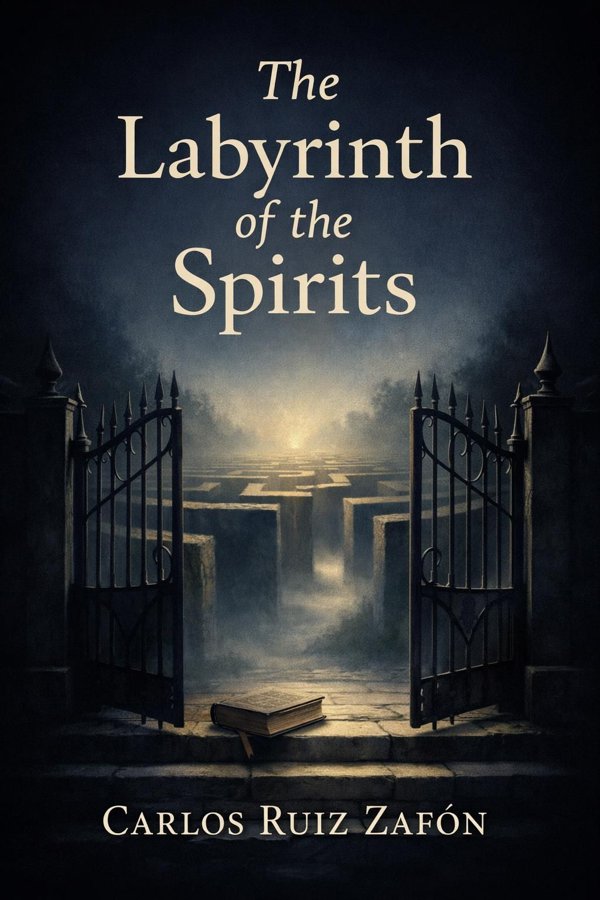
The Labyrinth of the Spirits: Summary & Key Insights
 10 min3 chaptersAudio available
What Is The Labyrinth of the Spirits About?
The Labyrinth of the Spirits by Carlos Ruiz Zafón is a classics book spanning 3 pages. In 1950s Barcelona, Alicia Gris, a woman scarred by war, becomes entangled in an investigation that leads her to the heart of the mystery surrounding the Cemetery of Forgotten Books. Blending love, revenge, and redemption, this novel concludes the saga that began with 'The Shadow of the Wind.'
This FizzRead summary covers all 3 key chapters of The Labyrinth of the Spirits in approximately 10 minutes, distilling the most important ideas, arguments, and takeaways from Carlos Ruiz Zafón's work. Also available as an audio summary and Key Quotes Podcast.
The Labyrinth of the Spirits
In 1950s Barcelona, Alicia Gris, a woman scarred by war, becomes entangled in an investigation that leads her to the heart of the mystery surrounding the Cemetery of Forgotten Books. Blending love, revenge, and redemption, this novel concludes the saga that began with 'The Shadow of the Wind.'
Who Should Read The Labyrinth of the Spirits?
This book is perfect for anyone interested in classics and looking to gain actionable insights in a short read. Whether you're a student, professional, or lifelong learner, the key ideas from The Labyrinth of the Spirits by Carlos Ruiz Zafón will help you think differently.
- ✓Readers who enjoy classics and want practical takeaways
- ✓Professionals looking to apply new ideas to their work and life
- ✓Anyone who wants the core insights of The Labyrinth of the Spirits in just 10 minutes
Want the full summary?
Get instant access to this book summary and 100K+ more with Fizz Moment.
Get Free SummaryAvailable on App Store • Free to download
Key Chapters
Alicia Gris enters the stage as a woman carrying the injuries of history itself. As a child fleeing the bombardment of Barcelona during the Civil War, she lost something more profound than innocence—a piece of her body and spirit. By the 1950s, she works for Spain’s secret police, a world of compromise and moral corrosion. Her assignment to find the missing Minister of Culture, Mauricio Valls, becomes more than a job—it is the initiation of her own redemption.
In these early chapters, I shaped Alicia as an embodiment of the post-war soul: intelligent, cynical, yet still vulnerable to beauty and truth. When she begins to investigate Valls’s disappearance, she navigates a landscape marked by silence and censorship. The Madrid of this era is suffocating under the regime’s apparatus, where artists are imprisoned or erased and where archives conceal more than they reveal. The irony of Valls’s title—Minister of Culture—haunts Alicia’s quest. What kind of culture survives when its guardians destroy those who create?
Her journey soon leads her back to Barcelona, the city that once shattered her life. The setting is crucial: it is both a labyrinth of stone and memory. Each street carries echoes from earlier novels—the Sempere bookshop, the hidden library of forgotten books—and the city itself becomes a character, breathing with sorrow and fascination. Through Alicia’s eyes, we perceive the haunting beauty of a world trying to live amidst ruins.
Alicia’s search is not merely procedural. Through interviews, hidden documents, and testimonies, she begins to uncover Valls’s past. He was not the cultured minister the public knew but a prison warden complicit in the persecution of writers and intellectuals during Franco’s early regime. The threads of power, corruption, and art intertwine; each revelation adds weight to Alicia’s moral burden. Her work as a state agent now stands against the very truth she seeks to protect, forcing her to question who the real enemies are.
Her partnership with Vargas, a colleague whose loyalty softens her cynicism, adds warmth to this cold investigation. Together they reveal not only political crimes but also the resilience of ordinary people trapped in the machinery of repression. Every clue they follow deepens Alicia’s confrontation with her own past. Each truth she uncovers becomes a step away from bitterness—a painful but necessary pilgrimage through Spain’s collective memory.
While Alicia follows the trail of the missing minister, another thread unravels in parallel: Daniel Sempere’s desperate attempt to understand the truth about his mother’s death. Having inherited his father’s bookshop and a legacy entwined with the mysteries of the Cemetery of Forgotten Books, Daniel’s life has become consumed by silence. He suspects that Mauricio Valls holds the key to the mystery, that the regime’s crimes and his family’s tragedy are bound together.
Through Daniel, I sought to explore how grief morphs into obsession. His wife, Bea, and his friend Fermín become witnesses to this internal storm. They remind him of love and loyalty, yet Daniel feels stripped of peace. His search mirrors Spain’s struggle with its own buried history. The dictatorship’s propaganda insists on forgetting, but Daniel refuses to forget. The more he uncovers—the imprisonment of authors, the destruction of manuscripts, the complicity of officials—the more he feels himself drifting into darkness.
There are moments when Daniel’s pain is almost unbearable. He confronts the corrosive nature of vengeance, realizing that truth may not heal but instead deepen the wounds. Fermín’s humor and wisdom provide contrast, serving as reminders that even in the shadows of tyranny, humanity endures through laughter and friendship. Their interactions bind this novel to previous volumes, stitching together a family of souls caught in the same web of secrets.
Daniel’s journey becomes intertwined with Alicia’s. When their paths finally converge, they recognize each other as different faces of the same struggle—the need to preserve what the regime tried to erase. The discovery of secret archives, surviving manuscripts, and testimonies of lost writers brings clarity to them both. Truth, they learn, is not a weapon of vengeance but a form of remembrance. In the moral labyrinth of their world, forgiveness becomes the most radical act.
Through Daniel, I wanted to show that memory demands courage. To remember is to reopen scars, to confront the complicity of those who survived by silence. Yet without remembrance, no nation can reclaim its soul. His obsession ultimately transforms into understanding, teaching that even broken stories can illuminate the path toward moral restoration.
+ 1 more chapters — available in the FizzRead app
All Chapters in The Labyrinth of the Spirits
About the Author
Carlos Ruiz Zafón (1964–2020) was a Spanish novelist best known for his series 'The Cemetery of Forgotten Books.' His work combines elements of mystery, history, and gothic literature, and has been translated into more than forty languages.
Get This Summary in Your Preferred Format
Read or listen to the The Labyrinth of the Spirits summary by Carlos Ruiz Zafón anytime, anywhere. FizzRead offers multiple formats so you can learn on your terms — all free.
Available formats: App · Audio · PDF · EPUB — All included free with FizzRead
Download The Labyrinth of the Spirits PDF and EPUB Summary
Key Quotes from The Labyrinth of the Spirits
“Alicia Gris enters the stage as a woman carrying the injuries of history itself.”
“While Alicia follows the trail of the missing minister, another thread unravels in parallel: Daniel Sempere’s desperate attempt to understand the truth about his mother’s death.”
Frequently Asked Questions about The Labyrinth of the Spirits
The Labyrinth of the Spirits by Carlos Ruiz Zafón is a classics book that explores key ideas across 3 chapters. In 1950s Barcelona, Alicia Gris, a woman scarred by war, becomes entangled in an investigation that leads her to the heart of the mystery surrounding the Cemetery of Forgotten Books. Blending love, revenge, and redemption, this novel concludes the saga that began with 'The Shadow of the Wind.'
More by Carlos Ruiz Zafón
You Might Also Like



Browse by Category
Ready to read The Labyrinth of the Spirits?
Get the full summary and 100K+ more books with Fizz Moment.