
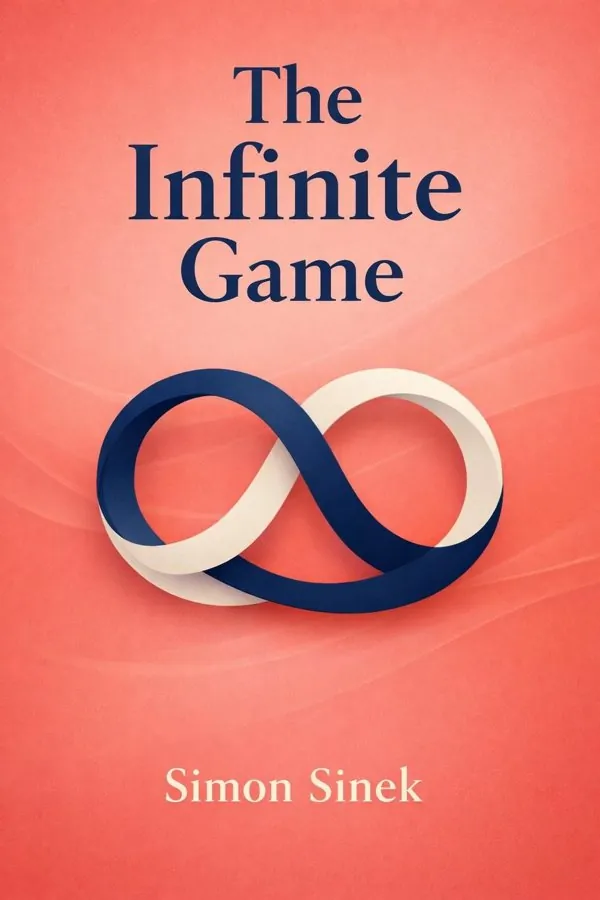
The Infinite Game: Summary & Key Insights
by Simon Sinek
 10 min6 chaptersAudio available
What Is The Infinite Game About?
The Infinite Game by Simon Sinek is a business book published in 2019 spanning 6 pages. In 'The Infinite Game', Simon Sinek explores the concept of infinite versus finite games, arguing that many organizations and leaders mistakenly play business as a finite game with fixed rules and clear winners. He proposes that true success and longevity come from adopting an infinite mindset—one focused on long-term purpose, resilience, and continuous improvement rather than short-term victories. Through examples from business, politics, and history, Sinek illustrates how leaders who embrace the infinite game inspire trust, innovation, and enduring success.
This FizzRead summary covers all 6 key chapters of The Infinite Game in approximately 10 minutes, distilling the most important ideas, arguments, and takeaways from Simon Sinek's work. Also available as an audio summary and Key Quotes Podcast.
The Infinite Game
In 'The Infinite Game', Simon Sinek explores the concept of infinite versus finite games, arguing that many organizations and leaders mistakenly play business as a finite game with fixed rules and clear winners. He proposes that true success and longevity come from adopting an infinite mindset—one focused on long-term purpose, resilience, and continuous improvement rather than short-term victories. Through examples from business, politics, and history, Sinek illustrates how leaders who embrace the infinite game inspire trust, innovation, and enduring success.
Who Should Read The Infinite Game?
This book is perfect for anyone interested in business and looking to gain actionable insights in a short read. Whether you're a student, professional, or lifelong learner, the key ideas from The Infinite Game by Simon Sinek will help you think differently.
- ✓Readers who enjoy business and want practical takeaways
- ✓Professionals looking to apply new ideas to their work and life
- ✓Anyone who wants the core insights of The Infinite Game in just 10 minutes
Want the full summary?
Get instant access to this book summary and 100K+ more with Fizz Moment.
Get Free SummaryAvailable on App Store • Free to download
Key Chapters
Carse’s idea forms the philosophical backbone of my work. In a finite game, players compete by universally agreed-upon rules toward a specific outcome—winning. The game ends once a winner is declared. Business leaders often approach their roles this way. They obsess over beating competitors, dominating markets, or securing quarterly profits. But here’s the paradox: unlike sports or chess, business is an infinite game. There’s no defined endpoint. New players enter the field, rules shift, technologies change, and yesterday’s victory quickly becomes irrelevant.
Once I understood this distinction, I began to see why so many organizations struggle. Finite thinking breeds competition and anxiety. It encourages manipulation of metrics and short-term tactics. Infinite thinking, in contrast, breeds collaboration, resilience, and long-term trust. The goal of an infinite game is not to win—it’s to perpetuate play. For leaders, this means building organizations that last, cultivating teams that thrive, and inspiring movements that endure well beyond their own tenure.
Through examples like Microsoft and Apple, we can see the difference clearly. There were times when Microsoft fixated on beating Apple; its energy revolved around competition. Apple, however, was driven by its cause—to empower the individual through technology. While Microsoft measured its worth in market share, Apple measured it in meaning. The latter’s infinite mindset fostered creativity and loyalty that outlived individual product cycles. That’s the essence of playing the Infinite Game.
Your Just Cause is your north star—it’s the enduring purpose that inspires people to commit their blood, sweat, and tears to something greater than themselves. A Just Cause is not a product, not a revenue goal, and not a mission statement carefully crafted in a boardroom. It’s an ideal vision of a future state so appealing that others voluntarily devote their energy toward helping realize it.
When I wrote about this idea, I wanted to challenge leaders to ask themselves: what would make people want to keep playing this game, even when there’s no prize? A Just Cause provides that reason. It’s the statement that says, “We envision a world in which…” and finishes with something so bold it stirs the human spirit. For example, Martin Luther King Jr. did not articulate a movement around defeating opponents; he articulated a vision—a world where character outweighed skin color. That’s a Just Cause.
In business, Patagonia exemplifies infinite-minded leadership. Its cause, "We’re in business to save our home planet," drives every decision. They make sacrifices for the environment even when it costs money, because they’re not playing to maximize quarterly gains—they’re playing to stay true to the cause. When organizations articulate and live by such a cause, they stop swaying with market winds and start shaping the climate itself.
Your Just Cause must be service-oriented, inclusive, resilient, and ultimately unachievable. You don’t reach it; you pursue it endlessly. That endless pursuit defines the Infinite Game. When leaders act in service of their Just Cause, they inspire loyalty and spark innovation without ever forcing competition. It’s the difference between being admired and being feared—and only one endures over time.
+ 4 more chapters — available in the FizzRead app
All Chapters in The Infinite Game
About the Author
Simon Sinek is a British-American author, motivational speaker, and organizational consultant known for his work on leadership and inspiration. He gained international recognition with his book 'Start With Why' and his TED Talk on the same topic, which became one of the most viewed of all time. Sinek’s work focuses on helping individuals and organizations find purpose and lead with vision.
Get This Summary in Your Preferred Format
Read or listen to the The Infinite Game summary by Simon Sinek anytime, anywhere. FizzRead offers multiple formats so you can learn on your terms — all free.
Available formats: App · Audio · PDF · EPUB — All included free with FizzRead
Download The Infinite Game PDF and EPUB Summary
Key Quotes from The Infinite Game
“Carse’s idea forms the philosophical backbone of my work.”
“Your Just Cause is your north star—it’s the enduring purpose that inspires people to commit their blood, sweat, and tears to something greater than themselves.”
Frequently Asked Questions about The Infinite Game
The Infinite Game by Simon Sinek is a business book that explores key ideas across 6 chapters. In 'The Infinite Game', Simon Sinek explores the concept of infinite versus finite games, arguing that many organizations and leaders mistakenly play business as a finite game with fixed rules and clear winners. He proposes that true success and longevity come from adopting an infinite mindset—one focused on long-term purpose, resilience, and continuous improvement rather than short-term victories. Through examples from business, politics, and history, Sinek illustrates how leaders who embrace the infinite game inspire trust, innovation, and enduring success.
More by Simon Sinek
You Might Also Like




Browse by Category
Ready to read The Infinite Game?
Get the full summary and 100K+ more books with Fizz Moment.