
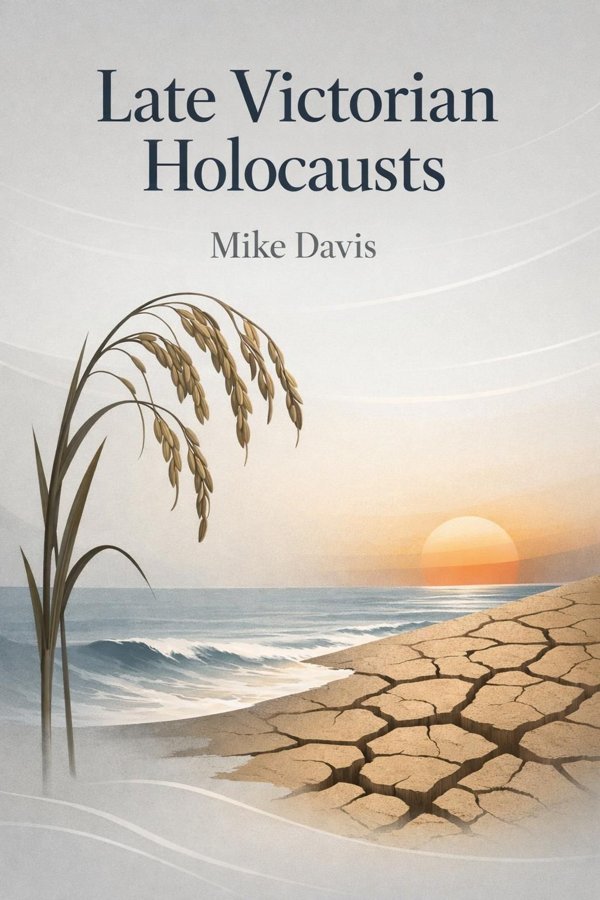
Late Victorian Holocausts: El Niño Famines and the Making of the Third World: Summary & Key Insights
by Mike Davis
 10 min10 chaptersAudio available
What Is Late Victorian Holocausts: El Niño Famines and the Making of the Third World About?
Late Victorian Holocausts: El Niño Famines and the Making of the Third World by Mike Davis is a world_history book spanning 10 pages. This book examines the devastating famines that struck India, China, and Brazil during the late nineteenth century, linking them to the global climatic events of El Niño and the political economy of imperialism. Davis argues that these catastrophes were not merely natural disasters but were exacerbated by colonial policies and capitalist expansion, which transformed local subsistence economies into export-oriented systems vulnerable to climatic shocks.
This FizzRead summary covers all 10 key chapters of Late Victorian Holocausts: El Niño Famines and the Making of the Third World in approximately 10 minutes, distilling the most important ideas, arguments, and takeaways from Mike Davis's work. Also available as an audio summary and Key Quotes Podcast.
Late Victorian Holocausts: El Niño Famines and the Making of the Third World
This book examines the devastating famines that struck India, China, and Brazil during the late nineteenth century, linking them to the global climatic events of El Niño and the political economy of imperialism. Davis argues that these catastrophes were not merely natural disasters but were exacerbated by colonial policies and capitalist expansion, which transformed local subsistence economies into export-oriented systems vulnerable to climatic shocks.
Who Should Read Late Victorian Holocausts: El Niño Famines and the Making of the Third World?
This book is perfect for anyone interested in world_history and looking to gain actionable insights in a short read. Whether you're a student, professional, or lifelong learner, the key ideas from Late Victorian Holocausts: El Niño Famines and the Making of the Third World by Mike Davis will help you think differently.
- ✓Readers who enjoy world_history and want practical takeaways
- ✓Professionals looking to apply new ideas to their work and life
- ✓Anyone who wants the core insights of Late Victorian Holocausts: El Niño Famines and the Making of the Third World in just 10 minutes
Want the full summary?
Get instant access to this book summary and 100K+ more with Fizz Moment.
Get Free SummaryAvailable on App Store • Free to download
Key Chapters
To understand the disasters that struck in the late nineteenth century, we must first grasp the planetary background. The El Niño–Southern Oscillation, a periodic warming of the central and eastern Pacific Ocean, disrupts rainfall across vast regions of the Earth. It is not new; its traces appear in tree rings and monsoon histories centuries before imperialism. But in the 1870s and 1890s, its effects coincided with global economic transformations that made societies newly vulnerable.
In those years, the El Niño phase produced prolonged drought in India, northern China, and northeastern Brazil. For traditional agrarian communities, these climatic perturbations had once been survivable; local granaries, mutual aid networks, and state relief mechanisms mitigated hunger. Yet under colonial rule these buffers were dismantled. While the rains failed, grain ships left Bombay for Britain, and local governments denied aid on ideological grounds, believing that the market would self-correct. It did not. The climate crisis of the 1870s thus became the crucible of a new form of disaster—one born of global interconnection.
In the nineteenth century, the world economy was reorganized under British hegemony. Railways, telegraphs, and steam navigation knit continents into a web of trade. For imperial administrators, this network promised progress and prosperity. For subsistence farmers, it meant exposure. India’s traditional balance between local production and consumption was shattered as colonial authorities converted agriculture into a tool of export. Wheat and cotton flowed outward, while internal food security withered.
London’s financiers and Manchester’s textile mills directed what grew on distant soils. In the logic of free trade, grain prices were set by global demand, not local need. When drought struck, local supplies vanished because merchants held stock for international sale. The Victorian ideology of laissez-faire—celebrating the self-regulating market—became a deadly dogma. Railways that might have carried relief instead transported exports. Thus, technological progress became an accomplice of starvation.
The integration of colonies into the global system created a hierarchy of resilience. Industrial nations accumulated surplus and power, while agrarian societies lost autonomy and reserve capacity. The famines were not accidents of global expansion but its structural consequences. What was hailed as globalization’s dawn was, for millions, the twilight of subsistence.
+ 8 more chapters — available in the FizzRead app
All Chapters in Late Victorian Holocausts: El Niño Famines and the Making of the Third World
About the Author
Mike Davis (1946–2022) was an American writer, historian, and social critic known for his works on urban theory, ecology, and political economy. He authored influential books such as 'City of Quartz' and 'Planet of Slums', focusing on the intersections of capitalism, environment, and social inequality.
Get This Summary in Your Preferred Format
Read or listen to the Late Victorian Holocausts: El Niño Famines and the Making of the Third World summary by Mike Davis anytime, anywhere. FizzRead offers multiple formats so you can learn on your terms — all free.
Available formats: App · Audio · PDF · EPUB — All included free with FizzRead
Download Late Victorian Holocausts: El Niño Famines and the Making of the Third World PDF and EPUB Summary
Key Quotes from Late Victorian Holocausts: El Niño Famines and the Making of the Third World
“To understand the disasters that struck in the late nineteenth century, we must first grasp the planetary background.”
“In the nineteenth century, the world economy was reorganized under British hegemony.”
Frequently Asked Questions about Late Victorian Holocausts: El Niño Famines and the Making of the Third World
Late Victorian Holocausts: El Niño Famines and the Making of the Third World by Mike Davis is a world_history book that explores key ideas across 10 chapters. This book examines the devastating famines that struck India, China, and Brazil during the late nineteenth century, linking them to the global climatic events of El Niño and the political economy of imperialism. Davis argues that these catastrophes were not merely natural disasters but were exacerbated by colonial policies and capitalist expansion, which transformed local subsistence economies into export-oriented systems vulnerable to climatic shocks.
More by Mike Davis
You Might Also Like
The Age of Capital
Eric Hobsbawm
10 min
The Gulag Archipelago
Aleksandr Solzhenitsyn
10 min
Jerusalem: The Biography
Simon Sebag Montefiore
10 min
The Anglo-Saxons
James Campbell
10 min
The Boer War
Thomas Pakenham
10 min
The Industrial Revolutionaries: The Making of the Modern World 1776–1914
Gavin Weightman
10 minBrowse by Category
Ready to read Late Victorian Holocausts: El Niño Famines and the Making of the Third World?
Get the full summary and 100K+ more books with Fizz Moment.