
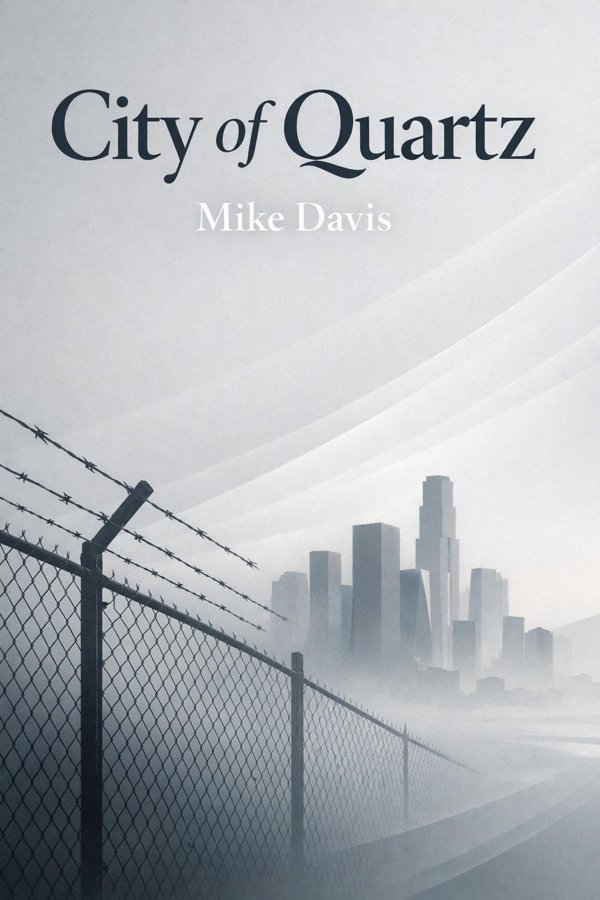
City of Quartz: Excavating the Future in Los Angeles: Summary & Key Insights
by Mike Davis
 10 min8 chaptersAudio available
What Is City of Quartz: Excavating the Future in Los Angeles About?
City of Quartz: Excavating the Future in Los Angeles by Mike Davis is a sociology book spanning 8 pages. City of Quartz: Excavating the Future in Los Angeles es un estudio crítico de la estructura social, económica y política de Los Ángeles. Mike Davis analiza cómo el poder, la arquitectura y la planificación urbana reflejan las desigualdades y tensiones de la ciudad moderna, revelando una historia oculta de exclusión, especulación y control social.
This FizzRead summary covers all 8 key chapters of City of Quartz: Excavating the Future in Los Angeles in approximately 10 minutes, distilling the most important ideas, arguments, and takeaways from Mike Davis's work. Also available as an audio summary and Key Quotes Podcast.
City of Quartz: Excavating the Future in Los Angeles
City of Quartz: Excavating the Future in Los Angeles es un estudio crítico de la estructura social, económica y política de Los Ángeles. Mike Davis analiza cómo el poder, la arquitectura y la planificación urbana reflejan las desigualdades y tensiones de la ciudad moderna, revelando una historia oculta de exclusión, especulación y control social.
Who Should Read City of Quartz: Excavating the Future in Los Angeles?
This book is perfect for anyone interested in sociology and looking to gain actionable insights in a short read. Whether you're a student, professional, or lifelong learner, the key ideas from City of Quartz: Excavating the Future in Los Angeles by Mike Davis will help you think differently.
- ✓Readers who enjoy sociology and want practical takeaways
- ✓Professionals looking to apply new ideas to their work and life
- ✓Anyone who wants the core insights of City of Quartz: Excavating the Future in Los Angeles in just 10 minutes
Want the full summary?
Get instant access to this book summary and 100K+ more with Fizz Moment.
Get Free SummaryAvailable on App Store • Free to download
Key Chapters
Los Angeles has always been less a city than a spectacle. From the earliest days of Hollywood, its urban identity has been shaped by an industry devoted to producing dreams. I conceived of the city’s cultural mythology as an immense theme park—an engineered experience designed to obscure underlying contradictions. In Hollywood’s endless replication of the city’s image, Los Angeles appears as a magical realm of possibility, where anyone can rise, reinvent, and belong. Yet behind the cinematic facade lies a social order organized around exclusion.
To understand Los Angeles’s mythology, we must grasp how entertainment and urban design intertwine. The city’s boosters and real estate magnates learned early on that selling Los Angeles meant selling a dream—sunshine, leisure, freedom. But this fantasy depended on erasing scenes of labor, poverty, and racial tension. The Hollywood sign, glowing from the hills, is the ultimate emblem of that ideology: the projection of desire overlooking valleys of neglected communities.
In my investigations, I traced how the entertainment complex shaped not only global consciousness but local identity. The imagery of LA as an endless summer became a cultural script through which the city rationalized inequality. The poor were absent from the picture; minorities were cast either as threats or exotic contrasts. Architecture reflected this performance—malls and boulevards choreographed like sets, each stage-managed for consumption. The city’s cultural economy, thus, became an engine of ideological reproduction, producing not truth but illusion.
The consequence is profound. Los Angeles’s theme-park persona defines the spatial and emotional logic of late capitalist urbanism: the city as commodity, the citizen as spectator. Walking through its polished districts, one doesn’t experience civic space but choreographed zones of access and exclusion. To live in this city is to navigate between fantasy and surveillance, between the promises of Hollywood and the realities of structural inequality. In this sense, the myth itself becomes an instrument of power—it distracts, beautifies, and neutralizes dissent. The task, therefore, is not to escape the dream but to awaken within it, recognizing the machinery that crafts this illusion and feeds on our desires.
If Hollywood metaphorically builds illusions, the city’s architects construct tangible walls. In *City of Quartz*, I coined the term “fortress architecture” to describe how Los Angeles’s built environment embodies its politics of fear. The city has learned to design itself defensively: malls fortified against the poor, plazas policed against loiterers, and office towers stripped of public space. This is not urban design for living together; it is architecture for separation.
Several decades ago, scholars wrote of public architecture as civic expression, but Los Angeles reversed that tradition. Here, corporate architects and security consultants collaborate to ensure exclusion. Benches are bolted to prevent sleeping, landscapes are manicured to deter gathering, and cameras proliferate as silent sentinels. These micro-designs express macro-politics—the spatial manifestation of the neoliberal city.
Driving through downtown or the sanitized neighborhoods of the Westside, one senses a siege mentality in concrete form. The city’s elite live behind gates, their children attend fortified schools, and public spaces are redefined as private experiences. This militarization of space stems from deeper social fears: fear of poverty, of crime, of racial others. In effect, Los Angeles turns urban anxiety into a design principle. Security becomes not a response but an ideology, reshaping civic life around exclusionary comfort.
What does this mean for the people who inhabit it? For the poor and for immigrants, the city offers not refuge but surveillance. I argued that the modern metropolis of Los Angeles was constructed upon “architectures of fear,” working seamlessly with policing strategies that criminalize visibility. The LAPD’s vision of control extends into concrete, asphalt, and glass—every checkpoint a symptom of social paranoia.
In a city that thinks like a fortress, community dissolves. Public culture erodes under the logic of security; even parks become managed zones rather than shared commons. The urban ideal of openness yields to privatized regimes of order. By documenting these patterns, I sought to reveal how architecture functions as social text—every design decision a miniaturized performance of class power. The city of quartz is transparent in its ambition yet opaque in its justice.
+ 6 more chapters — available in the FizzRead app
All Chapters in City of Quartz: Excavating the Future in Los Angeles
About the Author
Mike Davis (1946–2022) fue un historiador, teórico urbano y activista estadounidense. Conocido por su enfoque marxista y su crítica a la urbanización contemporánea, escribió obras influyentes como 'Ecology of Fear' y 'Planet of Slums'.
Get This Summary in Your Preferred Format
Read or listen to the City of Quartz: Excavating the Future in Los Angeles summary by Mike Davis anytime, anywhere. FizzRead offers multiple formats so you can learn on your terms — all free.
Available formats: App · Audio · PDF · EPUB — All included free with FizzRead
Download City of Quartz: Excavating the Future in Los Angeles PDF and EPUB Summary
Key Quotes from City of Quartz: Excavating the Future in Los Angeles
“Los Angeles has always been less a city than a spectacle.”
“If Hollywood metaphorically builds illusions, the city’s architects construct tangible walls.”
Frequently Asked Questions about City of Quartz: Excavating the Future in Los Angeles
City of Quartz: Excavating the Future in Los Angeles by Mike Davis is a sociology book that explores key ideas across 8 chapters. City of Quartz: Excavating the Future in Los Angeles es un estudio crítico de la estructura social, económica y política de Los Ángeles. Mike Davis analiza cómo el poder, la arquitectura y la planificación urbana reflejan las desigualdades y tensiones de la ciudad moderna, revelando una historia oculta de exclusión, especulación y control social.
More by Mike Davis

You Might Also Like
Between the World and Me
Ta-Nehisi Coates
10 min
Half the Sky
Nicholas D. Kristof, Sheryl WuDunn
10 min
Men Explain Things To Me
Rebecca Solnit
10 min
Rational Ritual
Michael Suk-Young Chwe
10 min
The New Jim Crow
Michelle Alexander
10 min
Beyond Culture
Edward T. Hall
10 minBrowse by Category
Ready to read City of Quartz: Excavating the Future in Los Angeles?
Get the full summary and 100K+ more books with Fizz Moment.