
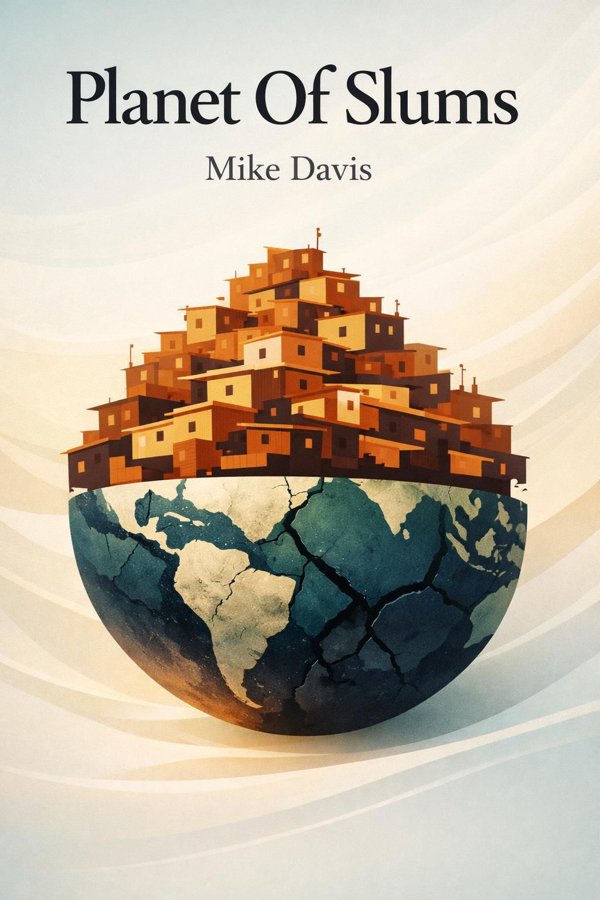
Planet Of Slums: Summary & Key Insights
by Mike Davis
 10 min11 chaptersAudio available
What Is Planet Of Slums About?
Planet Of Slums by Mike Davis is a sociology book spanning 11 pages. Planet of Slums es un estudio crítico sobre el crecimiento explosivo de los asentamientos informales urbanos en el mundo en desarrollo. Mike Davis examina cómo la urbanización global ha producido vastas áreas de pobreza y marginalidad, analizando las causas económicas, políticas y sociales detrás de la expansión de los barrios marginales y las consecuencias para el futuro urbano del planeta.
This FizzRead summary covers all 11 key chapters of Planet Of Slums in approximately 10 minutes, distilling the most important ideas, arguments, and takeaways from Mike Davis's work. Also available as an audio summary and Key Quotes Podcast.
Planet Of Slums
Planet of Slums es un estudio crítico sobre el crecimiento explosivo de los asentamientos informales urbanos en el mundo en desarrollo. Mike Davis examina cómo la urbanización global ha producido vastas áreas de pobreza y marginalidad, analizando las causas económicas, políticas y sociales detrás de la expansión de los barrios marginales y las consecuencias para el futuro urbano del planeta.
Who Should Read Planet Of Slums?
This book is perfect for anyone interested in sociology and looking to gain actionable insights in a short read. Whether you're a student, professional, or lifelong learner, the key ideas from Planet Of Slums by Mike Davis will help you think differently.
- ✓Readers who enjoy sociology and want practical takeaways
- ✓Professionals looking to apply new ideas to their work and life
- ✓Anyone who wants the core insights of Planet Of Slums in just 10 minutes
Want the full summary?
Get instant access to this book summary and 100K+ more with Fizz Moment.
Get Free SummaryAvailable on App Store • Free to download
Key Chapters
After World War II, the promise of development seemed universal. Nations emerging from colonialism envisioned modernization through industrial growth. Cities were to be the heart of that transformation: centers of labor, education, and citizenship. Yet by the late 20th century, this dream had begun to unravel. Urbanization continued—but without industrialization. What replaced the planned city was an informal metropolis.
I trace this history from the era of modernization theory to the era of structural adjustment. The manufacturing jobs that once drove rural migration collapsed under the weight of global competition and technological change. Developing countries, saddled with debt, dismantled their public sectors, leading millions of displaced workers to seek survival outside the formal economy. The result was the rise of shantytowns around megacities—settlements built from the ruins of failed modernization.
This shift also changed the meaning of citizenship. The classic industrial city promised inclusion through labor and service—the right to live in the urban center was earned. The post-colonial slum, however, represented exclusion by design. Housing policies pushed the poor to the peripheries, while property values and speculation locked them out of urban cores. Thus, the new social order was marked not by class mobility but by spatial confinement.
In tracing this historical trajectory, I argue that the slum is not a temporary stage of development to be overcome, but the permanent condition of a global system based on uneven accumulation. The informal city is the true child of late capitalism, born not in defiance but in compliance with its logic.
The global turn toward neoliberalism in the late 1970s and 1980s marked the decisive moment in the story I tell. Structural adjustment programs, enforced by institutions like the IMF and World Bank, demanded austerity, privatization, and trade liberalization as conditions for loans. These policies devastated urban economies in the Global South. Jobs in the formal sector vanished, public housing programs were dismantled, and welfare systems evaporated.
As governments cut spending, cities became arenas of self-help. Populations were told to rely on the informal market for survival—selling, scavenging, and building their own homes on marginal lands. Globalization promised prosperity through integration, yet for billions it meant being absorbed as surplus labor. The planetary city was built through the exclusion of the majority from its benefits.
In this context, the slum became both a product and a symptom. The logic of neoliberal urbanism turns poverty into a form of economic adaptability: informal sectors that absorb what formal industries expel. I observed how multinational corporations, free trade zones, and privatized infrastructure coexist with vast unregulated settlements. This is not contradiction—it is complementarity. The poor are essential precisely because they live cheaply and outside regulation.
This system widens inequality while appearing to promote growth. The urban world divides into gated enclaves of hyper-modernity and surrounding seas of precarity. For every Dubai that rises, a Karachi expands; for every shining mall, a vast bazaar proliferates just beyond its walls. The neoliberal city thus manufactures segregation as policy, not accident.
+ 9 more chapters — available in the FizzRead app
All Chapters in Planet Of Slums
About the Author
Mike Davis (1946–2022) fue un historiador urbano, activista y escritor estadounidense conocido por sus análisis sobre la ecología política, la urbanización y las desigualdades sociales. Su obra combina investigación académica con compromiso político, destacando títulos como City of Quartz y Planet of Slums.
Get This Summary in Your Preferred Format
Read or listen to the Planet Of Slums summary by Mike Davis anytime, anywhere. FizzRead offers multiple formats so you can learn on your terms — all free.
Available formats: App · Audio · PDF · EPUB — All included free with FizzRead
Download Planet Of Slums PDF and EPUB Summary
Key Quotes from Planet Of Slums
“After World War II, the promise of development seemed universal.”
“The global turn toward neoliberalism in the late 1970s and 1980s marked the decisive moment in the story I tell.”
Frequently Asked Questions about Planet Of Slums
Planet Of Slums by Mike Davis is a sociology book that explores key ideas across 11 chapters. Planet of Slums es un estudio crítico sobre el crecimiento explosivo de los asentamientos informales urbanos en el mundo en desarrollo. Mike Davis examina cómo la urbanización global ha producido vastas áreas de pobreza y marginalidad, analizando las causas económicas, políticas y sociales detrás de la expansión de los barrios marginales y las consecuencias para el futuro urbano del planeta.
More by Mike Davis

You Might Also Like

Between the World and Me
Ta-Nehisi Coates
10 min
Half the Sky
Nicholas D. Kristof, Sheryl WuDunn
10 min
Men Explain Things To Me
Rebecca Solnit
10 min
Rational Ritual
Michael Suk-Young Chwe
10 min
The New Jim Crow
Michelle Alexander
10 min
Beyond Culture
Edward T. Hall
10 minBrowse by Category
Ready to read Planet Of Slums?
Get the full summary and 100K+ more books with Fizz Moment.