
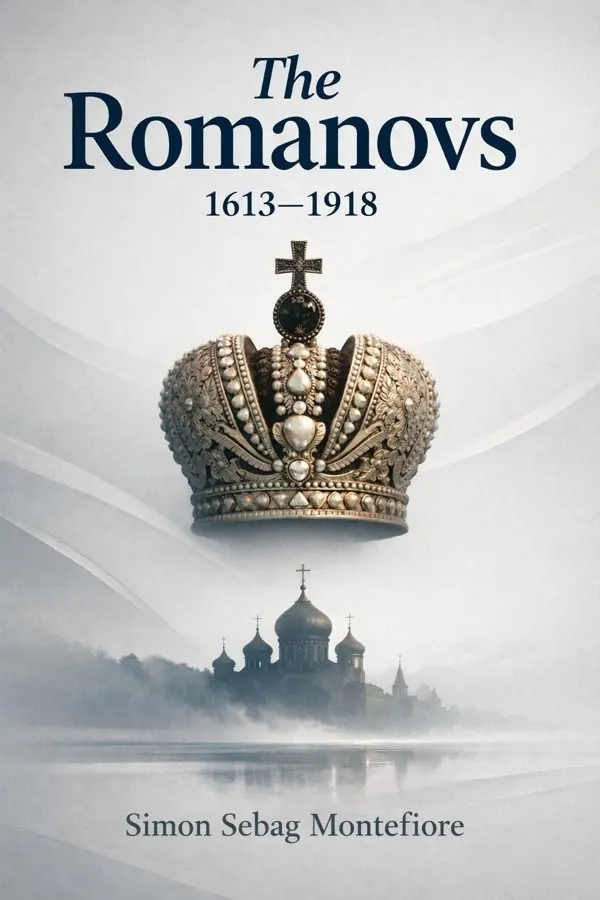
The Romanovs: 1613–1918: Summary & Key Insights
 10 min9 chaptersAudio available
Key Takeaways from The Romanovs: 1613–1918
Dynasties often begin not in triumph but in exhaustion.
Power lasts longer when it dresses itself as destiny.
Modernization is rarely gentle when imposed from above.
When succession is unclear, personality becomes policy.
Enlightenment ideals become complicated when they sit on an absolute throne.
What Is The Romanovs: 1613–1918 About?
The Romanovs: 1613–1918 by Simon Sebag Montefiore is a world_history book spanning 12 pages. The Romanovs: 1613–1918 is a vast, dramatic history of the dynasty that ruled Russia for more than three centuries and helped shape the modern world. Simon Sebag Montefiore traces the family’s story from the election of the teenage Michael Romanov after the chaos of the Time of Troubles to the murder of Nicholas II and his family during the Russian Revolution. But this is far more than a parade of rulers and dates. Montefiore shows how private passions, court rivalries, religious beliefs, sexual politics, ambition, fear, and violence all flowed into the exercise of power. The result is a portrait of empire as a family business—glittering, brutal, unstable, and intensely personal. What makes the book especially powerful is the author’s command of archival material and his gift for narrative. Montefiore combines scholarly depth with the pace of a novel, bringing to life tsars, empresses, rebels, generals, lovers, and mystics. The book matters because it explains not only how the Romanovs built one of history’s greatest empires, but also why a system that looked eternal could collapse with astonishing speed.
This FizzRead summary covers all 9 key chapters of The Romanovs: 1613–1918 in approximately 10 minutes, distilling the most important ideas, arguments, and takeaways from Simon Sebag Montefiore's work. Also available as an audio summary and Key Quotes Podcast.
The Romanovs: 1613–1918
The Romanovs: 1613–1918 is a vast, dramatic history of the dynasty that ruled Russia for more than three centuries and helped shape the modern world. Simon Sebag Montefiore traces the family’s story from the election of the teenage Michael Romanov after the chaos of the Time of Troubles to the murder of Nicholas II and his family during the Russian Revolution. But this is far more than a parade of rulers and dates. Montefiore shows how private passions, court rivalries, religious beliefs, sexual politics, ambition, fear, and violence all flowed into the exercise of power. The result is a portrait of empire as a family business—glittering, brutal, unstable, and intensely personal. What makes the book especially powerful is the author’s command of archival material and his gift for narrative. Montefiore combines scholarly depth with the pace of a novel, bringing to life tsars, empresses, rebels, generals, lovers, and mystics. The book matters because it explains not only how the Romanovs built one of history’s greatest empires, but also why a system that looked eternal could collapse with astonishing speed.
Who Should Read The Romanovs: 1613–1918?
This book is perfect for anyone interested in world_history and looking to gain actionable insights in a short read. Whether you're a student, professional, or lifelong learner, the key ideas from The Romanovs: 1613–1918 by Simon Sebag Montefiore will help you think differently.
- ✓Readers who enjoy world_history and want practical takeaways
- ✓Professionals looking to apply new ideas to their work and life
- ✓Anyone who wants the core insights of The Romanovs: 1613–1918 in just 10 minutes
Want the full summary?
Get instant access to this book summary and 100K+ more with Fizz Moment.
Get Free SummaryAvailable on App Store • Free to download
Key Chapters
Dynasties often begin not in triumph but in exhaustion. Montefiore opens with Russia’s Time of Troubles, the early seventeenth-century catastrophe that followed the end of Ivan the Terrible’s line. Famine, civil war, impostors claiming the throne, foreign intervention, and social collapse left the country desperate not for greatness, but for order. In that setting, the election of Michael Romanov in 1613 was less a glorious coronation than a collective gamble on stability. He was young, politically manageable, tied to old noble families, and acceptable to powerful factions. That made him useful at a moment when Russia needed legitimacy more than brilliance.
The book shows that the Romanov dynasty was born from compromise. This matters because it overturns the myth that powerful states are always founded by unstoppable leaders. Sometimes institutions emerge because elites and ordinary people are simply tired of bloodshed. Michael’s reign, and the influence of his formidable father Filaret, helped reassemble authority piece by piece—restoring administration, reasserting sacred monarchy, and beginning the long work of rebuilding confidence in the throne.
There is a practical lesson here for politics, business, and even family leadership: in moments of crisis, the first need is often not vision but trust. A leader does not have to be the most dazzling candidate to succeed; they may simply need to be the figure around whom exhausted rivals can unite. Montefiore’s account reminds us that legitimacy is often reconstructed through patience, symbols, and shared necessity.
Actionable takeaway: When facing institutional chaos, prioritize legitimacy and coalition-building before sweeping reform.
Power lasts longer when it dresses itself as destiny. Under Michael and especially his son Alexis I, the Romanovs transformed a vulnerable throne into a hereditary, sacred autocracy. Montefiore shows that this was not only a political development but a spiritual and cultural one. The tsar was presented as God’s anointed ruler, father of the nation, and guarantor of order. Orthodoxy, ritual, and court ceremony were not decorative extras; they were central technologies of rule.
Alexis appears in the book as pious, intelligent, and deeply attached to traditional authority. Yet his reign also revealed the tensions inside sacred monarchy. The great church schism triggered by Patriarch Nikon’s reforms divided believers and produced enduring bitterness. Meanwhile, Russia expanded territorially and strengthened administratively, but at the cost of reinforcing a system in which obedience mattered more than participation. Montefiore highlights a recurring Romanov pattern: rulers sought unity, but often achieved it by sharpening exclusion.
This idea remains relevant because all durable regimes rely on stories about themselves. Modern states may not use coronation rituals, but they still depend on narratives, symbols, founding myths, and moral claims. Organizations do the same: mission statements, traditions, and public language can create loyalty, but they can also silence necessary criticism if treated as sacred.
The Romanovs teach that ideology can stabilize power while also trapping it. Once rulers present themselves as holy or infallible, reform becomes harder because compromise looks like betrayal. Montefiore makes clear that the dynasty’s later crises were rooted partly in this early fusion of authority and sanctity.
Actionable takeaway: Build legitimacy through values and symbols, but never make your institutions so sacred that they cannot adapt.
Modernization is rarely gentle when imposed from above. Peter the Great dominates Montefiore’s narrative as one of the Romanovs’ most transformative and terrifying rulers. He was energetic, curious, brilliant, violent, and relentless. Determined to drag Russia into European power politics, he reorganized the army, built a navy, restructured government, expanded technical education, and founded St. Petersburg as a new imperial capital facing the West. He shaved beards, changed court manners, and symbolically attacked old Muscovite traditions. In Montefiore’s hands, Peter is neither a simple hero of progress nor a mere tyrant; he is a revolutionary autocrat who built the modern Russian state through coercion.
The paradox is central. Peter strengthened Russia by importing skills, institutions, and technologies from Europe, but he did so within an even harsher framework of autocratic control. Reform did not reduce absolutism—it intensified it. Even within his family, politics turned lethal: his conflict with his son Alexei exposed how modernization campaigns can become personal purges when rulers equate resistance with treason.
This chapter offers a practical insight about change management. Large-scale transformation requires urgency, capability, and institutional redesign. But when reform humiliates identities, ignores culture, or depends entirely on one leader’s will, it creates backlash. Peter succeeded spectacularly in building state power, yet he also deepened a Russian pattern in which modernization and repression advanced together.
For modern readers, whether leading companies or public institutions, Peter’s story is a warning against confusing speed with sustainability. Reform imposed without consent can produce impressive short-term results while storing up long-term resentment.
Actionable takeaway: Pursue bold modernization, but pair structural change with cultural legitimacy and humane limits.
When succession is unclear, personality becomes policy. After Peter’s death, the Romanov court entered an era of coups, factions, regencies, and extraordinary female rule. Montefiore vividly recounts how Catherine I, Anna, Elizabeth, and later Catherine the Great navigated a world where guards regiments, lovers, ministers, and aristocratic networks could decide the fate of the empire overnight. This was not a stable constitutional order but a theater of intimacy and power, where the bedroom, barracks, and throne room were often linked.
What stands out is how Montefiore rejects simplistic stereotypes. These empresses were not accidental placeholders. They used patronage, image-making, strategic alliances, and sheer political instinct to rule a vast empire. Elizabeth could be charming and indolent yet politically astute. Anna could be vindictive yet effective in preserving authority. The imperial court functioned as a machine in which emotion, ceremony, and coercion all mattered.
The practical lesson is that informal power can matter as much as formal office. In many institutions today, decisions are shaped not only by org charts but by trusted advisers, social access, rivalries, and hidden coalitions. Montefiore’s court politics teaches readers to pay attention to networks, gatekeepers, and the human realities behind official structures.
This period also shows the cost of systems that fail to establish clear succession rules. When leadership transfer depends on force or intrigue, governance becomes unstable even if the state survives. The Romanovs endured because the empire was resilient, but each succession crisis increased mistrust and normalized political violence.
Actionable takeaway: Never ignore informal influence, and create clear succession rules before ambition turns uncertainty into crisis.
Enlightenment ideals become complicated when they sit on an absolute throne. Montefiore presents Catherine the Great as one of the dynasty’s most formidable rulers: intellectually ambitious, politically shrewd, emotionally driven, and ruthlessly practical. A German-born outsider who seized power after the overthrow of her husband Peter III, she understood that legitimacy had to be performed as well as enforced. She corresponded with philosophers, cultivated the image of an enlightened monarch, expanded education and administration, and presided over a brilliant court culture. Yet she also expanded empire, entrenched serfdom, and crushed rebellion, especially during Pugachev’s uprising.
This tension is the heart of her reign. Catherine admired reason and reform, but she governed a huge and unequal empire whose stability rested on noble privilege and peasant subordination. Montefiore shows that she was not a hypocrite in any simple sense; she was a ruler confronting the limits of what ideas can do when institutions and interests resist them. Her reign demonstrates that reform-minded leaders often compromise not because they lack principles, but because power imposes trade-offs.
For modern readers, Catherine’s career offers a valuable leadership lesson. Charisma, intelligence, and strategic communication can expand a leader’s room for maneuver, but public ideals must eventually confront structural realities. It is easy to announce progressive goals; it is much harder to redesign incentives, institutions, and social relations to support them.
Montefiore also highlights Catherine’s mastery of narrative. She wrote, staged, charmed, and persuaded. Leaders today do the same through media, branding, and public storytelling. Narrative can extend authority, but it cannot permanently erase contradiction.
Actionable takeaway: Pair visionary rhetoric with realistic institutional change, or your reforms will remain image rather than transformation.
Great powers often look strongest just as their internal strains multiply. Across the eighteenth and nineteenth centuries, the Romanovs expanded into Europe, the Caucasus, Central Asia, Poland, and beyond, turning Russia into one of the world’s largest empires. Montefiore shows that conquest brought prestige, strategic depth, and wealth, but also enormous administrative burdens. The Romanov state ruled over many peoples, languages, religions, and local elites. Managing this diversity required not only armies but bargaining, coercion, bureaucracy, and mythmaking.
The Napoleonic era under Alexander I revealed both the empire’s might and its contradictions. Russia helped defeat Napoleon and emerged as a central force in Europe, yet victory abroad did not resolve questions at home. Elites who had seen Europe more closely began to imagine constitutional alternatives. The Decembrist revolt that followed Alexander’s death was small, but Montefiore treats it as a symptom: imperial success had exposed educated Russians to ideas the autocracy could not easily contain.
This pattern continued under Nicholas I, who promoted the doctrine of Orthodoxy, Autocracy, and Nationality as a defensive ideology. The regime sought cohesion through loyalty and repression, but the more diverse and complex the empire became, the harder it was to govern through uniform obedience alone.
Modern organizations and states face similar challenges when they expand quickly. Growth can create prestige while masking weak integration, inconsistent systems, and cultural fractures. Expansion is not the same as consolidation.
Montefiore’s broader point is that empire magnifies everything: ambition, glory, insecurity, and administrative failure. The Romanovs were strongest territorially when their political model was becoming intellectually and socially fragile.
Actionable takeaway: When growth accelerates, invest as much in integration and adaptability as in further expansion.
The most dangerous time for an old system is often when it finally admits it must change. Alexander II, remembered as the Liberator, recognized after the Crimean War that Russia could not remain militarily powerful and socially backward. Montefiore presents him as a serious ruler trying to modernize a rigid empire through major reforms: most famously the emancipation of the serfs in 1861, but also judicial changes, military reform, local self-government through the zemstvos, and educational expansion. These were historic achievements, yet they also revealed how difficult it is to reform a society built on hierarchy.
Emancipation did not produce simple freedom. Former serfs often remained poor, burdened, and disappointed. Nobles resented losses. Radicals thought reform too limited; conservatives thought it dangerously expansive. Montefiore shows that partial reform can destabilize expectations by awakening hopes the regime cannot satisfy. Alexander II’s tragedy was that he changed too much for reactionaries and too little for revolutionaries.
The same dynamic appears in many settings today. Companies, governments, and institutions often delay reform until pressures become unavoidable. By then, stakeholders have conflicting expectations, trust is low, and every change creates losers. Reform requires not just policy shifts, but communication, sequencing, and a realistic understanding of how people experience transition.
Alexander II’s assassination by terrorists underscored the bleak lesson that modernization does not automatically buy legitimacy. A reforming regime can become more exposed, not less, because it loosens controls without fully rebuilding consent.
Actionable takeaway: Don’t wait for crisis to reform; early, well-sequenced change is safer than late, fragmented transformation.
Fear can preserve power for a while, but it also narrows a ruler’s imagination. After Alexander II’s assassination, Alexander III and later Nicholas II leaned toward repression, centralization, and suspicion of reform. Montefiore portrays Alexander III as forceful, conservative, and deeply committed to autocracy. He restored state confidence after revolutionary violence, but he did so by hardening the regime’s hostility to pluralism. Russification, censorship, police surveillance, and an insistence on obedience sought to repair the empire through discipline.
Yet these policies intensified the disconnect between the throne and a rapidly changing society. Industrialization created new urban classes, labor unrest, and political movements. Educated elites grew more critical. Minority populations often experienced Romanov rule less as paternal guardianship than as coercive domination. Montefiore makes clear that reaction was not mere stubbornness; it was a strategic choice grounded in the dynasty’s belief that concession would invite collapse. But by shrinking the space for legal adaptation, the regime made revolutionary alternatives more attractive.
Nicholas II inherited not just a throne but a worldview unsuited to modern politics. Personally dutiful and family-centered, he lacked the flexibility, authority, and realism required by the age. Court influence, administrative weakness, and the toxic symbolism of figures like Rasputin further damaged the monarchy’s credibility.
This part of the book speaks directly to modern leadership. When environments change, doubling down on old controls can create a false sense of order while worsening alienation. Institutions that refuse feedback often mistake silence for loyalty.
Actionable takeaway: In times of social change, treat criticism as information to work with, not simply as disloyalty to suppress.
Collapse can look sudden only because warning signs were ignored for decades. Montefiore’s account of Nicholas II, the First World War, the Revolution, and the execution of the imperial family is devastating precisely because the end was not inevitable in one simple sense, yet the system had become incapable of saving itself. Nicholas believed deeply in autocracy as a sacred duty, but the war exposed every weakness of the regime: poor administration, military disaster, supply failures, elite division, and a catastrophic loss of public confidence. The tsar’s decision-making, including his assumption of personal command, tied the monarchy directly to defeat.
At court, Alexandra’s reliance on Rasputin further corroded legitimacy. Montefiore treats these episodes not as gossip but as evidence of institutional breakdown. When a regime’s authority becomes personalized and mystical, the quality of private judgment can have national consequences. By 1917, the monarchy had lost the confidence of workers, soldiers, many elites, and even key pillars of the state. Abdication came with astonishing speed.
The murder of the Romanov family in 1918 forms the book’s grim conclusion. Montefiore presents it as both a revolutionary crime and the symbolic destruction of a centuries-old political faith. The dynasty that had claimed sacred permanence ended in secrecy, fear, and blood.
The larger lesson is that institutions rarely fail because of one event alone. They decay through accumulated rigidity, bad incentives, poor communication, and an inability to recognize reality. Readers can apply this insight anywhere: families, businesses, governments, and communities all need mechanisms for truth-telling before crisis becomes irreversible.
Actionable takeaway: Build systems that surface uncomfortable realities early, because denial is often the final stage of decline.
All Chapters in The Romanovs: 1613–1918
About the Author
Simon Sebag Montefiore is a British historian, novelist, and presenter celebrated for turning major historical subjects into vivid, character-driven narratives. Educated at Gonville and Caius College, Cambridge, he first gained wide recognition for his acclaimed works on Russian history, especially Stalin: The Court of the Red Tsar and Young Stalin. His writing often explores the relationship between private life and political power, showing how courts, families, and personal ambition shape world events. Beyond Russia, he has also written on Jerusalem and other major historical subjects, earning an international readership and numerous literary honors. Montefiore is known for combining archival depth with storytelling flair, making complex history accessible without sacrificing nuance. The Romanovs reflects his signature strengths: rich research, strong narrative momentum, and a sharp eye for the human drama behind empire.
Get This Summary in Your Preferred Format
Read or listen to the The Romanovs: 1613–1918 summary by Simon Sebag Montefiore anytime, anywhere. FizzRead offers multiple formats so you can learn on your terms — all free.
Available formats: App · Audio · PDF · EPUB — All included free with FizzRead
Download The Romanovs: 1613–1918 PDF and EPUB Summary
Key Quotes from The Romanovs: 1613–1918
“Dynasties often begin not in triumph but in exhaustion.”
“Power lasts longer when it dresses itself as destiny.”
“Modernization is rarely gentle when imposed from above.”
“When succession is unclear, personality becomes policy.”
“Enlightenment ideals become complicated when they sit on an absolute throne.”
Frequently Asked Questions about The Romanovs: 1613–1918
The Romanovs: 1613–1918 by Simon Sebag Montefiore is a world_history book that explores key ideas across 9 chapters. The Romanovs: 1613–1918 is a vast, dramatic history of the dynasty that ruled Russia for more than three centuries and helped shape the modern world. Simon Sebag Montefiore traces the family’s story from the election of the teenage Michael Romanov after the chaos of the Time of Troubles to the murder of Nicholas II and his family during the Russian Revolution. But this is far more than a parade of rulers and dates. Montefiore shows how private passions, court rivalries, religious beliefs, sexual politics, ambition, fear, and violence all flowed into the exercise of power. The result is a portrait of empire as a family business—glittering, brutal, unstable, and intensely personal. What makes the book especially powerful is the author’s command of archival material and his gift for narrative. Montefiore combines scholarly depth with the pace of a novel, bringing to life tsars, empresses, rebels, generals, lovers, and mystics. The book matters because it explains not only how the Romanovs built one of history’s greatest empires, but also why a system that looked eternal could collapse with astonishing speed.
More by Simon Sebag Montefiore

You Might Also Like
The Age of Capital
Eric Hobsbawm
10 min
The Gulag Archipelago
Aleksandr Solzhenitsyn
10 min
Jerusalem: The Biography
Simon Sebag Montefiore
10 min
The Anglo-Saxons
James Campbell
10 min
The Boer War
Thomas Pakenham
10 min
The Industrial Revolutionaries: The Making of the Modern World 1776–1914
Gavin Weightman
10 minBrowse by Category
Ready to read The Romanovs: 1613–1918?
Get the full summary and 100K+ more books with Fizz Moment.