
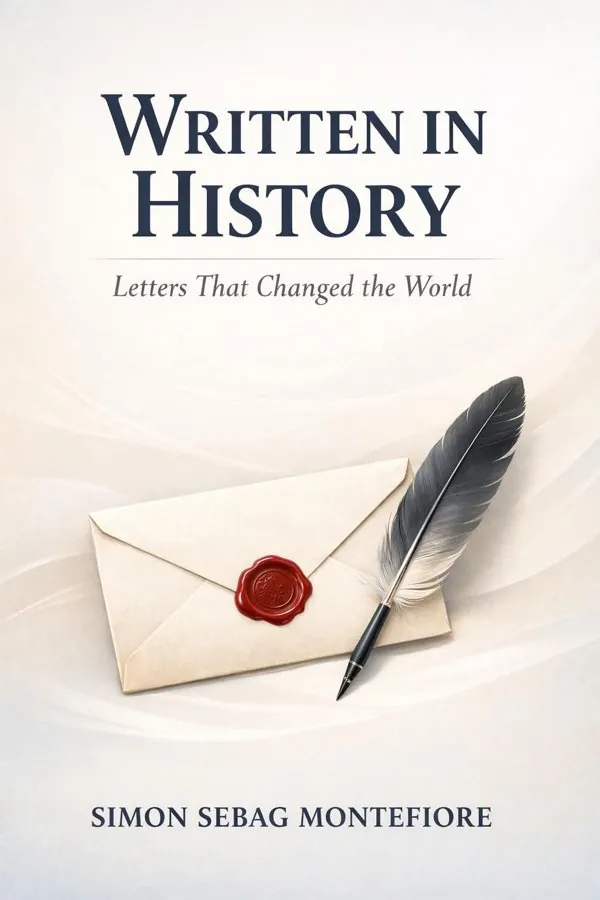
Written in History: Letters That Changed the World: Summary & Key Insights
 10 min9 chaptersAudio available
Key Takeaways from Written in History: Letters That Changed the World
History often feels vast, impersonal, and overcrowded with dates, battles, and treaties.
The oldest surviving letters prove that the human need to persuade, report, complain, and connect is far older than modern communication.
Great achievements often look inevitable in retrospect, but letters reveal how uncertain and improvised genius really is.
Revolutions in religion, philosophy, and politics often begin not with crowds, but with correspondence.
Political upheaval is not only fought in streets and parliaments; it is also prepared in letters.
What Is Written in History: Letters That Changed the World About?
Written in History: Letters That Changed the World by Simon Sebag Montefiore is a world_history book spanning 11 pages. Written in History: Letters That Changed the World is a remarkable anthology of private correspondence that reveals public history in its most human form. Edited and introduced by historian Simon Sebag Montefiore, the book gathers letters written across centuries by rulers, revolutionaries, artists, scientists, lovers, prisoners, generals, and visionaries. Rather than presenting history as a sequence of abstract events, it shows how great turning points were lived one message at a time: in fear, ambition, longing, calculation, grief, and hope. A letter can be both intimate and world-shaping, and Montefiore’s selection demonstrates that the written word has often altered the course of nations as surely as armies or laws. The collection matters because it restores personality to history. Here, legendary names become immediate voices, and distant eras feel startlingly contemporary. Montefiore is especially suited to curate such a work: known for combining deep archival research with vivid storytelling, he has built a career illuminating the private lives behind public power. This book is not just a treasury of documents; it is an invitation to hear history speaking in its own handwriting.
This FizzRead summary covers all 9 key chapters of Written in History: Letters That Changed the World in approximately 10 minutes, distilling the most important ideas, arguments, and takeaways from Simon Sebag Montefiore's work. Also available as an audio summary and Key Quotes Podcast.
Written in History: Letters That Changed the World
Written in History: Letters That Changed the World is a remarkable anthology of private correspondence that reveals public history in its most human form. Edited and introduced by historian Simon Sebag Montefiore, the book gathers letters written across centuries by rulers, revolutionaries, artists, scientists, lovers, prisoners, generals, and visionaries. Rather than presenting history as a sequence of abstract events, it shows how great turning points were lived one message at a time: in fear, ambition, longing, calculation, grief, and hope. A letter can be both intimate and world-shaping, and Montefiore’s selection demonstrates that the written word has often altered the course of nations as surely as armies or laws. The collection matters because it restores personality to history. Here, legendary names become immediate voices, and distant eras feel startlingly contemporary. Montefiore is especially suited to curate such a work: known for combining deep archival research with vivid storytelling, he has built a career illuminating the private lives behind public power. This book is not just a treasury of documents; it is an invitation to hear history speaking in its own handwriting.
Who Should Read Written in History: Letters That Changed the World?
This book is perfect for anyone interested in world_history and looking to gain actionable insights in a short read. Whether you're a student, professional, or lifelong learner, the key ideas from Written in History: Letters That Changed the World by Simon Sebag Montefiore will help you think differently.
- ✓Readers who enjoy world_history and want practical takeaways
- ✓Professionals looking to apply new ideas to their work and life
- ✓Anyone who wants the core insights of Written in History: Letters That Changed the World in just 10 minutes
Want the full summary?
Get instant access to this book summary and 100K+ more with Fizz Moment.
Get Free SummaryAvailable on App Store • Free to download
Key Chapters
History often feels vast, impersonal, and overcrowded with dates, battles, and treaties. Yet a single letter can shrink that scale and reveal history as one person speaking urgently to another. That is one of the central pleasures and insights of Written in History. Montefiore shows that letters are not merely background material for historians; they are often the emotional and intellectual core of an era. In them, rulers hesitate, commanders panic, prisoners endure, and lovers confess. A letter records not just what happened, but how it felt before outcomes were known.
This matters because hindsight can flatten the past. Speeches are frequently crafted for effect, memoirs are polished by memory, and official documents are shaped by institutions. Letters, by contrast, often capture a mind in motion. They may be strategic, manipulative, affectionate, or raw, but even when writers perform for their recipient, they reveal what they believed was persuasive, important, or dangerous. That gives readers access to the values and anxieties of another age.
Montefiore’s anthology invites us to read correspondence not as relics but as living evidence. A queen’s command, a scientist’s explanation, or a captive’s plea can all carry the same force: they remind us that history was experienced in real time by people who did not know what would happen next. In a modern context, this teaches us to value original voices over simplified summaries. Reading primary sources, even briefly, often changes our understanding more than reading commentary alone.
Actionable takeaway: when trying to understand any major event, seek out one primary voice from the period—a letter, diary, or firsthand message—before relying on secondhand interpretations.
The oldest surviving letters prove that the human need to persuade, report, complain, and connect is far older than modern communication. In the ancient and classical materials represented in this collection, we see writing emerging not just as record keeping but as a tool of personality and power. From the courts of Mesopotamia and Egypt to the political worlds of Greece and Rome, letters became instruments through which rulers governed, officials negotiated, and individuals tried to shape their destinies.
What makes these early letters so striking is their familiarity. Even across vast distances of time, they contain requests for loyalty, expressions of frustration, strategic instructions, and anxieties about disorder. They remind us that bureaucracy and emotion grew together. The ancient world was not run by marble statues; it was run by people sending messages under pressure. A letter from a ruler could secure an alliance, demand tribute, or avert rebellion. A private note could reveal philosophical thought, family tension, or political intrigue.
Montefiore’s curation highlights that literacy was never merely technical. It conferred influence. To write, preserve, and circulate words was to participate in statecraft, religion, trade, and memory. That remains true today, though our mediums have changed. Emails, memos, and public statements still define institutions and relationships, often more decisively than face-to-face meetings.
The practical lesson is that communication leaves a trail of intention. Early letters teach us to examine wording carefully: what is requested, what is implied, and what is omitted. The structure of a message can reveal hierarchy, urgency, and strategy.
Actionable takeaway: when reading any important written communication, ask three questions—who holds power, what outcome is desired, and what hidden fear may be driving the message.
Great achievements often look inevitable in retrospect, but letters reveal how uncertain and improvised genius really is. In the medieval and Renaissance sections of the book, Montefiore presents correspondence that lets us watch minds at work before masterpieces or discoveries had become history. Figures such as Leonardo da Vinci do not appear as untouchable legends; they appear as working thinkers pitching ideas, solving problems, seeking patronage, and navigating the demands of their age.
This is one of the most valuable correctives the book offers. We tend to imagine geniuses as fully formed, but their letters show experimentation, self-presentation, and practical ambition. Leonardo’s famous appeal to a ruler, for example, demonstrates how creativity often depends on persuasion. He markets his engineering skills, military usefulness, and artistic talents with calculated intelligence. The letter is not just a personal document; it is a career strategy. It shows that innovation requires both imagination and the ability to communicate value.
More broadly, Renaissance correspondence illuminates a world in which art, science, politics, and patronage were deeply intertwined. Thinkers needed sponsors. Artists negotiated commissions. Scholars exchanged ideas through fragile networks of trust and reputation. Their letters became vehicles for collaboration long before modern academic or professional systems existed.
For contemporary readers, this has obvious applications. Talent alone rarely speaks for itself. Whether you are applying for a job, seeking funding, or proposing a creative project, how you frame your abilities matters. The best self-presentation is specific, useful, and responsive to the recipient’s needs.
Actionable takeaway: study one great historical letter of self-presentation, then revise your own professional introduction so it clearly states what you can do, why it matters, and for whom.
Revolutions in religion, philosophy, and politics often begin not with crowds, but with correspondence. The letters associated with the Reformation and Enlightenment show how transformative ideas moved through personal networks long before mass media. Thinkers, reformers, rulers, and critics debated doctrine, liberty, reason, and authority through written exchange. In Montefiore’s collection, this world comes alive as one of argument carried by ink: private enough to be candid, portable enough to be influential.
Letters mattered because they created communities of thought across borders. A theologian could challenge orthodoxy from afar. A philosopher could refine an idea in dialogue with allies and rivals. A monarch could test reforms through trusted advisers. This reminds us that intellectual history is not only the history of books; it is also the history of messages between people who are thinking together, persuading each other, and competing for moral authority.
These exchanges also reveal the risks of writing. To put a dangerous idea on paper was to give it durability, but also to create evidence. Correspondence could educate, inspire, or incriminate. That dual nature makes letters especially revealing in periods of censorship or upheaval. We see not only what people believed, but how carefully they chose to express belief.
In modern life, the same principle applies to digital communication. Networks shape the spread of ideas, but trust and clarity determine whether ideas endure. We often overestimate the power of broadcasting and underestimate the power of thoughtful one-to-one communication. Many important shifts still begin in private exchanges before becoming public movements.
Actionable takeaway: if you want to advance an important idea, do not only publish it broadly—share it directly with a few thoughtful people who can challenge, strengthen, and carry it further.
Political upheaval is not only fought in streets and parliaments; it is also prepared in letters. The revolutionary eras represented in Written in History show correspondence functioning as declaration, justification, recruitment, and moral self-defense. Whether written by monarchs under pressure, rebels seeking legitimacy, or statesmen trying to control events, these letters reveal that revolutions are contests over narrative as much as power.
What makes this correspondence compelling is the collision between urgency and uncertainty. Writers often know they are living through dangerous change, but they do not know which side history will later favor. That tension gives these documents their electricity. A revolutionary letter might call for sacrifice while fearing betrayal. A royal letter might defend authority while sensing collapse. A political appeal may sound principled, strategic, and desperate all at once.
Montefiore’s selections help readers understand that legitimacy must be written into existence. Leaders explain why resistance is justified, why obedience is required, or why violence is regrettable but necessary. These arguments matter because revolutions succeed not only by force but by convincing people that a new order is morally and politically imaginable.
There is a practical modern lesson here for anyone leading change inside an organization, movement, or institution. People rarely support transformation just because it is announced. They need a story: what is changing, why now, what values are at stake, and what role they are being asked to play. The strongest change communication acknowledges risk instead of pretending certainty.
Actionable takeaway: when leading a major transition, write a short statement that explains the purpose, stakes, and human cost honestly—clear moral framing is often as important as the plan itself.
Empires are often imagined in maps and monuments, but they function through correspondence. One of Montefiore’s most consistent themes is that power depends on messages: orders dispatched across distances, reports sent back from frontiers, diplomatic assurances, pleas for reinforcements, and calculations made under pressure. In sections dealing with empire, exploration, and conflict, letters become the nerves of the state. Without them, command breaks down, alliances fracture, and misunderstandings multiply.
These letters reveal how fragile large systems of power really are. A commander may await instructions that arrive too late. An explorer may describe lands in terms that shape imperial ambition. A diplomat may use a few careful phrases to calm or inflame international tension. War especially exposes the importance of written communication. Behind every campaign lies an archive of confusion, pride, improvisation, and often tragic misjudgment.
What makes these documents valuable is that they show decision-making before results are known. We see leaders wrestling with incomplete information, competing priorities, and the limits of control. That is deeply relevant today. Modern organizations, governments, and even families often suffer not from lack of intelligence but from poorly timed, poorly framed, or poorly interpreted communication.
The book suggests that every large endeavor needs accurate channels upward and downward. Those in power need truthful reports, not flattering ones. Those receiving orders need clarity, not abstraction. The consequences of communication failure can be immense, whether on a battlefield or in a boardroom.
Actionable takeaway: in any high-stakes project, build a communication system that includes concise reporting, explicit responsibilities, and confirmation that crucial messages were actually understood—not merely sent.
Some of the most memorable letters in history are not commands or manifestos but expressions of love, grief, longing, and friendship. Montefiore wisely includes these because they reveal that emotional life is not separate from history; it is one of its engines. Relationships influence decisions, sustain people through crisis, and shape the moral texture of an age. A love letter, a note of farewell, or a message from exile can illuminate a historical figure more powerfully than a formal speech ever could.
These letters matter because public greatness often depends on private vulnerability. A ruler may seek tenderness amid power. A prisoner may preserve dignity through affection. An artist may confess insecurity that never appears in public work. Such correspondence reminds us that emotional honesty has archival value. It helps us understand not just what people did, but what sustained them, wounded them, or gave them courage.
There is also a broader insight here about writing itself. Letters can deepen relationships because they require attentiveness. Unlike fleeting conversation, they preserve thought and feeling in a crafted form. The writer chooses what to reveal, what to ask, and what to promise. That deliberate quality gives letters unusual emotional force.
For modern readers accustomed to instant messaging, this section of the book can feel especially instructive. Not every important message should be casual or fast. A carefully written note of gratitude, apology, encouragement, or love can have lasting impact because it shows care in both content and form.
Actionable takeaway: write one meaningful personal message this week—longer and more thoughtful than a text—to someone important in your life, preserving in words what you might otherwise leave unsaid.
Few documents reveal moral courage as clearly as letters written under oppression. In the sections on freedom, justice, and modern political voices, Montefiore includes correspondence from individuals confronting prison, persecution, racism, dictatorship, or historical catastrophe. These letters are powerful because they show conscience operating under constraint. When a person deprived of liberty still writes with clarity and principle, the act itself becomes resistance.
Such letters often perform several functions at once. They bear witness to injustice, sustain supporters, rebuke oppressors, and preserve the writer’s inner freedom. A prison letter can become a political document, a personal testament, and a future historical record simultaneously. This is one reason figures like Nelson Mandela loom so large in a collection like this: their words did not merely describe a struggle; they helped define its moral terms.
The deeper lesson is that writing can create dignity where power seeks silence. Even when immediate effects seem limited, a letter can outlast censorship and become part of a larger human conversation about rights, duty, and courage. It can transform private suffering into public meaning.
There is practical relevance here for anyone engaged in advocacy or leadership. Moral persuasion is strongest when it combines principle with specificity. The most enduring letters for justice do not rely only on outrage; they articulate values, document realities, and appeal to a wider human standard.
Actionable takeaway: when speaking out about an issue you care about, write with both evidence and moral clarity—describe the concrete facts, name the principle at stake, and state what change is needed.
Discovery is often imagined as a solitary breakthrough, but this book demonstrates that innovation is frequently collaborative, conversational, and cumulative. Letters between scientists, inventors, writers, and artists reveal the hidden infrastructure of creativity: questions asked, observations shared, drafts critiqued, experiments reported, and encouragement exchanged. In this sense, correspondence is not a side note to intellectual history; it is one of its chief mechanisms.
Montefiore’s selections show that breakthroughs do not emerge from genius alone. They require networks of trust, debate, rivalry, and revision. A scientist may write to explain a theory, test an argument, or claim priority. A writer may confess artistic struggle, seek advice, or defend a new style. The letter becomes a workshop on paper, where ideas are refined before they enter the world.
This matters because it breaks the myth that meaningful work is always individual. Even the most original minds are shaped by exchange. The courage to share unfinished thinking is often what allows excellence to develop. That is as true in modern creative and professional life as it was in earlier centuries. Teams innovate faster when people document ideas clearly, respond thoughtfully, and preserve evolving discussions.
The book also reminds us that style matters. Some historical letters endure not only because of what they say but because of how memorably they say it. Precision, elegance, and force can help an idea survive.
Actionable takeaway: treat your written exchanges as part of your creative process—document developing ideas, ask better questions in writing, and save important conversations so your thinking can evolve rather than vanish.
All Chapters in Written in History: Letters That Changed the World
About the Author
Simon Sebag Montefiore is a British historian, biographer, novelist, and television presenter celebrated for bringing the drama of history to a wide audience. He is best known for works such as Stalin: The Court of the Red Tsar, Young Stalin, Jerusalem: The Biography, and studies of the Romanovs, all of which combine rigorous archival research with vivid narrative style. Montefiore has a particular gift for revealing the private lives, ambitions, and contradictions of powerful historical figures, making large political stories feel intimate and immediate. His books have been widely translated and critically acclaimed for their scholarship and readability. As the editor of Written in History, he applies the same strengths to historical correspondence, showing how letters can illuminate the personalities and emotions behind world-changing events.
Get This Summary in Your Preferred Format
Read or listen to the Written in History: Letters That Changed the World summary by Simon Sebag Montefiore anytime, anywhere. FizzRead offers multiple formats so you can learn on your terms — all free.
Available formats: App · Audio · PDF · EPUB — All included free with FizzRead
Download Written in History: Letters That Changed the World PDF and EPUB Summary
Key Quotes from Written in History: Letters That Changed the World
“History often feels vast, impersonal, and overcrowded with dates, battles, and treaties.”
“The oldest surviving letters prove that the human need to persuade, report, complain, and connect is far older than modern communication.”
“Great achievements often look inevitable in retrospect, but letters reveal how uncertain and improvised genius really is.”
“Revolutions in religion, philosophy, and politics often begin not with crowds, but with correspondence.”
“Political upheaval is not only fought in streets and parliaments; it is also prepared in letters.”
Frequently Asked Questions about Written in History: Letters That Changed the World
Written in History: Letters That Changed the World by Simon Sebag Montefiore is a world_history book that explores key ideas across 9 chapters. Written in History: Letters That Changed the World is a remarkable anthology of private correspondence that reveals public history in its most human form. Edited and introduced by historian Simon Sebag Montefiore, the book gathers letters written across centuries by rulers, revolutionaries, artists, scientists, lovers, prisoners, generals, and visionaries. Rather than presenting history as a sequence of abstract events, it shows how great turning points were lived one message at a time: in fear, ambition, longing, calculation, grief, and hope. A letter can be both intimate and world-shaping, and Montefiore’s selection demonstrates that the written word has often altered the course of nations as surely as armies or laws. The collection matters because it restores personality to history. Here, legendary names become immediate voices, and distant eras feel startlingly contemporary. Montefiore is especially suited to curate such a work: known for combining deep archival research with vivid storytelling, he has built a career illuminating the private lives behind public power. This book is not just a treasury of documents; it is an invitation to hear history speaking in its own handwriting.
More by Simon Sebag Montefiore
You Might Also Like
The Age of Capital
Eric Hobsbawm
10 min
The Gulag Archipelago
Aleksandr Solzhenitsyn
10 min
Jerusalem: The Biography
Simon Sebag Montefiore
10 min
The Anglo-Saxons
James Campbell
10 min
The Boer War
Thomas Pakenham
10 min
The Industrial Revolutionaries: The Making of the Modern World 1776–1914
Gavin Weightman
10 minBrowse by Category
Ready to read Written in History: Letters That Changed the World?
Get the full summary and 100K+ more books with Fizz Moment.