
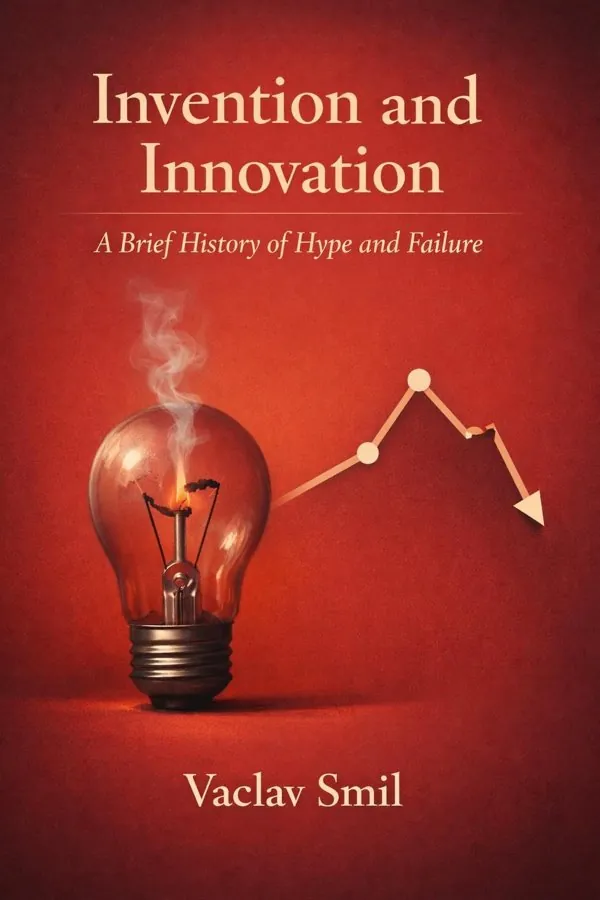
Invention and Innovation: A Brief History of Hype and Failure: Summary & Key Insights
by Vaclav Smil
 10 min9 chaptersAudio available
What Is Invention and Innovation: A Brief History of Hype and Failure About?
Invention and Innovation: A Brief History of Hype and Failure by Vaclav Smil is a popular_sci book spanning 9 pages. In this book, Vaclav Smil explores the complex history of technological innovation, emphasizing that progress is rarely linear or predictable. He examines both celebrated and forgotten inventions, showing how hype often overshadows the slow, incremental nature of real innovation. Smil argues that understanding the true patterns of invention is essential for shaping realistic expectations about future technological change.
This FizzRead summary covers all 9 key chapters of Invention and Innovation: A Brief History of Hype and Failure in approximately 10 minutes, distilling the most important ideas, arguments, and takeaways from Vaclav Smil's work. Also available as an audio summary and Key Quotes Podcast.
Invention and Innovation: A Brief History of Hype and Failure
In this book, Vaclav Smil explores the complex history of technological innovation, emphasizing that progress is rarely linear or predictable. He examines both celebrated and forgotten inventions, showing how hype often overshadows the slow, incremental nature of real innovation. Smil argues that understanding the true patterns of invention is essential for shaping realistic expectations about future technological change.
Who Should Read Invention and Innovation: A Brief History of Hype and Failure?
This book is perfect for anyone interested in popular_sci and looking to gain actionable insights in a short read. Whether you're a student, professional, or lifelong learner, the key ideas from Invention and Innovation: A Brief History of Hype and Failure by Vaclav Smil will help you think differently.
- ✓Readers who enjoy popular_sci and want practical takeaways
- ✓Professionals looking to apply new ideas to their work and life
- ✓Anyone who wants the core insights of Invention and Innovation: A Brief History of Hype and Failure in just 10 minutes
Want the full summary?
Get instant access to this book summary and 100K+ more with Fizz Moment.
Get Free SummaryAvailable on App Store • Free to download
Key Chapters
Across centuries, technological progress has unfolded not as a steady march but as a jagged landscape of surges and stasis. When we look back, the myth of linear improvement quickly dissolves. The Industrial Revolution, for example, was not a sudden burst of ingenuity but the accumulation of numerous modest breakthroughs—better steels, improved machine tools, refinements in coal mining and steam management—all interacting over generations. The pattern repeats across domains: agriculture, transportation, energy, information. progress is never evenly distributed; some eras brim with transformation while others languish.
In every instance, the diffusion of innovation depends on infrastructure, social readiness, and economic incentives. The electrification of cities did not follow instantly after Volta’s or Faraday’s pioneering work; it required durable generators, standardized voltages, affordable wiring, and compatible appliances. Similarly, the diffusion of automobiles waited upon fuel networks, road systems, and legal frameworks. History teaches us humility. We cannot compress decades of development into months merely because our enthusiasm demands it.
Thus, when we speak of 'revolutions'—industrial, digital, or biological—we must remember that these revolutions were evolutionary underneath. Even the most visionary inventors stand atop a dense strata of prior crafts, experiments, and failures. Understanding this unevenness grounds expectations and guards against the intoxication of futurism.
Few inventions illustrate the gulf between discovery and adoption better than the steam engine and electricity. The steam engine did not originate from one genius moment but from centuries of curiosity about harnessing heat. When Thomas Newcomen built his atmospheric engine in the early 18th century, it was crude and wasteful; James Watt’s refinements decades later—through separate condensers and rotary motion—turned it into a general-purpose machine. Yet even then, its expansion was slow: mines first, then factories, ships, and railways. Each step demanded complementary innovations in metallurgy, fuel supply, and design reliability.
Electricity followed a similar trajectory. The excitement born of Benjamin Franklin’s experiments and Michael Faraday’s laws of induction took nearly a century to mature into practical illumination and power distribution. The technology’s potential was obvious early on, but real-world implementation required systematic understanding of circuits, insulation, generation, and transmission. Only when corporate structures and municipal investments aligned did electricity truly transform life.
These examples reveal that big inventions do not leap into universal use—they crawl, they evolve. They need the slow nurturing of institutions, capital, and complementary know-how. Every 'epoch-making' invention began as a rough prototype, beset by inefficiency and skepticism. To recognize this truth is to cultivate patience—the rare virtue in a culture addicted to instant technological gratification.
+ 7 more chapters — available in the FizzRead app
All Chapters in Invention and Innovation: A Brief History of Hype and Failure
About the Author
Vaclav Smil is a Czech-Canadian scientist and policy analyst known for his interdisciplinary research on energy, environment, technology, and history. He is a Distinguished Professor Emeritus at the University of Manitoba and the author of more than forty books examining the interplay between technology, energy, and civilization.
Get This Summary in Your Preferred Format
Read or listen to the Invention and Innovation: A Brief History of Hype and Failure summary by Vaclav Smil anytime, anywhere. FizzRead offers multiple formats so you can learn on your terms — all free.
Available formats: App · Audio · PDF · EPUB — All included free with FizzRead
Download Invention and Innovation: A Brief History of Hype and Failure PDF and EPUB Summary
Key Quotes from Invention and Innovation: A Brief History of Hype and Failure
“Across centuries, technological progress has unfolded not as a steady march but as a jagged landscape of surges and stasis.”
“Few inventions illustrate the gulf between discovery and adoption better than the steam engine and electricity.”
Frequently Asked Questions about Invention and Innovation: A Brief History of Hype and Failure
Invention and Innovation: A Brief History of Hype and Failure by Vaclav Smil is a popular_sci book that explores key ideas across 9 chapters. In this book, Vaclav Smil explores the complex history of technological innovation, emphasizing that progress is rarely linear or predictable. He examines both celebrated and forgotten inventions, showing how hype often overshadows the slow, incremental nature of real innovation. Smil argues that understanding the true patterns of invention is essential for shaping realistic expectations about future technological change.
More by Vaclav Smil

Grand Transitions: How the Modern World Was Made
Vaclav Smil
10 min
How the World Really Works: The Science Behind How We Got Here and Where We're Going
Vaclav Smil
10 min
Making the Modern World: Materials and Dematerialization
Vaclav Smil
10 min
Invention and Innovation
Vaclav Smil
10 minYou Might Also Like

Structures: Or Why Things Don"t Fall Down
J.E. Gordon
10 min
The Road to Wigan Pier
George Orwell
10 min
Bonk: The Curious Coupling of Science and Sex
Mary Roach
10 min
First Bite: How We Learn to Eat
Bee Wilson
10 min
In Pursuit Of The Unknown: 17 Equations That Changed The World
Ian Stewart
10 min
Napoleon's Buttons: 17 Molecules That Changed History
Penny Le Couteur and Jay Burreson
10 minBrowse by Category
Ready to read Invention and Innovation: A Brief History of Hype and Failure?
Get the full summary and 100K+ more books with Fizz Moment.