
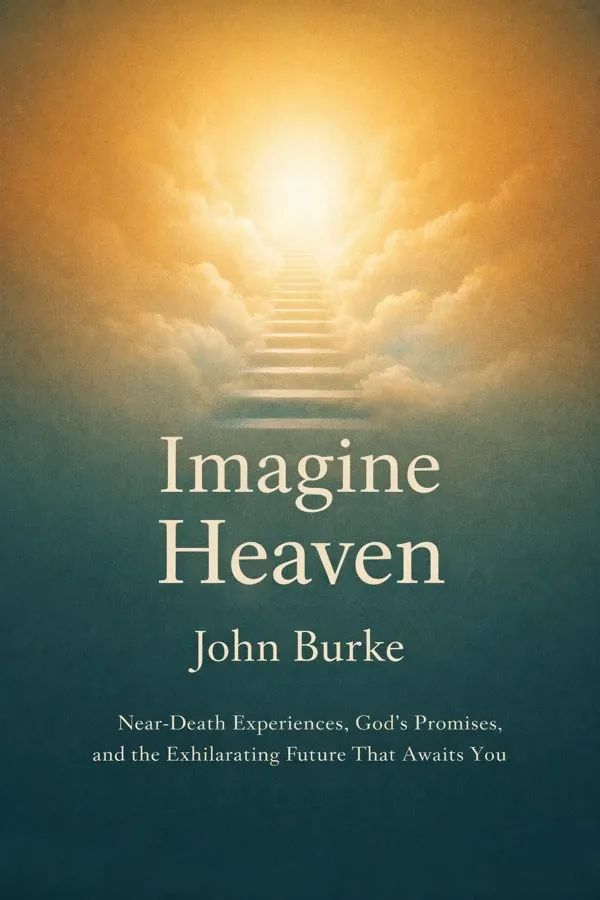
Imagine Heaven: Summary & Key Insights
by John Burke
 10 min10 chaptersAudio available
Key Takeaways from Imagine Heaven
One of the book’s most striking insights is that people who come close to death often report surprisingly similar experiences, even when they come from very different backgrounds.
Powerful experiences can inspire, but Burke insists that feelings alone are never enough.
Burke connects these reports with the biblical presentation of God as light, holiness, truth, and perfect love.
A deeply sobering theme in the book is the life review, a feature reported in many near-death experiences.
Many people imagine heaven as vague, abstract, or even boring, but Burke presents it as vivid, physical, relational, and intensely alive.
What Is Imagine Heaven About?
Imagine Heaven by John Burke is a self-help book published in 2015 spanning 10 pages. What if our deepest hopes about life after death are not mere wishful thinking, but glimpses of a reality that has already been partially revealed? In Imagine Heaven, pastor John Burke investigates more than one hundred near-death experiences from people of different ages, cultures, and religious backgrounds, then compares their accounts with biblical descriptions of heaven, judgment, love, and eternity. Rather than treating these stories as sensational curiosities, Burke approaches them as meaningful testimonies that may illuminate what Scripture has long promised. The result is a book that blends spiritual reflection, pastoral care, and apologetics into a deeply encouraging vision of the afterlife. For readers who fear death, grieve loss, question whether heaven is real, or simply want to live with greater purpose, the book offers both comfort and challenge. Burke’s authority comes not only from his role as a longtime pastor and teacher, but also from his careful effort to test extraordinary experiences against the Bible instead of accepting them uncritically. Imagine Heaven matters because it turns eternity from an abstract doctrine into a transforming lens for everyday life.
This FizzRead summary covers all 10 key chapters of Imagine Heaven in approximately 10 minutes, distilling the most important ideas, arguments, and takeaways from John Burke's work. Also available as an audio summary and Key Quotes Podcast.
Imagine Heaven
What if our deepest hopes about life after death are not mere wishful thinking, but glimpses of a reality that has already been partially revealed? In Imagine Heaven, pastor John Burke investigates more than one hundred near-death experiences from people of different ages, cultures, and religious backgrounds, then compares their accounts with biblical descriptions of heaven, judgment, love, and eternity. Rather than treating these stories as sensational curiosities, Burke approaches them as meaningful testimonies that may illuminate what Scripture has long promised. The result is a book that blends spiritual reflection, pastoral care, and apologetics into a deeply encouraging vision of the afterlife. For readers who fear death, grieve loss, question whether heaven is real, or simply want to live with greater purpose, the book offers both comfort and challenge. Burke’s authority comes not only from his role as a longtime pastor and teacher, but also from his careful effort to test extraordinary experiences against the Bible instead of accepting them uncritically. Imagine Heaven matters because it turns eternity from an abstract doctrine into a transforming lens for everyday life.
Who Should Read Imagine Heaven?
This book is perfect for anyone interested in self-help and looking to gain actionable insights in a short read. Whether you're a student, professional, or lifelong learner, the key ideas from Imagine Heaven by John Burke will help you think differently.
- ✓Readers who enjoy self-help and want practical takeaways
- ✓Professionals looking to apply new ideas to their work and life
- ✓Anyone who wants the core insights of Imagine Heaven in just 10 minutes
Want the full summary?
Get instant access to this book summary and 100K+ more with Fizz Moment.
Get Free SummaryAvailable on App Store • Free to download
Key Chapters
Powerful experiences can inspire, but Burke insists that feelings alone are never enough. A central idea in Imagine Heaven is that near-death testimonies should be evaluated through the lens of Scripture. Burke repeatedly compares what experiencers report with biblical passages about heaven, God’s presence, judgment, resurrection, angels, and the life to come. His goal is not to sensationalize mystical stories, but to test them. Where the accounts align with biblical truth, he sees confirmation; where they contradict core teachings, he urges caution.
This approach matters because it keeps the book grounded. Without a measuring standard, readers could easily drift into vague spirituality, taking every supernatural claim as equally valid. Burke argues that the Bible offers the clearest and most trustworthy revelation of eternal reality. Near-death experiences may provide vivid illustrations, but Scripture remains the foundation. This gives the book a distinctive tone: open to testimony, but anchored in Christian doctrine.
In daily life, this principle has wide application. People often make major decisions based on emotion, intuition, or dramatic experiences. Burke’s method reminds readers to examine every claim carefully. If someone says they had a profound spiritual moment, the question is not only whether it felt real, but whether it aligns with truth. This helps readers avoid both gullibility and cynicism.
For those exploring spiritual matters, this chapter encourages a healthy combination of wonder and discernment. It is possible to be moved by extraordinary stories without surrendering critical judgment. Faith, in Burke’s view, is not blind acceptance but tested trust.
Actionable takeaway: When encountering spiritual claims, ask two questions: Does this inspire me? And more importantly, does it align with Scripture and lead me toward God’s revealed character?
Many near-death experiencers struggle to describe the being they encounter, yet they return using the same language again and again: light, love, peace, beauty, and complete acceptance. Burke connects these reports with the biblical presentation of God as light, holiness, truth, and perfect love. In his reading, the radiant presence people describe is not an impersonal force but the personal God whose nature is more beautiful and loving than human language can contain.
What stands out in these stories is not sentimental comfort, but an intense sense of being fully known and fully loved at once. Experiencers often say they felt every hidden motive, wound, and failure was visible, yet they were not met with contempt. They were met with clarity and mercy. Burke sees in this a profound echo of the Christian gospel: God’s love does not ignore truth, and God’s truth does not erase love. The light reveals reality, but it also heals.
This idea has practical consequences. Many people live with shame, assuming that if others really knew them, they would be rejected. Imagine Heaven offers a different vision: ultimate reality is not cold exposure but transforming love. That can change how readers approach prayer, repentance, and relationships. Instead of hiding from God, they can move toward Him honestly. Instead of offering conditional acceptance to others, they can practice truth wrapped in compassion.
For grieving readers or those facing anxiety about death, this portrayal of God’s presence is especially significant. Heaven is not merely a better location; it is nearness to the source of all goodness. The promise of eternity becomes relational, not just architectural.
Actionable takeaway: Practice honest prayer without self-protection. Bring your fears, flaws, and regrets into God’s light, trusting that truth and love are not enemies in His presence.
A deeply sobering theme in the book is the life review, a feature reported in many near-death experiences. People often describe seeing their lives replayed with startling vividness, not just as a sequence of events but as a moral and relational reality. They relive their choices and feel the impact of their words and actions on others. Moments they considered small suddenly appear weighty. Kindness matters. Cruelty matters. Neglect matters. Love matters most.
Burke connects this with biblical teaching about judgment, accountability, and God’s complete knowledge of every human heart. Yet he emphasizes that the life review is not presented merely as condemnation. In many accounts, the review occurs in the presence of divine love, which makes the truth bearable and transformative. The point is not humiliation for its own sake, but revelation. People see what really mattered in their lives and return changed.
This idea challenges the modern temptation to treat morality as private or flexible. Imagine Heaven argues that our lives carry eternal significance. A sarcastic comment, a quiet act of generosity, a moment of forgiveness, years of selfish ambition—none of it is trivial. In practical terms, this can sharpen self-awareness. How do you treat family members when no one is watching? How do you respond to inconvenience, weakness, or people who cannot advance your goals?
The life review also offers hope. If love is the standard, then growth in love becomes the true measure of a meaningful life. Career success, status, and possessions are demoted. Integrity, compassion, humility, and service rise in importance.
Actionable takeaway: At the end of each day, review your actions through one question: Did I increase love, truth, and mercy in the lives of others today? Let that question shape tomorrow.
Many people imagine heaven as vague, abstract, or even boring, but Burke presents it as vivid, physical, relational, and intensely alive. Drawing on both near-death testimonies and biblical imagery, he describes landscapes full of beauty, colors beyond earthly comparison, music, joy, meaningful activity, and reunion with loved ones. Heaven, in this portrayal, is not an endless church service floating in the clouds. It is a realm saturated with God’s presence where relationships are restored, identity is completed, and creation itself reflects divine glory.
A major contribution of this idea is that it rescues heaven from caricature. If people secretly view eternity as monotonous, they may avoid thinking about it. But if heaven is the fulfillment of every good thing humans dimly long for—beauty, belonging, purpose, peace, delight, and love—then longing for it becomes natural rather than escapist. Burke emphasizes that heaven does not erase personality; it perfects it. People do not become less themselves in God’s presence, but more fully who they were meant to be.
This perspective changes how readers endure suffering and loss. Grief remains real, but it is framed by reunion rather than permanent separation. Work and creativity gain dignity when seen as shadows of a richer life to come. Even simple earthly pleasures—a sunset, laughter with friends, music, tenderness—can be understood as previews rather than endpoints.
Practically, this can help people facing bereavement, illness, or discouragement. Instead of clinging desperately to a broken world, they can hold earthly blessings gratefully while orienting their hopes toward something greater.
Actionable takeaway: When you experience beauty, joy, or deep connection, pause and let it point beyond itself. Train your heart to see earthly goodness as a signpost to eternal reality.
If heaven is real, then this life is not random. Burke argues that our time on earth functions as preparation, formation, and invitation. The choices we make now shape our capacity for love, trust, surrender, and communion with God. Near-death experiencers often return with a dramatically revised sense of what matters. They become less driven by status, wealth, image, and competition, and more focused on relationships, compassion, truth, and spiritual purpose. Burke interprets this as evidence that eternity throws earthly priorities into proper perspective.
This is not a call to withdraw from the world. On the contrary, the book suggests that belief in eternity should make us more engaged, not less. If every person has eternal value, then daily interactions matter profoundly. Parenting matters. Forgiving matters. Serving matters. The hidden decisions of the heart matter. Life becomes a training ground where we learn to love what is truly lasting.
Burke’s message is especially relevant in achievement-driven cultures. Many readers spend years chasing goals that deliver only temporary satisfaction. Imagine Heaven asks whether success without eternal alignment is actually failure. It challenges readers to define a good life not by accumulation, but by transformation.
A practical application is to evaluate your schedule and priorities. Do they reflect your stated values? If someone observed your calendar, spending habits, and emotional energy, would they conclude that love of God and neighbor is central? Eternity is not meant to make us irresponsible about today; it is meant to make today meaningful.
Actionable takeaway: Choose one regular activity—work, family meals, volunteering, conversation—and begin treating it as spiritual formation. Ask how this ordinary part of life can train you to become the kind of person fit for eternity.
Hope is central to Imagine Heaven, but Burke does not ignore the book’s more difficult theme: some near-death experiences include fear, darkness, regret, isolation, and an agonizing sense of separation from love. He connects these reports with biblical teaching about judgment and hell. Rather than using fear for manipulation, Burke presents separation from God as the tragic outcome of resisting the very source of life, truth, and love. If heaven is union with God, then hell is alienation from Him.
This idea matters because it restores moral seriousness to spiritual discussions. In a culture that often assumes everyone naturally drifts toward the same destiny, Burke argues that human freedom is real and our response to God matters. Love cannot be coerced. The book portrays God as gracious and relentlessly pursuing people, but not as overriding human refusal indefinitely. Judgment, in this view, is not arbitrary cruelty but the unveiling of what a soul has chosen.
For readers, this can feel unsettling, yet Burke’s aim is ultimately compassionate. Warnings are expressions of concern when the danger is real. The possibility of separation from God gives urgency to reconciliation, repentance, and faith. It also intensifies the significance of everyday spiritual decisions. We are not simply drifting through neutral space; we are becoming people oriented either toward God’s love or away from it.
In practical terms, this invites honest self-examination. Are there habits of pride, bitterness, deceit, or indifference hardening your heart? Are you resisting grace while assuming there will always be more time?
Actionable takeaway: Do not postpone spiritual clarity. Identify one area where you are resisting truth or avoiding God, and take a concrete step toward repentance, prayer, or trusted counsel today.
One of Burke’s most compelling claims is that a confident hope in heaven does not detach people from life; it transforms the way they live it. Many near-death experiencers return less afraid of dying and more committed to loving boldly, forgiving quickly, and serving generously. The encounter with eternity rearranges their inner world. Anxiety loses some of its power. Petty ambitions seem hollow. Compassion becomes urgent. Burke argues that this is exactly what authentic Christian hope is meant to do.
Hope, in this book, is not denial of suffering. It does not erase grief, illness, injustice, or pain. Instead, it places those realities within a larger story. If death is not the end, then suffering is not the final word. If love survives the grave, then courage makes sense. Readers are encouraged to live from eternity backward, allowing future certainty to shape present faithfulness.
This has practical relevance for people carrying loss, burnout, or discouragement. A parent exhausted by caregiving, a person grieving a spouse, or someone facing a frightening diagnosis may not need abstract philosophy as much as a reason to endure with meaning. Imagine Heaven offers that reason. It says that what is done in love is never wasted and that reunion, restoration, and joy are not fantasies but promises.
At the same time, hope can energize ordinary life. It can make people more patient in conflict, more generous with time, and less controlled by fear of failure or public opinion. When eternity matters most, approval and possessions matter less.
Actionable takeaway: In one current struggle, ask yourself: How would I face this differently if I truly believed death is not the end and love has eternal significance? Let your answer guide one brave action.
Burke does not stop at disembodied visions of heaven. He emphasizes a distinctly Christian hope: resurrection. According to Scripture, the final destiny of believers is not merely to exist as souls in a spiritual realm, but to be raised into renewed embodied life in a restored creation. This matters because it prevents heaven from becoming an escape from physical existence. God does not discard creation; He redeems it. Human beings are not meant to be forever fragmented into spirit without body. Full salvation includes restoration of the whole person.
Near-death experiences, for Burke, may provide glimpses of the intermediate state or the threshold of eternity, but the Bible points beyond that to resurrection and new creation. This broadens the reader’s understanding of hope. The Christian future is not less real than the present world, but more real. Justice, beauty, relationships, worship, work, and joy all find their fullest expression in a renewed order where death no longer reigns.
Practically, this strengthens dignity toward the body and the material world. If God intends redemption rather than abandonment, then what we do physically matters. Care for the sick matters. Stewardship of creation matters. Embodied acts of love matter. The resurrection also provides comfort for those who fear bodily decline. Aging, disability, and illness are not permanent definitions of a person’s identity.
This vision is especially helpful for readers who have only imagined heaven in abstract spiritual terms. Burke reminds them that Christian hope is concrete, future-oriented, and deeply connected to the resurrection of Jesus.
Actionable takeaway: Let resurrection hope shape how you treat your body, the physical needs of others, and the world around you. Practice one embodied act of care this week as a sign of trust in God’s coming renewal.
Perhaps the book’s most practical insight is that anticipation of eternity should change how we live today. Burke repeatedly returns to the idea that heaven is not just future consolation; it is present orientation. To anticipate eternity means to align our values, habits, and relationships with what will ultimately last. Love, worship, humility, truth, and service are not merely religious duties. They are preparation for reality.
This mindset can radically simplify life. Many people feel fragmented because they are trying to satisfy too many competing masters: ambition, pleasure, image, security, approval, comfort. Burke’s vision offers a unifying center. If knowing God is the highest good and eternity is the true horizon, then decisions can be made with greater clarity. Readers can ask: Will this deepen my love for God and others? Will this matter in eternity? Does this form Christlike character?
Examples are everywhere. In conflict, anticipation of eternity can make forgiveness more appealing than revenge. In career decisions, it can prioritize integrity over advancement. In parenting, it can shift focus from achievement to character. In suffering, it can provide endurance. In success, it can foster gratitude rather than pride. This does not mean becoming detached from earthly responsibilities. It means engaging them with a deeper purpose.
Burke’s central challenge is that belief in heaven should be visible. A person who truly expects eternal life ought to become less fearful, less selfish, and more loving over time. The anticipation of heaven is tested not in theories, but in habits.
Actionable takeaway: Before making a significant decision this week, ask one filtering question: What choice best reflects the values I believe will matter forever? Then act with consistency.
All Chapters in Imagine Heaven
About the Author
John Burke is an American pastor, teacher, and author known for writing about Christian faith, grace, spiritual transformation, and eternal life. He is the founding pastor of Gateway Church in Austin, Texas, where he has spent decades helping people explore Christianity in practical and intellectually accessible ways. Burke’s work often focuses on connecting biblical teaching with real human questions about identity, suffering, purpose, and what happens after death. In Imagine Heaven, he brings together his pastoral experience, scriptural study, and research into near-death experiences to present a hopeful vision of eternity rooted in Christian belief. His writing appeals to readers seeking both emotional encouragement and theological substance, especially on topics related to heaven, hope, and the reality of God’s love.
Get This Summary in Your Preferred Format
Read or listen to the Imagine Heaven summary by John Burke anytime, anywhere. FizzRead offers multiple formats so you can learn on your terms — all free.
Available formats: App · Audio · PDF · EPUB — All included free with FizzRead
Download Imagine Heaven PDF and EPUB Summary
Key Quotes from Imagine Heaven
“One of the book’s most striking insights is that people who come close to death often report surprisingly similar experiences, even when they come from very different backgrounds.”
“Powerful experiences can inspire, but Burke insists that feelings alone are never enough.”
“Many near-death experiencers struggle to describe the being they encounter, yet they return using the same language again and again: light, love, peace, beauty, and complete acceptance.”
“A deeply sobering theme in the book is the life review, a feature reported in many near-death experiences.”
“Many people imagine heaven as vague, abstract, or even boring, but Burke presents it as vivid, physical, relational, and intensely alive.”
Frequently Asked Questions about Imagine Heaven
Imagine Heaven by John Burke is a self-help book that explores key ideas across 10 chapters. What if our deepest hopes about life after death are not mere wishful thinking, but glimpses of a reality that has already been partially revealed? In Imagine Heaven, pastor John Burke investigates more than one hundred near-death experiences from people of different ages, cultures, and religious backgrounds, then compares their accounts with biblical descriptions of heaven, judgment, love, and eternity. Rather than treating these stories as sensational curiosities, Burke approaches them as meaningful testimonies that may illuminate what Scripture has long promised. The result is a book that blends spiritual reflection, pastoral care, and apologetics into a deeply encouraging vision of the afterlife. For readers who fear death, grieve loss, question whether heaven is real, or simply want to live with greater purpose, the book offers both comfort and challenge. Burke’s authority comes not only from his role as a longtime pastor and teacher, but also from his careful effort to test extraordinary experiences against the Bible instead of accepting them uncritically. Imagine Heaven matters because it turns eternity from an abstract doctrine into a transforming lens for everyday life.
You Might Also Like



Featured In
Browse by Category
Ready to read Imagine Heaven?
Get the full summary and 100K+ more books with Fizz Moment.