
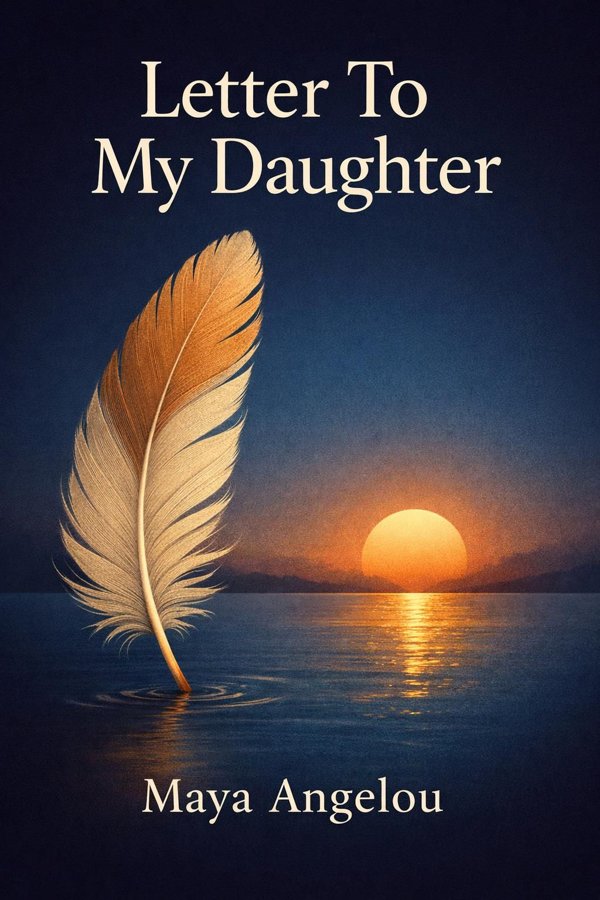
Letter To My Daughter: Summary & Key Insights
by Maya Angelou
 10 min10 chaptersAudio available
Key Takeaways from Letter To My Daughter
Home is not always the place where you begin; sometimes it is the place you slowly learn to create.
The most meaningful giving often has little to do with money and everything to do with attention.
To travel well is not simply to move across borders; it is to loosen the boundaries of the self.
A people cut off from their history often struggle to see themselves whole.
Maturity is not simply a matter of age; it is the courage to see yourself clearly.
What Is Letter To My Daughter About?
Letter To My Daughter by Maya Angelou is a biographies book spanning 10 pages. Letter To My Daughter is Maya Angelou’s intimate offering of guidance, memory, and hard-won wisdom to the daughter she never had—and, by extension, to every reader willing to listen. Rather than presenting one continuous narrative, the book gathers essays, reflections, and autobiographical moments that reveal how a life can be shaped by suffering, dignity, curiosity, and love. Angelou writes about race, womanhood, work, travel, family, style, generosity, spirituality, and survival with the authority of someone who has lived many lives in one: performer, activist, mother, writer, and witness to history. What makes this book endure is not only the beauty of Angelou’s language, but the moral clarity behind it. She does not pretend life is easy, fair, or tidy. Instead, she shows how people can remain human through disappointment, prejudice, loneliness, and change. This book matters because it feels both deeply personal and universally relevant. It is a literary conversation about becoming wiser without becoming bitter, stronger without losing tenderness, and more fully yourself without forgetting your connection to others.
This FizzRead summary covers all 10 key chapters of Letter To My Daughter in approximately 10 minutes, distilling the most important ideas, arguments, and takeaways from Maya Angelou's work. Also available as an audio summary and Key Quotes Podcast.
Letter To My Daughter
Letter To My Daughter is Maya Angelou’s intimate offering of guidance, memory, and hard-won wisdom to the daughter she never had—and, by extension, to every reader willing to listen. Rather than presenting one continuous narrative, the book gathers essays, reflections, and autobiographical moments that reveal how a life can be shaped by suffering, dignity, curiosity, and love. Angelou writes about race, womanhood, work, travel, family, style, generosity, spirituality, and survival with the authority of someone who has lived many lives in one: performer, activist, mother, writer, and witness to history. What makes this book endure is not only the beauty of Angelou’s language, but the moral clarity behind it. She does not pretend life is easy, fair, or tidy. Instead, she shows how people can remain human through disappointment, prejudice, loneliness, and change. This book matters because it feels both deeply personal and universally relevant. It is a literary conversation about becoming wiser without becoming bitter, stronger without losing tenderness, and more fully yourself without forgetting your connection to others.
Who Should Read Letter To My Daughter?
This book is perfect for anyone interested in biographies and looking to gain actionable insights in a short read. Whether you're a student, professional, or lifelong learner, the key ideas from Letter To My Daughter by Maya Angelou will help you think differently.
- ✓Readers who enjoy biographies and want practical takeaways
- ✓Professionals looking to apply new ideas to their work and life
- ✓Anyone who wants the core insights of Letter To My Daughter in just 10 minutes
Want the full summary?
Get instant access to this book summary and 100K+ more with Fizz Moment.
Get Free SummaryAvailable on App Store • Free to download
Key Chapters
Home is not always the place where you begin; sometimes it is the place you slowly learn to create. One of the most resonant ideas in Letter To My Daughter is that home is larger than geography. For Angelou, home is not merely a house, a city, or even a nation. It is the feeling of being recognized, accepted, and allowed to exist fully. Because her own life involved displacement, hardship, and reinvention, she understands that many people move through the world feeling like outsiders. Her reflections suggest that belonging is not something passively received. It is something nurtured through memory, community, and inner steadiness.
Angelou’s idea of home includes both pain and grace. Family homes may wound us, countries may reject us, and communities may fail to understand us. Yet she refuses to define home only by loss. Instead, she shows that we can make homes in language, friendship, ritual, and self-respect. A kitchen table where people tell the truth can be home. A relationship grounded in loyalty can be home. Even a clear sense of one’s own dignity can become a portable shelter.
This insight is practical because many people spend years waiting to feel settled. Angelou invites readers to ask different questions: Where am I welcomed? What relationships help me breathe more freely? What habits make me feel anchored? Creating home may mean keeping family traditions, opening your door to others, or choosing environments where your values are honored.
Actionable takeaway: Identify three places, people, or practices that make you feel most deeply yourself, and intentionally strengthen them as your personal foundation of home.
The most meaningful giving often has little to do with money and everything to do with attention. Angelou’s reflections on philanthropy challenge the narrow idea that generosity belongs only to the rich or publicly celebrated. She presents giving as a human practice available to everyone: sharing time, offering encouragement, noticing pain, and extending dignity to another person. In her worldview, philanthropy is not a performance. It is a discipline of recognizing that we belong to one another.
This makes generosity both humbling and demanding. It is easy to admire large charitable acts from a distance, but Angelou asks readers to consider the smaller, quieter forms of care that sustain everyday life. Listening seriously to a grieving friend, mentoring a younger person, paying for a stranger’s meal, or defending someone who is being diminished—all of these are acts of philanthropy. They say: your life matters to me.
Angelou’s broader point is that generosity changes both the receiver and the giver. When we act with compassion, we weaken the illusion that we are separate. We begin to see ourselves as participants in a shared moral world. This perspective is especially powerful in difficult times, when fear can make people guarded and self-protective. Generosity becomes a refusal to let scarcity define the spirit.
In practical life, this means asking not only what resources you possess, but what forms of care you can offer now. A professional can share knowledge. A parent can offer patience. A student can offer solidarity. A neighbor can offer presence. None of these require wealth, only willingness.
Actionable takeaway: Choose one concrete act of generosity you can practice weekly—whether mentoring, checking on someone, sharing a skill, or helping quietly—and make it part of your character, not just your schedule.
To travel well is not simply to move across borders; it is to loosen the boundaries of the self. Angelou treats travel as a source of education, humility, and awakening. Encountering unfamiliar customs, languages, histories, and people forces us to confront what we have taken for granted. Travel can expose prejudice, enlarge sympathy, and remind us that our own ways are not the only ways. For Angelou, the world is not a backdrop for self-discovery alone. It is a living classroom that teaches respect.
This matters because many people move through life with inherited assumptions they have never tested. Travel interrupts certainty. It can reveal the beauty of difference and the absurdity of arrogance. A meal shared in another country, a conversation with someone whose life looks nothing like your own, or the experience of being the outsider in a room can all sharpen empathy. Angelou suggests that such experiences are morally important because they help us become less provincial and more human.
Yet her view of travel is not romantic escapism. Travel can also be uncomfortable, disorienting, and revealing in painful ways. It may show us the reach of colonialism, inequality, or racism. But even those encounters are instructive. They remind us that to know the world honestly, we must be willing to see both its wonders and its wounds.
For modern readers, the lesson extends beyond international trips. Reading global literature, attending cultural events, learning a language, or building friendships across difference can also widen the mind. The goal is not collecting experiences, but becoming more porous, curious, and respectful.
Actionable takeaway: Deliberately seek one unfamiliar cultural experience this month—through travel, books, food, conversation, or art—and approach it with questions rather than assumptions.
A people cut off from their history often struggle to see themselves whole. Angelou’s reflections on Africa are deeply connected to identity, ancestry, and the emotional search for origin. For Black readers especially, Africa represents more than a place on a map; it can symbolize a recovery of memory after generations of displacement and erasure. Angelou writes with sensitivity about the longing to reconnect with a history that slavery and racism tried to sever.
Her engagement with Africa is not simplistic nostalgia. She does not treat the continent as a fantasy or a single story. Instead, she approaches it as a site of complexity, beauty, contradiction, and revelation. In doing so, she resists the flattening narratives often imposed by Western perspectives. Africa becomes a reminder that identity is richer and older than the stereotypes used to diminish it.
At a personal level, this idea speaks to anyone who has felt detached from their roots. To know where you come from can strengthen your sense of self, not by trapping you in the past but by enlarging your understanding of who you are. Family history, cultural traditions, language, and ancestral memory all help counter shame and fragmentation. Angelou’s message is that dignity grows when we reclaim the stories that were ignored, hidden, or distorted.
Practically, this may mean researching family histories, learning about the cultures that shaped your community, or questioning inherited narratives that make some histories central and others invisible. It can also mean recognizing that identity is both personal and historical: your life does not begin with you.
Actionable takeaway: Spend time learning one overlooked part of your heritage or cultural history, and reflect on how that knowledge changes the way you understand yourself today.
Maturity is not simply a matter of age; it is the courage to see yourself clearly. Throughout Letter To My Daughter, Angelou returns to the reality of growing up—not as a neat progression, but as a series of difficult reckonings. Childhood, adolescence, and early adulthood often involve confusion, shame, longing, and mistakes. Angelou does not sentimentalize these phases. Instead, she treats them as training grounds where character is formed through trial, not perfection.
A key part of growing up, in her view, is learning to tell the truth about one’s life. This includes acknowledging wounds without being ruled by them, admitting failures without surrendering self-respect, and understanding that confusion is not the same as worthlessness. Angelou’s wisdom comes from having endured deep hardship and still refusing to let pain have the final word. She suggests that growth begins when we stop performing strength and start practicing honesty.
This idea is especially useful in cultures that reward image over substance. Many people believe adulthood means having all the answers, but Angelou implies that real maturity looks more like responsibility, humility, and steadiness. It is the ability to learn from embarrassment, to apologize, to keep going, and to resist the temptation to define yourself by your worst moment.
In daily life, this can mean examining recurring patterns, accepting feedback, and abandoning the fantasy of flawless self-presentation. Parents can model honest growth for children. Young adults can treat setbacks as information, not verdicts. Older adults can continue evolving rather than hiding behind habit.
Actionable takeaway: Write down one mistake or painful memory that still shapes you, then identify the lesson it taught and one healthier way you now choose to respond.
What we wear and how we carry ourselves can express more than taste; they can reveal self-regard. Angelou’s reflections on style go beyond fashion in the superficial sense. She is interested in presentation as a language of presence, confidence, and intention. Style, for her, is not about pleasing others or chasing trends. It is about showing up in the world with deliberateness and care. The way you inhabit your body, choose your words, and present yourself can communicate dignity before you speak.
This idea is liberating because it makes style available to everyone. Angelou does not suggest that worth depends on glamour or expense. Rather, she highlights the power of grooming, posture, grace, and authenticity. A well-kept appearance can say, I value myself. A distinctive voice or a calm manner can be as much a part of style as clothing. What matters is alignment between outer presentation and inner respect.
Style also has social meaning. In a world quick to stereotype or diminish people—especially women and marginalized communities—self-presentation can become an act of self-definition. Choosing how to appear is one way of refusing to be carelessly interpreted by others. It does not guarantee fairness, but it can strengthen personal agency.
In practical terms, cultivating style may mean simplifying your wardrobe so it reflects your life, speaking with more intention, or paying attention to the atmosphere you create around yourself. It is less about impressing and more about embodying coherence.
Actionable takeaway: Identify one change in dress, posture, speech, or daily routine that helps you feel more grounded and self-respecting, and practice it consistently for two weeks.
The people who shape us are not always the people who share our blood. Angelou’s understanding of family is expansive, realistic, and compassionate. She knows that biological ties can nurture, but they can also wound, disappoint, or fail to protect. Rather than clinging to an idealized image of family, she asks readers to recognize the fuller truth: family may be inherited, but it is also built through loyalty, care, and mutual recognition.
This broadened view matters because many people live with grief about what their families were not. Angelou makes room for that pain without surrendering to cynicism. She shows that family can include mentors, friends, elders, neighbors, and communities that offer the love or steadiness one did not receive at home. Chosen family does not erase biological family, but it can supplement, heal, and in some cases transform the meaning of belonging.
Her reflections also remind readers that family is a responsibility, not just a label. To be family means showing up, telling the truth, offering forgiveness when possible, and protecting each other’s humanity. It means understanding that love is proved over time. This applies to parents and children, siblings, partners, and friendships that become kinship.
Practically, Angelou’s insight invites readers to take stock of their relational world. Who consistently supports your growth? Whom do you trust with your vulnerability? Where do obligations need healthier boundaries? Family need not be romanticized to be cherished.
Actionable takeaway: Make a list of the people who have truly acted like family in your life, then strengthen one of those relationships this week through gratitude, honesty, or meaningful time together.
When circumstances become unbearable, the spirit often carries what strength alone cannot. Angelou’s reflections on spirit are not narrowly doctrinal. They point to an inner life shaped by reverence, resilience, humility, and trust in something larger than immediate suffering. For her, spirit is what helps a person continue when logic offers little comfort. It is not denial of pain, but a refusal to let pain become the only reality.
This spiritual dimension is central to Angelou’s wisdom because her life included profound injustice and instability. She understands that survival requires more than strategy. People need meaning, song, prayer, memory, beauty, and an inner language for hope. Spirit can be religious faith, but it can also take form through gratitude, ritual, service, silence, or a deep sense of moral order. What matters is the sustaining force that lifts a person above bitterness and despair.
Angelou’s perspective is useful in modern life, where many people are materially busy yet spiritually undernourished. Without reflection, values can become shallow and endurance brittle. Spirit reconnects us to patience, wonder, and compassion. It reminds us that not every problem is solved by control; some must be met with surrender, faith, and perspective.
In practical terms, nurturing spirit might involve prayer, meditation, journaling, reading sacred or meaningful texts, spending time in nature, singing, or serving others. These practices do not remove hardship, but they create inner room to bear it differently.
Actionable takeaway: Create a simple daily spiritual practice—five minutes of silence, gratitude, prayer, or reflection—and use it to anchor yourself before the demands of the day take over.
Gentleness without bravery can become passivity, and bravery without grace can become cruelty. Angelou’s vision of character depends on the union of grace and courage. She admires those who can stand firm without becoming hard, speak truth without humiliating others, and endure struggle without losing elegance of spirit. This balance is one of the book’s deepest moral lessons.
Grace, in Angelou’s sense, is not fragility or social polish alone. It is composure, generosity, and the ability to move through difficulty without needlessly spreading pain. Courage is not theatrical fearlessness. It is the willingness to act despite fear, to defend dignity, to face loss, and to continue growing. Together, they create a powerful model for living: strength disciplined by compassion.
This teaching has immediate applications. In conflict, grace and courage might mean setting a boundary without contempt. In leadership, it might mean making a difficult decision while treating people fairly. In personal pain, it might mean acknowledging hurt without choosing revenge. Angelou’s own life gives credibility to this idea. She knew humiliation, danger, and public pressure, yet her writing continually reaches toward moral largeness rather than narrow retaliation.
Many readers confuse grace with weakness and courage with aggression. Angelou rejects both misunderstandings. She shows that the most admirable people are often those who can remain humane under pressure. They do not collapse, and they do not brutalize.
Actionable takeaway: In your next difficult conversation, decide in advance how you will be both courageous and gracious—clear about your truth, but respectful in your tone and intent.
Unforgiveness can feel like strength, but often it is only prolonged captivity. Angelou’s reflections on kindness and forgiveness do not ask readers to excuse abuse or forget injustice. Instead, she explores how resentment can imprison the person carrying it. Kindness is not naïveté, and forgiveness is not surrender. Both are forms of freedom that allow the soul to move without being chained to old injury.
Angelou’s understanding of kindness begins with recognition. To be kind is to remember that every person carries burdens, contradictions, and wounds you may never see. This does not mean tolerating harmful behavior. It means resisting the impulse to reduce others to their failures. Forgiveness, similarly, is not a public gesture of moral superiority. It is an internal release from the exhausting duty of hatred.
This is one of the hardest lessons in the book because hurt often demands repayment. But Angelou suggests that clinging to revenge distorts the self. The goal is not to deny pain, but to prevent it from shaping your whole identity. Sometimes forgiveness includes reconciliation; often it does not. You may forgive and still set distance. You may be kind and still say no. The essential point is to choose peace over poison.
In everyday life, this can look like refusing to escalate conflict, offering compassion where contempt is expected, or letting go of a grudge that no longer serves any truth. These choices protect inner life.
Actionable takeaway: Think of one lingering resentment you carry, and take one step toward release—through journaling, prayer, honest conversation, or a decision to stop rehearsing the injury.
All Chapters in Letter To My Daughter
About the Author
Maya Angelou (1928–2014) was an American poet, memoirist, essayist, actress, and civil rights activist whose work reshaped modern autobiographical writing. She became internationally known for I Know Why the Caged Bird Sings, a groundbreaking memoir that explored race, trauma, identity, and resilience with remarkable honesty and literary power. Across her career, Angelou published multiple autobiographies, poetry collections, essays, and public addresses, becoming one of the most respected voices in American literature. She also worked as a performer, journalist, educator, and activist, and was associated with major figures in the civil rights movement, including Martin Luther King Jr. and Malcolm X. Angelou’s writing is celebrated for its lyrical style, moral clarity, and deep compassion. Her legacy endures as a source of courage, dignity, and wisdom for readers around the world.
Get This Summary in Your Preferred Format
Read or listen to the Letter To My Daughter summary by Maya Angelou anytime, anywhere. FizzRead offers multiple formats so you can learn on your terms — all free.
Available formats: App · Audio · PDF · EPUB — All included free with FizzRead
Download Letter To My Daughter PDF and EPUB Summary
Key Quotes from Letter To My Daughter
“Home is not always the place where you begin; sometimes it is the place you slowly learn to create.”
“The most meaningful giving often has little to do with money and everything to do with attention.”
“To travel well is not simply to move across borders; it is to loosen the boundaries of the self.”
“A people cut off from their history often struggle to see themselves whole.”
“Maturity is not simply a matter of age; it is the courage to see yourself clearly.”
Frequently Asked Questions about Letter To My Daughter
Letter To My Daughter by Maya Angelou is a biographies book that explores key ideas across 10 chapters. Letter To My Daughter is Maya Angelou’s intimate offering of guidance, memory, and hard-won wisdom to the daughter she never had—and, by extension, to every reader willing to listen. Rather than presenting one continuous narrative, the book gathers essays, reflections, and autobiographical moments that reveal how a life can be shaped by suffering, dignity, curiosity, and love. Angelou writes about race, womanhood, work, travel, family, style, generosity, spirituality, and survival with the authority of someone who has lived many lives in one: performer, activist, mother, writer, and witness to history. What makes this book endure is not only the beauty of Angelou’s language, but the moral clarity behind it. She does not pretend life is easy, fair, or tidy. Instead, she shows how people can remain human through disappointment, prejudice, loneliness, and change. This book matters because it feels both deeply personal and universally relevant. It is a literary conversation about becoming wiser without becoming bitter, stronger without losing tenderness, and more fully yourself without forgetting your connection to others.
More by Maya Angelou
You Might Also Like

An American Marriage
Tayari Jones
10 min
Benjamin Franklin: An American Life
Walter Isaacson
10 min
I Know Why The Caged Bird Sings
Maya Angelou
10 min
Long Walk to Freedom
Nelson Mandela
10 min
Persepolis
Marjane Satrapi
10 min
Surely You're Joking, Mr. Feynman!
Richard P. Feynman
10 minBrowse by Category
Ready to read Letter To My Daughter?
Get the full summary and 100K+ more books with Fizz Moment.