
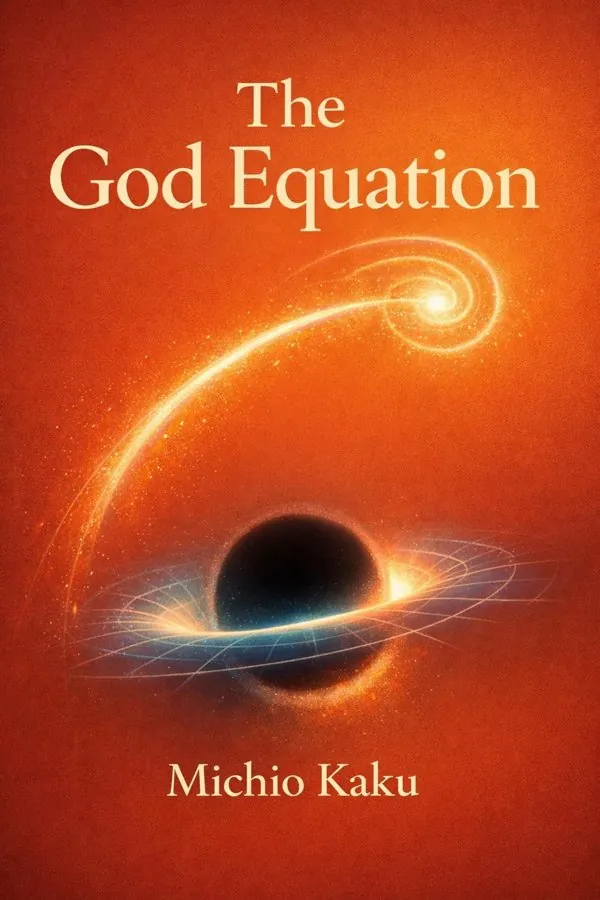
The God Equation: The Quest for a Theory of Everything: Summary & Key Insights
by Michio Kaku
 10 min11 chaptersAudio available
What Is The God Equation: The Quest for a Theory of Everything About?
The God Equation: The Quest for a Theory of Everything by Michio Kaku is a popular_sci book spanning 11 pages. In this book, theoretical physicist Michio Kaku explores the long-standing quest to find a single, elegant theory that unites all the fundamental forces of the universe. He traces the history of physics from Newton and Einstein to string theory, explaining how scientists have sought a 'God Equation' that could explain everything from the Big Bang to black holes. Kaku presents complex ideas in accessible language, offering insights into the future of physics and humanity’s understanding of the cosmos.
This FizzRead summary covers all 11 key chapters of The God Equation: The Quest for a Theory of Everything in approximately 10 minutes, distilling the most important ideas, arguments, and takeaways from Michio Kaku's work. Also available as an audio summary and Key Quotes Podcast.
The God Equation: The Quest for a Theory of Everything
In this book, theoretical physicist Michio Kaku explores the long-standing quest to find a single, elegant theory that unites all the fundamental forces of the universe. He traces the history of physics from Newton and Einstein to string theory, explaining how scientists have sought a 'God Equation' that could explain everything from the Big Bang to black holes. Kaku presents complex ideas in accessible language, offering insights into the future of physics and humanity’s understanding of the cosmos.
Who Should Read The God Equation: The Quest for a Theory of Everything?
This book is perfect for anyone interested in popular_sci and looking to gain actionable insights in a short read. Whether you're a student, professional, or lifelong learner, the key ideas from The God Equation: The Quest for a Theory of Everything by Michio Kaku will help you think differently.
- ✓Readers who enjoy popular_sci and want practical takeaways
- ✓Professionals looking to apply new ideas to their work and life
- ✓Anyone who wants the core insights of The God Equation: The Quest for a Theory of Everything in just 10 minutes
Want the full summary?
Get instant access to this book summary and 100K+ more with Fizz Moment.
Get Free SummaryAvailable on App Store • Free to download
Key Chapters
Our quest begins with Isaac Newton, the man who turned celestial wonder into mathematics. In the seventeenth century, humankind still believed that the heavens obeyed divine mysteries. Then Newton, with nothing more than a prism, an apple, and a restless mind, unified the motion of the Earth and the heavens. His laws of motion and gravitation revealed an astonishing truth: the same force that pulls an apple to the ground governs the orbit of the Moon. For the first time, we glimpsed a universe governed not by whims of gods but by comprehensible order.
This concept of a mechanistic universe shaped human thought for centuries. Everything, from the planets to the pendulum, could be described by deterministic equations. Nature became a grand clockwork—predictable, rational, and governed by immutable law. Yet Newton’s model, powerful though it was, also locked us into a seductively simple view. It worked superbly for cannonballs and comets, but failed utterly when we peered into the heart of the atom or ventured to the cosmic edge.
Then came Einstein, who shattered Newton’s clockwork. While working in a Swiss patent office, he dared to ask how light behaves if one rides upon a beam of it. The question led him to special relativity, where time slows and space contracts depending on one’s motion. Later, his general theory of relativity transformed gravity from a mysterious force into the warping of spacetime itself. Matter tells space how to curve, and space tells matter how to move. Such simplicity hid in plain sight, waiting for a mind capable of abandoning convention.
Einstein’s universe is not static or mechanical but dynamic and flexible. Gravity, in his view, is geometry in motion. Planets, instead of being dragged by some invisible tether, simply follow the straightest possible paths through curved spacetime. This elegant insight not only explained Mercury’s orbit and predicted the bending of starlight but also gave us the framework to understand black holes and the expansion of the cosmos. Yet even as Einstein unified the cosmic scale, a new revolution was brewing deep within the atom that threatened to undo this harmony.
+ 9 more chapters — available in the FizzRead app
All Chapters in The God Equation: The Quest for a Theory of Everything
About the Author
Michio Kaku is an American theoretical physicist, futurist, and popular science communicator. He is a professor of theoretical physics at the City College of New York and the CUNY Graduate Center. Kaku is known for his work on string theory and for authoring several bestselling books that make advanced scientific concepts accessible to the general public.
Get This Summary in Your Preferred Format
Read or listen to the The God Equation: The Quest for a Theory of Everything summary by Michio Kaku anytime, anywhere. FizzRead offers multiple formats so you can learn on your terms — all free.
Available formats: App · Audio · PDF · EPUB — All included free with FizzRead
Download The God Equation: The Quest for a Theory of Everything PDF and EPUB Summary
Key Quotes from The God Equation: The Quest for a Theory of Everything
“Our quest begins with Isaac Newton, the man who turned celestial wonder into mathematics.”
“Then came Einstein, who shattered Newton’s clockwork.”
Frequently Asked Questions about The God Equation: The Quest for a Theory of Everything
The God Equation: The Quest for a Theory of Everything by Michio Kaku is a popular_sci book that explores key ideas across 11 chapters. In this book, theoretical physicist Michio Kaku explores the long-standing quest to find a single, elegant theory that unites all the fundamental forces of the universe. He traces the history of physics from Newton and Einstein to string theory, explaining how scientists have sought a 'God Equation' that could explain everything from the Big Bang to black holes. Kaku presents complex ideas in accessible language, offering insights into the future of physics and humanity’s understanding of the cosmos.
More by Michio Kaku
Quantum Supremacy: How the Quantum Computer Revolution Will Change Everything
Michio Kaku
10 min
The Future of Humanity: Terraforming Mars, Interstellar Travel, Immortality, and Our Destiny Beyond Earth
Michio Kaku
10 min
Physics of the Impossible: A Scientific Exploration into the World of Phasers, Force Fields, Teleportation, and Time Travel
Michio Kaku
10 min
Hyperspace: A Scientific Odyssey Through Parallel Universes, Time Warps, and the 10th Dimension
Michio Kaku
10 minYou Might Also Like

Structures: Or Why Things Don"t Fall Down
J.E. Gordon
10 min
The Road to Wigan Pier
George Orwell
10 min
Bonk: The Curious Coupling of Science and Sex
Mary Roach
10 min
First Bite: How We Learn to Eat
Bee Wilson
10 min
In Pursuit Of The Unknown: 17 Equations That Changed The World
Ian Stewart
10 min
Napoleon's Buttons: 17 Molecules That Changed History
Penny Le Couteur and Jay Burreson
10 minBrowse by Category
Ready to read The God Equation: The Quest for a Theory of Everything?
Get the full summary and 100K+ more books with Fizz Moment.