
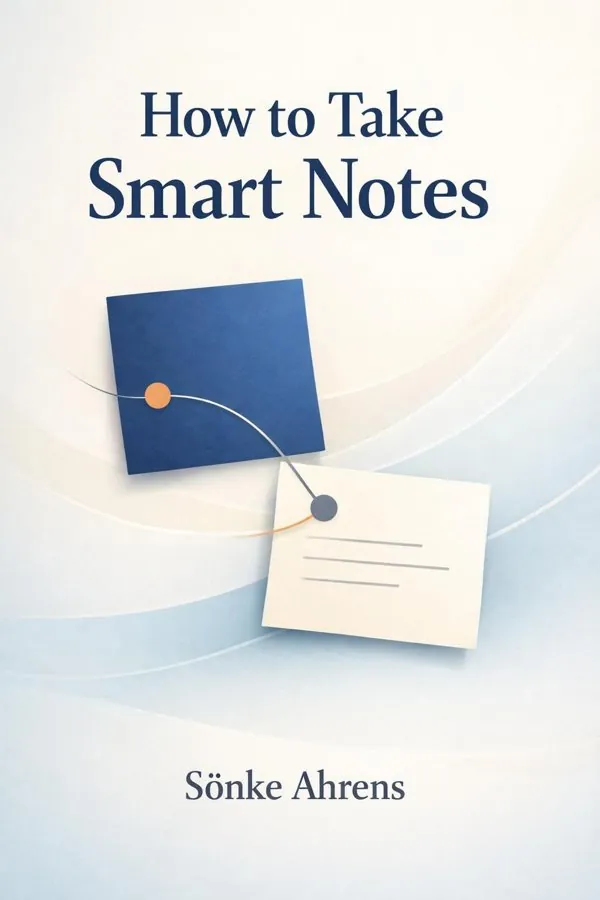
How to Take Smart Notes: One Simple Technique to Boost Writing, Learning and Thinking: Summary & Key Insights
by Sönke Ahrens
 10 min6 chaptersAudio available
What Is How to Take Smart Notes: One Simple Technique to Boost Writing, Learning and Thinking About?
How to Take Smart Notes: One Simple Technique to Boost Writing, Learning and Thinking by Sönke Ahrens is a education book spanning 6 pages. This book introduces the Zettelkasten method, a note-taking and knowledge management technique developed by sociologist Niklas Luhmann. Sönke Ahrens explains how students, researchers, and writers can use systematic note-making and linking of ideas to work more productively and creatively. It provides practical guidance on structuring notes to generate long-term insights and written output.
This FizzRead summary covers all 6 key chapters of How to Take Smart Notes: One Simple Technique to Boost Writing, Learning and Thinking in approximately 10 minutes, distilling the most important ideas, arguments, and takeaways from Sönke Ahrens's work. Also available as an audio summary and Key Quotes Podcast.
How to Take Smart Notes: One Simple Technique to Boost Writing, Learning and Thinking
This book introduces the Zettelkasten method, a note-taking and knowledge management technique developed by sociologist Niklas Luhmann. Sönke Ahrens explains how students, researchers, and writers can use systematic note-making and linking of ideas to work more productively and creatively. It provides practical guidance on structuring notes to generate long-term insights and written output.
Who Should Read How to Take Smart Notes: One Simple Technique to Boost Writing, Learning and Thinking?
This book is perfect for anyone interested in education and looking to gain actionable insights in a short read. Whether you're a student, professional, or lifelong learner, the key ideas from How to Take Smart Notes: One Simple Technique to Boost Writing, Learning and Thinking by Sönke Ahrens will help you think differently.
- ✓Readers who enjoy education and want practical takeaways
- ✓Professionals looking to apply new ideas to their work and life
- ✓Anyone who wants the core insights of How to Take Smart Notes: One Simple Technique to Boost Writing, Learning and Thinking in just 10 minutes
Want the full summary?
Get instant access to this book summary and 100K+ more with Fizz Moment.
Get Free SummaryAvailable on App Store • Free to download
Key Chapters
When we think of good study habits, many of us imagine meticulously organized folders, color-coded highlights, or stacks of neatly labeled notebooks. The intent is noble: we want order, control, and the assurance that our hard work will pay off later. Yet time and again, students and writers find themselves disappointed when those carefully stored notes fail to support actual writing or recall. Why does this happen?
Traditional note-taking methods are often linear and topic-based. They ask us to store information by subject—‘History,’ ‘Biology,’ ‘Research Ideas’—as if knowledge itself were neatly compartmentalized. But real understanding is cross-pollinated; insights come from the unexpected intersections between fields. In a linear system, such connections rarely surface. We find ourselves flipping through pages, hunting for a passage we once found interesting but can no longer trace or contextualize.
Even digital tools, when used in this old mindset, tend to mimic the same failure. They make retrieval easier but don’t help with creative recombination. The result is a vast archive of disconnected fragments—notes that remain inert because they were never processed into genuine understanding.
The deeper issue, however, is psychological. Many people treat note-taking as a passive act of storage rather than an active process of thinking. Highlighting material or copying key points gives the illusion of learning while bypassing the mental work of interpretation. We confuse collection with comprehension.
This is why the Zettelkasten method feels so liberating. It reframes the entire purpose of note-taking: notes are not records but thoughts in conversation with each other. This shift changes everything. Suddenly, each note becomes a building block—not in a pile but in a growing structure of ideas. You’re no longer archiving; you’re constructing. What emerges from this practice is not just an organized database but an evolving network that mirrors the interconnected nature of real thinking.
Niklas Luhmann’s Zettelkasten was a modest-looking collection of about ninety thousand index cards. Each card held a single idea—self-contained, precisely worded, and linked to others by a unique identifier. To the casual observer, it looked like a massive filing cabinet; in reality, it was a dynamic knowledge engine. Luhmann treated this system as a collaborator. He would pose a question to the box, retrieve a few notes, discover unexpected connections, and often find new ideas emerging from the interplay.
The genius of the Zettelkasten lies in its simplicity. The system is based on three principles: atomicity, connectivity, and evolution. Each note must express one idea; each must connect to others through clear references; and each must remain open to future revision and linkage. This infrastructure transforms knowledge into a living web that grows organically over time.
To build your own Zettelkasten, you start by writing ideas as standalone notes. These can arise from your readings, reflections, or observations. You assign each note an identifier and link it to other relevant notes through explicit connections. The aim is not to create a hierarchical structure but a network—just like neurons in the brain. When you navigate this network, you don’t move through topics from top to bottom but trace relationships sideways, discovering novel pathways and insights.
Luhmann famously claimed that his Zettelkasten ‘thinks.’ While this statement is poetic, it captures a genuine truth: an external system of linked notes amplifies human cognition. It allows complexity to accumulate without overwhelming memory because relationships are stored outside the mind. Each new note extends and reshapes the network, making it a co-evolving system—a dialogue between your thoughts and your notes.
Once you grasp this concept, you realize that the Zettelkasten is not a productivity tool but a philosophy of learning: knowledge grows through relationships, not repositories.
+ 4 more chapters — available in the FizzRead app
All Chapters in How to Take Smart Notes: One Simple Technique to Boost Writing, Learning and Thinking
About the Author
Sönke Ahrens is a German educational researcher and author. His work focuses on learning, writing, and academic productivity. He is best known for his writings on the Zettelkasten method and improving scholarly workflows.
Get This Summary in Your Preferred Format
Read or listen to the How to Take Smart Notes: One Simple Technique to Boost Writing, Learning and Thinking summary by Sönke Ahrens anytime, anywhere. FizzRead offers multiple formats so you can learn on your terms — all free.
Available formats: App · Audio · PDF · EPUB — All included free with FizzRead
Download How to Take Smart Notes: One Simple Technique to Boost Writing, Learning and Thinking PDF and EPUB Summary
Key Quotes from How to Take Smart Notes: One Simple Technique to Boost Writing, Learning and Thinking
“When we think of good study habits, many of us imagine meticulously organized folders, color-coded highlights, or stacks of neatly labeled notebooks.”
“Niklas Luhmann’s Zettelkasten was a modest-looking collection of about ninety thousand index cards.”
Frequently Asked Questions about How to Take Smart Notes: One Simple Technique to Boost Writing, Learning and Thinking
How to Take Smart Notes: One Simple Technique to Boost Writing, Learning and Thinking by Sönke Ahrens is a education book that explores key ideas across 6 chapters. This book introduces the Zettelkasten method, a note-taking and knowledge management technique developed by sociologist Niklas Luhmann. Sönke Ahrens explains how students, researchers, and writers can use systematic note-making and linking of ideas to work more productively and creatively. It provides practical guidance on structuring notes to generate long-term insights and written output.
More by Sönke Ahrens
You Might Also Like

Bedtime Biography: Florence Nightingale
Isabel Thomas
10 min
Introduction To Museum Studies
Howard H. Hoyt
10 min
A Mind for Numbers: How to Excel at Math and Science (Even If You Flunked Algebra)
Barbara Oakley
10 min
AI for Educators: Learning Strategies, Teacher Empowerment, and the Future of Education
Matt Miller
10 min
Animation For Beginners
Morr Meroz
10 min
Artificial Intelligence for Learning
Donald Clark
10 minBrowse by Category
Ready to read How to Take Smart Notes: One Simple Technique to Boost Writing, Learning and Thinking?
Get the full summary and 100K+ more books with Fizz Moment.