
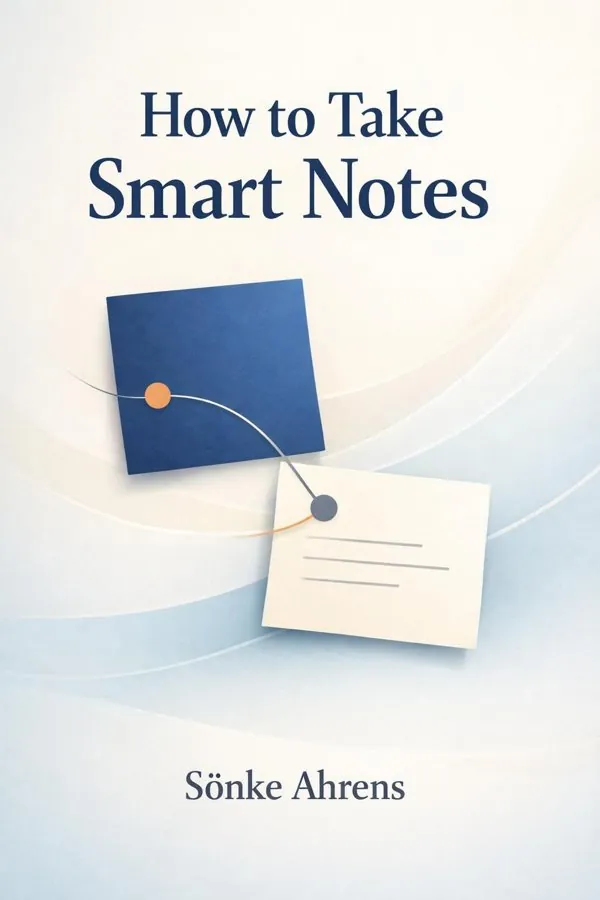
How to Take Smart Notes: Summary & Key Insights
by Sönke Ahrens
 10 min9 chaptersAudio available
Key Takeaways from How to Take Smart Notes
A blank page feels intimidating only when thinking has been postponed until the last moment.
The systems that make us feel organized are not always the ones that make us think well.
A note becomes powerful when it can speak to other notes.
Not all notes serve the same purpose, and confusing them creates clutter.
Understanding is revealed not by what you can highlight, but by what you can explain.
What Is How to Take Smart Notes About?
How to Take Smart Notes by Sönke Ahrens is a productivity book. Most people think writing starts when we open a blank document. Sönke Ahrens argues that good writing begins much earlier—with the way we read, think, capture ideas, and connect them over time. In How to Take Smart Notes, he introduces readers to the Zettelkasten method, a deceptively simple system of creating small, self-contained notes and linking them into a growing network of thought. Inspired by the workflow of sociologist Niklas Luhmann, who used this approach to produce an astonishing body of published work, Ahrens shows that productivity is not about forcing yourself to work harder. It is about building an external thinking partner that helps you develop ideas before you ever start drafting. The book matters because it challenges common assumptions about note-taking, studying, and knowledge management. Rather than collecting information passively, Ahrens teaches readers to engage with ideas actively and transform them into usable insights. Drawing on educational research, writing practice, and the history of Luhmann’s system, he offers a practical framework for students, academics, writers, and knowledge workers who want deeper learning and more consistent creative output.
This FizzRead summary covers all 9 key chapters of How to Take Smart Notes in approximately 10 minutes, distilling the most important ideas, arguments, and takeaways from Sönke Ahrens's work. Also available as an audio summary and Key Quotes Podcast.
How to Take Smart Notes
Most people think writing starts when we open a blank document. Sönke Ahrens argues that good writing begins much earlier—with the way we read, think, capture ideas, and connect them over time. In How to Take Smart Notes, he introduces readers to the Zettelkasten method, a deceptively simple system of creating small, self-contained notes and linking them into a growing network of thought. Inspired by the workflow of sociologist Niklas Luhmann, who used this approach to produce an astonishing body of published work, Ahrens shows that productivity is not about forcing yourself to work harder. It is about building an external thinking partner that helps you develop ideas before you ever start drafting. The book matters because it challenges common assumptions about note-taking, studying, and knowledge management. Rather than collecting information passively, Ahrens teaches readers to engage with ideas actively and transform them into usable insights. Drawing on educational research, writing practice, and the history of Luhmann’s system, he offers a practical framework for students, academics, writers, and knowledge workers who want deeper learning and more consistent creative output.
Who Should Read How to Take Smart Notes?
This book is perfect for anyone interested in productivity and looking to gain actionable insights in a short read. Whether you're a student, professional, or lifelong learner, the key ideas from How to Take Smart Notes by Sönke Ahrens will help you think differently.
- ✓Readers who enjoy productivity and want practical takeaways
- ✓Professionals looking to apply new ideas to their work and life
- ✓Anyone who wants the core insights of How to Take Smart Notes in just 10 minutes
Want the full summary?
Get instant access to this book summary and 100K+ more with Fizz Moment.
Get Free SummaryAvailable on App Store • Free to download
Key Chapters
A blank page feels intimidating only when thinking has been postponed until the last moment. One of Ahrens’s central insights is that writing should not be treated as a separate, final-stage activity. Instead, it is the visible result of a much longer process of reading, reflecting, note-making, and idea development. When people struggle to write, the problem is often not a lack of talent or discipline. It is that they have not built a reliable path from raw information to clarified thought.
Ahrens explains that smart note-taking reduces the friction of writing because the real intellectual work happens in small steps over time. Rather than reading a book, underlining passages, and hoping inspiration appears later, readers should convert what they encounter into their own words, capture the implications, and connect those notes to previous ideas. This creates a body of prepared thinking. When it is time to draft an article, essay, report, or chapter, you are no longer starting from zero. You are assembling and refining arguments that have already been tested in note form.
For example, a student preparing a paper on habit formation might create individual notes on cue-triggered behavior, reward loops, environmental design, and motivation myths. Weeks later, these notes can be linked into a strong argument without frantic re-reading. A manager studying team communication could do the same with notes on feedback, psychological safety, and meeting design.
The key lesson is simple: stop treating writing as a last-minute performance. Build your ideas as you go, and drafting becomes the natural next step. Actionable takeaway: after every reading session, write at least one note in your own words that could later appear in a piece of writing.
The systems that make us feel organized are not always the ones that make us think well. Ahrens challenges many familiar productivity habits—highlighting aggressively, filing notes by topic, collecting quotes, and maintaining elaborate folders—because they often create the illusion of progress without producing real understanding. These systems prioritize storage and order, but they do not necessarily help us generate insight or original output.
The problem with traditional note-taking is that it treats information as something to be archived rather than transformed. A notebook full of highlighted passages can look impressive, but if those ideas remain trapped in the language and structure of the source, they are difficult to use later. Likewise, rigid category systems may seem neat, yet they can prevent unexpected connections. Real thinking is messy, cross-disciplinary, and often driven by associations that formal filing systems bury.
Ahrens argues that productivity should be measured not by how much material you collect, but by how effectively your system helps you develop arguments, solve problems, and create new work. A doctoral student who spends hours perfecting a bibliography database but never writes explanatory notes may be less productive than someone who creates fewer records but actively connects concepts. Similarly, a consultant who clips dozens of articles into a knowledge app without processing them is building a pile, not a system.
This critique is practical, not theoretical. If your workflow repeatedly forces you to re-read sources, search through scattered highlights, or rebuild thoughts from scratch, the system is failing. Actionable takeaway: audit your current note-taking process and eliminate any step that helps you collect information but does not help you think, connect, or write.
A note becomes powerful when it can speak to other notes. That is the heart of the Zettelkasten method, which Ahrens presents not as a quirky historical technique but as a disciplined way to build an external network of ideas. Developed most famously by sociologist Niklas Luhmann, the method relies on making small, self-contained notes, each focused on one idea, and linking them through references so that thoughts can evolve through relationships rather than static categories.
Ahrens emphasizes that the brilliance of the system lies in its simplicity. Each permanent note should be written clearly enough to stand on its own, as if it were addressed to your future self. It should capture a specific idea in your own words, include the source if relevant, and be linked to related notes. Over time, this creates a living web of concepts. Instead of storing notes under broad subjects like “psychology” or “history,” you connect them by meaning: a note on habit loops might link to notes on identity change, routines, dopamine, and design of environments.
This structure allows the system to surprise you. Because ideas are linked conceptually, not imprisoned in folders, you can discover patterns you did not plan in advance. That is why Luhmann’s slip-box was so productive: it did not merely remember information for him; it actively supported thinking and writing.
In a digital setting, this can be done with note apps that support links and tags, but Ahrens’s point is methodological, not technological. The value comes from the quality of the notes and the links between them. Actionable takeaway: create notes that contain one clear idea each, then deliberately link every new note to at least one existing note.
Not all notes serve the same purpose, and confusing them creates clutter. Ahrens distinguishes between three kinds of notes—fleeting notes, literature notes, and permanent notes—to show how raw impressions become durable knowledge. This distinction matters because many people either keep everything forever or throw away useful thoughts before they mature. A smart system separates temporary capture from long-term thinking.
Fleeting notes are quick reminders: an idea during a walk, a question raised in class, a phrase you do not want to forget. They are informal and disposable. Literature notes are more structured notes taken while reading; they summarize key points from a source in concise form. Permanent notes are the most important. They are written in your own words, contain a complete idea, and are stored in your slip-box or knowledge system because they are worth thinking with in the future.
This process prevents overload. Imagine reading a book on behavioral economics. You may jot a fleeting note about an interesting example, write literature notes about loss aversion and default effects, and then create permanent notes such as “Default choices shape behavior because they reduce decision friction” or “Perceived losses often outweigh equal gains in decision-making.” These permanent notes can later connect to work on marketing, policy, negotiation, or personal habits.
The discipline here is conversion. Fleeting notes should be reviewed quickly. Literature notes should not become a graveyard of copied text. Permanent notes should represent a decision that an idea is worth preserving and linking.
Actionable takeaway: after each reading or thinking session, process your rough notes within 24 hours and turn only the best ideas into permanent notes written in your own words.
Understanding is revealed not by what you can highlight, but by what you can explain. Ahrens insists that the most important step in note-making is translating ideas into your own words. This simple practice forces comprehension, exposes confusion, and turns passive reading into active thinking. When notes are copied directly from sources, they remain tied to the author’s context and language. When they are rewritten clearly and independently, they become usable building blocks for your own work.
This matters because borrowed wording often creates a false sense of mastery. A paragraph may seem clear while reading, yet become impossible to explain later. By paraphrasing, summarizing, and reformulating the idea, you test whether you truly understand it. If you cannot rewrite it simply, you probably do not understand it deeply enough. The act of rephrasing is therefore both a learning tool and a quality filter.
Consider a researcher reading about confirmation bias. Instead of copying a textbook definition, they might write: “People often seek evidence that supports what they already believe, which makes self-correction harder and disagreement more persistent.” That version is easier to connect with notes on decision-making, politics, groupthink, or product testing. Ahrens wants notes that are portable across contexts, and your own language makes them more adaptable.
This approach also helps avoid plagiarism and supports smoother writing later. When your notes already sound like your thinking, drafting becomes less about translation and more about selection and arrangement.
Actionable takeaway: whenever you capture an important idea, close the book or article for a moment and rewrite the idea from memory in plain language before saving it as a permanent note.
Creativity often looks like a sudden flash, but it usually grows from connected ideas. Ahrens argues that the real power of smart notes comes from linking concepts across sources, topics, and projects. A note system becomes intellectually valuable not when it contains a lot of information, but when it makes relationships visible. These relationships are where new arguments, questions, and perspectives emerge.
Traditional systems tend to isolate material by project or subject. You take marketing notes for marketing, philosophy notes for philosophy, and meeting notes for work. But real-world thinking rarely stays inside those walls. A note on incentives in economics may connect to motivation in education, management in business, and behavior change in health. By linking notes wherever meaningful overlap exists, you create a system that can generate interdisciplinary insights.
Ahrens shows that this changes the nature of research and writing. Instead of collecting material for one assignment and abandoning it afterward, every note becomes part of a larger intellectual conversation. A note written for today’s essay may become crucial for next year’s article. A teacher may connect notes on memory, testing, and curriculum design. A startup founder might connect notes on customer trust, interface design, and habit loops. Over time, the network becomes more valuable because each new note has more possible neighbors.
Importantly, links should not be random. They should reflect a meaningful relationship: support, contrast, extension, cause, analogy, or question. The goal is not to build a dense maze but a useful map of thinking.
Actionable takeaway: every time you create a permanent note, ask, “What existing idea does this support, challenge, or extend?” and record that link explicitly.
The less energy you waste on managing your workflow, the more energy you have for thinking. Ahrens repeatedly emphasizes that a good note-taking system should reduce the number of choices you must make in the moment. Many people lose momentum because their process depends on constant decisions: Where should this note go? Which folder fits best? Is this for one project or another? Should I save this quote somewhere else too? These tiny uncertainties create friction that compounds over time.
The Zettelkasten approach lowers that friction by replacing complicated organization with a small set of reliable habits. Capture fleeting notes quickly. Take concise literature notes while reading. Convert worthwhile ideas into permanent notes. Link them to related notes. Follow interesting connections when writing. This routine removes the need for perfect planning. You do not have to know in advance what every idea will eventually be used for. You only need to make the next useful note.
This is especially powerful for people juggling multiple responsibilities. A student with several courses, a professional managing client work, or a writer balancing research and content creation can all benefit from a system that scales without becoming brittle. Instead of maintaining separate mental stacks for every project, they can trust that valuable ideas will remain findable and generative inside the note network.
Ahrens’s broader point is that productivity is less about motivation than about environment and process. A well-designed system supports consistency even on low-energy days.
Actionable takeaway: simplify your workflow to a few repeatable steps and make them your default, so capturing and developing ideas becomes automatic rather than a series of exhausting choices.
Most people read for the task in front of them. Ahrens teaches readers to read for the long term. One of the most valuable shifts in How to Take Smart Notes is the idea that research should not only serve your current assignment, article, or project. It should also strengthen your future thinking. Every carefully written permanent note becomes an asset that can outlive the immediate context in which it was created.
This approach changes how you evaluate effort. Time spent processing a source deeply may seem slower than skimming and highlighting, but it pays back through reuse. A note on “feedback loops in learning” might later support work in education, management, coaching, or product design. A note on “narratives shape identity” could become relevant in psychology, marketing, leadership, or memoir writing. Instead of starting over with each new project, you carry forward accumulated understanding.
Ahrens contrasts this with project-based note silos, where each effort generates its own isolated pile of notes. Once the paper is submitted or the report is delivered, the material is forgotten. In a smart-note system, completed projects do not end the value of your work. They enrich the archive from which later projects grow. This is how gradual effort compounds into expertise.
For professionals, this means turning meetings, articles, courses, and books into reusable insights. For students, it means learning in a way that prepares future semesters, not just the next exam. For writers, it means that no serious reading is wasted.
Actionable takeaway: when making a permanent note, phrase it so that it is useful beyond the current project, and ask how it might apply in a different domain later.
Strong arguments are discovered as much as they are designed. Ahrens advises against forcing a rigid outline too early, because premature structure often leads people to defend a weak framework instead of following the best ideas. In the smart-notes approach, structure emerges gradually from the accumulated notes and the links among them. This allows thinking to remain flexible while still becoming increasingly organized.
When notes are written clearly and linked thoughtfully, clusters begin to form naturally. You might notice several notes converging around a question, contradiction, or theme. These clusters can evolve into sections of an essay, chapters of a thesis, or pillars of a presentation. Rather than inventing an outline from scratch, you assemble one from patterns that already exist in your note system. This makes writing more grounded and often more original.
Suppose you are preparing an article on remote work. Over time, your notes may gather around trust, asynchronous communication, attention management, and culture-building. These clusters suggest a structure. You may also discover surprising connections—perhaps a note on autonomy from motivation research becomes central to your argument. Because the structure grows from note relationships, the final piece often reflects deeper thinking than a top-down outline imposed too soon.
This does not mean planning is useless. It means planning should remain responsive to what the notes reveal. Ahrens encourages writers to move back and forth between note development and emerging structure.
Actionable takeaway: before creating a formal outline, review your linked notes and identify clusters of ideas that naturally belong together; let those clusters shape the structure of your next piece.
All Chapters in How to Take Smart Notes
About the Author
Sönke Ahrens is a German writer and educational researcher whose work focuses on learning, writing, and intellectual productivity. He is best known for How to Take Smart Notes, the book that popularized the Zettelkasten method for a wide audience of students, academics, writers, and knowledge workers. Ahrens combines insights from educational theory, research on cognition, and practical experience to explore how people can work more effectively with ideas. Rather than promoting superficial efficiency, he is interested in systems that support deep understanding, original thought, and sustained creative output. His writing has been especially influential among readers seeking better ways to read, take notes, conduct research, and turn scattered information into clear, publishable thinking.
Get This Summary in Your Preferred Format
Read or listen to the How to Take Smart Notes summary by Sönke Ahrens anytime, anywhere. FizzRead offers multiple formats so you can learn on your terms — all free.
Available formats: App · Audio · PDF · EPUB — All included free with FizzRead
Download How to Take Smart Notes PDF and EPUB Summary
Key Quotes from How to Take Smart Notes
“A blank page feels intimidating only when thinking has been postponed until the last moment.”
“The systems that make us feel organized are not always the ones that make us think well.”
“A note becomes powerful when it can speak to other notes.”
“Not all notes serve the same purpose, and confusing them creates clutter.”
“Understanding is revealed not by what you can highlight, but by what you can explain.”
Frequently Asked Questions about How to Take Smart Notes
How to Take Smart Notes by Sönke Ahrens is a productivity book that explores key ideas across 9 chapters. Most people think writing starts when we open a blank document. Sönke Ahrens argues that good writing begins much earlier—with the way we read, think, capture ideas, and connect them over time. In How to Take Smart Notes, he introduces readers to the Zettelkasten method, a deceptively simple system of creating small, self-contained notes and linking them into a growing network of thought. Inspired by the workflow of sociologist Niklas Luhmann, who used this approach to produce an astonishing body of published work, Ahrens shows that productivity is not about forcing yourself to work harder. It is about building an external thinking partner that helps you develop ideas before you ever start drafting. The book matters because it challenges common assumptions about note-taking, studying, and knowledge management. Rather than collecting information passively, Ahrens teaches readers to engage with ideas actively and transform them into usable insights. Drawing on educational research, writing practice, and the history of Luhmann’s system, he offers a practical framework for students, academics, writers, and knowledge workers who want deeper learning and more consistent creative output.
More by Sönke Ahrens
You Might Also Like




Browse by Category
Ready to read How to Take Smart Notes?
Get the full summary and 100K+ more books with Fizz Moment.