
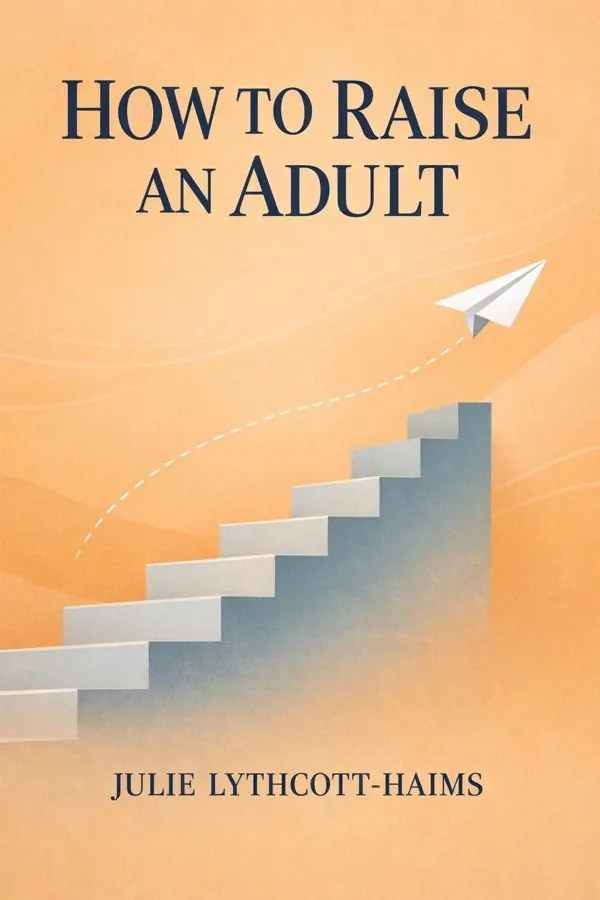
How to Raise an Adult: Break Free of the Overparenting Trap and Prepare Your Kid for Success: Summary & Key Insights
 10 min4 chaptersAudio available
What Is How to Raise an Adult: Break Free of the Overparenting Trap and Prepare Your Kid for Success About?
How to Raise an Adult: Break Free of the Overparenting Trap and Prepare Your Kid for Success by Julie Lythcott-Haims is a parenting book spanning 4 pages. A groundbreaking book that challenges the modern culture of overparenting and offers practical strategies for raising self-reliant, resilient, and capable young adults. Drawing on research, personal experience, and insights from educators and employers, Julie Lythcott-Haims explores how excessive involvement in children’s lives can hinder their development and independence, and provides guidance for parents to foster autonomy and confidence in their children.
This FizzRead summary covers all 4 key chapters of How to Raise an Adult: Break Free of the Overparenting Trap and Prepare Your Kid for Success in approximately 10 minutes, distilling the most important ideas, arguments, and takeaways from Julie Lythcott-Haims's work. Also available as an audio summary and Key Quotes Podcast.
How to Raise an Adult: Break Free of the Overparenting Trap and Prepare Your Kid for Success
A groundbreaking book that challenges the modern culture of overparenting and offers practical strategies for raising self-reliant, resilient, and capable young adults. Drawing on research, personal experience, and insights from educators and employers, Julie Lythcott-Haims explores how excessive involvement in children’s lives can hinder their development and independence, and provides guidance for parents to foster autonomy and confidence in their children.
Who Should Read How to Raise an Adult: Break Free of the Overparenting Trap and Prepare Your Kid for Success?
This book is perfect for anyone interested in parenting and looking to gain actionable insights in a short read. Whether you're a student, professional, or lifelong learner, the key ideas from How to Raise an Adult: Break Free of the Overparenting Trap and Prepare Your Kid for Success by Julie Lythcott-Haims will help you think differently.
- ✓Readers who enjoy parenting and want practical takeaways
- ✓Professionals looking to apply new ideas to their work and life
- ✓Anyone who wants the core insights of How to Raise an Adult: Break Free of the Overparenting Trap and Prepare Your Kid for Success in just 10 minutes
Want the full summary?
Get instant access to this book summary and 100K+ more with Fizz Moment.
Get Free SummaryAvailable on App Store • Free to download
Key Chapters
When I first began to observe the phenomenon of overparenting, I noticed it was particularly acute in certain circles—among affluent, educated families, often those who believed deeply in the power of education and achievement. Parents who once championed independence now weave safety nets so tight their children rarely touch the ground. Historically, American culture prized self-reliance. Children walked to school, solved their own social conflicts, and learned by doing. But over the past several decades, a shift has occurred. A combination of social fearmongering, hyper-competitiveness, and new parenting norms has led us toward unprecedented control over our children’s lives.
This transformation did not happen in isolation. In the latter twentieth century, cultural narratives about danger—real or imagined—spread rapidly. News cycles magnified kidnappings and accidents, creating what psychologists call a “culture of fear.” Parents became convinced the world was perilous, and the result was a gradual curtailment of childhood freedom. Add to that the mounting pressures of college admissions, where success appeared to hinge on flawless résumés and perfect grades, and you get parents who hover, who manage, who intervene. The irony is profound: in trying to guarantee success, we undermine the very qualities that make success possible.
Overparenting typically manifests in three main behaviors: hovering, rescuing, and directing. Hoverers monitor every step, orchestrating their children’s days to optimize safety and productivity. Rescuers swoop in at the first sign of difficulty—redoing forgotten homework, resolving conflicts with teachers, stepping in before mistakes can take root. Directors control the path entirely, mapping out what classes to take, what sports to play, what colleges to apply to, sometimes what passions to pursue. Each of these is motivated by love, yet each teaches dependence instead of mastery. Children learn that someone will always step in, that the price of failure is too high, that their own judgment cannot be trusted. Over time, this erodes both competence and confidence.
Through interviews, research, and personal experience, I came to see that the overparenting trap is sustained by fear—fear of risk, fear of failure, fear of judgment. But fear cannot build a healthy future. To raise an adult, we must trade fear for trust, control for guidance, and anxiety for confidence in our children’s humanity.
The effects of overparenting are not only visible but measurable. Young people who are protected from failure develop an external locus of control. They come to believe that their outcomes in life are the product of authority figures’ decisions, not their own actions. When such children arrive at college or enter the workforce, they frequently struggle with decision-making, time management, and mental health challenges. Professors and employers alike describe them as bright and capable but hesitant, sometimes paralyzed by choice or feedback. In my years advising university students, I encountered many who called their parents at every bump in the road, seeking permission, reassurance, or solutions that should have been their own to find.
Underneath the perfectionism that overparenting breeds lies a deep insecurity. When everything is orchestrated, children never get the practice or the evidence that they can overcome setbacks. Consequently, even small disappointments—a poor grade, a social rejection—can feel catastrophic. This fragility is not innate but learned. It’s the byproduct of being deprived of the sublime and necessary experience of struggle.
The damage does not stop with children. Overparenting corrodes the parent’s own sense of identity. Parenting becomes a performance rather than a relationship, measured by external achievements rather than intrinsic joy. Many parents I speak with confess that they feel trapped—driven by fear of judgment, comparison, and failure. Their self-worth becomes entangled with their children’s outcomes. The parenting journey, once fueled by love, morphs into a treadmill of anxiety and exhaustion.
When we reclaim perspective, we remember that our children are not projects. They are human beings growing toward independence. The greatest service we can render them is to practice stepping back. Paradoxically, our children flourish most when we resist the urge to intervene. They grow stronger, and we grow freer. We rediscover that the essence of parenting is not about crafting a flawless life, but about nurturing a resilient soul.
+ 2 more chapters — available in the FizzRead app
All Chapters in How to Raise an Adult: Break Free of the Overparenting Trap and Prepare Your Kid for Success
About the Author
Julie Lythcott-Haims is an American author, educator, and former Dean of Freshmen at Stanford University. She is known for her work on parenting, education, and personal development, advocating for raising independent and self-sufficient young adults.
Get This Summary in Your Preferred Format
Read or listen to the How to Raise an Adult: Break Free of the Overparenting Trap and Prepare Your Kid for Success summary by Julie Lythcott-Haims anytime, anywhere. FizzRead offers multiple formats so you can learn on your terms — all free.
Available formats: App · Audio · PDF · EPUB — All included free with FizzRead
Download How to Raise an Adult: Break Free of the Overparenting Trap and Prepare Your Kid for Success PDF and EPUB Summary
Key Quotes from How to Raise an Adult: Break Free of the Overparenting Trap and Prepare Your Kid for Success
“Parents who once championed independence now weave safety nets so tight their children rarely touch the ground.”
“The effects of overparenting are not only visible but measurable.”
Frequently Asked Questions about How to Raise an Adult: Break Free of the Overparenting Trap and Prepare Your Kid for Success
How to Raise an Adult: Break Free of the Overparenting Trap and Prepare Your Kid for Success by Julie Lythcott-Haims is a parenting book that explores key ideas across 4 chapters. A groundbreaking book that challenges the modern culture of overparenting and offers practical strategies for raising self-reliant, resilient, and capable young adults. Drawing on research, personal experience, and insights from educators and employers, Julie Lythcott-Haims explores how excessive involvement in children’s lives can hinder their development and independence, and provides guidance for parents to foster autonomy and confidence in their children.
More by Julie Lythcott-Haims

You Might Also Like
Never Enough
Jennifer Breheny Wallace
10 min
Bluey: Sleepytime
Joe Brumm
10 min
In My Heart: A Book of Feelings
Jo Witek
10 min
Love From The Crayons
Drew Daywalt, Oliver Jeffers
10 min
Pete The Cat: Big Easter Adventure
James Dean, Kimberly Dean
10 min
Smart Money Smart Kids: Raising the Next Generation to Win with Money
Dave Ramsey, Rachel Cruze
10 minBrowse by Category
Ready to read How to Raise an Adult: Break Free of the Overparenting Trap and Prepare Your Kid for Success?
Get the full summary and 100K+ more books with Fizz Moment.